dw2

25 August 2025

The biggest blockages to successful governance of advanced AI

“Humanity has never faced a greater problem than itself.”

That phrase was what my brain hallucinated, while I was browsing the opening section of the Introduction of the groundbreaking new book Global Governance of the Transition to Artificial General Intelligence written by my friend and colleague Jerome C. Glenn, Executive Director of The Millennium Project.

I thought to myself: That’s a bold but accurate way of summing up the enormous challenge faced by humanity over the next few years.

In previous centuries, our biggest problems have often come from the environment around us: deadly pathogens, devastating earthquakes, torrential storms, plagues of locusts – as well as marauding hordes of invaders from outside our local neighbourhood.

But in the second half of the 2020s, our problems are being compounded as never before by our own human inadequacies:

  • We’re too quick to rush to judgement, seeing only parts of the bigger picture
  • We’re too loyal to the tribes to which we perceive ourselves as belonging
  • We’re overconfident in our ability to know what’s happening
  • We’re too comfortable with manufacturing and spreading untruths and distortions
  • We’re too bound into incentive systems that prioritise short-term rewards
  • We’re too fatalistic, as regards the possible scenarios ahead.

You may ask, What’s new?

What’s new is the combination of these deep flaws in human nature with technology that is remarkably powerful yet opaque and intractable. AI that is increasingly beyond our understanding and beyond our control is being coupled in potentially devastating ways with our over-hasty, over-tribal, over-confident thoughts and actions. New AI systems are being rushed into deployment and used in attempts:

  • To manufacture and spread truly insidious narratives
  • To incentivize people around the world to act against their own best interests, and
  • To resign people to inaction when in fact it is still within their power to alter and uplift the trajectory of human destiny.

In case this sounds like a counsel of despair, I should clarify at once my appreciation of aspects of human nature that are truly wonderful, as counters to the negative characteristics that I have already mentioned:

  • Our thoughtfulness, that can counter rushes to judgement
  • Our collaborative spirit, that can transcend partisanship
  • Our wisdom, that can recognise our areas of lack of knowledge or lack of certainty
  • Our admiration for truth, integrity, and accountability, that can counter ends-justify-the-means expediency
  • Our foresight, that can counter short-termism and free us from locked-in inertia
  • Our creativity, to imagine and then create better futures.

Just as AI can magnify the regrettable aspects of human nature, so also it can, if used well, magnify those commendable aspects.

So, which is it to be?

The fundamental importance of governance

The question I’ve just asked isn’t a question that can be answered by individuals alone. Any one group – whether an organisation, a corporation, or a decentralised partnership – can have its own beneficial actions overtaken and capsized by catastrophic outcomes of groups that failed to heed the better angels of their nature, and which, instead, allowed themselves to be governed by wishful naivety, careless bravado, pangs of jealousy, hostile alienation, assertive egotism, or the madness of the crowd.

That’s why the message of this new book by Jerome Glenn is so timely: the processes of developing and deploying increasingly capable AIs are something that needs to be:

  • Governed, rather than happening chaotically
  • Globally coordinated, rather than there being no cohesion between the different governance processes applicable in different localities
  • Progressed urgently, without being shut out of mind by all the shorter-term issues that, understandably, also demand governance attention.

Before giving more of my own thoughts about this book, let me share some of the commendations it has received:

  • “This book is an eye-opening study of the transition to a completely new chapter of history.” – Csaba Korösi, 77th President of the UN General Assembly
  • “A comprehensive overview, drawing both on leading academic and industry thinkers worldwide, and valuable perspectives from within the OECD, United Nations.” – Jaan Tallinn, founding engineer, Skype and Kazaa; co-founder, Cambridge Centre for the Study of Existential Risk and the Future of Life Institute
  • “Written in lucid and accessible language, this book is a must read for people who care about the governance and policy of AGI.” – Lan Xue, Chair of the Chinese National Expert Committee on AI Governance.

The book also carries an absorbing foreword by Ben Goertzel. In this foreword, Ben introduces himself as follows:

Since the 1980s, I have been immersed in the field of AI, working to unravel the complexities of intelligence and to build systems capable of emulating it. My journey has included introducing and popularizing the concept of AGI, developing innovative AGI software frameworks such as OpenCog, and leading efforts to decentralize AI development through initiatives like SingularityNET and the ASI Alliance. This work has been driven by an understanding that AGI is not just an engineering challenge but a profound societal pivot point – a moment requiring foresight, ethical grounding, and global collaboration.

He clarifies why the subject of the book is so important:

The potential benefits of AGI are vast: solutions to climate change, the eradication of diseases, the enrichment of human creativity, and the possibility of postscarcity economies. However, the risks are equally significant. AGI, wielded irresponsibly or emerging in a poorly aligned manner, could exacerbate inequalities, entrench authoritarianism, or unleash existential dangers. At this critical juncture, the questions of how AGI will be developed, governed, and integrated into society must be addressed with both urgency and care.

The need for a globally participatory approach to AGI governance cannot be overstated. AGI, by its nature, will be a force that transcends national borders, cultural paradigms, and economic systems. To ensure its benefits are distributed equitably and its risks mitigated effectively, the voices of diverse communities and stakeholders must be included in shaping its development. This is not merely a matter of fairness but a pragmatic necessity. A multiplicity of perspectives enriches our understanding of AGI’s implications and fosters the global trust needed to govern it responsibly.

He then offers wide praise for the contents of the book:

This is where the work of Jerome Glenn and The Millennium Project may well prove invaluable. For decades, The Millennium Project has been at the forefront of fostering participatory futures thinking, weaving together insights from experts across disciplines and geographies to address humanity’s most pressing challenges. In Governing the Transition to Artificial General Intelligence, this expertise is applied to one of the most consequential questions of our time. Through rigorous analysis, thoughtful exploration of governance models, and a commitment to inclusivity, this book provides a roadmap for navigating the complexities of AGI’s emergence.

What makes this work particularly compelling is its grounding in both pragmatism and idealism. It does not shy away from the technical and geopolitical hurdles of AGI governance, nor does it ignore the ethical imperatives of ensuring AGI serves the collective good. It recognizes that governing AGI is not a task for any single entity but a shared responsibility requiring cooperation among nations, corporations, civil society, and, indeed, future AGI systems themselves.

As we venture into this new era, this book reminds us that the transition to AGI is not solely about technology; it is about humanity, and about life, mind, and complexity in general. It is about how we choose to define intelligence, collaboration, and progress. It is about the frameworks we build now to ensure that the tools we create amplify the best of what it means to be human, and what it means to both retain and grow beyond what we are.

My own involvement

To fill in some background detail: I was pleased to be part of the team that developed the set of 22 critical questions which sat at the heart of the interviews and research which are summarised in Part I of the book – and I conducted a number of the resulting interviews. In parallel, I explored related ideas via two different online Transpolitica surveys:

And I’ve been writing roughly one major article (or giving a public presentation) on similar topics every month since then. Recent examples include:

Over this time period, my views have evolved. I see the biggest priority, nowadays, not as figuring out how to govern AGI as it comes into existence, but rather, how to pause the development and deployment of any new types of AI that could spark the existence of self-improving AGI.

That global pause needs to last long enough that the global community can justifiably be highly confident that any AGI that will subsequently be built will be what I have called a BGI (a Beneficial General Intelligence) rather than a CGI (a Catastrophic General Intelligence).

Govern AGI and/or Pause the development of AGI?

I recently posted a diagram on various social media platforms to illustrate some of the thinking behind that stance of mine:
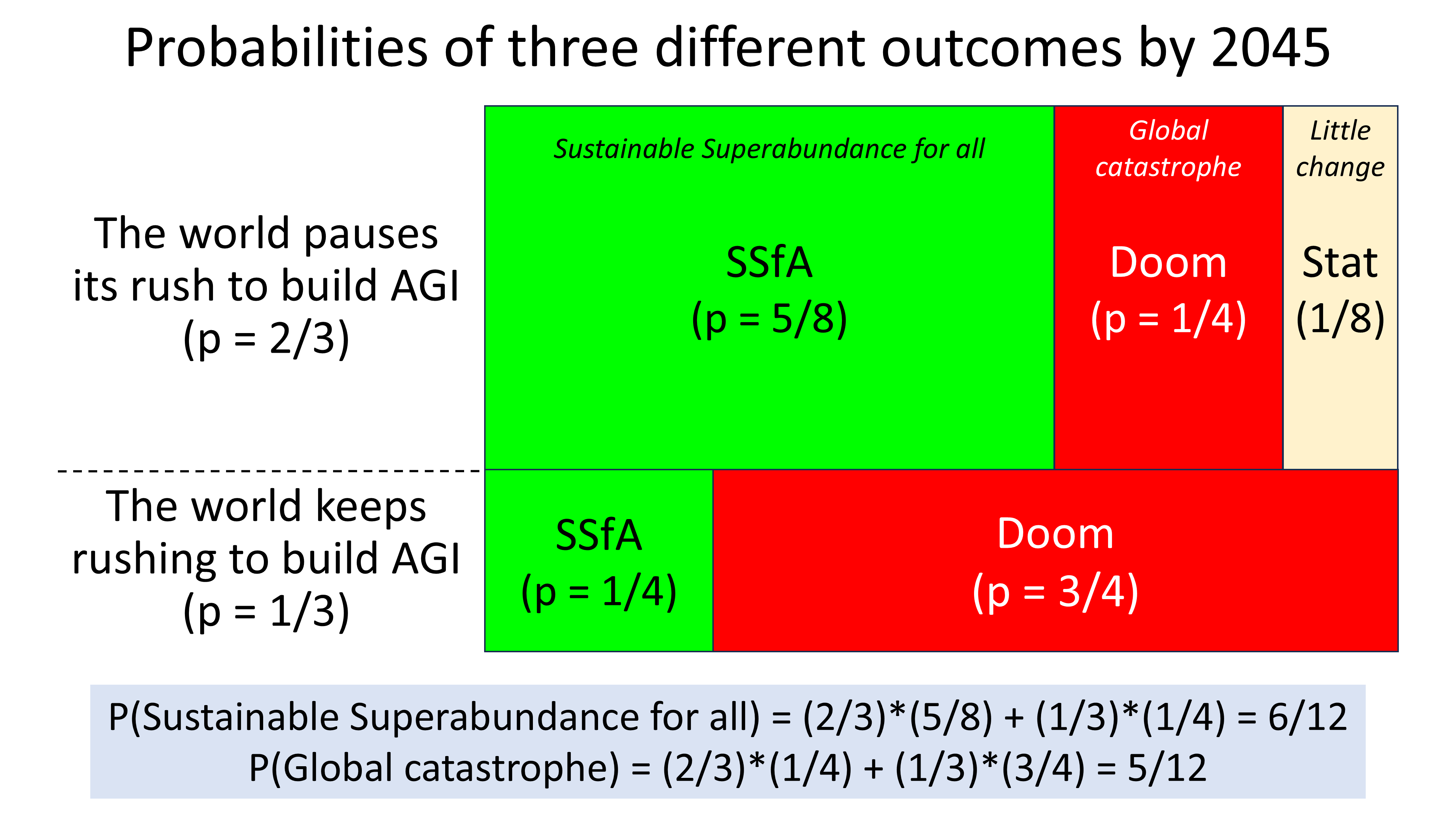
Alongside that diagram, I offered the following commentary:

The next time someone asks me what’s my p(Doom), compared with my p(SSfA) (the probability of Sustainable Superabundance for all), I may try to talk them through a diagram like this one. In particular, we need to break down the analysis into two cases – will the world keep rushing to build AGI, or will it pause from that rush.

To explain some points from the diagram:

We can reach the very desirable future of SSfA by making wise use of AI only modestly more capable than what we have today;
We might also get there as a side-effect of building AGI, but that’s very risky.

None of the probabilities are meant to be considered precise. They’re just ballpark estimates.

I estimate around 2/3 chance that the world will come to its senses and pause its current headlong rush toward building AGI.

But even in that case, risks of global catastrophe remain.

The date 2045 is also just a ballpark choice. Either of the “singularity” outcomes (wonderful or dreadful) could arrive a lot sooner than that.

The 1/12 probability I’ve calculated for “stat” (I use “stat” here as shorthand for a relatively unchanged status quo) by 2045 reflects my expectation of huge disruptions ahead, one sort or another.

The overall conclusion: if we want SSfA, we’re much more likely to get it via the “pause AGI” branch than via the “headlong rush to AGI” branch.

And whilst doom is possible in either branch, it’s much more likely in the headlong rush branch.

For more discussion of how to get the best out of AI and other cataclysmically disruptive technologies, see my book The Singularity Principles (the entire contents are freely available online).

Feel free to post your own version of this diagram, with your own estimates of the various conditional probabilities.

As indicated, I was hoping for feedback, and I was pleased to see a number of comments and questions in response.

One excellent question was this, by Bill Trowbridge:

What’s the difference between:
(a) better AI, and
(b) AGI

The line is hard to draw. So, we’ll likely just keep making better AI until it becomes AGI.

I offered this answer:

On first thought, it may seem hard to identify that distinction. But thankfully, we humans don’t just throw up our hands in resignation every time we encounter a hard problem.

For a good starting point on making the distinction, see the ideas in “A Narrow Path” by Control AI.

But what surprised me the most was the confidence expressed by various online commenters that:

  • “A pause however desirable is unlikely: p(pause) = 0.01”
  • “I am confident in saying this – pause is not an option. It is actually impossible.”
  • “There are several organisations working on AI development and at least some of them are ungovernable [hence a pause can never be global]”.

There’s evidently a large gulf behind the figure of 2/3 that I suggested for P(pause), and the views of these clearly intelligent respondents.

Why a pause isn’t that inconceivable

I’ll start my argument on this topic by confirming that I see this discussion as deeply important. Different viewpoints are welcome, provided they are held thoughtfully and offered honestly.

Next, although it’s true that some organisations may appear to be ungovernable, I don’t see any fundamental issue here. As I said online,

“Given sufficient public will and/or political will, no organisation is ungovernable.”

Witness the compliance by a number of powerful corporations in both China and the US to control measures declared by national governments.

Of course, smaller actors and decentralized labs pose enforcement challenges, but these labs are less likely to be able to marshal sufficient computing capabilities to be the first to reach breakthrough new levels of capability, especially if decentralised monitoring of dangerous attributes is established.

I’ve drawn attention on previous occasions to the parallel with the apparent headlong rush in the 1980s toward nuclear weapons systems that were ever more powerful and ever more dangerous. As I explained at some length in the “Geopolitics” chapter of my 2021 book Vital Foresight, it was an appreciation of the horrific risks of nuclear winter (first articulated in the 1980s) that helped to catalyse a profound change in attitude amongst the leadership camps in both the US and the USSR.

It’s the wide recognition of risk that can provide the opportunity for governments around the world to impose an effective pause in the headlong rush toward AGI. But that’s only one of five steps that I believe are needed:

  1. Awareness of catastrophic risks
  2. Awareness of bottlenecks
  3. Awareness of mechanisms for verification and control
  4. Awareness of profound benefits ahead
  5. Awareness of the utility of incremental progress

Here are more details about these five steps I envision:

  1. Clarify in an undeniable way how superintelligent AIs could pose catastrophic risks of human disaster within just a few decades or even within years – so that this topic receives urgent high-priority public attention
  2. Highlight bottlenecks and other locations within the AI production pipeline where constraints can more easily be applied (for example, distribution of large GPU chip clusters, and the few companies that are providing unique services in the creation of cutting-edge chips)
  3. Establish mechanisms that go beyond “trust” to “trust and verify”, including robust independent monitors and auditors, as well as tamperproof remote shut-down capabilities
  4. Indicate how the remarkable benefits anticipated for humanity from aspects of superintelligence can be secured, more safely and more reliably, by applying the governance mechanisms of points 2 and 3 above, rather than just blindly trusting in a no-holds-barred race to be the first to create superintelligence
  5. Be prepared to start with simpler agreements, involving fewer signatories and fewer control points, and be ready to build up stronger governance processes and culture as public consensus and understanding moves forward.

Critics can assert that each of these five steps is implausible. In each case, there are some crunchy discussions to be had. What I find dangerous, however, isn’t when people disagree with my assessments on plausibility. It’s when they approach the questions with what seems to be

  • A closed mind
  • A tribal loyalty to their perceived online buddies
  • Overconfidence that they already know all relevant examples and facts in this space
  • A willingness to distract or troll, or to offer arguments not in good faith
  • A desire to protect their flow of income, rather than honestly review new ideas
  • A resignation to the conclusion that humanity is impotent.

(For analysis of a writer who displays several of these tendencies, see my recent blogpost on the book More Everything Forever by Adam Beck.)

I’m not saying any of this will be easy! It’s probably going to be humanity’s hardest task over our long history.

As an illustration of points worthy of further discussion, I offer this diagram that highlights strengths and weakness of both the “governance” and “pause” approaches:

DimensionGovernance (Continue AGI Development with Oversight)Pause (Moratorium on AGI Development)
Core StrategyImplement global rules, standards, and monitoring while AGI is developedImpose a temporary but enforceable pause on new AGI-capable systems until safety can be assured
AssumptionsGovernance structures can keep pace with AI progress;
Compliance can be verified
Public and political will can enforce a pause;
Technical progress can be slowed
BenefitsEncourages innovation while managing risks;
Allows early harnessing of AGI for societal benefit;
Promotes global collaboration mechanisms
Buys time to improve safety research;
Reduces risk of premature, unsafe AGI;
Raises chance of achieving Beneficial General Intelligence (BGI) instead of CGI
RisksGovernance may be too slow, fragmented, or under-enforced;
Race dynamics could undermine agreements;
Possibility of catastrophic failure despite regulation
Hard to achieve global compliance;
Incentives for “rogue” actors to defect, in the absence of compelling monitoring;
Risk of stagnation or loss of trust in governance processes
Implementation ChallengesRequires international treaties;
Robust verification and auditing mechanisms;
Balancing national interests vs. global good
Defining what counts as “AGI-capable” research;
Enforcing restrictions across borders and corporations;
Maintaining pause momentum without indefinite paralysis
Historical AnalogiesNuclear Non-Proliferation Treaty (NPT);
Montreal Protocol (ozone layer);
Financial regulation frameworks
Nuclear test bans;
Moratoria on human cloning research;
Apollo program wind-down (pause in space race intensity)
Long-Term Outcomes (if successful)Controlled and safer path to AGI;
Possibility of Sustainable Superabundance but with higher risk of misalignment
Higher probability of reaching Sustainable Superabundance safely, but risks innovation slowdown or “black market” AGI

In short, governance offers continuity and innovation but with heightened risks of misalignment, whereas a pause increases the chances of long-term safety but faces serious feasibility hurdles.

Perhaps the best way to loosen attitudes, to allow a healthier conversation on the above points and others arising, is exposure to a greater diversity of thoughtful analysis.

And that brings me back to Global Governance of the Transition to Artificial General Intelligence by Jerome Glenn.

A necessary focus

Jerome’s book contains his personal stamp all over. His is a unique passion – that the particular risks and issues of AGI should not be swept into a side-discussion about the risks and issues of today’s AI. These latter discussions are deeply important too, but time and again, they result in existential questions about AGI being kicked down the road for months or even years. That’s something Jerome regularly challenges, rightly, and with vigour and intelligence.

Jerome’s presence is felt all over the book in one other way – he has painstakingly curated and augmented the insights of scores of different contributors and reviewers, including

  • Insights from 55 AGI experts and thought leaders across six major regions – the United States, China, the United Kingdom, Canada, the European Union, and Russia
  • The online panel of 229 participants from the global community around The Millennium Project who logged into a Real Time Delphi study of potential solutions to AGI governance, and provided at least one answer
  • Chairs and co-chairs of the 70 nodes of The Millennium Project worldwide, who provided additional feedback and opinion.

The book therefore includes many contradictory suggestions, but Jerome has woven these different threads of thoughts into a compelling unified tapestry.

The result is a book that carries the kind of pricing normally reserved for academic text books (as insisted by the publisher). My suggestion to you is that you recommend your local library to obtain a copy of what is a unique collection of ideas.

Finally, about my hallucination, mentioned at the start of this review. On double-checking, I realise that Jerome’s statement is actually, “Humanity has never faced a greater intelligence than itself.” The opening paragraph of that introduction continues,

Within a few years, most people reading these words will live with such superior artificial nonhuman intelligence for the rest of their lives. This book is intended to help us shape that intelligence or, more likely, those intelligences as they emerge.

Shaping the intelligence of the AI systems that are on the point of emerging is, indeed, a vital task.

And as Ben Goertzel says in his Foreword,

These are fantastic and unprecedented times, in which the impending technological singularity is no longer the province of visionaries and outsiders but almost the standard perspective of tech industry leaders. The dawn of transformative intelligence surpassing human capability – the rise of artificial general intelligence, systems capable of reasoning, learning, and innovating across domains in ways comparable to, or beyond, human capabilities – is now broadly accepted as a reasonably likely near-term eventuality, rather than a vague long-term potential.

The moral, social, and political implications of this are at least as striking as the technological ones. The choices we make now will define not only the future of technology but also the trajectory of our species and the broader biosphere.

To which I respond: whether we make these choices well or badly will depend on which aspects of humanity we allow to dominate our global conversation. Will humanity turn out to be its own worst enemy? Or its own best friend?

Postscript: Opportunity at the United Nations

Like it or loathe it, the United Nations still represents one of the world’s best venues where serious international discussion can, sometimes, take place on major issues and risks.

From 22nd to 30th September, the UNGA (United Nations General Assembly) will be holding what it calls its “high-level week”. This includes a multi-day “General Debate”, described as follows:

At the General Debate – the annual meeting of Heads of State and Government at the beginning of the General Assembly session – world leaders make statements outlining their positions and priorities in the context of complex and interconnected global challenges.

Ahead of this General Debate, the national delegates who will be speaking on behalf of their countries have the ability to recommend to the President of the UNGA that particular topics be named in advance as topics to be covered during the session. If the advisors to these delegates are attuned to the special issues of AGI safety, they should press their representative to call for that topic to be added to the schedule.

If this happens, all other countries will then be required to do their own research into that topic. That’s because each country will be expected to state its position on this issue, and no diplomat or politician wants to look uninformed. The speakers will therefore contact the relevant experts in their own country, and, ideally, will do at least some research of their own. Some countries might call for a pause in AGI development if it appears impossible to establish national licensing systems and international governance in sufficient time.

These leaders (and their advisors) would do well to read the report recently released by the UNCPGA entitled “Governance of the Transition to Artificial General Intelligence (AGI): Urgent Considerations for the UN General Assembly” – a report which I wrote about three months ago.

As I said at that time, anyone who reads that report carefully, and digs further into some of the excellent of references it contains, ought to be jolted out of any sense of complacency. The sooner, the better.

14 March 2017

Public events – chances to watch me speak

Here are a few places I’ll be speaking at public events over the next few weeks.

If you happen to be in one of these neighbourhoods, and the timing works for you, it would be great to see you there.

(1) Funzing experience, London EC2A 4JH, Tues 25th April

I’ve only recently found out about Funzing. They connect event hosts and event guests, to allow more people to discover and share experiences that are engaging, interesting, and (yes) fun. Categories of experience on offer include tours and walks, comedy and music shows, craft and DIY workshops, and inspiring talks and lectures.

As an experiment, I’m speaking at one of these events on Tuesday 25th April. My topic will be “Can we abolish aging?”

By 2040, could we have abolished what we now know as biological aging?

It’s a big “if”, but if we decide as a species to make this project a priority, there’s around a 50% chance that practical rejuvenation therapies resulting in the comprehensive reversal of aging will be widely available as early as 2040.

People everywhere, on the application of these treatments, will, if they wish, stop becoming biologically older. Instead, again if they wish, they’ll start to become biologically younger, in both body and mind, as rejuvenation therapies take hold. In short, everyone will have the option to become ageless.

This suggestion tends to provoke two powerful objections. First, people say that it’s not possible that such treatments are going to exist in any meaningful timescale any time soon. In other words, they insist that human rejuvenation can’t be done. It’s wishful thinking to suppose otherwise, they say. It’s bad science. It’s naively over-optimistic. It’s ignorant of the long history of failures in this field. The technical challenges remain overwhelmingly difficult.

Secondly, people say that any such treatments would be socially destructive and morally indefensible. In other words, they insist that human rejuvenation shouldn’t be done. It’s essentially a selfish idea, they say – an idea with all kinds of undesirable consequences for societal harmony or planetary well-being. It’s an arrogant idea, from immature minds. It’s an idea that deserves to be strangled.

Can’t be done; shouldn’t be done – this talk will argue that both these objections are profoundly wrong. The speaker will argue instead that rejuvenation is a noble, highly desirable, eminently practical destiny for our species – a “Humanity+” destiny that could be achieved within just one human generation from now. The abolition of aging is set to take its place on the upward arc of human social progress, echoing developments such as the abolition of slavery, the abolition of racism, and the abolition of poverty…

Funzing clock

For more details, visit the Funzing event page.

Note: you can use the code ‘david10‘ for 10% discount from the normal Funzing entry fee.

For details of other events where I’ll be speaking on themes related to radical extension of healthy life expectancy, keep your eyes on this list.

(2) The future of politics, Manchester, Fri 24th March

Manchester Futurists were founded in January this year, announcing themselves to the world as follows:

We are fascinated by how technological advancement will shape the future, and the social, ethical and economic challenges humanity will face. Come talk about it with us!

We plan to hold regular meetups that introduce concepts relating to futurism, followed by an informal discussion on the subject. Probably followed by the pub 🙂 …

We aim to take an evidence-based approach and avoid pseudoscience. We believe social justice is important to a utopian future, and where appropriate will discuss intersections with feminism, racism, etc…

Join us to exercise your brain, discuss the future and meet people with a passion for technology!

I’ll be their guest speaker on Friday 24th March. Click here for more details and to RSVP.

It will be a chance for me to share some ideas from my forthcoming new book “Fixing Politics: A Technoprogressive Roadmap to a Radically Better Future”.

Cover v2

(This placeholder book cover design is intended to suggest that our political infrastructure is in a perilous state of ruin.)

(3) The case for transhumanism, Brighton, Tues 11th April

On the evening of Tuesday 11th April I’ll be the guest speaker at Brighton Skeptics in the Cafe, presenting the case for transhumanism.

Three logos

Here’s a collection of good definitions of transhumanism, taken from H+Pedia:

  • “Transhumanism is a class of philosophies of life that seek the continuation and acceleration of the evolution of intelligent life beyond its currently human form and human limitations by means of science and technology, guided by life-promoting principles and values” – Max More, 1990
  • “Transhumanism is a way of thinking about the future that is based on the premise that the human species in its current form does not represent the end of our development but rather a comparatively early phase” – Transhumanist FAQ
  • “Transhumanism is the philosophy that we can and should develop to higher levels, both physically, mentally and socially using rational methods” – Anders Sandberg, 1997
  • “Transhumanists view human nature as a work-in-progress, a half-baked beginning that we can learn to remould in desirable ways. Current humanity need not be the endpoint of evolution. Transhumanists hope that by responsible use of science, technology, and other rational means we shall eventually manage to become posthuman beings with vastly greater capacities than present human beings have” – Nick Bostrom, 2003
  • “Transhumanism promotes an interdisciplinary approach to understanding and evaluating the opportunities for enhancing the human condition and the human organism opened up by the advancement of technology; attention is given to both present technologies, like genetic engineering and information technology, and anticipated future ones, such as molecular nanotechnology and artificial intelligence” – Nick Bostrom, 2003
  • “Transhumanism is the science-based movement that seeks to transcend human biological limitations via technology” – Philippe van Nedervelde, 2015
  • “Transhumanism anticipates tomorrow’s humanity: Envisaging the positive qualities and characteristics of future intelligent life; Taking steps towards achieving these qualities and characteristics; Identifying and managing risks of negative characteristics of future intelligent life” – Transpolitica website, 2015

At the event, I’ll be setting out my personal vision of “Transhumanism for all”:

  • “Transhumanist benefits for all” – The tremendous benefits of new technology should become available to anyone who wishes to take advantage of them (rather than being restricted to the well off or the well connected)
  • “Transhumanist thinking for all” – The core transhumanist memes should become understood, accepted, and endorsed by a wider and wider set of people, from all walks of life, en route to becoming the default worldview in more and more areas of society.

(4) Artificial Intelligence transforming healthcare, Lyon, Wed 5th April

Biovision Full

Biovision is holding a World Life Sciences Forum from 4th to 6th April in Lyon, France:

This year’s topic in ‘From Global health to One health’. One health is “the collaborative effort of multiple disciplines – working locally, nationally, and globally – to attain optimal health for people, animals and the environment”.

The event will have six main themes:

  • Global medical education & training
  • Digital health and innovation for sustainable healthcare
  • Emerging viral diseases
  • Animal health
  • Innovative technologies
  • Science of metagenomics.

I’ll be part of a multi-talented panel on the Wednesday: “Artificial Intelligence: A generous revolution serving health”.

For more details, click here.

(5) Postscript – forthcoming London Futurists events

Don’t forget that London Futurists regularly hold discussion events on Saturday afternoons in Birkbeck College, central London. I chair these events to help ensure a rich flow of questions and answers.

Forthcoming London Futurists events are listed here (with links to more information):

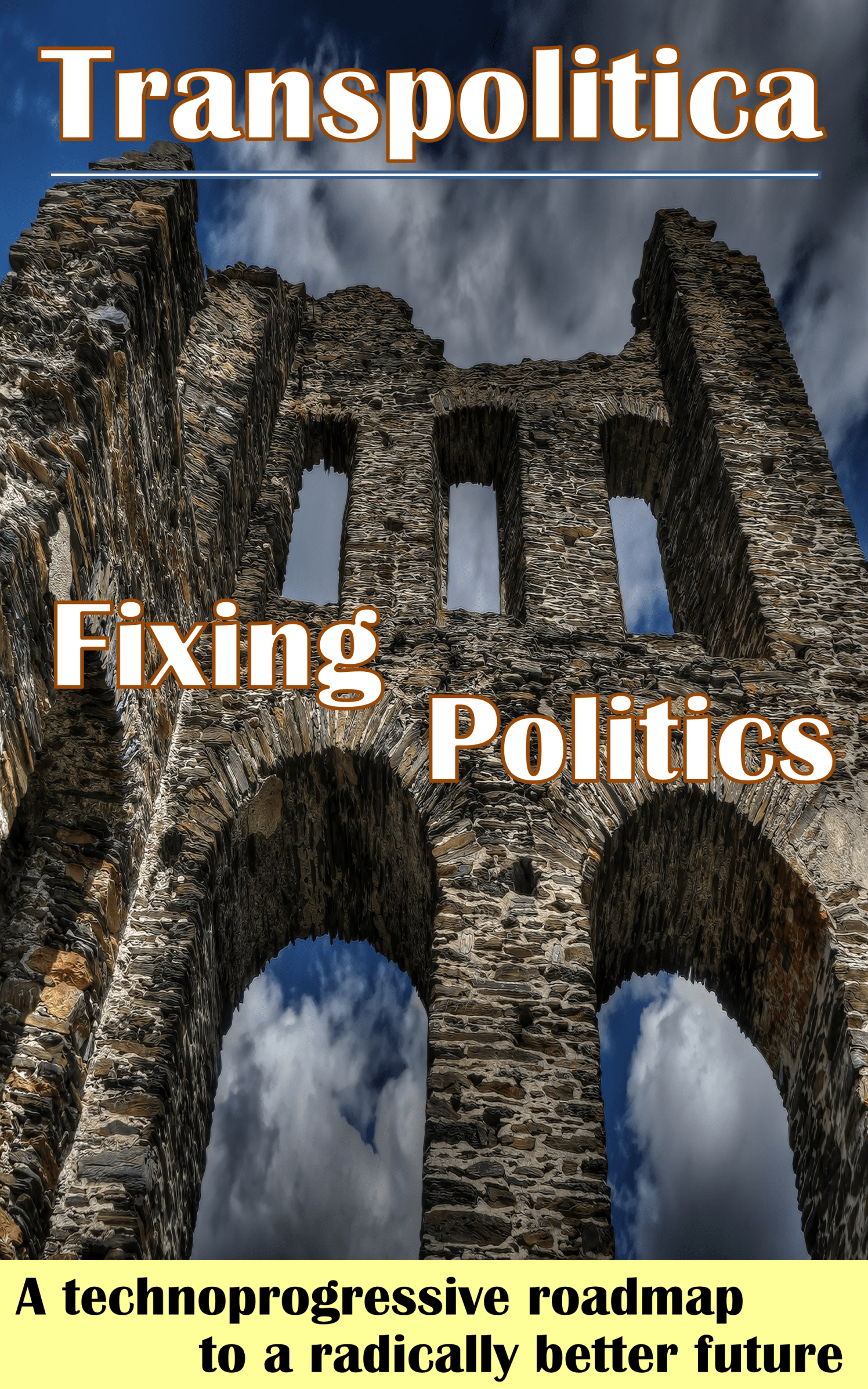
The event this Saturday features Azeem Azhar, the curator and publisher of the phenomenally interesting weekly newsletter “The Exponential View”. Azeem’s topic is “The age of technology has arrived. Now what?”

LonFut AA 18 March 2017.png


8 November 2016

Agile organisations for agile politics

Filed under: Agile, H+Pedia, politics, Transpolitica, Uncategorized — Tags: , , , , — David Wood @ 6:23 pm

The pace of change in politics over the last twelve months has been breathtaking. It’s possible the change will accelerate further over the next twelve months:

  • Huge dissatisfaction exists with present-day political parties, candidates, and processes
  • Ideas can spread extremely rapidly, due to extensive usage of social media
  • Although many people feel alienated from mainstream politics, they have a hunger for political change.

Growing awareness of forthcoming technological disruptions heightens the general feeling of angst:

  • Technological unemployment (automation) threatens to eliminate whole swathes of jobs, or to reduce the salaries available to people who continue in their current roles
  • Genetic editing and artificial intelligence have the potential for people living “better than well” and even “more than human”, but it’s unclear how widely these benefits will be shared among all sectors of society
  • Technologies such as blockchain and 3D printing raise the possibility of decentralised coordination – coordination with less need for powerful states or corporations
  • Virtual Reality, along with new types of drug, could lead to large-scale disengagement of citizens from mainstream society – with people “tuning in and dropping out” as never before
  • Breakthroughs in fields of energy, nanotech, the Internet of Things, synthetic biology, and self-learning artificial intelligence could result, intentionally or unintentionally, in extremely chaotic outcomes – with recourse to new types of “weapons of mass destruction” (including cyber-terrorism, nano-terrorism, gene-terrorism, and AI-terrorism)
  • Technologies of surveillance could put more power than ever before in the hands of all-seeing, all-manipulating governments and/or corporations
  • Misguided attempts to “geo-engineer” planetary solutions to potential runaway climate change could have devastating unintended consequences for the environment.

In the light of such uncertainty, two skills are becoming more important than ever:

  • The skill of foresight – the anticipation and evaluation of new scenarios, arising from the convergence of multiple developing trends
  • The skill of agility – the capability to change plans rapidly, as unexpected developments take on a life of their own.

An update on the Transhumanist Party of the UK

This context is the background for a significant change in a political party that was formed nearly two years ago – the Transhumanist Party of the UK (TPUK).

As a reminder, here’s a 90 second promotional video for TPUK from April last year:

.

The messages in that video remain as relevant and important today as when the Party was founded:

The Transhumanist Party – Transcending human limitations

Harnessing accelerating technology:

  • Enabling positive social change and personal freedom,
  • With no-one abandoned,
  • So technology benefits all – not just vested interests.

Sustainable, bright green policies – good for humanity and good for the environment

  • Policies informed by science and evidence,
  • Ideology and divisiveness replaced by rationality and compassion ,
  • Risks managed proactively, enabling innovation to flourish.

Regenerative solutions – for body, mind, education, society, and politics

  • Smart automation and artificial intelligence addressing age-old human burdens,
  • Huge personal and financial benefits from preventive medicine and healthy longevity,
  • Politics transcending past biases and weaknesses.

However, despite this vision, and despite an initial flurry of positive publicity (including the parliamentary candidacy of Alex Karran), the Party has made little progress over the last 6-9 months. And in the last couple of weeks, two key members of the Party’s NEC (National Executive Committee) have resigned from the Party:

These resignations arise from the recognition that there are many drawbacks to creating and developing a new political party in the United Kingdom:

  • The “first past the post” electoral system makes it especially difficult for minority parties to win seats in parliament
  • Political parties need to establish a set of policies on a wide range of issues – issues away from the areas of core agreement among members, and where dissension can easily arise
  • The timescales spoken about for full electoral success – potentially up to 25 years – are far too far into the future, given all the other changes expected in the meantime.

Party executives will each be following their own decisions about the best way to progress the underlying goals of transhumanist politics. Many of us will be redoubling our efforts behind Transpolitica – the think tank which was established at the same time as the Transhumanist Party. The relationship between Transpolitica and TPUK is covered in this FAQ from the Transpolitica website:

Q: What is the relation between Transpolitica and the various Transhumanist Parties?

Transpolitica aims to provide material and services that will be found useful by transhumanist politicians worldwide, including:

  • Transhumanist supporters who form or join parties with the name “Transhumanist Party” in various countries
  • Transhumanist supporters who form other new parties, without using the word “transhumanist” in their party name
  • Transhumanist supporters inside other existing political parties, including mainstream and long-established parties
  • Transhumanist supporters who prefer not to associate closely with any one political party, but who have an interest in political action.

Transpolitica 2016

Transpolitica is hosting a major conference later this year – on 3rd December. It’s a conference with a very practical ambition – to gather and review proposals for “Real world policy changes for a radically better future”. There will be 15 speakers, covering topics in three broad sections:

  • Regulations, health, and transformation
  • Politics, tools, and transformation
  • Society, data, and transformation

Click here for more details, and to register to attend (while tickets are still available).

I’ll be kicking off the proceedings, with a talk entitled “What prospects for better politics?”.

dw-speaker-transpolitica-2016

Watch out for more news about the topics being covered by the other speakers.

Note that a focus on devising practical policies for a radically better future – policies which could become the focus of subsequent cross-party campaigns for legislative changes – resonates with an important evolution taking place within the IEET (the Institute for Ethics and Emerging Technologies). As James Hughes (the IEET Executive Director) writes:

I am proposing that the IEET re-focus in a major way, on our website, with our blog, with our community, and in our work, on the explicit project of building a global technoprogressive ideological tendency to intervene in debates within futurism, academe and public policy. While we will remain a nonpartisan nonprofit organization, and will not be endorsing specific candidates, parties or pieces of legislation, we can focus on the broad parameters of the technoprogressive regulatory and legislative agenda to be pursued globally.

Regarding a first concrete project in this new direction, I have in mind our editing a Technoprogressive Policy Briefing Book, comparable to the briefing books of think tanks like the Brookings Institution, AEI, or Heritage Foundation. This project can collect and collaborate with the excellent work done by Transpolitica and other technoprogressive groups and friends. Each policy briefing would state a general issue in a couple of paragraphs, outline the key technoprogressive policy ideas to address the issue, and then list key publications and links to organizations pursuing those policies.

Next steps with the TPUK

As the official Treasurer of the TPUK, and following (as mentioned above) the resignation of both the leader and deputy leader of the Party, it legally falls to me to manage the evolution of the Party in a way that serves the vision of the remaining members. I’m in discussion with the other remaining representatives on the National Executive Committee, and we’ll be consulting members via the Party’s email conferencing systems. The basic principles I’ll be proposing are as follows:

  1. Times of rapid change demand organisational agility, rather than any heavyweight structures
  2. We will retain our radical purpose – the social changes ahead could (and should) be momentous over the next 5-25 years
  3. We will retain our progressive vision, in which technology benefits all – not just vested interests
  4. We will provide support across the spectrum of existing political parties to sympathisers of transhumanist and technoprogressive changes
  5. We will be ready to play a key positive enabling role as the existing political spectrum undergoes its own changes ahead – including the fragmentation of current parties and the creation of new alliances and new initiatives
  6. We will continue to champion the vision of (a.) Harnessing accelerating technology to enable positive social change and personal freedom; (b.) Sustainable, bright green policies – good for humanity and good for the environment; (c.) Regenerative solutions – for body, mind, education, society, and politics
  7. We will aim to provide actionable, practical analyses – of the sort being presented at Transpolitica 2016 – rather than (just) statements of principle
  8. Rather than maintain an expensive infrastructure of our own, we should feed our work into existing systems – such as H+Pedia, Transpolitica, the IEET, and the Transhuman National Committee of the United States
  9. As far as possible, we will remain collaborative rather than divisive
  10. We will hold onto our domain names
  11. We will retain the option to field our own candidates in future elections, in case that turns out to be the most sensible course of action at that time (this means the Party will remain officially registered with the Electoral Commission – at modest cost)
  12. We will offer our donors and members a refund of the payments they have provided the Party within the last six months, in case they feel they no longer support our vision.


21 May 2015

Anticipating 2040: The triple A, triple h+ vision

Abundance Access Action

The following vision arises from discussions with colleagues in the Transhumanist Party.

TPUK_LOGO3_400pxAbundance

Abundance – sustainable abundance – is just around the corner – provided we humans collectively get our act together.

We have within our grasp a sustainable abundance of renewable energy, material goods, health, longevity, intelligence, creativity, freedom, and positive experience.

This can be attained within one human generation, by wisely accelerating the green technology revolution – including stem cell therapies, 3D printing, prosthetics, robotics, nanotechnology, genetic engineering, synthetic biology, neuro-enhancement, artificial intelligence, and supercomputing.

TPUK_LOGO2_400pxAccess

The rich fruits of technology – abundance – can and should be provided for all, not just for those who manage to rise to the top of the present-day social struggle.

A bold reorganisation of society can and should take place in parallel with the green technology revolution – so that everyone can freely access the education, healthcare, and everything else needed to flourish as a full member of society.

Action

TPUK_LOGO1_400pxTo channel the energies of industry, business, finance, universities, and the media, for a richly positive outcome within the next generation, swift action is needed:

  • Widespread education on the opportunities – and risks – of new technology
  • Regulations and checks to counter short-termist action by incumbent vested interests
  • The celebration and enablement of proactive innovation for the common good
  • The promotion of scientific, rational, evidence-based methods for taking decisions, rather than ideologies
  • Transformation of our democracy so that governance benefits from the wisdom of all of society, and serves the genuine needs of everyone, rather than perpetuating the existing establishment.

Transhumanism 2040

2040Within one generation – 25 years, that is, by 2040 – human society can and should be radically transformed.

This next step of conscious evolution is called transhumanism. Transhumanists see, and welcome, the opportunity to intelligently redesign humanity, drawing wisely on the best resources of existing humanity.

The transhumanist party is the party of abundance, access, and action. It is the party with a programme to transcend (overcome) our ingrained human limitations – limitations of animal biology, primate psychology, antiquated philosophy, and 20th century social structures.

Transhumanism 2020

2020As education spreads about the potential for a transhumanist future of abundance, access, and action – and as tangible transhumanist projects are seen to be having an increasingly positive political impact – more and more people will start to identify themselves as transhumanists.

This growing movement will have consequences around the world. For example, in the general election in 2020 in the UK, there may well be, in every constituency, either a candidate from the Transhumanist Party, or a candidate from one of the other parties who openly and proudly identifies as a transhumanist.

The political landscape will never be the same again.

Call to action

To offer support to the Transhumanist Party in the UK (regardless of where you are based in the world), you can join the party by clicking the following PayPal button:

Join now

Membership costs £25 per annum. Members will be invited to participate in internal party discussions of our roadmap.

For information about the Transhumanist Party in other parts of the world, see http://transhumanistpartyglobal.org/.

For a worldwide transhumanist network without an overt political angle, consider joining Humanity+.

To discuss the politics of the future, without any exclusive link to the Transhumanist Party, consider participating in one of the Transpolitica projects – for example, the project to publish the book “Politics 2.0”.

Anticipating the Transhumanist Party roadmap to 2040

Footnote: Look out for more news of a conference to be held in London during Autumn (*), entitled “Anticipating 2040: The Transhumanist Party roadmap”, featuring speakers, debates, open plenaries, and closed party sessions.

If anyone would like to speak at this event, please get in touch.

Anticipating 2040
(*) Possible date is 3-4 October 2015, though planning is presently at a preliminary stage.


28 April 2015

Why just small fries? Why no big potatoes?

Filed under: innovation, politics, Transpolitica, vision — Tags: , , , , — David Wood @ 3:12 pm

Big potatoesLast night I joined a gathering known as “Big Potatoes”, for informal discussion over dinner at the De Santis restaurant in London’s Old Street.

The potatoes in question weren’t on the menu. They were the potential big innovations that politicians ought to be contemplating.

The Big Potatoes group has a tag-line: “The London Manifesto for Innovation”.

As their website states,

The London Manifesto for Innovation is a contribution to improving the climate for innovation globally.

The group first formed in the run-up to the previous UK general election (2010). I blogged about them at that time, here, when I listed the principles from their manifesto:

  • We should “think big” about the potential of innovation, since there’s a great deal that innovation can accomplish;
  • Rather than “small is beautiful” we should keep in mind the slogan “scale is beautiful”;
  • We should seek more than just a continuation of the “post-war legacy of innovation” – that’s only the start;
  • Breakthrough innovations are driven by new technology – so we should prioritise the enablement of new technology;
  • Innovation is hard work and an uphill struggle – so we need to give it our full support;
  • Innovation arises from pure scientific research as well as from applied research – both are needed;
  • Rather than seeking to avoid risk or even to manage risk, we have to be ready to confront risk;
  • Great innovation needs great leaders of innovation, to make it happen;
  • Instead of trusting regulations, we should be ready to trust people;
  • Markets, sticks, carrots and nudges are no substitute for what innovation itself can accomplish.

That was 2010. What has caused the group to re-form now, in 2015, is the question:

Why is so much of the campaigning for the 2015 election preoccupied with small fries, when it could – and should – be concentrating on big potatoes?

Last night’s gathering was facilitated by three of the writers of the 2010 big potato manifestoNico MacdonaldJames Woudhuysen, and Martyn Perks. The Chatham House rules that were in place prevents me from quoting directly from the participants. But the discussion stirred up plenty of thoughts in my own mind, which I’ll share now.

The biggest potato

FreemanDysonI share the view expressed by renowned physicist Freeman Dyson, in the book “Infinite in all directions” from his 1985 Gifford lectures:

Technology is… the mother of civilizations, of arts, and of sciences

Technology has given rise to enormous progress in civilization, arts and sciences over recent centuries. New technology is poised to have even bigger impacts on civilization in the next 10-20 years. So why aren’t politicians paying more attention to it?

MIT professor Andrew McAfee takes up the same theme, in an article published in October last year:

History teaches us that nothing changes the world like technology

McAfee spells out a “before” and “after” analysis. Here’s the “before”:

For thousands of years, until the middle of the 18th century, there were only glacial rates of population growth, economic expansion, and social development.

And the “after”:

Then an industrial revolution happened, centred around James Watt’s improved steam engine, and humanity’s trajectory bent sharply and permanently upward

AndrewMcAfeeOne further quote from McAfee’s article rams home the conclusion:


Great wars and empires, despots and democrats, the insights of science and the revelations of religion – none of them transformed lives and civilizations as much as a few practical inventions

Inventions ahead

In principle, many of the grave challenges facing society over the next ten years could be solved by “a few practical inventions”:

  • Students complain, with some justification, about the costs of attending university. But technology can enable better MOOCs – Massive Online Open Courses – that can deliver high quality lectures, removing significant parts of the ongoing costs of running universities; free access to such courses can do a lot to help everyone re-skill, as new occupational challenges arise
  • With one million people losing their lives to traffic accidents worldwide every year, mainly caused by human driver error, we should welcome the accelerated introduction of self-driving cars
  • Medical costs could be reduced by greater application of the principles of preventive maintenance (“a stitch in time saves nine”), particularly through rejuvenation biotechnology and healthier diets
  • A sustained green tech new deal should push society away from dependency on fuels that emit dangerous amounts of greenhouse gases, resulting in lifestyles that are positive for the environment as well as positive for humanity
  • The growing costs of governmental bureaucracy itself could be reduced by whole-heartedly embracing improved information technology and lean automation.

Society has already seen remarkable changes in the last 10-20 years as a result of rapid progress in fields such as electronics, computers, digitisation, and automation. In each case, the description “revolution” is appropriate. But even these revolutions pale in significance to the changes that will, potentially, arise in the next 10-20 years from extraordinary developments in healthcare, brain sciences, atomically precise manufacturing, 3D printing, distributed production of renewable energy, artificial intelligence, and improved knowledge management.

Indeed, the next 10-20 years look set to witness four profound convergences:

  • Between artificial intelligence and human intelligence – with next generation systems increasingly embodying so-called “deep learning”, “hybrid intelligence”, and even “artificial emotional intelligence”
  • Between machine and human – with smart technology evolving from “mobile” to “wearable” and then to “insideable”, and with the emergence of exoskeletons and other cyborg technology
  • Between software and biology – with programming moving from silicon (semiconductor) to carbon (DNA and beyond), with the expansion of synthetic biology, and with the application of genetic engineering
  • Between virtual and physical – with the prevalence of augmented reality vision systems, augmented reality education via new MOOCs (massive open online courses), cryptocurrencies that remove the need for centralised audit authorities, and lots more.

To take just one example: Wired UK has just reported a claim by Brad Perkins, chief medical offer at Human Longevity Inc., that

A “supercharged” approach to human genome research could see as many health breakthroughs made in the next decade as in the previous century

The “supercharging” involves taking advantage of four converging trends:

“I don’t have a pill” to boost human lifespan, Perkins admitted on stage at WIRED Health 2015. But he has perhaps the next best thing — data, and the means to make sense of it. Based in San Diego, Human Longevity is fixed on using genome data and analytics to develop new ways to fight age-related diseases.

Perkins says the opportunity for humanity — and Human Longevity — is the result of the convergence of four trends: the reduction in the cost of genome sequencing (from $100m per genome in 2000, to just over $1,000 in 2014); the vast improvement in computational power; the development of large-scale machine learning techniques; and the wider movement of health care systems towards ‘value-based’ models. Together these trends are making it easier than ever to analyse human genomes at scale.

Small fries

french-fries-525005_1280Whilst entrepreneurs and technologists are foreseeing comprehensive solutions to age-related diseases – as well as the rise of smart automation that could free almost every member of the society of the need to toil in employment that they dislike – what are politicians obsessing about?

Instead of the opportunities of tomorrow, politicians are caught up in the challenges of yesteryear and today. Like a short-sighted business management team obsessed by the next few quarterly financial results but losing sight of the longer term, these politicians are putting all their effort into policies for incremental changes to present-day metrics – metrics such as tax thresholds, the gross domestic product, policing levels, the degree of privatisation in the health service, and the rate of flow of migrants from Eastern Europe into the United Kingdom.

It’s like the restricted vision which car manufacturing pioneer Henry Ford is said to have complained about:

If I had asked people what they wanted, they would have said faster horses.

This is light years away from leadership. It’s no wonder that electors are deeply dissatisfied.

The role of politics

To be clear, I’m not asking for politicians to dictate to entrepreneurs and technologists which products they should be creating. That’s not the role of politicians.

However, politicians should be ensuring that the broad social environment provides as much support as possible to:

  • The speedy, reliable development of those technologies which have the potential to improve our lives so fully
  • The distribution of the benefits of these technologies to all members of society, in a way that preserves social cohesion without infringing individual liberties
  • Monitoring for risks of accidental outcomes from these technologies that would have disastrous unintended consequences.

PeterDruckerIn this way, politicians help to address the human angle to technology. It’s as stated by management guru Peter Drucker in his 1986 book “Technology, Management, and Society”:

We are becoming aware that the major questions regarding technology are not technical but human questions.

Indeed, as the Transpolitica manifesto emphasises:

The speed and direction of technological adoption can be strongly influenced by social and psychological factors, by legislation, by subsidies, and by the provision or restriction of public funding.

Political action can impact all these factors, either for better or for worse.

The manifesto goes on to set out its objectives:

Transpolitica wishes to engage with politicians of all parties to increase the likelihood of an attractive, equitable, sustainable, progressive future. The policies we recommend are designed:

  • To elevate the thinking of politicians and other leaders, away from being dominated by the raucous issues of the present, to addressing the larger possibilities of the near future
  • To draw attention to technological opportunities, map out attractive roads ahead, and address the obstacles which are preventing us from fulfilling our cosmic potential.

Specific big potatoes that are missing from the discussion

If our political leaders truly were attuned to the possibilities of disruptive technological change, here’s a selection of the topics I believe would find much greater prominence in political discussion:

  1. How to accelerate lower-cost high quality continuous access to educational material, such as MOOCs, that will prepare people for the radically different future that lies ahead
  2. How to accelerate the development of personal genome healthcare, stem cell therapies, rejuvenation biotech, and other regenerative medicine, in order to enable much healthier people with much lower ongoing healthcare costs
  3. How to ensure that a green tech new deal succeeds, rather than continues to fall short of expectations (as it has been doing for the last 5-6 years)
  4. How to identify and accelerate the new industries where the UK can be playing a leading role over the next 5-10 years
  5. How to construct a new social contract – perhaps involving universal basic income – in order to cope with the increased technological unemployment which is likely to arise from improved automation
  6. How society should be intelligently assessing any new existential risks that emerging technologies may unintentionally trigger
  7. How to transition the network of bodies that operate international governance to a new status that is fit for the growing challenges of the coming decades (rather than perpetuating the inertia from the times of their foundations)
  8. How technology can involve more people – and more wisdom and insight from more people – in the collective decision-making that passes for political processes
  9. How to create new goals for society that embody a much better understanding of human happiness, human potential, and human flourishing, rather than the narrow economic criteria that currently dominate decisions
  10. How to prepare everyone for the next leaps forward in human consciousness which will be enabled by explorations of both inner and outer space.

Why small fries?

But the biggest question of all isn’t anything I’ve just listed. It’s this:

  • Why are politicians still stuck in present-day small fries, rather than focusing on the big potatoes?

I’ll be interested in answers to that question from readers. In the meantime, here are my own initial thoughts:

  • The power of inertia – politicians, like the rest of us, tend to keep doing what they’re used to doing
  • Too few politicians have any deep personal insight (from their professional background) into the promise (and perils) of disruptive technology
  • The lack of a specific vision for how to make progress on these Big Potato questions
  • The lack of clamour from the electorate as a whole for answers on these Big Potato questions.

If this is true, we must expect it will take some time for public pressure to grow, leading politicians in due course to pay attention to these topics.

It will be like the growth in capability of any given exponential technology. At first, development takes a long time. It seems as if nothing much is changing. But finally, tipping points are reached. At that stage, it become imperative to act quickly. And at that stage, politicians (and their advisors) will be looking around urgently for ready-made solutions they can adapt from think tanks. So we should be ready.

Blog at WordPress.com.