dw2

1 March 2025

€10 million, nine choices

Filed under: aging, rejuveneering — Tags: , , , — David Wood @ 3:09 pm

What’s the most humanitarian way to spend ten million euros?

Imagine that a rich acquaintance gifted you €10 million, and you wanted to have the biggest humanitarian impact from the way you spend that money. You gather some friends to review your options.

There are some reasonably straightforward ways you could spend that money, to improve people’s lives here and now:

  • Providing food for people who are malnourished
  • Obtaining shelter for people who are homeless or dispossessed
  • Purchasing medical vaccines, for people in an area where infectious diseases pose problems
  • Improving hygiene and sanitation.

But you might also consider tackling some root causes. As the saying goes, instead of buying fish for a group of people, you could teach them how to fish for themselves. Instead of paying for prosthetic limbs for people injured in war zones, you could in principle help negotiate a lasting peace settlement. Instead of covering medical costs for people who suffer chronic diseases arising from bad lifestyle choices, you could pay for effective prevention campaigns. And – and this is the big one – instead of trying to treat the individual diseases that become more prevalent as people become older – diseases such as cancer, heart failure, and dementia – the diseases from which most people die – you could tackle their common underlying cause, namely biological aging.

Now you might protest: solving these root causes is likely to cost a lot more than €10 million. And I would agree. So consider instead the possibility that your €10 million, spent well, could catalyse a whole lot more expenditure. The results of your own spending could alter people’s hearts and minds, around the world, which would in turn unleash a cascade of greater funding.

That’s what I want to explore. It’s the possibility that biological aging could be defeated, in the not-too-distant future, if society decides to apply sufficient resources for that goal. These resources would enable the development and deployment of low-cost high-quality rejuvenation treatments, available for everyone. In other words, a profoundly humanitarian outcome, removing vast amounts of human decline, degradation, frailty, pain, and suffering.

I realise that I’ve lost some of you by now. You may protest that solving biological aging isn’t possible, or that it’s somehow ethically wrong. But I suspect that, even in that case, there’s some interest, somewhere in the back of your mind, as to what it would take to create a world freed from biological aging. And if it turns out that spending €10 million wisely could hasten the arrival of such a world, maybe you’ll permit yourself to change your mind.

So, how could €10 million best be spent, to accelerate a societal tipping point, that would bring about a successful war on aging? People have different ideas on that question. I’m going to run through nine different ideas. Please let me know, in the comments, which one you would pick.

Option 1: Help develop special economic zones, sometimes called longevity states, that will encourage and support greater innovation with rejuvenation therapies, faster than is possible under existing FDA regulations and procedures.

Option 2: Target politicians, to get them to change their minds about the desirability of using public funds and resources to tackle biological aging; this could involve public Open Letters and petitions, or sharing research with politicians in language that is legislation-friendly.

Option 3: A more general coordinated public communications campaign, with improved messaging, including memes, songs, short stories, documentaries, wiki articles, Netflix series, and so on.

Option 4: A campaign targeted instead at High Net Worth Individuals – people with billions at their disposal – to push them beyond what’s been called the billionaires’ paradox, in which most billionaires fail to invest in the kind of research that could significantly extend the lifespans and healthspans of them and their family and friends.

Option 5: Efforts to transform existing healthspan initiatives, such as the “Don’t Die” project of Bryan Johnson, so that these initiatives move beyond lifestyle changes and instead support significant research into deeper rejuvenation treatments.

Option 6: Carry out rejuvenation experiments on relatively short-lived animals, such as mice, dogs, or C. elegans worms, where the results could be dramatic in just a few years.

Option 7: Support research into alternative theories of aging and rejuvenation, such as organ replacement and body replacement, or the body’s electrome.

Option 8: Don’t bother with any biological research, but plough the entire €10 million into improving AI systems, with the expectation that these AI systems will soon outpace human researchers in being able to solve aging.

Option 9: Provide a prize fund, with prizes being awarded to the individuals or teams who submit the best ideas for how to accelerate the comprehensive defeat of aging.

But which of the nine options would you personally choose? Or would you spend the money in yet another different way? Please let me know what you think!

My own choice, since you asked, would be for option 6, since I believe €10 million is likely to be sufficient to fund experiments with combination rejuvenation treatments for middle-aged mice, over the next 2-3 years, that could double the remaining lifespan of these mice. That’s similar to giving treatments to humans aged 50, and changing their expected lifespan from 80 years to 110 years. Wouldn’t that make the world sit up?

By the way, if you prefer a video version of this article, here it is:

2 May 2024

LEV: Rational Optimism and Breakthrough Initiatives

How likely is it that longevity escape velocity (LEV) will be achieved by, say, 2040?

In other words, how likely is it that, by 2040, biomedical interventions will be widely available that result in each adult becoming (if they wish) biologically younger – becoming systematically healthier and more resilient?

In that scenario, to give one illustration, adults who are aged 65 in 2050 will generally be healthier than they were at the age of 50 some 15 years earlier. They’ll be mentally sharper, with stronger muscles, a better immune system, cleaner arteries, and so on. That’s instead of them following the downward health spiral which has accompanied human existence throughout all of history so far – a spiral in which each additional year of life from middle age onward brings a decline in vitality and robustness, and an increase in the probability of death.

Members of the extended longevity community express a variety of degrees of optimism or pessimism on such questions. The pessimists highlight what they see as a lack of significant progress over recent decades: not a single person has reached the age of 120 this century. They also lament the apparent unfathomable complexity of the biological metabolism, and differences of opinion over theories of what actually causes aging. They may conclude that the chance of reaching LEV by 2040 is less than one percent.

In contrast to that pessimism, I believe there are strong grounds for optimism. That’s the subject of this essay.

To be clear, there’s no inevitabilism to my optimism. I offer a probability for success, rather than any certainty. Whether humanity makes it to LEV by 2040 still remains to be seen.

Theories of aging

It’s true that aging is complicated. However, we don’t need to understand all aspects of aging in order to reverse it. Nor do we need to map out a comprehensive diagram of all the relationships of cause and effect at the biochemical level. Nor to pinpoint all the interactions of every gene in every cell of the body. Nor to debate whether aging happens because of evolution or despite evolution. Nor whether aging is best understood from a “reductionist” perspective or a “holistic” perspective.

Instead, to my mind, we already understand enough. There are plenty of details still to be filled in, but we already understand the basic framework that can lead to the comprehensive reversal of aging.

I’m referring to the damage repair approach to ending aging. This approach views aging as the accumulation of damage at the cellular and biomolecular levels throughout our bodies, with that damage in turn reducing the vitality of bodily subsystems. Moreover, this approach maintains that our biological vitality can be restored by repeatedly intervening to remove or repair that damage before it reaches a critical level.

What needs to be researched, therefore, is the set of interventions that can be developed and applied to remove or repair biological damage, without having adverse side-effects on overall metabolism.

These interventions need to be understood at an engineering level rather than at a detailed scientific level. We need to ascertain that such-and-such interventions result in given observable reductions in cellular or biomolecular damage. The way in which damage accumulates before being removed or repaired is of secondary concern.

This approach involves categorizing different types of damage, where each type of damage is associated with one or more potential mechanisms that could repair or remove it. Examples include:

  • A decline in the number or health of stem cells available – which could be addressed by the introduction of new stem cells
  • An accumulation of cells that are in a senescent state – which could be addressed by bolstering the innate biological mechanisms that normally break down these senescent cells
  • Damage to the long-lived proteins in the extra-cellular matrix that normally supports cells, with results such as the stiffening of arteries – which could be addressed by a variety of mechanisms including breaking crosslinks between adjacent proteins.

In this understanding, what needs to be done, to accelerate the advent of LEV, is to:

  • Identify and research mechanisms that have the potential to remove or repair aspects of the damage
  • Determine how these mechanisms might be applied in practice
  • Consider and monitor for potential side-effects of these mechanisms, and, as required, design modifications or alternatives to them
  • Consider and monitor for potential interactions between various such mechanisms.

This program was first suggested over twenty years ago. It was the subject of a major book published in 2007, Ending Aging: The Rejuvenation Breakthroughs that Could Reverse Human Aging in Our Lifetime, and it has been explored in a series of academic conferences held at various times from 2003 onward in Queens’ College Cambridge, San Francisco, Berlin, and Dublin. (Since you ask, the next one in that series is taking place in Dublin from 13-16 June.)

My own optimism that LEV might be achieved by 2040 is based on my assessment of the viability of this damage repair approach. In turn, that’s because I see:

  • A wide set of potential damage repair interventions that deserve further study
  • Early encouraging signs that damage repair can extend healthy lifespans in various species
  • A general pattern that slow progress in a field can transition into a new phase with much faster progress
  • Ways in which “breakthrough initiatives” can trigger such a phase transition for the project to achieve LEV.

I’ll now turn to each of these four points in sequence.

Damage repair mechanisms – plenty to explore

There are five basic sources of ideas for mechanisms to repair or remove damage at the cellular and biomolecular levels throughout the body:

  1. Identifying and improving the repair mechanisms that already work within the human body when we are younger – before these mechanisms lose their effectiveness
  2. Learning from the special self-repairing features of the small proportion of humans who are “superagers” in the sense that they reach the age of 95 without having suffered any of the usual age-related diseases such as heart disease, cancer, dementia, or stroke
  3. Learning from the fascinating self-repairing features of numerous species which avoid various age-related diseases, and which can retain their vitality for decades longer than other species with whom they share many other characteristics
  4. Learning from other regenerative features that various species possess, such as the regrowth of damaged limbs or organs, as well as the birth of a baby whose cells are aged zero from parents who can be many decades older
  5. New interventions that don’t exist anywhere in nature, but which can be introduced as a result of scientific analysis and engineering innovation (relatively simple examples are blood transfusions, and stents that can repair a narrowed or blocked blood vessel; more complicated examples involve nanobots and 3D printing).

Progress so far

Here are some pointers to descriptions of various results obtained so far from investigations of possible damage repair interventions – disappointments as well as successes:

Some conclusions from this data are uncontentious:

  • None of these treatments, so far, have resulted in animals passing the LEV threshold
  • The extension of healthy lifespan achieved in these trials is generally less than 50%, and is usually significantly less than that
  • Results obtained in experiments with shorter-lived animals, such as mice and rats, often do not translate into similar results with humans (or have not done so yet).

These conclusions would appear to bolster the case for pessimism mentioned earlier. However, they are by no means the entire story:

  • The various trials indicate that at least some rejuvenation can be engineered, and that there are multiple ways of doing so
  • Trials of combinations of different rejuvenation treatments (which might be expected to have more substantial results) are still at an early stage
  • Nothing like a proof of impossibility has been found, or even seriously suggested
  • The total amount of resources dedicated to this field is far below that in many other fields of scientific research; the field might, plausibly, be expected to make faster improvements if it gains more support.

Key to faster progress will be the removal of roadblocks. That’s the subject of the remainder of this essay.

The possibility of a phase change

Sometimes a field of technology or other endeavour remains relatively stagnant for decades, apparently making little progress, before bursting forward in a major new spurt of progress. Factors that can cause such a tipping point to such a phase change include:

  • The availability of re-usable tools (such as improved microscopes, molecular assembly techniques, diagnostic tests, or reliable biomarkers of aging)
  • The availability of important new sets of data (such as population-scale genomic analyses)
  • The maturity of complementary technologies (such as a network of electrical recharging stations, to allow the wide adoption of electric vehicles; or a network of wireless towers, to allow the wide adoption of wireless phones)
  • Vindication of particular theoretical ideas (such as the paramount importance of mechanisms of balance, in the earliest powered airplanes; or the germ theory for the transmission of infectious diseases)
  • Results that demonstrate possibilities which previously seemed beyond feasibility (such as the first time someone ran a mile in under four minutes)
  • Fear regarding a new competitive threat (such as the USSR launching Sputnik, which led to wide changes in the application of public funding in the United States)
  • Fear regarding an impending disaster (such as the spread of Covid-19, which accelerated development of vaccines for coronaviruses)
  • The availability of significant financial prizes (such as those provided by the XPrize)
  • A change in the attitude of researchers about the attractiveness of working in the field
  • A change in the public narrative regarding the importance of the field
  • The different groups who are all trying to find solutions to problems in the field finding and committing to a productive new method of collaboration on what turns out to be core issues.

When such factors apply – especially in combination – it can transform the pace of a change in a field from “linear” or “incremental” to “exponential” or “disruptive”, meaning that progress which previously was forecast as requiring (say) 100 years of research might actually happen within (say) 15 years.

That’s a general pattern. Now let’s consider how it can apply to accelerating progress toward LEV.

The existing roadblocks

Based on my observations of the longevity community stretching back nearly twenty years, here are my own assessment of the roadblocks which are presently hindering progress toward LEV:

  1. Lack of funding for some of the experiments that would produce important new data, since commercial interests such as VCs see little prospect of them earning a financial return from supplying that funding.
  2. Some people who are in a position to supply funding to support important experiments choose not to do so, because they are dominated by a mindset (sometimes called “longevity myths” or the “pro-aging trance”) that it’s wrong to support significantly longer lifespans.
  3. More broadly: society as a whole assigns insufficient priority to the comprehensive prevention and reversal of age-related diseases.
  4. Some potential supporters are deterred by what they perceive as irresponsible or untrustworthy aspects of the longevity field (snake-oil solutions, uncritical claims, tedious infighting).
  5. There is disagreement or confusion about which experiments are most important; as a result, available funds are being misdirected into, for example, less useful “lifestyle research”.
  6. Related: there is no agreed list of which experiments (or other research) should be conducted next, once additional funds become available.
  7. In the absence of biometrics that are accepted as being good measurements of overall biological aging (as opposed to measuring only an aspect of biological aging), it’s hard to know whether treatments increase the life expectancy of any long-lived animal.
  8. It’s likely that pools of data already in existence contain important insights related to aging and its possible alleviation – namely biological and other health data about individuals as they age and pass through different experiences and treatments. However, much of this data is kept in proprietary or private databases and isn’t made available for scrutiny by other researchers. Especially with the greater power nowadays of data analysis tools such as deep learning, the potential for open analysis isn’t being achieved. (This is another example where commercial or personal concerns are preventing the development of public goods from which everyone would benefit.)

Given this analysis, let’s look at four initiatives that could coalesce to cause the kind of phase transition discussed above.

The breakthrough initiatives

From one perspective, the breakthrough initiatives involve biomedical reengineering: projects such as the RMR (Robust Mouse Rejuvenation) study of combination interventions, designed and managed by the LEV Foundation. These are projects which have the potential to make the whole world wake up and pay attention.

But from another perspective, what most needs to change is the availability and application of sufficient funding to allow many such biomedical engineering projects to proceed in parallel. This can be termed the rejuvenation financial reengineering initiative – the initiative to direct more of the world’s vast financial resources toward these projects.

Taking one step further back, the financial reengineering will be facilitated by perhaps the most important initiative of all – namely narrative reengineering, altering the kinds of stories people in society tell themselves about the desirability of the comprehensive prevention and reversal of age-related diseases. Whereas today many people have an underlying insight that aging and death are deeply regrettable, they manage to persuade themselves (and each other) that there’s nothing that can be done about these trends, so that the appropriate response is to “accept what cannot be changed”. That is, they lack “the courage to change what can be changed”, in turn (to complete the citation of the so-called “serenity prayer” of Reinhold Niebuhr) because they lack the wisdom (or awareness) that such change is possible.

In parallel, important elements of community reengineering are required:

  • To clarify which experiments and research have the biggest potential for dramatic results
  • To avoid behaviours or statements which alienate or deter important potential supporters
  • To reduce amounts of wasteful duplication and “noise”
  • To develop and publicise meaningful quantitative metrics of progress toward LEV
  • To share more openly both the successes and the failures of experiments conducted, to allow more effective collaborative learning.

The breakthrough narratives

Some observers are pessimistic about any changes any time soon in the public narrative about the desirability of reaching LEV. These observers say they have been awaiting such a change for years or even decades, without it happening.

Part of the answer is that experimental results will make people pay attention. When middle-aged mice have their remaining life expectancy doubled – and then when similar treatments become available for middle-aged pet dogs – it is going to cause a large number of “road to Damascus” conversion experiences. People will set aside their former proclaimed “acceptance” of aging and death, and will instead start to clamor for rejuvenation treatments to be made available for humans too, as soon as possible.

But another part of the answer is to develop new themes within the public conversation related to aging and death. If these new themes have sufficient innate interest, they may develop a momentum of their own.

Here are some of the potential “breakthrough narratives” that I have in mind:

  1. Building on top of the latest “longevity dividend” and “evergreen society” arguments in the new book by the economist Andrew Scott, The Longevity Imperative: How to Build a Healthier and More Productive Society to Support Our Longer Lives, to highlight the broader economic and social benefits of biorejuvenation treatments
  2. The fascinating learning that can be obtained from looking more closely at the damage repair mechanisms already utilized by some “superaging” animal species; more and more of these mechanisms are being discovered and explored, and deserve greater publicity.
  3. Additional learning that can be obtained from further study into human superagers. Note that, for evolutionary reasons, it is likely that different superaging families around the world employ different biological damage repair mechanisms.
  4. The RMR narrative that the particularly useful data to collect is that from the combination of multiple treatments administered in mid-life; as this data accumulates, it is likely to give rise to lots of new theories about interactions between these treatments.
  5. The attractiveness of extending the RMR projects (for the robust rejuvenation of middle-aged mice) to similar investigations that might be called RDR (focused on dogs) and RSR (focused on simians, that is, monkeys and apes).
  6. The ups and downs of the various teams that are entering the XPrize Healthspan – a contest that can be seen as promoting an “RHR” extension (the ‘H’ for “human) to the RMR / RDR / RSR progression mentioned above
  7. A new analysis to supersede the existing “hallmarks of aging” diagrams, with a richer model of the interactions between different types of aging damage and the different possible damage repair mechanisms.
  8. Exploration of some “left field” rejuvenation interventions, such as those of Jean Hébert about growing and using replacement organs (including gradual replacement of parts of our brains), and those of Michael Levin about the ways in which the electrome can trigger biorejuvenation.
  9. The new possibilities that are continuing to emerge that take advantage of CRISPR-style genetic reprogramming and the reprogramming of epigenetics by Yamanaka factors or other means.
  10. More powerful AI platforms can enable faster advances in fields of science than were previously expected; examples include AlphaFold by DeepMind and the so-called menagerie of AI models utilised by Insilico Medicine
  11. Further championing of the ideas of anti-death philosopher Ingemar Patrick Linden from his book The Case Against Death.
  12. Engaging new video versions of some of the above narratives, in the manner of the CGP Grey video of Nick Bostrom’s allegory “Fable of the Dragon Tyrant” and those in the “Aging” YouTube playlist of Andrew Steele.

A probability, not a certainty

As I said earlier, there’s nothing inevitable about the longevity community experiencing the kind of tipping point and phase transition that I have described above.

Instead, I estimate the probability of humanity reaching LEV by 2040 to be less than 50%, although more than 25%. That’s because there are plenty of things that can go wrong along the way:

  • Distractions and loss of focus
  • Too much infighting and lack of constructive collaboration
  • A decline in the understanding and use of scientific methods
  • The field becomes dominated by pseudoscience, uncritical hero-worship, snake-oil, or wishful thinking
  • A growth of societal irrationality and preference for conspiracy thinking
  • An adverse change in the global political and geopolitical environment
  • The triggering of one or more of what I have called “Landmines”.

Which set of forces will prevail – the ones highlighted by the optimists, or those highlighted by the pessimists?

Frankly, it’s still too early to tell. But each of us can and should help to influence the outcome, by finding the roles where we can make the biggest positive impact.

29 December 2020

The best book on the science of aging in the last ten years

Filed under: aging, books, rejuveneering, science, The Abolition of Aging — Tags: , — David Wood @ 10:44 am

Science points to many possibilities for aging to be reversed. Within a few decades, medical therapies based on these possibilities could become widespread and affordable, allowing all of us, if we wish, to remain in a youthful state for much longer than is currently the norm – perhaps even indefinitely. Instead of healthcare systems continuing to consume huge financial resources in order to treat people with the extended chronic diseases that become increasingly common as patients’ bodies age, much smaller expenditure would keep all of us much healthier for the vast majority of the time.

Nevertheless, far too many people fail to take these possibilities seriously. They believe that aging is basically inevitable, and that people who say otherwise are deluded and/or irresponsible.

Public opinion matters. Investments made by governments and by businesses alike are heavily influenced by perceived public reaction. Without active public support for smart investments in support of the science and medicine that could systematically reverse aging, that outcome will be pushed backwards in time – perhaps even indefinitely.

What can change this public opinion? An important part of the answer is to take the time to explain the science of aging in an accessible, engaging way – including the many recent experimental breakthroughs that, collectively, show such promise.

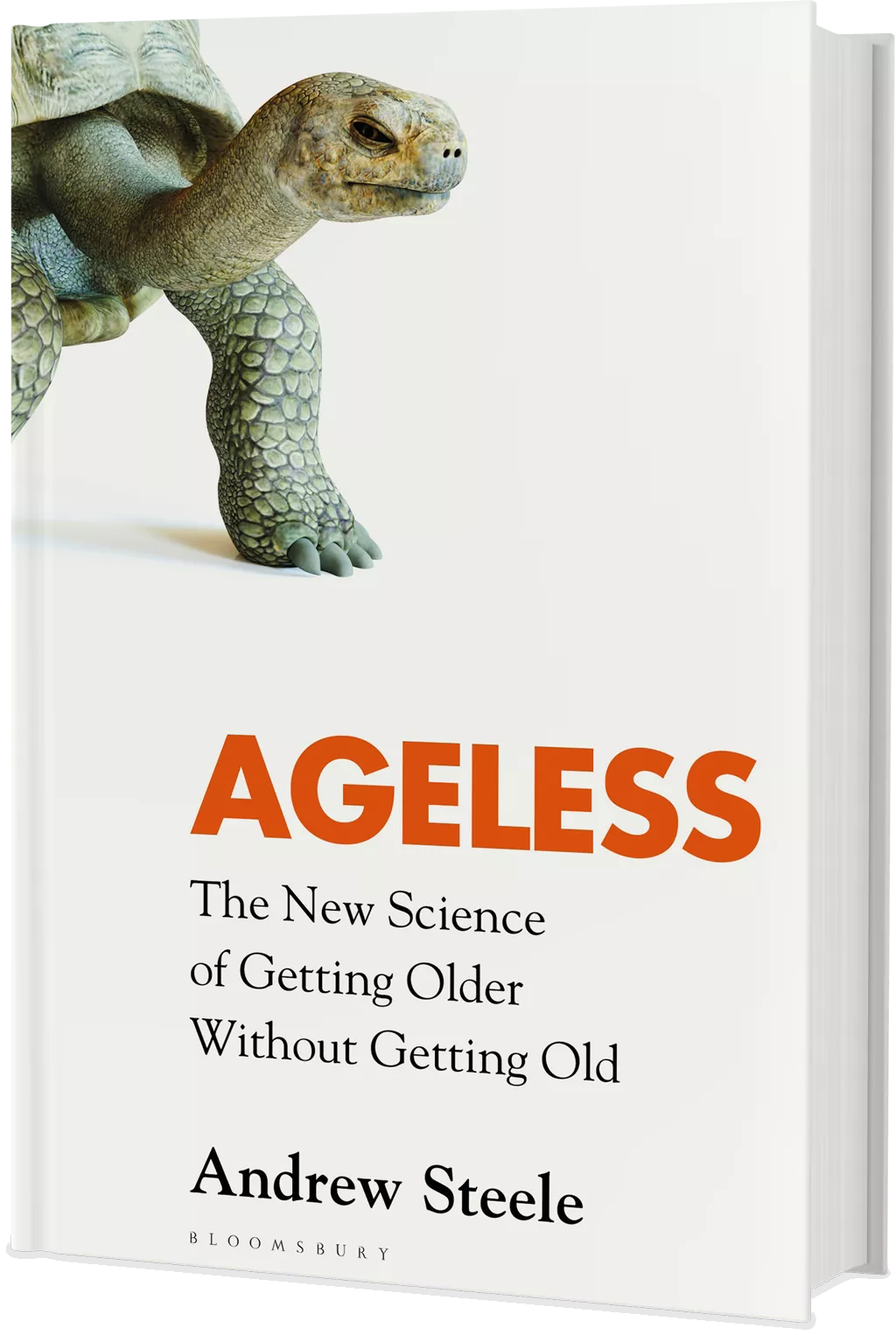
That’s exactly what Dr Andrew Steele accomplishes in his excellent book Ageless: The new science of getting older without getting old.

The audio version of this book became available on Christmas Eve, narrated by Andrew himself. It has been a delight to listen to it over the intervening days.

Over the last few years, I’ve learned a great deal from a number of books that address the science of aging, and I’ve been happy to recommend these books to wider audiences. These include:

But I hope that these esteemed authors won’t mind if I nominate Andrew Steele’s book as a better starting point into the whole subject. Here’s what’s special about it:

  • It provides a systematic treatment of the science, showing clear relationships between the many different angles to what is undeniably a complex subject
  • The way it explains the science seems just right for the general reader with a good basic education – neither over-simplified or over-dense
  • There’s good material all the way through the book, to keep readers turning the pages
  • The author is clearly passionate about his research, seeing it as important, but he avoids any in-your-face evangelism
  • The book avoids excessive claims or hyperbole: the claims it makes are, in my view, always well based
  • Where research results have been disappointing, there’s no attempt to hide these or gloss over them
  • The book includes many interesting anecdotes, but the point of these stories is always the science, rather than the personalities or psychologies of the researchers involved, or clashing business interests, or whatever
  • The information it contains is right up to date, as of late 2020.

Compared to other research, Ageless provides a slightly different decomposition of what is known as the hallmarks of aging, offering ten in total:

  1. DNA damage and mutations
  2. Trimmed telomeres
  3. Protein problems: autophagy, amyloids and adducts
  4. Epigenetic alterations
  5. Accumulation of senescent cells
  6. Malfunctioning mitochondria
  7. Signal failure
  8. Changes in the microbiome
  9. Cellular exhaustion
  10. Malfunction of the immune system

As the book points out, there are three criteria for something to be a useful “hallmark of aging”:

  1. It needs to increase with age
  2. Accelerating a hallmark’s progress should accelerate aging
  3. Reducing the hallmark should decrease aging

The core of the book is a fascinating survey of interventions that could reduce each of these hallmarks and thereby decrease aging – that is, decrease the probability of dying in the next year. These interventions are grouped into four categories:

  1. Remove
  2. Replace
  3. Repair
  4. Reprogram

Each category of intervention is in turn split into several subgroups. Yes, the treatment of aging is likely to be complicated. However, there are plenty of examples in which single interventions turned out to have multiple positive effects on different hallmarks of aging.

There are a couple of points where some readers might quibble with the content, for example regarding dietary supplements, or whether the concept of group selection can ever be useful within evolutionary theory.

However, my own presentations on the subject of the abolition of aging will almost certainly evolve in the light of the framework and examples in Ageless. I’m much the wiser from reading it.

Here’s my advice to anyone who, like me, believes the subject of reversing aging is important, and who wishes to accelerate progress in this field:

  • Read Ageless with some care, all the way through
  • Digest its contents and explore the implications, for example via discussion in online groups
  • Recommend others to read it too.

Ideally, a sizeable proportion of the book’s readers will alter their own research or other activity, in order to assist the projects covered in Ageless.

Finally, a brief comparison between Ageless and the remarkable grandfather book of this whole field: Ending Aging: The Rejuvenation Breakthroughs That Could Reverse Human Aging in Our Lifetime, authored by Aubrey de Grey and Michael Rae. Ending Aging was published in 2007 and remains highly relevant, even though numerous experimental findings and new ideas have emerged since its publication. There’s a deep overlap in the basic approach advocated in the two books. Both books are written by polymaths who are evidently very bright – people who, incidentally, did their first research in fields outside biology, and who brought valuable external perspectives to the field.

So I see Ageless as a worthy successor to Ending Aging. Indeed, it’s probably a better starting point for people less familiar with this field, in view of its coverage of important developments since 2007, and some readers may find Andrew’s writing style more accessible.

14 May 2020

The second coming of the Longevity Dividend

Please find below an extended copy of my remarks at today’s online Round Table of the Business Coalition for Healthier Longer Lives, jointed hosted by the UK’s APPG (All Party Parliamentary Group) on Longevity and Longevity Leaders.

(The stated goal of today’s Round Table is “Development of values for the Business Coalition for Healthier Longer Lives”.)

I’m David Wood, and I’ve been researching future scenarios for over 30 years.

The concept I want to put on the table today is that of the Longevity Dividend.

It’s actually a kind of second coming of the Longevity Dividend, since the idea was first proposed some 14 years ago by a quartet of distinguished longevity researchers (PDF).

It’s a good concept, but didn’t take hold in its first coming, for reasons I’ll get to shortly.

The core idea is that it is economically sensible – that is, financially wise – for society to make investments in research,

  • not just into individual aspects of aging,
  • nor just into individual diseases of aging,
  • but rather into the common root causes of many of the diseases and other adverse characteristics of aging

– that is, research into items we would nowadays call the hallmarks of aging.

The argument is that such investments wouldn’t just be positive from a humanitarian point of view. They would also be very positive from a medium-term financial point of view.

We can sum up their likely benefits in the age-old saying, a stitch in time saves nine. Healthier long-lived people are better contributors to the economy, and better consumers of the economy, rather than being a nine-fold drain.

To move forwards with this concept of the Longevity Dividend, we have to acknowledge that the calculations of costs and benefits are inherently probabilistic.

There are no guarantees that any particular research investments will prove successful. But that’s no reason for society to avoid making these investments into the hallmarks of aging. VCs already know well how to adjust their portfolios on account of probabilistic calculations.

The reason the first coming of the Longevity Dividend didn’t get very far, in the public mind, was that people implicitly rated the probabilities of these therapies succeeding as being very low. Why speculate about potential economic benefits of biorejuvenation interventions if these interventions have little chance of working? However, with lots of more promising research having taken place in the last 14 years, it’s no longer possible to wave away this calculation of significant benefits. So it’s time to bring the Longevity Dividend into the centre stage of public discussion.

The Longevity Dividend has a partner concept: that of Super Agers. They’re people who reach the age of 95 with minimal experience of cancer, heart disease, dementia, or diabetes. Of course, these Super Agers do succumb to one or other disease in due course. Often an infection. But the total healthcare cost of these people, throughout their long lives, is usually less than the total healthcare cost of people who have shorter lives. Quite a lot less total healthcare cost.

So one way to realise the Longevity Dividend would be to put more research into understanding what’s different about Super Agers.

But why isn’t this happening (or not happening much)? We need to go deeper into this topic.

We need to reflect on the general poor regard that society places in practice into any measures that prevent diseases rather than curing them.

Previous discussions in this series of Round Tables have highlighted how our societal incentive structures are deeply flawed in this regard.

Without addressing this misalignment, there’s unlikely to be much progress with the Longevity Dividend.

So one of the big outcomes of our collective deliberations must be to demand sustained attention to the question of how to alter society’s overall priorities and incentives.

And there’s an important lesson from history here, which will be my final remarks for now. That lesson is that the free market, by itself, cannot fix problems of flawed societal incentives. That kind of thing needs political action. But the politicians can be aided in this by industry groups stepping forward with specific agreed proposals.

It’s similar to how factory owners actually helped pressurise politicians in this country, two centuries ago, into changing the law about children working in their factories.

These factory owners saw that economic incentives were pressurising them into employing children, against their own humanitarian instincts. Many of these factory owners, as individuals, felt unable to stop hiring children, for fear of being out-competed and going out of business. It needed a change in law to cause that practice to change. And networks of factory inspectors to ensure conformance to the law.

Working out a similar change of law in the early 2020s is surely a key practical activity for this business coalition, so that prevention moves to centre stage, and with it, the concepts of Longevity Dividend and Super Agers. Thank you.

Further reading

For an extended analysis of the economic arguments about the Longevity Dividend, see Chapter 9, “Money Matters”, of my book The Abolition of Aging.

For the reasons why people disregard the economic and other logical arguments in favour of society investing more in a potential forthcoming radical extension of healthy human longevity, see Chapter 10, “Adverse Psychology”, of the same book.

For the example of the coalition to change the laws on child employment, see the section “When competition needs to be curtailed” in Chapter 9, “Markets and fundamentalists” of my book Transcending Politics.


24 April 2019

Supporting the SomosMiel revolution: time to act

The most important changes often arise from the bold actions of outsiders.

Those of us who desire positive humanitarian change need to be flexible enough to recognise which outsiders can be the best vehicles for the transformations we want to see in society.

And we need to be ready to get behind these opportunities when they arise.

Consider the key example of the transformation of healthcare, towards a new focus on the reversal of aging as providing the best route to better health for everyone.

For those of us who hold that vision of the forthcoming “abolition of aging”, what are the most practical steps to make that vision a reality?

Here’s my answer. It’s time to get behind “Somos Miel”.

Futuristicamente

Miel is a recently formed political party, which is taking part in Spain in the elections on the 26th of May to the European Parliament.

The word “miel” has two meanings. First, it’s the Spanish for “honey”. Somos Miel means “We are honey”. The association of honey with improved health exists in many cultures around the world.

Second, MIEL is the abbreviation for “Movimiento Independiente Euro Latino”. Translating from Spanish to English gives: “The Independent Latin Euro Movement”.

Heading the party’s list of candidates is José Cordeiro, described as follows in the introduction of his Wikipedia article:

José Luis Cordeiro is an engineer, economist, futurist, and transhumanist, who has worked on different areas including economic development, international relations, Latin America, the European Union, monetary policy, comparison of constitutions, energy trends, cryonics, and longevity. Books he has authored include The Great TabooConstitutions Around the World: A Comparative View from Latin America, and (in Spanish) El Desafio Latinoamericano (“The Latin American challenge”) and La Muerte de la Muerte (“The death of death”).

Cordeiro was born in Caracas, Venezuela from Spanish parents who emigrated from Madrid during the Franco dictatorship…

He’s evidently a man of many talents. He’s by no means a European political insider, infused by the old ways of doing politics. Instead, he brings with him a welcome spread of bold outsider perspectives.

When asked if he is from “the right” or “the left”, his answer, instead, is that he is from “the future”. Indeed, he often appends the greeting “futuristicamente” after his name, meaning “Yours futuristically”.

José is also known as a vocal advocate for “revolution” – a revolution in the potential of humanity. He has the courage to advocate ideas that are presently unpopular – ideas that he believes will soon grow in public understanding and public support.

Working together

I first met José at the TransVision 2006 conference in Helsinki, Finland. I remember how he spoke with great passion about the positive possibilities of technology in the next stage in the evolution of life on the earth. As the abstract from that long-ago talk proclaims:

Since the Big Bang, the universe has been in constant evolution and continuous transformation. First there were physical and chemical processes, then biological evolution, and finally now technological evolution. As we begin to ride the wave into human redesign, the destination is still largely unknown but the opportunities are almost limitless.

Biological evolution continues but it is just too slow to achieve the goals now possible thanks to technological evolution. Natural selection with trial and error can now be substituted by technical selection with engineering design. Humanity’s monopoly as the only advanced sentient life form on the planet will soon come to an end, supplemented by a number of posthuman incarnations. Moreover, how we re-engineer ourselves could fundamentally change the ways in which our society functions, and raise crucial questions about our identities and moral status as human beings.

Since that first meeting, the two of us have collaborated on many projects. For example, we both sit on the board of directors of Humanity+. José has spoken on a number of occasions at the London Futurists events I organise – such as TransVision 2019 which will take place in London on 6-7 July. And we are named as co-authors of the Spanish language book La Muerte de la Muerte which has attained wide press coverage throughout Spain.

Another thing we have in common is that we are both impatient for change. We’re not content to sit back and watch impersonal forces operate in society at their own pace and following their own inner direction. We believe in doing more than cheering from the sidelines. We both believe that the actions of individuals, wisely targeted, can have a huge impact on human affairs. We both believe that inspired political action, at the right time, can unleash vast public resources in support of important transformational projects.

We also recognise that delays have major consequences. Each single day that passes without the widespread availability of reliable treatments for biological aging, upwards of 100,000 people die as a result of aging-related diseases. That’s 100,000 unnecessary human deaths, every single day – preceded in almost every case by extended suffering and heartache.

Moving faster

On a positive note, there is considerable good news to report, regarding progress with regenerative medicine and rejuvenation biotechnology. The Undoing Aging conference in Berlin last month contained an encouraging set of reports from a host of world-leading scientists working in this field. Keep an eye on the Undoing Aging channel in YouTube for videos from that event. For a review of the human implications of these scientific breakthroughs, the forthcoming RAADfest in Las Vegas in October will be well worth attending – to hear about “the most powerful information and inspiration for staying alive”.

But the opportunity exists for progress to go much faster, if more elements of society decide to put their weight behind this project.

That’s where Miel comes in. José is a well-known figure in Spain, due to his many media appearances there. Current indications are that he stands a fighting chance of being elected to the European Parliament. If elected, he’ll be a tireless public advocate for the cause of rejuvenation healthcare. He’ll promote studies of the economic implications of different scenarios for the treatment of aging. He’ll also champion the creation of a European Agency for Anti-Aging, to boost research on how addressing aging can have multiple positive benefits for the treatments of individual aging-related diseases, such as dementia, cancer, and heart failure.

You’ll find a number of articles on the Miel blog about these aspects of Miel policy. For example, see “Within 25 years, dying will be optional” and “I’m not afraid of artificial intelligence, I’m afraid of human stupidity”.

You’ll also observe from its website how Miel is, wisely, giving voice in Spain to a community that perceives itself to be under-represented, namely the Latin Americans – people like José himself, who was born in Venezuela. Those of us who aren’t Latin Americans should appreciate the potential for positive change that this political grouping can bring.

Time for action

Despite the groundswell of popular support that Miel is receiving, it’s still in the balance whether the party will indeed receive enough votes throughout Spain to gain at least one member in the European Parliament.

I’m told that what will make a big difference is an old-fashioned word: money.

If it receives more donations, Miel will be able to place more advertisements in social media (Facebook, YouTube, Instagram, etc). With its messages in front of more eyeballs, the chance increases of popular support at the ballot box.

In a better world, money would have a lower influence over politics. But whilst we should all aspire to move politics into that better state, we need to recognise the present reality. In that reality, donations have a big role to play.

To support Miel, visit the party’s donation page. Donations are accepted via credit cards, debit cards, or PayPal.

But please don’t delay. The elections are in just one month’s time. The time for action is now.

3 May 2018

Recommended: The Longevity Code

If you’re interested in the latest advice on how to extend your healthspan, you should read The Longevity Code by Kris Verburgh.

The full title of the book is “The Longevity Code: Secrets to Living Well for Longer, from the Front Lines of Science”.

The book has the following description (on Goodreads):

Medical doctor and researcher Kris Verburgh is fast emerging as one of the world’s leading research authorities on the science of aging. The Longevity Code is Dr. Verburgh’s authoritative guide on why and how we age — and on the four most crucial areas we have control over, to slow down, and even reverse, the aging process.

We learn why some animal species age hardly at all while others age and die very quickly, and about the mechanisms at work that slowly but definitely cause our bodies to age, making us susceptible to heart attack, stroke, cancer, pneumonia and/or dementia.

Dr. Verburgh devotes the last third of The Longevity Code to what we can do to slow down the process of aging. He concludes by introducing and assessing the wide range of cutting-edge developments in anti-aging technology, the stuff once only of science fiction: new types of vaccines, and the use of mitochondrial DNA, CRISPR proteins, stem cells, and more.

In the course of researching and writing my own book The Abolition of Aging, I read dozens of different books on broadly similar topics. (For a partial list, scan the online copy of the Endnotes for that book.)

However, I found The Longevity Code to address a number of issues in ways that were particularly compelling and engaging:

  1. Persuasive advice on how to modify diet and lifestyle, now, in order to increase your likelihood to remain healthy long enough to benefit from forthcoming rejuvenation therapies (therapies which Verburgh lists as “Step 4” of a four-stage “longevity staircase”)
  2. A compelling analysis of different “theories of aging”, in Chapter 1 of his book, including the implications of the notably different lifespans of various animals that seem on first sight to have similar biology
  3. A down-to-earth matter-of-fact analysis, in Chapter 4 of his book, on the desirability of living longer lives.

The first of these points is an area where I have often struggled, in the Q&A portions of my own presentations on The Abolition of Aging, to give satisfactory answers to audience questions. I now have better answers to offer!

Allowable weakness

One “allowable weakness” of the book is that the author repeats himself on occasion – especially when it comes to making recommendations on diet and food supplements. I say this is “allowable” because his messages deserve repetition, in a world where there is an abundance of apparent expert dietary advice that is, alas, confusing, contradictory, and often compromised (due to the influence of vested interests – as Verburgh documents).

Table of Contents

The table of contents gives a good idea of what the book contains:

  1. Why do we age?
    • Making room?
    • Dying before growing old
    • Young and healthy, old and sick
    • Sex and aging
  2. What causes aging?
    • Proteins
    • Carbohydrates
    • Fats
    • Our energy generators and their role in life, death, and aging
    • Shoelaces and string
    • Other causes, and conclusion
  3. The longevity staircase
    • Avoid deficiencies
    • Stimulate hormesis
    • Reduce growth stimulation
    • Reverse the aging process
  4. Some thoughts about aging, longevity, and immortality
    • Do we really want to grow that old?
    • A new society?
  5. Recipes
  6. Afterword

About Kris Verburgh

You can read more about the author on the bio page of his website. Here’s a brief extract:

Kris Verburgh (born 1986) graduated magna cum laude as a medical doctor from the University of Antwerp, Belgium.

Dr. Verburgh is a researcher at the Center Leo Apostel for Interdisciplinary Studies (CLEA) at the Free University Brussels (VUB) and a member of the Evolution, Complexity and Cognition group at the Free University of Brussels.

Dr. Verburgh’s fields of research are aging, nutrition, metabolism, preventive medicine and health. In this context, he created a new scientific discipline, called ‘nutrigerontology‘, which studies the impact of nutrition on the aging process and aging-related diseases.

Additionally, he has a profound interest in new technologies that will disrupt medicine, health(care) and our lifespans. He follows the new trends and paradigm shifts in medicine an biotechnology and how they are impacted by the fourth industrial revolution

Verburgh wrote his first science book when he was 16 years old. At age 25, he had written 3 science books.

Dr. Verburgh gives talks on new developments and paradigm shifts in medicine, healthcare and the science of aging. He gave lectures for the European Parliament, Google, Singularity University, various academic institutes, organizations and international companies.

And I’d be delighted to host him at London Futurists, when schedules allow!

25 June 2017

12 months progress in radical life extension: RAADfest 2016 & 2017

The few days that I spent at RAADfest 2016, August 4-7 last year, were a wake-up call for me, in a very pleasant way.

RAAD stands for “Revolution Against Aging and Death”. It’s a bold name, for a set of big ideas that have to fight an uphill battle in a world that is, sadly, predisposed to find a kind of reconciliation with aging and death.

Critically, RAADfest is more than a set of ideas. It’s a community of people – the Coalition for Radical Life Extension – which exists both as a formal organisation and as a broader informal network. The “fest” part of the name is short for “festival”. RAADfest 2016 featured a combination of presentations, discussions, and art performances. The result was to highlight scientific progress, celebrate personal experiences, and to debate candidly about issues and opportunities.

RAADfest 2016 was also a chance for participants to reflect on the positive examples provided by the lifestyles and the projects of other attendees. What might we learn from each others’ experiences and achievements? That was where the wake-up call could be heard.

So what have we learned since last August? And what are the next steps?

With these questions in mind, I recently took part in a video conversation with Jim Strole, Director of the Coalition for Radical Life Extension and RAADfest.

The two of us looked forward to a bigger, longer RAADfest taking place this year, August 9-13. I’ll have the honour of chairing one of the key panels at that event. I’ll be asking a number of distinguished experts on healthy life extension questions about progress since the inaugural RAADfest twelve months previous:

  • What has happened faster than you expected?
  • What has happened slower than you expected?
  • What took you completely by surprise?
  • And in the light of these lessons, what do you recommend is done differently in the next twelve months?

It’s a long journey from the UK all the way to San Diego, southern California, where RAADfest will be taking place. But, judging from what happened at the event last year, that long journey could well be a gateway into a much better future.

To gain a fuller idea of the topics that will be included at RAADfest 2017, you can find a whole series of short videos of “RAADfest preview conversations” on YouTube.

Important: If you register by July 16th, using the discount code FUTURISTS, you can obtain tickets for just $497, rather than the current headline price of $692.

Postscript 1: If you can’t wait until August…

If you can’t wait until August before taking a deep dive into the question of how technology can abolish aging, let me draw your attention to a talk I’ll be giving on Monday evening (26th June) in a venue in Brick Lane, London E1.

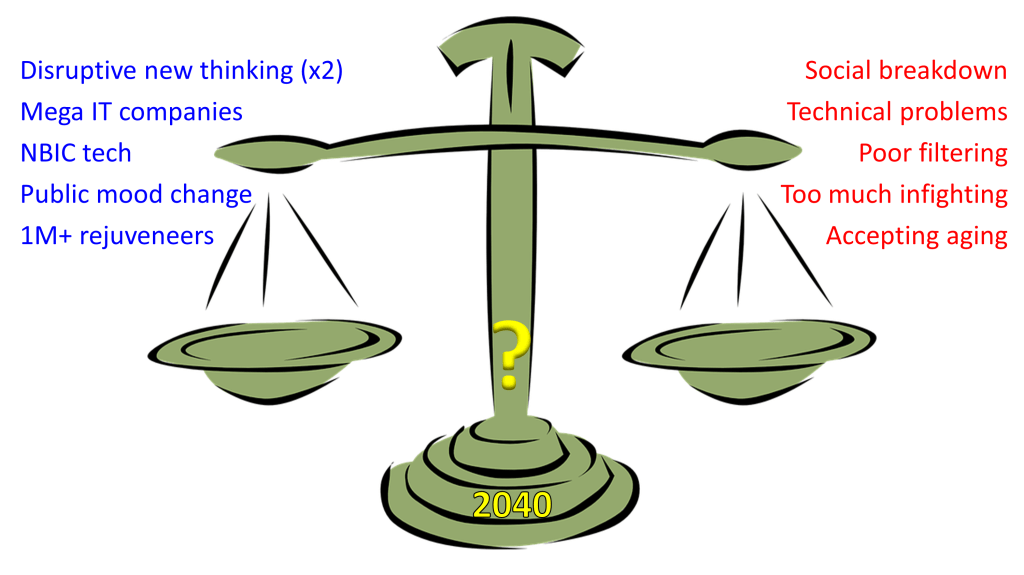
I’ll be describing what I see as a credible roadmap to abolish aging by 2040. Click here to read more about this talk, and to register to attend. I’ll be building up to explaining the content of the near-balance of conflicting forces depicted as follows:

Postscript 2: More interested in AI and sustainability?

In case you’re more interested in AI and sustainability than in the radical extension of healthspans, note that the London Futurists event at Birkbeck College next Saturday (1st July) is “The future of AI and sustainability, with Alex Housley”:

Artificial intelligence (AI) is powering the fourth industrial revolution. Intelligent machines are tackling new cognitive tasks at scale, leading to enormous economic efficiency gains and disruption across the labour market. But what will be the net impact of AI on society and the ecological environment?

In this talk, Alex Housley, founder of open-source machine learning platform Seldon, will explain how the collaborative approach to AI development helps transform industries and provides the macro-scale opportunities for AI to make the world a better and more sustainable place.

Questions to be considered will include:

  • What role can AI play in the transition to a sustainable economy?
  • What successes can we already identify, with AI systems improving uses of energy, waste recycling, and the circular economy?
  • What extra results can reasonably be expected, with future enhancements in AI?

For more details, click here.

30 September 2016

A declaration for radical healthspan extension

Filed under: aging, healthcare, medicine, rejuveneering, Uncategorized — Tags: , , , — David Wood @ 5:26 pm

I’m writing during a short break in the proceedings of the 2016 Eurosymposium on Healthy Ageing, which is being held in central Brussels.

The organisers have in mind that attendees could issue a declaration at the end of the event, tomorrow, Saturday 1st October – a date which happens to be Longevity Day.

Please find some draft text for this declaration. Lots of other text has been proposed too, but this is a fairly minimal version.

Before the text of the declaration is finalised, I’m interested to hear comments:

  • What should be added – or omitted?
  • What’s unclear?
  • What do people particularly like about it?
  • What improvements might be made to the language?
  • What changes (if any) would convince you to add your signature to it?
  • What’s a good way to conclude the declaration?

Please let us know!

Note: Many thanks are due to various members and supporters of Heales for suggesting text – especially Didier Coeurnelle.

(Update 6pm Brussels time 1st October – the draft text has evolved. The latest version is below.)

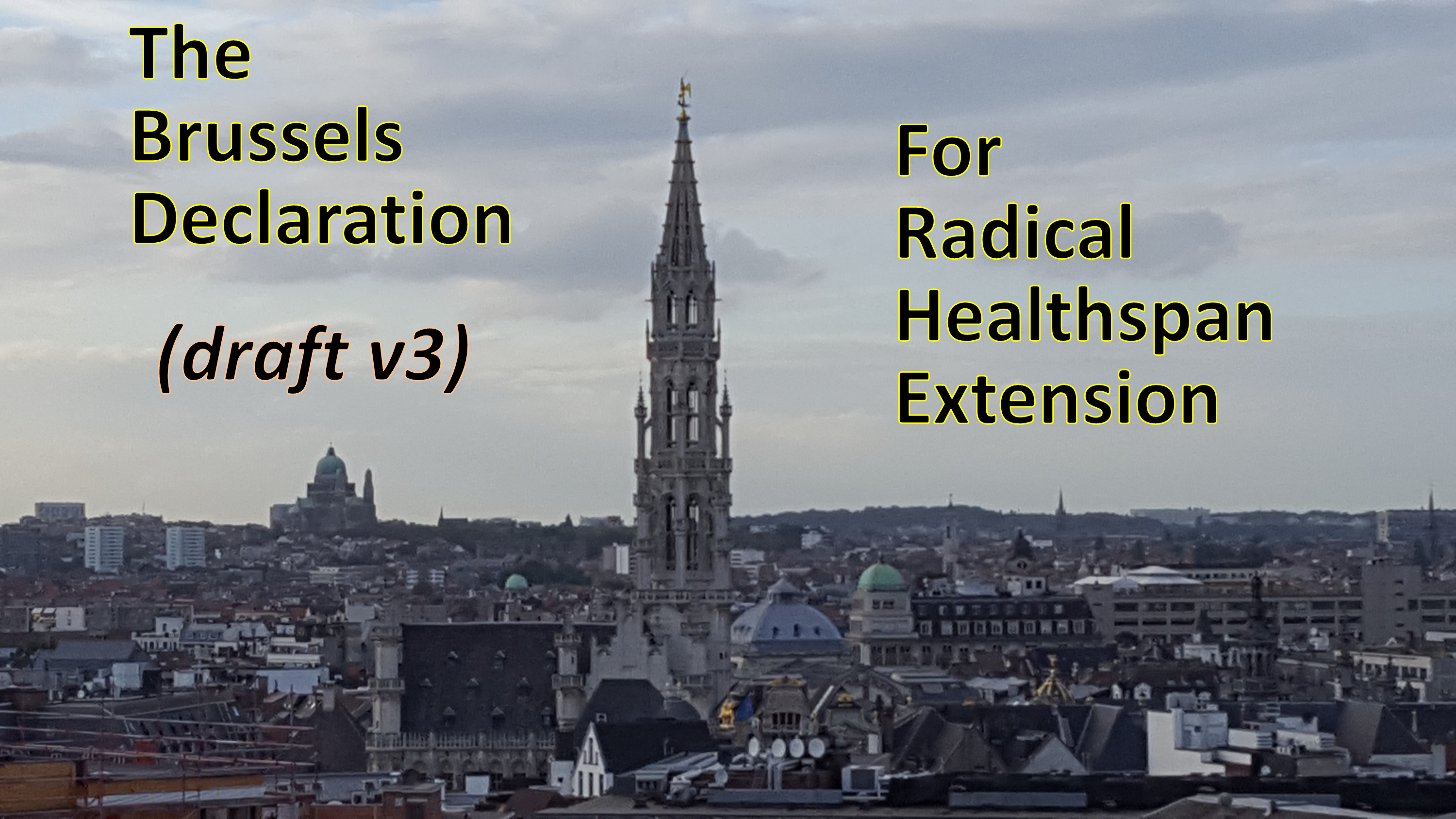
declaration-v3

The Brussels Declaration for Radical Healthspan Extension

The defeat of aging lies within our collective grasp. It’s time to seize this remarkable opportunity.

This 1st of October 2016, during International Longevity Day, the Eurosymposium on Healthy Ageing (EHA) meeting in Brussels proclaims the possibility and the imperative of a moonshot project to overcome all age-related diseases within 25 years by tackling aging as their root cause.

The result will be a world:

  • Where healthcare is far less expensive
  • Where human well-being can be radically extended
  • Where people place greater value on the environment and on peace, in view of their expectation of much longer lives
  • Where the right to life is more precious than ever, because life is longer.

Key steps in this initiative will include:

  • A paradigm shift stressing the need for research on aging itself, rather than only on individual diseases of old age
  • The removal of regulatory and other barriers which prevent or disincentivize companies from developing treatments for aging itself
  • An accelerated program to test anti-aging interventions on a much larger scale than anything that exists at the moment, leading to multiple human clinical trials of genuine rejuvenation biotechnologies by 2021.

These programs will require a coordinated effort at national and international level, integrating diverse existing and novel research approaches. They need to be financed by both public and private organizations, and create inclusive, affordable solutions available on equal terms to everybody.

25 May 2016

The Abolition of Aging – epublished

TAoA Cover page v11

I’m happy to report that my new book was epublished today, for Amazon Kindle. It’s “The Abolition of Aging: The forthcoming radical extension of healthy human longevity”.

You can find it on Amazon US, Amazon UK, …

It’s not a book about reprogramming our (silicon-based) devices – the kind of thing that used to be on my mind in my smartphone industry days. Instead, it’s about reprogramming our biology.

My reasons for writing this book are contained in its foreword. For convenience, I append a copy of the foreword at the end of this blogpost.

Physical copies of the book should be available from some time next month, for readers who prefer atoms to bits. I am planning to create an audio version too.

You can find more details about the book on its own website:

  • Advance praise, from people who have read pre-publication copies
  • The book’s description and dedication
  • An expanded table of contents
  • A community page, for further information about topics covered in the book.

If anyone has comments or queries about anything they read in the book, they’re welcome to raise them as responses to this blogpost.

Foreword

(This content is part of the introductory material of the book “The Abolition of Aging”.)

Within our collective grasp dwells the remarkable possibility of the abolition of biological aging.

It’s a big “if”, but if we decide as a species to make this project a priority, there’s around a 50% chance that practical rejuvenation therapies resulting in the comprehensive reversal of aging will be widely available as early as 2040.

People everywhere, on the application of these treatments, will, if they wish, stop becoming biologically older. Instead, again if they wish, they’ll start to become biologically younger, in both body and mind, as rejuvenation therapies take hold. In short, everyone will have the option to become ageless.

Two objections

The viewpoint I’ve just described is a position I’ve reached following extensive research, carried out over more than ten years. My research has led me to become a strong supporter of what can be called “the rejuveneering project”: a multi-decade cross-disciplinary endeavour to engineer human rejuvenation and thereby enable the choice to abolish aging.

But when I mention this viewpoint to people that I meet – as part of my activity as a futurist, or when I catch up with my former colleagues from the smartphone industry – I frequently encounter one of two adverse reactions.

First, people tell me that it’s not possible that such treatments are going to exist in any meaningful timescale any time soon. In other words, they insist that human rejuvenation can’t be done. It’s wishful thinking to suppose otherwise, they say. It’s bad science. It’s naively over-optimistic. It’s ignorant of the long history of failures in this field. The technical challenges remain overwhelmingly difficult.

Second, people tell me that any such treatments would be socially destructive and morally indefensible. In other words, they insist that human rejuvenation shouldn’t be done. It’s essentially a selfish idea, they say – an idea with all kinds of undesirable consequences for societal harmony or planetary well-being. It’s an arrogant idea, from immature minds. It’s an idea that deserves to be strangled.

Can’t be done; shouldn’t be done – in this book, I will argue that both these objections are profoundly wrong. I’ll argue instead that rejuvenation is a noble, highly desirable, eminently practical destiny for our species – a “Humanity+” destiny that could be achieved within just one human generation from now. As I see it, the abolition of aging is set to take its place on the upward arc of human social progress, echoing developments such as the abolition of slavery, the abolition of racism, and the abolition of poverty.

It turns out that the can’t/shouldn’t objections are interlinked. They reinforce each other. It’s often because someone thinks an effort is technically impossible that they object to any time or finance being applied to it. It would be much better, they say, to apply these resources to other philanthropic causes where real progress is possible. That, allegedly, would be the moral, mature thing to do. Conversely, when someone’s moral stance predisposes them to accept personal bodily decline and death, they become eager to find technical reasons that back up their decision. After all, it’s human nature to tend to cherry pick evidence that supports what we want to believe.

Two paradigms

A set of mutually reinforcing interlinked beliefs is sometimes called a “paradigm”. Our paradigms guide us, both consciously and unconsciously, in how we see the world, and in the kinds of projects we deem to be worthwhile. Our paradigms filter our perceptions and constrain our imaginations.

Changing paradigms is hard work. Just ask anyone who has tried to alter the opinion of others on contentious matters such as climate change, gun control, regulating the free market, or progressive taxation. Mere reason alone cannot unseat opinions on such topics. What to some observers is clear and compelling evidence for one position is hardly even noticed by someone entrenched in a competing paradigm. The inconvenient evidence is swatted away with little conscious thought.

The paradigm that accepts human bodily decline and aging as somehow desirable has even deeper roots than the vexatious political topics mentioned in the previous paragraph. It’s not going to be easy to dislodge that accepting-agingparadigm. However, in the chapters ahead, I will marshal a wide range of considerations in favour of a different paradigm – the paradigm that heartily anticipates and endorses rejuvenation. I’ll try to encourage readers to see things from that anticipating-rejuvenation paradigm.

Two abolitions

Accepting aging can be compared to accepting slavery.

For millennia, people from all social classes took slavery for granted. Thoughtful participants may have seen drawbacks with the system, but they assumed that there was no alternative to the basic fact of slavery. They could not conceive how society would function properly without slaves. Even the Bible takes slavery as a given. There is no Mosaic commandment which says “Thou shalt not keep slaves”. Nor is there anything in the New Testament that tells slave owners to set their slaves free.

But in recent times, thank goodness, the public mind changed. The accepting-slavery paradigm wilted in the face of a crescendo of opposing arguments. As with slavery, so also with aging: the time will come for its abolition. The public will cease to take aging for granted. They’ll stop believing in spurious justifications for its inevitability. They’ll demand better. They’ll see how rejuvenation is ready to be embraced.

One reason why slavery is so objectionable is the extent of its curtailment of human opportunity – the denial of free choice to the people enslaved. Another reason is that life expectancy of slaves frequently fell far short of the life expectancy of people not enslaved. As such, slavery can be counted as a major killer: it accelerated death.

From the anticipating-rejuvenation perspective, aging should be seen as the biggest killer of all. Compared to “standard” killers of the present day, such as drunken driving, terrorism, lead fumes, or other carcinogens – killers which rouse us to action to constrain them – aging destroys many more people. Globally, aging is the cause of at least two thirds of human deaths. Aging is the awful elephant in the room, which we have collectively learned to ignore, but which we must learn to recognise and challenge anew.

Every single week the rejuveneering project is delayed, hundreds of thousands more people suffer and die worldwide due to aging-related diseases. Advocates of rejuveneering see this ongoing situation as a needless slaughter. It’s an intolerable offence against human potential. We ought, therefore, to be powerfully motivated to raise the probability of 50% which I offered at the start of this foreword. A 50% chance of success with the rejuveneering project means, equally, a 50% chance of that project failing. That’s a 50% chance of the human slaughter continuing.

Motivation

In the same way as we have become fervently motivated in recent decades to deal with the other killers mentioned above – vigorously campaigning against, for example, drunk drivers and emitters of noxious chemical pollutants – we ought to be even more motivated to deal with aging. The anger that society has directed against tobacco companies, for long obscuring the links between smoking and lung cancer, ought to find a resonance in a new social passion to uncover and address links between biological aging and numerous diseases. If it’s right to seek to change behaviours and metabolism to cut down bad cholesterol (a precursor of heart disease) and concentrated glucose (a precursor of diabetes), it should be equally right to change behaviours and metabolism to cut down something that’s a precursor of even more diseases, namely, biological aging.

This is a discussion with enormous consequences. Changes in the public mood regarding the desirability of rejuveneering could trigger large reallocations of both public and private research expenditure. In turn, these reallocations are likely to have major implications in many areas of public well-being. Clearly, these decisions need to be taken wisely – with decisions being guided by a better understanding of the rich landscape of rejuveneering possibilities.

An ongoing surge of motivation, wisely coordinated, is one of the factors which can assist the rejuveneering project to overcome the weighty challenges it faces – challenges in science, technology, engineering, and human collaboration. Stubborn “unknown unknowns” surely lie ahead too. Due to these complexities and unknowns, no one can be sure of the outcome of this project. Despite what some rejuvenation enthusiasts may suggest, there’s nothing inevitable about the pace of future medical progress. That’s why I give the probability of success as only around 50%.

Although the end outcome remains unclear, the sense of discovery is increasing. The underlying scientific context is changing rapidly. Every day brings its own fresh firehose of news of potential breakthrough medical approaches. In the midst of so much innovation, it behoves us to seek clarity on the bigger picture.

To the extent that my book can provide that bigger picture, it will have met at least some of its goals. Armed with that bigger picture, readers of this book will, hopefully, be better placed to find the aspect of the overall rejuveneering project where they can make their best contributions. Together, we can tilt that 50% success probability upwards. The sooner, the better.

(If you found this interesting, you may like to read “The discussion ahead” next.)


19 September 2014

The new future of old age

In an enchanting four minute video, Korean artist Seok Jeong Hyeon, who is also known as Stonehouse, portrays the gradual aging of a baby girl. At first, the changes are slow, but they accumulate as years and then decades pass. The end result is an elderly woman, adorned with lines and wrinkles, who finally stops breathing.

The video is beautiful, and the woman maintains her own elegance to the end. As such, it presents a romantic view of aging. (And the video even hints at another romantic idea, namely reincarnation.)

In reality, as we age, we suffer from increasing numbers of aches and pains. We half-laugh when we say that we’re experiencing a “senior moment” of forgetfulness, but we notice our declining potency. Worse, every extra eight years that we live, past the age of around 35, we become twice as likely to die within the next year. In other words, our mortality rate increases exponentially. This was first observed in 1825 by British actuary and mathematician Benjamin Gompertz. Empirical data continues to support Gompertz, nearly two centuries later. For example, here’s a chart of the exponentially increasing death rate in the USA:

gompertz-mortality-curve

One of the factors underlying this upwards surge of mortality rate is the fact that, as we become older, we become increasingly vulnerable to various horrible diseases, such as cancer, heart disease, diabetes, Alzheimer’s, and lung disorders. Aging researcher Avi Roy of Oxford has collected information from the Office of National Statistics as follows:

Death rates from diseases

These five diseases aren’t random choices, by the way. They’re currently all high up in the list of the current largest causes of death.

The romantic notion of death is that we grow old gracefully, lose our powers almost imperceptibly, and die in our sleep, contented, surrounded by happy thoughts. In all too many cases, alas, death is preceded by viciously nasty diseases.

The Palo Alto prize

One of the deeply cherished visions of potential human progress has been the hope that, one day, we could reverse this state of affairs. Instead of the rate of mortality increasing with chronological age, it could remain constant. The terrible diseases listed, and others like them, which all currently increase their impact the older we get, could be conquered by the development of medicine – much the same as medicine has already made huge inroads against infectious diseases. The best solution would be, not a wide range of individual interventions each targeted at specific diseases, but an intervention that undoes the underlying damage of aging – the damage which accumulates throughout our body, and which makes it more likely that we fall prey to “diseases of old age”.

Until recently, that vision has lain well outside scientific orthodoxy. People have been loath to mention the idea, as it could spell the end of their academic careers.

However, that reticence seems to be changing. No less than eleven research teams from universities around the world have already publicly committed to entering for the recently announced “Palo Alto Longevity Prize”, which has a $1M prize fund. This video provides an introduction to the prize:

This video introduces key personnel from the different teams who are already engaged in developing solutions for contest:

.

The eleven teams and their leaders are listed in a recent TechCrunch article about the prize:

Doris Taylor, Ph.D.
Texas Heart Institute, Houston, TX
http://paloaltoprize.com/team/team-taylor-lab/ ‎
TEAM NAME: T.H.I. REGENERATIVE MEDICINE (approach: stem cells)

Dongsheng Cai, M.D., Ph.D.
Albert Einstein College of Medicine, New York, NY
http://paloaltoprize.com/team/cai-lab/
TEAM NAME: CAI LAB (approach: hypothalamic regulation)

Andreas Birkenfeld, M.D.
Charite University School of Medicine, Berlin, Germany
http://paloaltoprize.com/team/team-indy/
TEAM NAME: INDY (approach: gene modification)

Jin Hyung Lee, Ph.D.
Stanford University, Palo Alto, CA
http://paloaltoprize.com/team/team-lee-lab/
TEAM NAME: LEE LAB (approach: neuromodulation)

David Mendelowitz, Ph.D.
George Washington University, Washington, D.C.
http://paloaltoprize.com/team/team-mendelowitz-lab/
TEAM NAME: MENDELOWITZ LAB (approach: oxytocin)

Scott Wolf, M.D.
Mountain View, CA
http://paloaltoprize.com/team/volts-medical/
TEAM NAME: VOLTS MEDICAL (approach: inflammatory tissues)

Irving Zucker, Ph.D.
University of Nebraska Medical Center, Omaha, NE
http://paloaltoprize.com/team/team-zucker-lab/
TEAM NAME: ZUCKER LAB (approach: neuromodulation)

Brian Olshansky, M.D.
University of Iowa Medical Center, Iowa City, IA
http://paloaltoprize.com/team/team-olshansky-lab
TEAM NAME: IOWA PRO-AUTONOMIA (approach: not yet public)

William Sarill, M.A.
Arlington, MA
http://paloaltoprize.com/team/team-sarill-lab/
TEAM NAME: DECO (approach: pituitary hormones)

Steven Porges, Ph.D.
University of North Carolina, Chapel Hill, NC
http://paloaltoprize.com/team/team-porges-lab/
TEAM NAME: POLYVAGAL SCIENCE (approach: optimizing both the left & right vagal branches)

Shin-Ichiro Imai, M.D., Ph.D.
Washington University, St. Louis, MO
http://paloaltoprize.com/team/imai-lab/
TEAM NAME: IMAI LAB (approach: gene modification)

Approaching rejuvenation

AR Cover page v2In the light of all the fascinating developments around the field of increasing healthy longevity, I’ve decided that my next book will focus on that field.

The book is entitled “Approaching rejuvenation: Is science on the point of radically extending human longevity”. My intent is that the book will provide a bird’s eye report from the frontiers of the emerging field of rejuvenation biology:

  • The goals and motivations of key players in this field
  • The rapid progress that has been achieved in the last few years
  • The challenges that threaten to thwart further development
  • The critical questions that need to be faced.

The book will be based around material from interviews with more than a dozen researchers, engineers, entrepreneurs, and humanitarians, who are making it their life’s quest to enable human rejuvenation. I’ve already started doing these interviews.

I’m far from being an expert in any branch of biochemistry or medicine. However, I hope to bring five important angles to this writing task:

  1. My background in history and philosophy of science, wrestling with the question of how to distinguish science from pseudoscience, and the more general dilemma of how to decide whether lines of research are likely to turn out to be misguided dead-ends
  2. My professional career within the smartphone industry, where I saw a lot of similar aspirations (though on a much smaller scale) regarding the breakthroughs that fast-moving technology could enable
  3. My experience as a writer, in which I seek to explain complicated subjects in a relatively straightforward but engaging manner
  4. The six years in which I have had the privilege to organise meetups in London dedicated to futurist, singularitarian, and technoprogressive topics – meetings which have featured a wide variety of different attitudes and outlooks
  5. My aspiration as a humanitarian to probe for both the human upsides and the human downsides of changing technology – in order to set possible engineering breakthroughs (such as rejuvenation biotech) in a broader societal context.

If you have any suggestions or comments about this new book project, please don’t hesitate to get in touch.

The new future of old age

The London Futurists event next Saturday (27th September) addresses the same general theme. I close this blogpost with an excerpt from the description of the meetup. Please see the associated meetup page for more information about the speakers, for logistics details, and to register to attend. I hope to see some of you there!

Futurists, life extension advocates, transhumanists and others have been speaking for several decades already about the possibility, desirability, and broader consequences of significantly extending the human healthy lifespan. In this vision, the deteriorating effects of infirmity and old age could be radically postponed, and perhaps abolished altogether, via improvements in regenerative biotechnology.

Forget “70 is the new 50”. We might have the possibility of “150 is the new 50”. And alongside the existing booming cosmetics industry, with huge amounts spent to reduce the visible signs of aging, we might envision a booming rejuvenation industry, reversing the actual underlying biochemical damage that constitutes aging.

Recently, the pace of change in the field of healthy life extension seems to have increased: almost every day there are reports of possible breakthrough treatment methods, unexpected experimental results, new economic analyses of demographic changes, and innovative theoretical ideas. It’s hard to keep up with all these reports.

How can we evaluate this flurry of change?

Held in conjunction with the UN International Day of Older People (which occurs each year on 1st October), this event brings together a panel of expert speakers – William BainsMichael Price, Alex Zhavoronkov, and Sebastian Sethe – who will each give their assessment of “what’s new in the field of old age”:

  • What are some of the most significant research findings and other potential breakthroughs from the last five years?
  • What is the likelihood of significant practical change in healthy longevity within, say, the next 10-20 years?
  • What would be the economic, social, and psychological implications of such changes?
  • Are there any new grounds for scepticism or fear regarding these potential changes?
  • If individuals wish to help accelerate these changes, what should they do?
  • What are the major obstacles that could prevent real progress being made?

FB meeting image


Older Posts »

Blog at WordPress.com.