dw2

10 September 2009

Unimaginative thinking about longer lives

Filed under: aging, Methuselah, vision — David Wood @ 12:21 am

TimesOnline recently carried a piece entitled, “Live For Ever – The promise of more and more life will bring us all problems“.

I believe the article to be small-minded.  It displays a weak imagination.  I submitted an online comment to explain my viewpoint, but the moderator butchered my comment, making it almost unintelligible.  My opinion of the Times has taken a dive.

Here’s what I submitted – referring in each case to text from the original article:

…we will pay a heavy price for our longevity. If we are unable to abolish chronic illness, then the cost of treating an extended span would quickly bankrupt the National Health Service.

Any serious anti-aging program will address chronic illness en route to extending human lifespan.  There’s no need to worry, on this account, about bankrupting the NHS.

If genetic therapy did somehow extend the quality of life into deep old age, then pension provision and social care would be astronomically expensive. The pension age will have to rise in units of a decade.

But what’s the problem about raising the pension age?  Any serious anti-aging program intends to extend youthful (productive) life, rather than frail (unproductive) life.  People who live longer will probably have several different careers, interspersed with periods of voluntary “retirement”.  There are many attractive scenarios to contemplate.

The pressure on resources — housing, schools, employment, food — would soon become intolerable.

Yes, there are challenges in providing food (etc) for larger populations, but there’s nothing insurmountable about these challenges.  For example, the sun emits enormous amounts of energy that we presently fail to tap.  The technology of the next decades should allow us to use this energy to feed a population many times larger than at present.

Life in the eternal future may yet be solitary, poor, nasty and brutish, precisely because it will no longer be short.

Anti-aging programs intend, not only to extend life, but to expand it.  My expectation is that people will gain huge numbers of new interests, new social connections, and ways of spending time that are both enjoyable and valuable.

Footnote: Anyone who finds these arguments of interest will probably benefit from reading at least the earlier chapters of Aubrey de Grey‘s book “Ending Aging: The Rejuvenation Breakthroughs That Could Reverse Human Aging in Our Lifetime“.  Note this is not a light read, but it is well written and makes a strong case.

PS Anders Sandberg also posted comments to the TimesOnline system, but the moderator seems to have deleted these entirely.  See Anders’ own posts “Stupid arguments against life extension” and “Longer life, more trouble?”  I can’t resist quoting an extract of the latter article:

Arguing that longer life should not be pursued because it would mess up pension ages and other current social institutions is like arguing that we should not try to reduce crime – after all, what would the legal system do if there were fewer criminals and victims? The great ills of infirmity, disease and death caused by ageing are significantly greater than the potential social problems their cure would cause. Each of the stated problems can also be overcome if society so wishes – changing the pension system or having to pay a more taxes is a small price to pay for more life and potential happiness.

If the finitude of human life is what makes us happy, how come the generally happiest (as measured by e.g. the World Values Study) countries are the most long-lived? How come countries and populations with shorter lifespans are not happier?

…to assume that [death] gives meaning to life is like arguing that the value of love is entirely due to divorce.

30 August 2009

Where intuition misleads

Filed under: books, intuition — David Wood @ 7:24 pm

Some visions of the future provoke a three-letter reaction: Wow!

  • The audience is inspired by the vision.

Sometimes, however, the very same vision provokes, in different listeners, an alternative three-letter reaction: Yuk!

  • The audience is disgusted by the vision.

The “Yuk!” reaction is usually sparked by intuition – a internal feeling that the vision somehow violates nature, decency, or goodness.

I have a lot of respect for intuition, but I’m in no doubt that it often throws up wrong conclusions.

Optical illusions are a case in point. I’m sure we’ve all got our own favourite optical illusions.

I recently came across the striking example of the two pictures above.  As explained in a 2007 Scientific American article,

No, you have not had one grappa too many. These images of the Leaning Tower are actually identical, but the tower on the right looks more lopsided because the human visual system treats the two images as one scene. Our brains have learned that two tall objects in our view will usually rise at the same angle but converge toward the top—think of standing at the base of neighboring skyscrapers. Because these towers are parallel, they do not converge, so the visual system thinks they must be rising at different angles

And here’s another really stunning case – created by Edward H. Adelson of MIT:

Almost unbelievably, the squares marked A and B are the same shade of gray.  (Click here for the proof.)  How badly our intuition leads us astray in such examples!

I was recently reminded of some more serious limitations of intuition by the following extracts from the opening chapter of Good and Real by Gary Drescher:

To view the universe and its contents – including us – as machines strikes many people as implausibly and unpleasantly cold, a peculiar denial of our true nature…

Distinguishing what is true from what merely feels true is important to our understanding of anything.

Our culture’s pervasive skepticism about reason and mechanism is amply proclaimed in our popular entertainment.  In Star Wars, a mentor instructs his blindfolded student to trust his true feelings, his intuition, as a substitute for the missing sensory information.  In the film’s mystical fantasy world, that advice turns out to be sound, which makes for fun storytelling.

But reality is quite different.  In the early days of aviation, for example, pilots flying inside clouds would regularly lose control of their aircraft and crash.  Unable to see the ground or the sky, the pilots literally could not tell which way was up.  They relied on their sense of balance and their overall spatial intuition.  But as an airplane banks, its flight path curves, and centrifugal effects keep the apparent downward direction pointing straight to the floor of the airplane.  To its occupant, the cloud-enshrouded airplane still feels level even as it banks and dives more steeply.

Today, safe flight inside clouds is possible using gyroscopic instruments that report the airplane’s orientation without being misled by centrifugal effects.  But the pilot’s spatial intuition is still active, and often contradicts the instruments.  Piliots are explicitly, emphatically trained to trust the instruments and ignore intuition – precisely the opposite of the Star Wars advice – and those who fail to do so often perish.

In fact, the pilot’s spatial intuition is itself based on information from mechanical sensors in the pilot’s body – sensors that provide visual, tactile, proprioceptive, and vestibular cues about spatial orientation.  Ordinarily, those sensors work well: without them, we’d be unable even to walk.  But those particular sensors are inadequate when flying inside clouds – there, we need gyroscopes.

Drescher draws the following conclusion:

The plight of the pilot illustrates a crucial principle: rationally understanding how our feelings and intuitions are mechanically implemented can help us distinguish when our intuitions are trustworthy and useful and when, on the other hand, they mislead us – sometimes calamitously.

It provides a great lead-in to the rest of Dreschler’s book:

The following chapters look into the underpinnings of some of our deepest intuitions – about consciousness, choice, right and wrong, the passage of time, and other matters – in an effort to draw a similar distinction.

I’m still at an early stage in reading the book, so I can’t yet say whether I agree with Dreschler’s more substantial proposals.  But I do think that the vivid example of cloud-enshrouded pilots will stick in my mind.

29 August 2009

The human mind as a flawed creation of nature

Filed under: books, evolution, happiness, intelligence, unconscious — David Wood @ 11:38 am

I’m sharing these thoughts after finishing reading Kluge – the haphazard construction of the human mind by NYU Professor of Psychology, Gary Marcus.

I bought this book after seeing it on the recommended reading list for the forthcoming 2009 Singularity Summit.  The quote from Bertrand Russell at the top of chapter 1 gave me warm feelings towards the book as soon as I started reading:

It has been said that man is a rational animal.  All my life I have been searching for evidence which could support this.

A few days later, I’ve finished the book, still with warm feelings.

(Alas, although I’ve started at least 20 books this year, I can only remember two others that I finished – reviewed here and here.  In part, I blame the hard challenges of my work life this year for putting unusual stress and strain on my reading habits.  In part, I blame the ease-of-distraction of Twitter, for cutting into time that I would previously have spent on reading.  Anyway, it’s a sign of how readable Kluge is, that I’ve made it all the way to the end so quickly.)

I first knew the word “Kluge” as “Kludge”, a term my software engineering colleagues in Psion often used.  This book explores the history of the term, as well as its different spellings.  The definition given is as follows:

Kluge – noun, pronounced klooj (engineering): a solution that is clumsy or inelegant yet surprisingly effective.

Despite their surface effectiveness, kluges have many limitations in practice.  Engineers who have sufficient time prefer to avoid kluges, and instead to design solutions that work well under a wider range of circumstances.

The basic claim of the book is that many aspects of the human mind operate in clumsy and suboptimal ways – ways which betray the haphazard and often flawed evolutionary history of the mind.  Many of the case studies quoted are familiar to me from previous reading (eg from Jonathan Haidt’s The Happiness Hypothesis and Timothy Wilson’s Strangers to Ourselves), but Gary Marcus fits the case studies together into a different framework.

The framework is, to me, both convincing and illuminating.  It provides a battery of evidence relevant to what might be called “The Nature Delusion” – the pervasive yet often unspoken belief that things crafted by nature are inevitably optimal and incapable of serious improvement.

A good flavour of the book is conveyed by some extracts from near the end:

In this book, we’ve discussed several bugs in our cognitive makeup: confirmation bias, mental contamination, anchoring, framing, inadequate self-control, the ruminative cycle, the focussing illusion, motivated reasoning, and false memory, not to mention absent-mindedness, an ambiguous linguistic system, and vulnerability to mental disorders.  Our memory, contextually driven as it is, is ill suited to many of the demands of modern life, and our self-control mechanisms are almost hopelessly split.  Our ancestral mechanisms were shaped in a different world, and our more modern deliberative mechanisms can’t shake the influence of that past.  In every domain we have considered, from memory to belief, choice, language, and pleasure, we have seen that a mind built largely through the progressive overlay of technologies is far from perfect.  None of these aspects of human psychology would be expected from an intelligent designer; instead, the only reasonable way to interpret them is as relics, leftovers of evolution.

In a sense, the argument I have presented here is part of a long tradition.  Stephen Jay Gould‘s notion of remnants of history, a key inspiration of this book, goes back to Darwin, who started his legendary work The Descent of Man with a list of a dozen “useless, or nearly useless” features – body hair, wisdom teeth, the vestigial tail bone known as the coccyx.  Such quirks of nature were essential to Darwin’s argument.

Yet imperfections of the mind have rarely been discussed in the context of evolution…

Scientifically, every kluge contains a clue to our past; wherever there is a cumbersome solution, there is insight into how nature layered our brain together; it is no exaggeration to say that the history of evolution is a history of overlaid technologies, and kluges help expose the seams.

Every kluge also underscores what is fundamentally wrong-headed about creationism: the presumption that we are the product of an all-seeing entity.  Creationists may hold on to the bitter end, but imperfection (unlike perfection) beggars the imagination.  It’s one thing to imagine an all-knowing engineer designing a perfect eyeball, another to imagine that engineer slacking off and building a half-baked spine.

There’s a practical side too: investigations into human idiosyncrasies can provide a great deal of useful insight into the human condition.  As they say at Alcoholics Anonymous, recognition is the first step.  The more we can understand our clumsy nature, the more we can do something about it.

The final chapter of the book is entitled “True Wisdom”.  In that chapter, the author provides a list of practical suggestions for dealing with our mental imperfections.

Some of these suggestions entail changes in our education processes.  For example, I was intrigued by the description of Harry Stottlemeier’s Discovery – a book intended to help teach children skills in critical thinking:

The eponymous Harry is asked to write an essay called “The most interesting thing in the world”.  Harry, a boy after my own heart, choosing to write his on thinking.  “To me, the most interesting thing in the whole world is thinking…”

Kids of ages 10-12 who were exposed to a version of this curriculum for 16 months, for just an hour a week, showed significant gains in verbal intelligence, nonverbal intelligence, self-confidence, and independence.

The core of the final chapter is a list of 13 pieces of individual-level advice, for how we can all “do better as thinkers”, despite the kluges in our design.  Each suggestion is founded (the author says) on careful empirical research:

  1. Whenever possible, consider alternative hypotheses
  2. Reframe the question
  3. Always remember that correlation does not entail causation
  4. Never forget the size of your sample
  5. Anticipate your own impulsivity and pre-commit
  6. Don’t just set goals.  Make contingency plans
  7. Whenever possible, don’t make important decisions when you are tired or have other things on your mind
  8. Always weigh benefits against costs
  9. Imagine that your decisions may be spot-checked
  10. Distance yourself
  11. Beware the vivid, the personal, and the anecdotal
  12. Pick your spots
  13. Remind yourself frequently of the need to be rational.

You’ll need to read the book itself for further details (often thought-provoking) about each of these suggestions.

A different kind of suggestion that we can augment our own mental processes, imperfect though they are, with electronic mental processes that are much more reliable.  The book touches on that idea in places too, mentioning the author’s reliance on the memory powers of his Palm Pilot and the contacts application on a mobile phone.  I think there’s lots more to come, along similar lines.

20 August 2009

Registering for the Singularity

Filed under: Singularity — David Wood @ 10:28 pm

Today (20th August 2009) is the last day of the 20% discounted “early bird” price for registering for the 2009 Singularity Summit.

Singularity Summit

The summit is taking place at the Y on 92nd Street, New York, on the weekend of 3-4 October.  I’ve been unsure whether to attend: my work is very busy these days, and I’ve also got some important family commitments at around the same date.

However, some things are more important even than work.  There’s an argument that the Singularity could become the most important event in the near-to-medium term future.

I have a fair amount of sympathy for what Roko Mijic wrote recently (only partly with tongue-in-cheek):

Save the world by going to the Singularity Summit

Sometimes, you have to do unpleasant things in order to save the world, like stopping washing in order to save water or swapping your sports car for a Prius. But today, good readers, I give you an opportunity to do something that will contribute much more to the total expected utility in our common future light-cone than anything you have ever done before, whilst at the same time being a nice little holiday for your good selves, and an excellent opportunity to network with the movers and shakers of the world.

Yes, I am talking about the Singularity Summit 2009. Just look at the list of speakers. You would probably want to go just to listen to 10% of them. The summit will be held at the historic 92nd Street Y in New York City on October 3-4th.

Now, why will you attending this summit actually be even better for the world than you eating organic, not showering and driving a milkfloat for the rest of your life? Put simply, the possibility of smarter-than-human intelligence puts the entire planet solar system future light-cone at risk, and the singularity summits are the best way to get that message out. Adding more people to the summits generates prestige and interest, and this increases the rate at which something gets done about the problem.

I attended last year’s summit – and wrote up my impressions in my blog shortly afterwards.  This year’s summit is longer, and has an even more attractive list of top-notch speakers.

I’ve made up my mind.  I’ve booked a couple of days holiday from work, and have registered myself for the event.

Footnote: While browsing the summit site, I noticed the reading list, with its five recommended “introductory books”.  I’ve read and deeply appreciated three of them already, but the two others on the list are new to me.  Clicking through to Amazon.com for each of these last two books, I find myself in each case to be extremely interested by the book description:

If you can judge the quality of a conference (in part) by the quality of the recommended reading it highlights, this is another sign that the summit could be remarkable.

16 August 2009

A quick WordPress question

Filed under: Uncategorized, WordPress — David Wood @ 8:39 pm

The comment box that is presented at the end of postings in this blog is only 36 characters wide.

That doesn’t make for easy entry of meaty comments.  I’d like to make the box wider.

I’ve had a quick look at the WordPress settings, but I don’t see anything that controls this.  Am I missing something?

I’ll be grateful for any suggestions from people who have travelled further than me down the road of learning about WordPress.

By the way, my selection process for the theme to use for this blog – “Silver is the New Black” – was conducted fairly quickly.  I liked its “flexible width” attribute, and my initial experiments with it were encouraging.  But I’m by no means wedded to it, and I’ll happily switch to another one that turns out to be more user-friendly.

PS Since I’m far from being an expert in CSS, I’d prefer (for the moment) to fix this issue without needing to overwrite the CSS from the theme designer.

14 August 2009

Deadly serious changes

Filed under: cryonics, death, medicine, Uncategorized — David Wood @ 12:26 am

Who could fail to be moved by the story that emerged in Asuncion, Paraguay last weekend, of the baby boy Angel Salvador born 16 week premature?  Doctors declared the boy to be dead shortly after birth.  But four hours later, when family member Liliana Alvarenga removed the baby’s body from a cardboard box to dress it ahead of burial, the baby started crying.  The baby was not dead after all.

The baby’s grandfather, Guarani Caceres, was certainly moved.  He said of the doctors at the hospital, “they are criminals”.

Knowing when someone is “dead beyond all chance of recovery” can be a tough problem. History contains many horrific accounts of premature burials.  A short list includes:

  • The grammarian and metaphysician, Johannes Duns Scotus died in Cologne in 1308.  When the vault his corpse resided in was opened later he was found lying outside the coffin.
  • Thomas A Kempis died in 1471 and was denied canonization because splinters were found embedded under his nails. Anyone aspiring to be a saint would not fight death if he found himself buried alive!
  • Ann Green was hanged by the neck until dead – or so they thought – in 1650 at Oxford  She was found to be alive after being placed in a coffin for burial.  One kindly gentleman attempted to assist her back to the land of the dead by raising his foot and stamping her chest and stomach with such severe force that he only succeeded in completely reviving her.  She lived a long life and bore several children.
  • Virginia Macdonald was buried in a Brooklyn cemetery in 1850.  Her mother was so persistent that she had been buried alive that authorities finally relented and raised her coffin.  The lid was opened to find that her delicate hands had been badly bitten and she was lying on her side.
  • When the Les Innocents cemetery in Paris, France was moved from the center of the city to the suburbs the number of skeletons found face down convinced the lay people and several doctors that premature burial was very common.

(One source for many of these points is the book “Death: A History of Man’s Obsessions and Fears” by Robert Wilkins.)

Changes in technology are on the point of throwing a big new twist on this age-old problem. We have to bear in mind, not only the power of present-day medicine to revive someone from near-deadly diseases and traumas, but also the significantly greater power of future medicine.  The practice of cryonics is focused on preserving the body of someone who has many of the signs of death, in a state so that there is at least a chance that, at some time in the future, the body can be revived and cured of whatever disease or trauma was inflicting it.  Of course, it’s a controversial topic.

And there are at least two big legal and ethical issues that are bound to be discussed more and more often, in connection with cryonics.  These issues potentially apply to anyone who believes in cryonics and who makes provision for the preservation of their body at around the time of death.

The first issue is when medical professionals or other officials demand the right to autopsy the person following death. To quote from the website “Autopsy choice“:

Autopsy is a process of cutting open the body and removing all organs for examination. The organs are [later] placed together to the chest cavity and the wounds are sown up and the body made presentable for the funeral profession…

Advantages are that the medical profession has information for research and quality control, and the legal profession has information for research which it may be able to use in cases of crime or professional misconduct…

Nevertheless, some individuals because of religious or moral belief, would prefer not to be autopsied.

Indeed, anyone signed up for cryonics needs to give careful consideration to avoiding the risk of being autopsied in any way that significantly reduce the chances of subsequent revivification.  An autopsy that destroys the brain is particularly to be feared.  The Cryonics Insitute has a useful webpage “Avoiding Autopsy for Cryonics” on this topic.  Evidently, there’s a potential “clash of rights”:

  • The right of the state, to conduct an autopsy in order to advance knowledge beneficial to society as a whole;
  • The right of any individual, who is alive or potentially revivable, not to be treated in a way that destroys the potential for life.

Depending on the degree of credence that society is prepared to give to the possibility that future technology could revive someone who has recently died, this balance of rights is bound to change.

The second issue is if an individual wishes to start the body preservation process even before the medical profession is ready to declare them as dead. For example, someone whose brain is deteriorating under dementia may feel that their chances for eventual full mental recovery will be better if they are cryogenically vitrified sooner rather than later.

This seems close to the case of someone seeking the right to “assisted suicide“.  That’s already a hot potato!  But many of the same arguments apply for what we might term “early cryonic suspension”.

I’m expecting both these issues to receive increasing public debate.  My hope is that the debate avoids being hijacked by any claims that “death is natural and inevitable”.  If society is prepared to grant certain respect and concessions to people with a variety of religious beliefs, it should also be prepared to grant certain respect and concessions to people who sincerely believe that cyronics might be a pathway to life beyond death.

At some not-too-distant future date, if post-cryonic revival is successfully demonstrated in a laboratory, there may be many more people venting the same kind of anger expressed by Guarani Caceres, denouncing as “criminals” the people who interfered with access to cryonics procedures for their dead relatives.

Footnote: The story of baby Angel Salvador did not have a happy ending.  Shortly after his apparently miraculous recovery, he lost the fight to live.  Medical staff explained that he had now died as his vital organs were not strong enough to survive.  It’s not clear if the four hours the baby spent in the cardboard box (instead of a hospital incubator) contributed to these organ failures.

12 August 2009

No magic dry rice

Filed under: death, E71, Nokia, twitter, Uncategorized — David Wood @ 10:28 pm

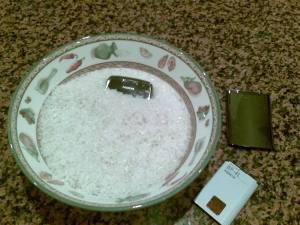
Rice potHere’s a tale of my personal naivety.  Hopefully others can learn from my errors.

Last Thursday, at about 6pm, I bent forward.  When I’m not looking at it, my Nokia E71 smartphone usually resides in my shirt pocket.  But because I was bending forwards, it slid out, and started crashing towards the floor.

I was disconcerted, but not too much.  The same thing had happened several times before.  I had learned that the E71 has incredible engineering, and it usually survives falling onto the floor, without even a dent or scratch to show for the experience.  It’s a solid piece of work.

But this time was different.

I was in a toilet, and the E71 landed straight in the water closet.

Things were bad, but they could have been worse.

Thankfully, I had flushed the toilet a few minutes earlier, so the bowl was clean.  (Well, as clean as toilets get.)

Without any conscious thought that I can remember, my hand shot into the water after the E71, and pulled it out.  Immediately.

I shook some water off the phone, and looked at the screen.  Everything seemed fine.  The phone was still switched on, the home screen was still live, and when I pressed up or down, the highlight moved up and down the display.  “What a great device”, I thought to myself.

There was still some water dripping off the device, so I thought I’d better dry it out.  I took off the back, removed the battery, and dabbed every visible area with paper towels.  A few seconds later, I put everything back together again, and pressed the On key.

In retrospect, that was my first big mistake.

The E71 seemed to boot up as normal.  The screen lit up, and the apps started.

Then I saw that there was no signal.  No problem, I thought, there’s poor signal strength in this hotel.  (I was in The Bingham, in Richmond upon Thames, for a work leadership team offsite meeting.  It’s a fine hotel, but we had been remarking all day that the cellular signal strength was poor in the rooms we were using.)

I rejoined my colleagues, and for a while forgot about my phone’s big escapade.  After all, there were plenty of other things to discuss.  (And I felt too embarrassed to mention that I had just thrust my hand into a water closet.)

That was probably my second mistake.

About 15 minutes later, I pulled out the phone again, curious to see if the signal had returned.  This time I noticed some fading at the bottom of the screen.  The two pieces of text for the soft buttons were illegible.  Water vapour had clearly got in behind the screen.  Woops.  So I separated all the parts of the phone again.

When I finally got home, I tried drying everything again, putting everything back together, and switching on.  This time things looked much worse.  The phone still gave the little vibrate immediately after the On button was pushed, and the screen and keyboard lit up.  But nothing else happened.  After around 30 seconds, the screen and keyboard switched off again.

I tried a different battery, and I tried plugging in a mains lead.  The result remained the same.

Then I thought of something different to try.  Twitter.  At 1.22 in the morning I tweeted:

dw2 wonders how long it will take his Nokia E71 to start working again, after dropping it in a basin of (clean) water yesterday

Twitter produced results.  Lots of them.

The first was at 1.23 in the morning:

kevinmcintyre09 @dw2 Would suggest leaving it in the airing cupboard for a few days to dry out

The next came at 1.27:

croozeus @dw2 It took my Nokia N95 a week before it dried out completely! Still it doesn’t charge but works properly…

Then at 1.28:

jomtwi Heh 🙂 RT @OscarB: Everytime I write “Symbian Foundation” I think of @dw2 as Hari Seldon

Then at 1.42:

dan_mcneil @dw2 http://bit.ly/83A1 may have some clues…

Then at 1.54:

jebbrilliant @dw2 Have you tried putting the E71 in a bag of DRY white rice?

And so the stream of tweets continued…

[I confess: one of the above tweets is irrelevant to this particular tale – but it’s so funny I left it in.]

Whoever said “the Internet never sleeps” has a point.  However, I was tired.  I put the E71 in the airing cupboard and retired to bed.

The next morning, I started reading some of the links, and a dawning realisation set in.

The above bit.ly link resolves to “How to Save a Wet Cell Phone” which contains the elementary advice (which I had failed to consider):

  1. Get it out of the water as soon as possible. The plastic covers on cell phones are fairly tight, but water can enter the phone in a short period of time, perhaps only 20 seconds or less. So grab your phone quickly! If you can’t get to it in time, your best bet is to remove the battery while it is still under water. Water helps dissipate heat from shorts that can damage the phone, so most damage occurs when the inside of the phone is merely wet and there is a power source. This can go both ways. Being under water is more likely to short the battery to even more sensitive contacts, so be careful.
  2. Don’t panic. Your phone will probably not be too damaged if you right away take it out of the water. While it’s in the water, immediately take it out.
  3. Remove the battery. This is one of the most important steps. Don’t take time to think about it; electricity and water do not mix. Cutting power to your phone is a crucial first step in saving it. Many circuits inside the phone will survive immersion in water provided they are not attached to a power source when wet.

To repeat: “most damage occurs when the inside of the phone is merely wet and there is a power source … electricity and water do not mix … Cutting power to your phone is a crucial first step in saving it”.

There’s not much more to say, except that I left the E71 in the airing cupboard for several days, with no luck, then I put it in a bowl of dry white rice for several more days, with no luck either.  There are certain kinds of damage that no amount of embalming will fix.

To be philosophical, there are points I could make about the need for prompt and skillful action following an accident to ensure good chances of survival, but I’ll save that for my next blog post.

11 August 2009

The future of energy

Filed under: books, Energy, innovation, UKTA — David Wood @ 11:03 pm

On Saturday afternoon (15th August), I’ll be chairing a meeting in Central London on the topic, “The future of energy: Leadership and technological innovation”.

The speaker is James Woudhuysen, Professor of Forecasting & Innovation, De Montfort University, Leicester, UK. I’ve seen James speak several times over the years, and he’s always both entertaining and thought-provoking.

The talk will cover some of the same ground as the recent book “Energise – A future for energy innovation” which James co-authored with Joe Kaplinksy.
Energise

Some extracts from the back cover convey the flavour of the book:

  • The way to deal with global warming is to build a bigger, better energy supply, not to invite the state to meter your family’s every use of energy at home and in the car;
  • This book shows you… why there’s still time to fix global warming without downgrading your lifestyle;
  • Energise! sets out a programme for innovation in nuclear, carbon-based and renewable energy.  The programme is one in which governments and industry do what they are supposed to do: enable people to get on with their lives;
  • Energise is a challenge to climate zealots, climate sceptics, and government moralisers alike;
  • This is a refreshing and a required read for anybody … bored with the idea of merely surviving, and confident that human beings can still make a much better world.

I’m expecting a lively debate!  The future of energy is a critically important topic, for all kinds of reason.

If you think you might like to attend, there are more details on the event blog.

10 August 2009

Starting over

Filed under: Blogger, WordPress — David Wood @ 9:33 pm

I’ve got a few pieces of blog-related news to share:

1.) I kept my personal blog on Blogger for more than a year, but in the meantime, I’ve grown to appreciate the power of WordPress – and I’ve decided to switch.  The old content has imported fairly smoothly – though there’s some tidying up I still need to do (for example, updating internal links).

2.) I’m also switching the URL for my personal blog.  It used to be dw2-0.com.  Now it’s dw2blog.com.  To cut a long story short, I was slow off the mark to renew my ownership of dw2-0, and a cybersquatter has moved in.  (It didn’t help that my old symbian.com email stopped working shortly beforehand, and all the emails Blogger and GoDaddy sent to that email address failed to reach me.)

3.) As for what I’ll be writing about here – I’ll keep work-related thoughtpieces out of here.  Instead, I’ll address a host of other futurist topics – in line with the description in the box at the top-right of the blog page:

  • Eclectic thoughts on technologies, markets, innovation, openness, collaboration, disruption, risks, and solutions

Anyone who used to bookmark dw2-0.com is now welcome to bookmark dw2blog.com instead.

20 July 2009

An engaging family-friendly vision of the future

Filed under: books, cryonics, futurist — David Wood @ 7:59 pm

When I was around 11-15 years old, I devoured almost all the science fiction books in the local village library. The experience not only inspired me and stretched my imagination, but pre-disposed me to be open-minded about possible large impacts by technology on how life would be lived in the future.

Much of the technology that will have the biggest impact on the 21st century remains as yet undiscovered. Some of these discoveries will, presumably, be made by people who are currently still children. My hope is that these children will take interest in the kinds of ideas that permeate Shannon Vyff’s fine book “21st century kids: a trip from the future to you”.

The majority of the action in this book is set 180 years in the future – although there are several loop-backs to the present day. Here are just a few of the themes that are woven together in this fast-moving book:

  • Cryonic suspension, and the problems of eventual re-animation;
  • Brain implants, that enable a kind of telepathic communication;
  • Implications if human brains and human bodies could be dramatically improved;
  • Options for improving the brains of other animal species, even to the point of enabling rich communications between these creatures and humans;
  • Humans co-existing with self-aware robots and other AIs;
  • Friendly versus unfriendly AI;
  • Transferring human consciousness into robots (and back again);
  • Coping with the drawbacks of environmental degradation;
  • Future modes of manufacturing, transport, recreation, education, and religion;
  • Circumstances in which alien civilisations might take an active interest in developments on the Earth.

Adults can enjoy reading “21st century kids”, but there are parts of the book that speak more directly to children as the primary intended readership. Since I’ve long left my own adolescent days behind, I’m not able to fully judge the likely reactions of that target audience. My expectation is that many of them will find the contents engaging, thought-provoking, and exciting. It’s family-friendly throughout.
One unusual aspect of the book is that several of the main characters have the same names (and early life histories) as three of the author’s own children: Avianna, Avryn, and Avalyse. The author herself features in the book, as the (unnamed) “Mom”. I found this occasionally unsettling, but it adds to the book’s vividness and immediacy.

As regards the vision the book paints of the future, it’s certainly possible to take issue with some of the details. However, the bigger picture is that the book is sufficiently interesting that it is highly likely to provoke a lot of valuable debate and discussion. Hopefully it will stretch the imagination of many potential future technologists and engineers, and inspire them to keep an open mind about what innovative technology can accomplish.

« Newer PostsOlder Posts »

Blog at WordPress.com.