dw2

24 December 2009

How markets fail – part two

Filed under: books, Economics, market failure, regulation — David Wood @ 2:46 am

Free markets have been a tremendous force for progress.  However, they need oversight and regulation.  Lack of appreciation of this point is the fundamental cause of the Great Crunch that the world financial systems recently experienced.  That’s the essential message of the important book by the New Yorker journalist John Cassidy (pictured right), “How markets fail: the logic of economic calamities“.

I call this book “important” because it contains a sweeping but compelling survey of a notion Cassidy dubs “Utopian economics”, before providing layer after layer of decisive critique of that notion.  As such, the book provides a very useful (if occasionally drawn out) guide to the history of economic thinking, covering Adam Smith, Friedrich Hayek, Milton Friedman, John Maynard Keynes, Arthur Pigou, Hyman Minsky, and many, many others.

The key theme in the book is that markets do fail from time to time, potentially in disastrous ways, and that some element of government oversight and intervention is both critical and necessary, to avoid calamity.  This theme is hardly new, but many people resist it, and the book has the merit of marshalling the arguments more comprehensively than I have seen elsewhere.

As Cassidy describes it, “utopian economics” is the widespread view that the self-interest of individuals and agencies, allowed to express itself via a free market economy, will inevitably produce results that are good for the whole economy.  The book starts with eight chapters that sympathetically outline the history of thinking about utopian economics.  Along the way, he regularly points out instances when free market champions nevertheless described cases when government intervention and control was required.  For example, referring to Adam Smith, Cassidy writes:

Smith and his successors … believed that the government had a duty to protect the public from financial swindles and speculative panics, which were both common in 18th and 19th century Britain…

To prevent a recurrence of credit busts, Smith advocated preventing banks from issuing notes to speculative lenders.  “Such regulations may, no doubt, be considered as in some respects a violation of natural liberty”, he wrote.  “But these exertions of the natural liberty of a few individuals, which might endanger the security of the whole society, are, and ought to be, restrained by the laws of all governments…  The obligation of building party walls [between adjacent houses], in order to prevent the communication of a fire, is a violation of natural liberty, exactly of the same kind with the regulations of the banking trade which are here proposed.”

The book identifies long-time Federal Reserve chairman Alan Greenspan as one of the villains of the Great Crunch.  Near the beginning of the book, Cassidy quotes a reply given by Greenspan to the question “Were you wrong” asked of him in October 2008 by the US House Committee on Oversight and Government Reform:

“I made a mistake in presuming that the self-interest of organizations, specifically banks and others, were such that they were best capable of protecting their own shareholders and their equity in the firms…”

Greenspan was far from alone in his belief in the self-correcting power of economies in which self-interest is allowed to flourish.  There were many reasons for people to hold that belief.  It appeared to be justified both theoretically and empirically.  As Greenspan remarked,

“I had been going for forty years, or more, with very considerable evidence that it was working exceptionally well.”

Cassidy devotes another eight chapters to reviewing the history of criticisms of utopian economics.  This part of the book is entitled “Reality-based economics“.  It is full of fascinating and enlightening material, covering topics such as:

  • game theory (“the prisoners dilemma”),
  • behavioural economics (pioneered by Daniel Kahneman and Amos Tversky) – including disaster myopia,
  • problems of spillovers and externalities (such as pollution) – which can only be fully addressed by centralised collective action,
  • drawbacks of hidden information and the failure of “price signalling”,
  • loss of competiveness when monopoly conditions are approached,
  • flaws in banking risk management policies (which drastically under-estimated the consequences of larger deviations from “business as usual”),
  • problems with asymmetric bonus structure,
  • and the perverse psychology of investment bubbles.

In summary, Cassidy lists four “illusions” of utopian economics:

  1. The illusion of harmony: that free markets always generate good outcomes;
  2. The illusion of stability: that free market economy is sturdy;
  3. The illusion of predictability: that distribution of returns can be foreseen;
  4. The illusion of Homo Economicus: that individuals are rational and act on perfect information.

The common theme of this section is that of “rational irrationality”: circumstances in which it is rational for people to choose courses of action that end up producing a bad outcome for society as a whole.  You can read more about “rational irrationality” in a recent online New Yorker article of the same name, written by Cassidy:

A number of explanations have been proposed for the great boom and bust, most of which focus on greed, overconfidence, and downright stupidity on the part of mortgage lenders, investment bankers, and Wall Street C.E.O.s. According to a common narrative, we have lived through a textbook instance of the madness of crowds. If this were all there was to it, we could rest more comfortably: greed can be controlled, with some difficulty, admittedly; overconfidence gets punctured; even stupid people can be educated. Unfortunately, the real causes of the crisis are much scarier and less amenable to reform: they have to do with the inner logic of an economy like ours. The root problem is what might be termed “rational irrationality”—behavior that, on the individual level, is perfectly reasonable but that, when aggregated in the marketplace, produces calamity.

Consider the [lending] freeze that started in August of 2007. Each bank was adopting a prudent course by turning away questionable borrowers and holding on to its capital. But the results were mutually ruinous: once credit stopped flowing, many financial firms—the banks included—were forced to sell off assets in order to raise cash. This round of selling caused stocks, bonds, and other assets to decline in value, which generated a new round of losses.

A similar feedback loop was at work during the boom stage of the cycle, when many mortgage companies extended home loans to low- and middle-income applicants who couldn’t afford to repay them. In hindsight, that looks like reckless lending. It didn’t at the time. In most cases, lenders had no intention of holding on to the mortgages they issued. After taking a generous fee for originating the loans, they planned to sell them to Wall Street banks, such as Merrill Lynch and Goldman Sachs, which were in the business of pooling mortgages and using the monthly payments they generated to issue mortgage bonds. When a borrower whose home loan has been “securitized” in this way defaults on his payments, it is the buyer of the mortgage bond who suffers a loss, not the issuer of the mortgage.

This was the climate that produced business successes like New Century Financial Corporation, of Orange County, which originated $51.6 billion in subprime mortgages in 2006, making it the second-largest subprime lender in the United States…

The book then provides a seven chapter blow-by-blow run through of the events of the Great Crunch itself.  Much of this material is familiar from recent news coverage and from other books, but the context provided by the prior discussion of utopian economics and reality-based economics provides new insight into the individual tosses and turns of the unfolding crisis.  It becomes clear that the roots of the crunch go back much further than the “subprime mortgage crisis”.

The more worrying conclusion is that many of the conditions responsible for the Great Crunch remain in place:

In the world of utopian economics, the latest crisis of capitalism is always a blip.

As memories of September 2008 fade, revisionism and disaster myopia will become increasingly common.  Many will say that the Great Crunch wasn’t so bad, downplaying the government intervention that prevented a much, much worse outcome.  Incentives for excessive risk-taking will revive, and so will the lobbying power of banks and other financial firms.  If these special interests succeed in blocking meaningful reform, we could well end up with the worst of all worlds.

As Cassidy explains:

It won’t be as easy to deal with the bouts of instability to which our financial system is prone. But the first step is simply to recognize that they aren’t aberrations; they are the inevitable result of individuals going about their normal business in a relatively unfettered marketplace. Our system of oversight fails to account for how sensible individual choices can add up to collective disaster. Rather than blaming the pedestrians for swarming the footway, governments need to reinforce the foundations of the structure, by installing more stabilizers. “Our system failed in basic fundamental ways,” Treasury Secretary Timothy Geithner acknowledged earlier this year. “To address this will require comprehensive reform. Not modest repairs at the margin, but new rules of the game.”

Despite this radical statement of intent, serious doubts remain over whether the Obama Administration’s proposed regulatory overhaul goes far enough in dealing with the problem of rational irrationality…

In his final chapter, addressing the question “What is to be done?“, Cassidy advocates a few specific proposals, ranging from the specific to the over-arching:

  • Banks that create and distribute mortgage securities should be forced to keep some of them on their books (perhaps as much as a fifth) – to make them monitor more closely the types of loan they purchase;
  • Mortgage brokers and mortgage lenders should be regulated at the federal level;
  • The government should outlaw stated-income loans, and enforce the existing fraud laws for mortgage applicants, which make it a crime to misrepresent your personal finances;
  • Wall Street needs taming … the more systemic risk an institution poses, the more tightly it should be controlled;
  • The Federal Reserve should set rules for Wall Street compensation and bonuses that all firms would have to follow … the aim must be to prevent rationally irrational behaviour.  Unless some restrictions are placed on people’s actions, they will inevitably revert to it.

Footnote: For more by John Cassidy, see his online blog.

16 December 2009

How markets fail – part one

Filed under: books, Economics, market failure — David Wood @ 1:45 am

I’m currently enjoying reading the new book by John Cassidy: “How markets fail: the logic of economic calamities“.

I was led to this book by the review of it in the Economist:

In “How Markets Fail”, Mr Cassidy, a British writer for the New Yorker, recounts the story of America’s housing boom and its devastating bust. It is more than just an account of the failures of regulators and the self-deception of bankers and homebuyers, although these are well covered. For Mr Cassidy, the deeper roots of the crisis lie in the enduring appeal of an idea: that society is always best served when individuals are left to pursue their self-interest in free markets. He calls this “Utopian economics”.

This approach turns much of the book into a very good history of economic thought…

Having set out the tenets of Utopian economics, the author then pokes holes in them. Individual self interest does not always benefit society, he argues, and draws on a deep pool of research (what he calls “reality-based economics”) to support his case…

I’m half-way through the book.  It’s a bit like a who-done-it page-turner: each additional section introduces new twists and turns.  I can hardly wait to find out what happens next 😉

But in the meantime, in parallel, I’ve got a minor market failure of my own to explore.  I’ll be grateful for insight that any readers can provide.

As well as being a fan of books, I’m a fan of audio books.  I’ve been downloading audio books from Audible.com for at least four years.  They’ve got a good selection.  However, I’m often surprised to notice that various books are missing from their catalogue.  I think to myself: such-and-such a book is really popular: why don’t Audible provide it?

The market failure I mentioned is that Audible frequently do have these books in audio format, but if I ever find them on their site, and click on them to buy them, they for some reason display a most irritating message:

“We are not authorized to sell this item to your geographic location”

It appears that the UI of Audible tries to hide such books from people, like myself, who are based in the UK.  (I’ve heard similar reports from people who are based in Australia.)  But sometimes there are glitches, and some of these books can be glimpsed.

For example, the front page of their website currently promotes an audio book that caught my attention immediately:

The Strangest Man: The Hidden Life of Paul Dirac, Mystic of the Atom

Paul Dirac was among the great scientific geniuses of the modern age. One of the discoverers of quantum mechanics, the most revolutionary theory of the past century, his contributions had a unique insight, eloquence, clarity, and mathematical power. His prediction of antimatter was one of the greatest triumphs in the history of physics.

One of Einstein’s most admired colleagues, Dirac was in 1933 the youngest theoretician ever to win the Nobel Prize in physics. Dirac’s personality is legendary…

Back in my days at Cambridge, I learned a lot about Dirac – both from studying mathematics, and from researching the philosophical implications of quantum mechanics.  Some of my lecturers had been taught, some decades earlier, by Dirac himself.  He’s a fascinating character.  I’d never come across a book about Dirac before.  So I jumped at the chance to download this audio book – until I hit the message

“We are not authorized to sell this item to your geographic location”

It doesn’t help me if I log out of the international website, Audible.com, and log into the UK-specific site Audible.co.uk instead.  I’ve learned from bitter experience that books which are “not authorized” for sale from one site fail likewise to show up on the other one.  Nor can I find this audio book on any other site.

What’s going on here? There are at least some customers in the UK who are prepared to spend money to purchase these audio books.  What’s the rationale for a restriction?  Why can’t we willing customers find a market where our “demand” can be balanced by “supply” of these audio books?  (Is it that the owner of the book is somehow reserving the opportunity to sell the audio book, in the UK, in due course, at a higher price than Audible are presently prepared to charge?)

Of course, this particular case of apparent market failure pales in comparison to the failures reviewed in Cassidy’s book – calamitous outcomes such as environmental degradation, lack of development of much-needed medicines that would primarily benefit poorer parts of the human population, and the recent global financial crisis.  My reason for writing about this case is that it is so annoying when it happens!

6 December 2009

The art of community

Filed under: books, catalysts, collaboration, ecosystem management — David Wood @ 8:42 pm

A PDF version of the presentation I gave last Thursday to a meeting of the Software/Open Source SIG of the Cambridge Wireless Network, “Open ecosystems – Communities that build the future“, is now available for download from the resources page of the Cambridge Wireless website.

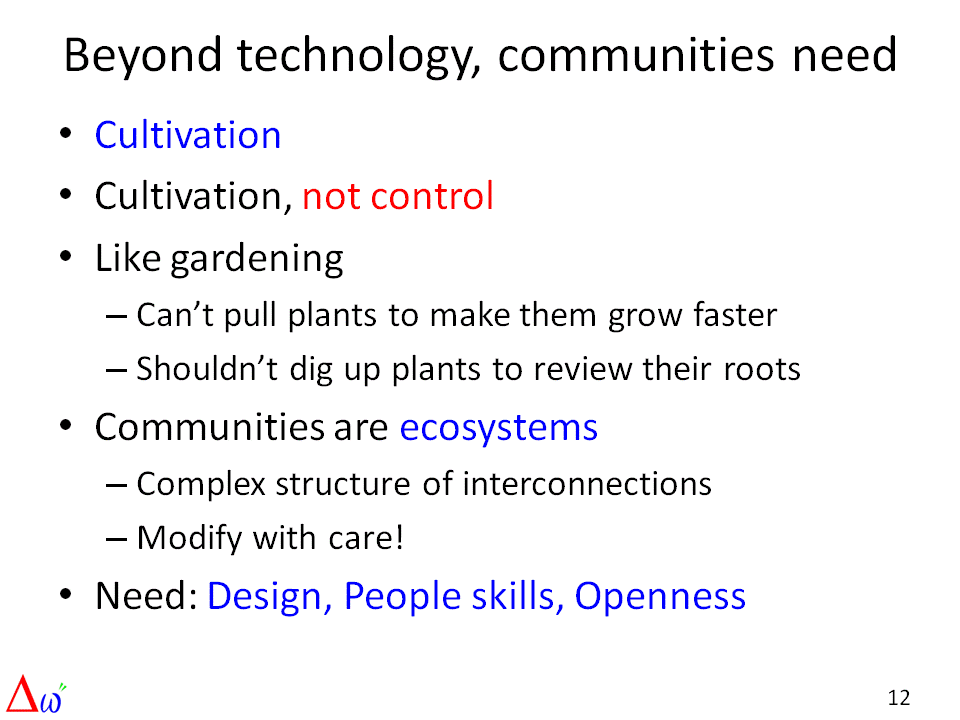
The overall contents of my presentation are introduced by the text from slide 2:

Slide 12 provides a summary of the second half of my presentation

Someone who clearly shares my belief in the importance of community, and in the fact that there are key management skills that need to be brought to bear to get the best out of the potential of a community, is Jono Bacon, who works at Canonical as the Ubuntu Community Manager.  Jono’s recent book, “The art of community: building the new age of participation” has been widely praised – deservedly so.

The whole book is available online for free download.

Over the course of 11 chapters spanning 360 pages, Jono provides a host of practical advice about how to best cultivate a community.  Although many of the examples he provides are rooted in the world of open source software (and, in particular, the community which supports the Ubuntu distribution of Linux), the principles generally apply far more widely – to all sorts of communities, particularly communities with a significant online presence and significant numbers of volunteers.  To quote from the preface:

The Art of Community is not specifically focused on computing communities, and the vast majority of its content is useful for anything from political groups to digital rights to knitting and beyond.

Within this wide range of possible communities, this book will be useful for a range of readers:

  • Professional community managers – If you work in the area of community management professionally
  • Volunteers and community leaders – If you want to build a strong and vibrant community for your volunteer project
  • Commercial organizations – If you want to work with, interact with, or build a community around your product or service
  • Open source developers – If you want to build a successful project, manage contributors, and build buzz
  • Marketeers – If you want to learn about viral marketing and building a following around a product or service
  • Activists – If you want to get people excited about your cause

Every chapter in this book is applicable to each of these roles. While technology communities provide many examples throughout the book, the purpose of these examples requires little technical knowledge.

I’ve just finished reading all 360 pages.  Each new chapter introduces important new principles and techniques.  I was reading the book for three reasons:

  1. To compare ideas about the best way to run parts of an open source software community (as used to be part of my responsibilities at the Symbian Foundation);
  2. To get ideas about how to boost the emerging community of people who share my interest in the “Humanity Plus” ideas covered in some of my other blog postings;
  3. To consider the possible wider role of well-catalysed communities to address the bigger challenges and opportunities facing society at the present time;

The book succeeded, for me, on all three levels.  Parts that I particularly liked included:

  • The importance of establishing a compelling mission statement for a community (Chapter 2)
  • Tips on building simple, effective, and nonbureaucratic processes that enable your community to conduct tasks, work together, and share their successes (Chapter 4)
  • How to build excitement and buzz around your community – and some telling examples of how not to do this (Chapter 6)
  • The importance of open and transparent community governance principles – and some reasons for occasionally limiting openness (Chapter 8)
  • Guidance on how to identify, handle, and prevent irksome conflict (ahead of time, if possible), and on dealing with divisive personalities (Chapter 9)
  • Ideas on running events – where (if done right) the “community” feeling can deepen to something more akin to “family” (Chapter 10).

(This blogpost contains an extended table of contents for Jono’s book.  And see here for a short video of Jono describing his book.)

The very end of the book mentions an annual conference called “The community leadership summit”.  To quote from the event website:

Take the microphone and join experienced community leaders and organizers to discuss, debate and explore the many avenues of building strong community in an open unconference setting, complimented by additional structured presentations.

I’m attracted by the idea of participating in the 2010 version of that summit 🙂

26 November 2009

The secrets of consulting

Filed under: books, consulting — David Wood @ 12:38 pm

One thing I’m likely to want to do in the weeks and months ahead is to earn some income via consulting (perhaps on an interim basis).  I’ve therefore updated my own (still rudimentary) “business” website, http://deltawisdom.com, to mention that I can “provide high-value facilitation, consultancy, and presentations”.

Responding to this, my good friend and long-term Symbian colleague, John Pagonis of Pragmaticomm, sent me a short piece of advice:

may I suggest you study the “Secrets of Consulting” by G. M. Weinberg again if you haven’t done this already

I took John’s advice and have just finished reading the book – full title is “The secrets of consulting: a guide to giving and getting advice successfully“.

It contains a lot of interesting and useful ideas for an aspiring consultant, expressed with good humour, and memorably summed up in pithily-stated laws.

Here are just a few examples:

You can make buffalo go anywhere just so long as they want to go there

Trust takes years to win, moments to lose

The trick of earning trust is to avoid all tricks

Nobody but you cares about the reason you let them down

Spend at least one fourth of your time doing nothing

Pricing has many functions, only one of which is the exchange of money

In spite of what your client says, there’s always a problem

No matter how it looks at first, it’s always a people problem

Clients always know how to solve their problems, and always tell the solution in the first five minutes

Consultants should not care who gets the credit… When an effective consultant is present, the client solves problems

(This is just a small fraction of the laws stated – and explained – in the book.)

I think I already had the same views as what the author was explaining, so I didn’t get any blinding “aha” insight from it.  However, the laws are very handy reminders.  Indeed, Weinberg states a law about that too:

What you don’t know may not hurt you, but what you don’t remember always does

For me, the chapters “Marketing yourself” and “Putting a price on your head” were probably the most useful 🙂

9 November 2009

Sustainable energy without the hot air

Filed under: books, Energy, Nuclear energy, solar energy — David Wood @ 1:00 am

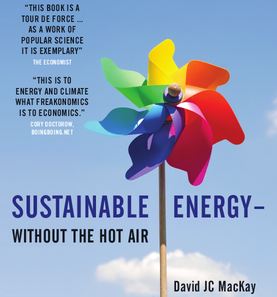
Over the last ten days, I’ve been reading “Sustainable energy – without the hot air“.

It’s no surprise that the reviews for it on Amazon.com are, at time of writing, 95% 5-star, and only 5% 4-star.  In many way, this an exemplary book:

  1. The book is made up of easily digestible chunks;
  2. Each chunk contains numbers.  Anyone who disagrees with the conclusions of the book is therefore invited to identify the numbers that they disagree with;
  3. In each case, the author explains where the various numbers come from;
  4. The author makes the numbers seem plausible, but also provides copious references for people to investigate by themselves;
  5. Mathematical formulae are provided too – but separated into appendices at the end of the book, to avoid detracting from the main flow of the argument;
  6. The author punctures a lot of what might be called “hot air” – which he also calls “twaddle”: wishful thinking about how sustainable energy might be achieved;
  7. There are many “mythconceptions” sections where various widespread notions are gently but firmly dismantled;
  8. The text is accompanied by a set of very clear diagrams;
  9. The author sets out a range of possible solutions, rather than identifying a single way forwards;
  10. The author makes it clear that none of the solutions are going to be easy, and each will require substantial (“country-sized”) changes.

Since publishing the book, the author – David JC MacKay, physics professor at Cambridge University – has been appointed Chief Scientific Advisor at the UK’s Department of Energy and Climate Change – an appointment that took effect on 1st October 2009.

The author says he seeks to avoid being labelled as “pro-wind” or “pro-nuclear”, declaring instead that he wishes to be known as “pro-arithmetic”.  Whatever solutions are contemplated, he says, must meet the test of adding up.  He disagrees with those who say that “if everyone does a little, it will add up to a lot”.  Instead, he says, if everyone does a little, it will add up to a little.  That’s because of the scale of the total amount of energy used by an entire country.  Actions need to be effective:

Here are two simple individual actions. One is useless, one is very effective.

Turning phone chargers off when they are not in use is a feeble gesture, like bailing the Titanic with a teaspoon.

The widespread inclusion of “switching off phone chargers” in lists of “10 things you can do” is a bad thing, because it distracts attention from more effective actions that people could be taking.

In contrast, turning the thermostat down (or the air-conditioning in hot climates) is the single most effective energy-saving technology available to a typical person.

Every degree you turn it down will reduce your heating costs by 10%; and, speaking of Britain at least, heating is likely to be the biggest form of energy consumption in most buildings.

The entire book is available free online.  The online summaries (eg page 238239) reiterate the following point:

We have a clear conclusion: the non-solar renewables may be “huge,” but they are not huge enough. To complete a plan that adds up, we must rely on one or more forms of solar power. Or use nuclear power. Or both.

Any viable solar power solutions need to consider collecting energy from sunnier climates, and then transporting huge amounts of that energy to sun-deprived countries like the UK.  From page 178:

…focusing on Europe, “what area is required in the North Sahara to supply everyone in Europe and North Africa with an average European’s power consumption? Taking the population of Europe and North Africa to be 1 billion, the area required drops to 340 000 km2, which corresponds to a square 600 km by 600 km. This area is equal to one Germany, to 1.4 United Kingdoms, or to 16 Waleses.

The UK’s share of this 16-Wales area would be one Wales: a 145 km by 145 km square in the Sahara would provide all the UK’s current primary energy consumption.

Backing up this idea, David MacKay speaks favourably about the Desertec concept.  From the Desertec website:

In the upcoming decades, several global developments will create new challenges for mankind. We will be confronted with problems and obstacles such as climate change, population growth beyond earth’s capacity, and an increase in demand for energy and water caused by a strive for prosperity and expansion.

The DESERTEC Concept provides a way to solve these challenges…

The DESERTEC Concept describes the perspective of a sustainable supply of electricity for Europe (EU), the Middle East (ME) and North Africa (NA) up to the year 2050. It shows that a transition to competitive, secure and compatible supply is possible using renewable energy sources and efficiency gains, and fossil fuels as backup for balancing power.

A close cooperation between EU and MENA for market introduction of renewable energy and interconnection of electricity grids by high-voltage direct-current transmission are keys for economic and physical survival of the whole region. However, the necessary measures will take at least two decades to become effective. Therefore, adequate policy and economic frameworks for their realization must be introduced immediately. The role of sustainable energy to secure freshwater supplies based on seawater desalination is also addressed.

David MacKay’s chapter on nuclear energy is also an eye-opener.  It ably addresses the objections that have been made against nuclear energy.  Among the positive messages in this chapter:

…the nuclear energy available per atom is roughly one million times bigger than the chemical energy per atom of typical fuels. This means that the amounts of fuel and waste that must be dealt with at a nuclear reactor can be up to one million times smaller than the amounts of fuel and waste at an equivalent fossil-fuel power station.

…I conclude that ocean extraction of uranium would turn today’s once-through reactors into a “sustainable” option

…Japanese researchers have found a technique for extracting uranium from seawater at a cost of $100–300 per kilogram of uranium, in comparison with a current cost of about $20/kg for uranium from ore. Because uranium contains so much more energy per ton than traditional fuels, this 5-fold or 15-fold increase in the cost of uranium would have little effect on the cost of nuclear power: nuclear power’s price is dominated by the cost of power-station construction and decommissioning, not by the cost of the fuel. Even a price of $300/kg would increase the cost of nuclear energy by only about 0.3 p per kWh. The expense of uranium extraction could be reduced by combining it with another use of seawater – for example, power-station cooling.

…we must not let ourselves be swept off our feet in horror at the danger of nuclear power. Nuclear power is not infinitely dangerous. It’s just dangerous, much as coal mines, petrol repositories, fossil-fuel burning and wind turbines are dangerous. Even if we have no guarantee against nuclear accidents in the future, I think the right way to assess nuclear is to compare it objectively with other sources of power. Coal power stations, for example, expose the public to nuclear radiation, because coal ash typically contains uranium. Indeed, according to a paper published in the journal Science, people in America living near coal-fired power stations are exposed to higher radiation doses than those living near nuclear power plants.

…Spurred on by worries about nuclear accidents, engineers have devised many new reactors with improved safety features. The GT-MHR power plant, for example, is claimed to be inherently safe; and, moreover it has a higher efficiency of conversion of heat to electricity than conventional nuclear plants

…the volumes are so small, I feel nuclear waste is only a minor worry, compared with all the other forms of waste we are inflicting on future generations. At 25 ml per year, a lifetime’s worth of high-level nuclear waste would amount to less than 2 litres. Even when we multiply by 60 million people, the lifetime volume of nuclear waste doesn’t sound unmanageable: 105 000 cubic metres. That’s the same volume as 35 olympic swimming pools. If this waste were put in a layer one metre deep, it would occupy just one tenth of a square kilometre.

There are already plenty of places that are off-limits to humans. I may not trespass in your garden. Nor should you in mine. We are neither of us welcome in Balmoral. “Keep out” signs are everywhere. Downing Street, Heathrow airport, military facilities, disused mines – they’re all off limits. Is it impossible to imagine making another one-square-kilometre spot – perhaps deep underground – off limits for 1000 years?

…the assertion that “civil nuclear construction on this scale is a pipe dream, and completely unfeasible” is poppycock. Yes, it’s a big construction rate, but it’s in the same ballpark as historical construction rates.

So far, I haven’t found any significant criticism of the points made in this book.  It’s highly recommended.  You may also enjoy David MacKay’s blog.

Footnote: for further reading on nuclear energy, take a look at “10 reasons to support nuclear power“; and for more about Desertec, see their FAQ.

29 October 2009

Bridging the knowing doing gap

Filed under: books, change, complacency, leadership — David Wood @ 12:50 pm

A May 2000 Fast Company article Why Can’t We Get Anything Done? poses a very good question:

These days, people know a lot. Thousands of business books are published around the world each year. U.S. organizations alone spend more than $60 billion a year on training — mostly on management training. Companies spend billions of dollars a year on consulting. Meanwhile, more than 80,000 MBAs graduate each year from U.S. business schools. These students presumably have been taught the skills that they need to improve the way that companies do business.

But all of that state-of-the-art knowledge leaves us with a nagging question: Why can’t we get anything done? It’s a mystery worthy of a business-school case study. If we’re so well trained and so well informed, then why aren’t we a lot more effective? Or, as Stanford professors Jeffrey Pfeffer and Robert I. Sutton ask in their useful book, The Knowing-Doing Gap: How Smart Companies Turn Knowledge Into Action (Harvard Business School Press, 2000), “Why is it that, at the end of so many books and seminars, leaders report being enlightened and wiser, but not much happens in their organizations?”

Pfeffer and Sutton’s book “The Knowing Doing Gap” made a big impact on me when I read it.

The book recounts a story of a company paying consultants to come in and give them advice on particular strategy issues.  The consultants eventually found that previous consultants had already been engaged and produced reports that matched what they themselves were going to recommend.  The company had already received the advice which the consultants thought was best – but had failed to be able to act on that advice.

It’s a familiar story.  Companies bring in external advisors who say things that management agree make sense, but … nothing changes.

My own takeaway from the book was the following set of five characteristics of companies that can successfully bridge this vicious “Knowing Doing Gap”:

  1. They have leaders with a profound hands-on knowledge of the work domain;
  2. They have a bias for plain language and simple concepts;
  3. They encourage solutions rather than inaction, by framing questions asking “how”, not just “why”;
  4. They have strong mechanisms that close the loop – ensuring that actions are completed (rather than being forgotten, or excuses being accepted);
  5. They are not afraid to “learn by doing”, and thereby avoid analysis paralysis.

If you don’t have time to read the whole book, there’s a 38 minute long download “The smart talk trap” from Audible that covers much of the same ground.  It’s the audio version of a 1999 Harvard Business Review article by Pfeffer and Sutton:

The key to success in business is action. But in most companies, people are rewarded for talking – and the longer, louder, and more confusingly, the better. The good news is, there are 5 strategies that can help you avoid the trap.

Footnote: There’s one other angle that deserves a mention on this topic.  It’s the angle of why change programs frequently fail.  John Kotter has shed much light on this question.  I wrote about this previously, in “Why good people fail to change bad things“.

Searching for energy

Filed under: books, Energy — David Wood @ 12:22 am

Three big, important questions seem to defy consensus:

  1. How serious a matter is humanity’s increasing usage of energy?
  2. Will “business as usual” find suitable ways to keep on supplying sufficient energy in response to market needs, or is some special concerted action necessary?
  3. If some special concerted action is required, what should that be?  For example, should extra priority be placed on nuclear energy, solar energy, wind power, selected new biofuels, or what?

When I picked up the latest Scientific American, I experienced a short flush of optimism.  The cover story is “A plan for a sustainable future: How to get all energy from wind, water and solar power by 2030”.

The authors of the piece in question appear to have excellent credentials:

  • Mark Z. Jacobson is professor of civil and environmental engineering at Stanford University and director of the Atmosphere/Energy Program there;
  • Mark A. Delucchi is a research scientist at the Institute of Transportation Studies at the University of California, Davis.

The key concepts of the article are listed as follows:

  • Supplies of wind and solar energy on accessible land dwarf the energy consumed by people around the globe;
  • The authors’ plan calls for 3.8 million large wind turbines, 90,000 solar plants, and numerous geothermal, tidal and rooftop photovoltaic installations worldwide;
  • The cost of generating and transmitting power would be less than the projected cost per kilowatt-hour for fossil-fuel and nuclear power;
  • Shortages of a few specialty materials, along with lack of political will, loom as the greatest obstacles.

The authors accept that the figure of 3.8 million wind turbines may sound enormous, but point out that the world manufactures 73 million cars and light trucks every year.  They note:

Our plan calls for millions of wind turbines, water machines and solar installations.  The numbers are large, but the scale is not an insurmountable hurdle; society has achieved massive transformations before;

During World War II, the U.S. retooled automobile factories to produce 300,000 aircraft, and other countries produced 486,000 more;

In 1956 the U.S. began building the Interstate Highway System, which after 35 years extended for 47,000 miles, changing commerce and society.

I read the article carefully.  It all seemed to make good sense to me.

But then I looked on the Scientific American website, at the online comments for this articleAnd then things seemed much less clear.

One comment speaks up in favour of selected bio-fuels:

The November 2009 article “A Path To Sustainable Energy By 2030” is based on a false premise and then naturally develops the wrong solution…

All carbon-based fuels are not created equal. Replacing FOSSIL fuels with BIO fuels would also work.  Not all biofuels are created equal either…

Another comment refers to some analysis that reaches a much less encouraging view about wind energy:

Tom Blees has just written a devastating analysis … that just blows away any dreams of Wind becoming an effective substitute for fossil fuels

and continues by dismissing the potential for solar energy too.  Instead, nuclear energy is recommended as the best way forwards.

Another comment laments:

The article is in direct conflict with David JC MacKay’s book: “Sustainable Energy – Without the Hot Air” (which is available free online). He does a detailed analysis of many renewable and not-so-renewable sources of energy, and the basic conclusion is that without nuclear, it doesn’t work.

My question for the authors and SciAm editors, is “what are we poor non-scientists to make of all of this?” We don’t have the resources or time to compare these conflicting books/articles head to head. You could do us a tremendous service, and help the public debate along by doing so.

Reading the SciAm article, a bunch of folks are going to say, “peachy: we’re done. All the world has to do is spend 5 trillion a year for 20 years.” Those reading MacKay’s book will say, “Peachy: bring on the nuc’s and we’re all set.”

We are inundated with conflicting information that we cannot verify, so each faction picks the data that serves its ends, and blathers  away on some TV show, then some politicians simplify it even more, and use it to push an unknown agenda.

And so the debate continued.

Happily, the book mentioned in this comment – “Sustainable Energy – Without the hot air“, authored by Cambridge University Physics Professor David MacKay – looks like being a significant step forwards.

I remembered that my long-time friend Martin Budden, whose opinions I greatly respect, had already recommended this book to me.  This book is available for free online.  For ease of reading, I bought a bound copy today on the way home from central London.

I’ve only read the opening sections so far, but they convey a strong air of natural authority, and resonate well with me:

I recently read two books, one by a physicist, and one by an economist.

In Out of Gas, Caltech physicist David Goodstein describes an impending energy crisis brought on by The End of the Age of Oil. This crisis is coming soon, he predicts: the crisis will bite, not when the last drop of oil is extracted, but when oil extraction can’t meet demand – perhaps as soon as 2015 or 2025. Moreover, even if we magically switched all our energy-guzzling to nuclear power right away, Goodstein says, the oil crisis would simply be replaced by a nuclear crisis in just twenty years or so, as uranium reserves also became depleted.

In The Skeptical Environmentalist, Bjørn Lomborg paints a completely different picture. “Everything is fine.” Indeed, “everything is getting better.” Furthermore, “we are not headed for a major energy crisis,” and “there is plenty of energy.”

How could two smart people come to such different conclusions? I had to get to the bottom of this…

I’m concerned about cutting UK emissions of twaddle – twaddle about sustainable energy. Everyone says getting off fossil fuels is important, and we’re all encouraged to “make a difference,” but many of the things that allegedly make a difference don’t add up.

Twaddle emissions are high at the moment because people get emotional (for example about wind farms or nuclear power) and no-one talks about numbers. Or if they do mention numbers, they select them to sound big, to make an impression, and to score points in arguments, rather than to aid thoughtful discussion.

This is a straight-talking book about the numbers. The aim is to guide the reader around the claptrap to actions that really make a difference and to policies that add up…

It doesn’t take long to see that the characterisation of this book given by the earlier comment I quoted above – “bring on the nuc’s and we’re all set” – is a gross distortion.  Instead, here’s a taste of the conclusions (taken from pages 116 and 117):

Are you eager to know the end of the story right away? Here is a quick summary, a sneak preview of Part II.

First, we electrify transport. Electrification both gets transport off fossil fuels, and makes transport more energy-efficient. (Of course, electrification increases our demand for green electricity.)

Second, to supplement solar-thermal heating, we electrify most heating of air and water in buildings using heat pumps, which are four times more efficient than ordinary electrical heaters. This electrification of heating further increases the amount of green electricity required.

Third, we get all the green electricity from a mix of four sources: from our own renewables; perhaps from “clean coal;” perhaps from nuclear; and finally, and with great politeness, from other countries’ renewables.

Among other countries’ renewables, solar power in deserts is the most plentiful option. As long as we can build peaceful international collaborations, solar power in other people’s deserts certainly has the technical potential to provide us, them, and everyone with 125 kWh per day per person.

Questions? Read on…

So far, so good.  I particularly like the level of clarity and intellectual rigour in what I’ve read of the book so far.  I hope my new flush of optimism doesn’t deflate in the same way as before!

I’ll be putting my tentative opinions to the test again this Sunday, by listening to the “Battle of Ideas” held at London’s Royal College of Arts, organised by the Institute of Ideas.  Three of the debates cover energy topics:

  • From 10.45-12.15 there’s a debate ABUNDANT, CHEAP, CLEAN…CONTENTIOUS?  WHY IS ENERGY A BATTLEFIELD TODAY? From environmental to security concerns, energy is a big issue – how much, where from and what type?We are warned that coal is dirty, oil is running out, and nuclear is risky, so what is the future of energy?Will new sources of energy boost human prosperity, or simply accelerate the destruction of the planet?
  • This is followed, from 13.45-15.15, by a debate THE NEW NUCLEAR AGE? Nuclear energy is championed by some as the best way to meet rising power needs while protecting the environment, but others are anxious about the risks. Could nuclear power create a more resilient energy system and bring energy to the developing world, or is it a disaster waiting to happen?
  • Finally, from 15.45-17.15, the afternoon rounds off with a debate HOW TO SOLVE THE ENERGY CRISIS: MORE THAN LIGHTBULBS AND LIFESTYLE? Campaigners and politicians urge us to use less energy day-to-day, but can individual consumers really make a difference? Is it time to change the expectation that economic growth means ever more, and carefree, energy use? Or can we aspire to a future where we are not obsessed with reducing consumption?

Two of the speakers in these debates are James Woudhuysen and Joe Kaplinsky, authors of the book “Energise – the future of energy innovation” which I’ve previous mentioned.  The speakers as a whole cover a large range of opinions.  Hopefully the “battle” will generate light as well as heat.

18 October 2009

Influencer – the power to change anything

Filed under: books, catalysts, communications, Singularity — David Wood @ 12:48 am

Are people in general dominated by unreason?  Are there effective ways to influence changes in behaviour, for good, despite the irrationality and other obstacles to change?

Here’s an example quoted by Eliezer Yudkowsky in his presentation Cognitive Biases and Giant Risks at the Singularity Summit earlier this month.  The original research was carried out by behavioural economists Amos Tversky and Daniel Kahneman in 1982:

115 professional analysts, employed by industry, universities, or research institutes, were randomly divided into two different experimental groups who were then asked to rate the probability of two different statements, each group seeing only one statement:

  1. “A complete suspension of diplomatic relations between the USA and the Soviet Union, sometime in 1983.”
  2. “A Russian invasion of Poland, and a complete suspension of diplomatic relations between the USA and the Soviet Union, sometime in 1983.”

Estimates of probability were low for both statements, but significantly lower for the first group (1%) than the second (4%).

The moral?  Adding more detail or extra assumptions can make an event seem more plausible, even though the event necessarily becomes less probable. (The cessation of diplomatic relations could happen for all kinds of reasons, not just in response to the invasion. So the first statement must, in rationality, be more probable than the second.)

Eliezer’s talk continued with further examples of this “Conjunction fallacy” and other examples of persistent fallacies of human reasoning.  As summarised by New Atlantis blogger Ari N. Schulman:

People are bad at analyzing what is really a risk, particularly for things that are more long-term or not as immediately frightening, like stomach cancer versus homicide; people think the latter is a much bigger killer than it is.

This is particularly important with the risk of extinction, because it’s subject to all sorts of logical fallacies: the conjunction fallacy; scope insensitivity (it’s hard for us to fathom scale); availability (no one remembers an extinction event); imaginability (it’s hard for us to imagine future technology); and conformity (such as the bystander effect, where people are less likely to render help in a crowd).

Yudkowsky concludes by asking, why are we as a nation spending millions on football when we’re spending so little on all different sorts of existential threats? We are, he concludes, crazy.

It was a pessimistic presentation.  It was followed by a panel discussion featuring Eliezer, life extension researcher Aubrey de Grey, entrepreneur and venture capitalist Peter Thiel, and Singularity Institute president Michael Vassar.  One sub-current of the discussion was: given how irrational people tend to be as a whole, how can we get the public to pay attention to the important themes being addressed at this event?

The answers I heard were variants of “try harder”, “find ways to embarass people”, and “find some well-liked popular figure who would become a Singularity champion”.  I was unconvinced. (Though the third of these ideas has some merit – as I’ll revisit at the end of this article.)

For a much more constructive approach, I recommend the ideas in the very fine book I’ve just finished reading: Influencer: the power to change anything.

No less than five people are named as co-authors: Kerry Patterson, Joseph Grenny, David Maxfield, Ron McMillan, and Al Switzler.  It’s a grand collaborative effort.

For a good idea of the scope of the book, here’s an extract from the related website, http://influencerbook.com:

When it comes to influence we stink. Consider these examples:

  • Companies spend more than $300 billion annually for training and less than 10 percent of what people are taught sticks.
  • Dieters spend $40 billion a year and 19 out of 20 lose nothing but their money.
  • Two out of three criminals are rearrested within three years.

If influence is the capacity to help ourselves and others change behavior, then we all want influence, but few know how to get it.

Influencer delivers a powerful new science of influence that draws from the skills of hundreds of successful change agents combined with more than five decades of the best social science research. The book delivers a coherent and portable model for changing behaviors—a model that anyone can learn and apply.

The key to successful influence lies in three powerful principles:

  • Identify a handful of high-leverage behaviors that lead to rapid and profound change.
  • Use personal and vicarious experience to change thoughts and actions.
  • Marshall multiple sources of influence to make change inevitable.

As I worked through chapter after chapter, I kept thinking “Aha…” to myself.  The material is backed up by extensive academic research by change specialists such as Albert Bandura and Brian Wansink.  There are also numerous references to successful real-life influence programs, such as the eradication of guinea worm diseasee in sub-saharan Africa, controlling AIDS in Thailand, and the work of Mimi Silbert of Delancy Street with “substance abusers, ex-convicts, homeless and others who have hit bottom”.

The book starts by noting that we are, in effect, too often resigned to a state of helplessness, as covered by the “acceptance clause” of the so-called “serenity prayer” of Reinhold Niebuhr

God grant me the serenity
To accept the things I cannot change;
Courage to change the things I can;
And wisdom to know the difference

What we lack, the book says, is the skillset to be able to change more things.  It’s not a matter of exhorting people to “try harder”.  Nor is a matter that we need to become better in talking to people, to convince them of the need to change.  Instead, we need a better framework for how influence can be successful.

Part of the framework is to take the time to learn about the “handful of high-leverage behaviors” that, if changed, would have the biggest impact.  This is a matter of focusing – leaving out many possibilities in order to target behaviours with the greatest leverage.  Another part of the framework initially seems the opposite: it recommends that we prepare to use a large array of different influence methods (all with the same intended result).  These influence methods start by recognising the realities of human reasoning, and works with these realities, rather than seeking to drastically re-write them.

The framework describes six sources of influence, in a 2×3 matrix.  One set of three sources addresses motivation, and the other set of three addresses capability.  In each case, there are personal, social, and structural approaches (hence the 2×3).  The book has a separate chapter for each of these six sources.  Each chapter is full of good material.

  • For example, the section on personal motivation analyses the idea of “making the undesirable desirable”
  • The section on social motivation analyses “the positive power of peer pressure”
  • The section on structural motivation recognises the potential power of extrinsic rewards systems, but insists that they come third: you need to have the personal and social motivators in place first
  • Personal ability: new behaviour requires new skills, which need regular practice
  • Social ability: finding strength in numbers
  • Structural ability: change the environment: harness the invisible and pervasive power of environment to support new behaviour.

Rather than bemoaning the fact that making a story more specific messes up people’s abilities to calculate probabilities rationally, the book has several examples of how stories (especially soap operas broadcast in the third world) can have very powerful influence effects, in changing social behaviours for the better.  Listeners are able to personally identify with the characters in the stories, with good outcomes.

The section on social motivation revisits the famous “technology adoption” lifecycle curve, originally drawn by Everett Rogers:

This curve is famous inside the technology industry.  Like many other, I learned of it via the “Crossing the chasm” series of books by Geoffrey Moore (who, incidentally, is one of the keynote speakers on day 2 of the Symbian Exchange and Expo, on Oct 28th).  Moore draws the same curve, but with a large gap (“chasm”) in it, where numerous hi-tech companies fail:

However, the analysis of this curve in “Influencer” focused instead on the difference between “Innovators” and “Early adopters”.  The innovators may be the first to adopt a new technology – whether it be a new type of seed (as studied by Everett Rogers), a new hi-tech product (as studied by Geoffrey Moore), or an understanding of the importance of the Singularity.  However, they are bad references as far as the remainder of the population are concerned.  They probably are perceived as dressing strangely, holding strange beliefs and customs, and generally not being “one of us”.  If they adopt something, it doesn’t increase the probability of anyone in the majority of the population being impressed.  If anything, they’re likely to be un-impressed as a result. It’s only when people who are seen as more representative of the mainstream adopt a product, that this fact becomes influential to the wider population.

As Singularity enthusiasts reflect on how to gain wider influence over public discussion, they would do well to take to heart the lessons of “Influencer: the power to change anything”.

Footnote: recommended further reading:

Two other books I’ve read over the years made a similar impact on me, as regards their insight over influence:

Another two good books on how humans are “predictably irrational”:

30 August 2009

Where intuition misleads

Filed under: books, intuition — David Wood @ 7:24 pm

Some visions of the future provoke a three-letter reaction: Wow!

  • The audience is inspired by the vision.

Sometimes, however, the very same vision provokes, in different listeners, an alternative three-letter reaction: Yuk!

  • The audience is disgusted by the vision.

The “Yuk!” reaction is usually sparked by intuition – a internal feeling that the vision somehow violates nature, decency, or goodness.

I have a lot of respect for intuition, but I’m in no doubt that it often throws up wrong conclusions.

Optical illusions are a case in point. I’m sure we’ve all got our own favourite optical illusions.

I recently came across the striking example of the two pictures above.  As explained in a 2007 Scientific American article,

No, you have not had one grappa too many. These images of the Leaning Tower are actually identical, but the tower on the right looks more lopsided because the human visual system treats the two images as one scene. Our brains have learned that two tall objects in our view will usually rise at the same angle but converge toward the top—think of standing at the base of neighboring skyscrapers. Because these towers are parallel, they do not converge, so the visual system thinks they must be rising at different angles

And here’s another really stunning case – created by Edward H. Adelson of MIT:

Almost unbelievably, the squares marked A and B are the same shade of gray.  (Click here for the proof.)  How badly our intuition leads us astray in such examples!

I was recently reminded of some more serious limitations of intuition by the following extracts from the opening chapter of Good and Real by Gary Drescher:

To view the universe and its contents – including us – as machines strikes many people as implausibly and unpleasantly cold, a peculiar denial of our true nature…

Distinguishing what is true from what merely feels true is important to our understanding of anything.

Our culture’s pervasive skepticism about reason and mechanism is amply proclaimed in our popular entertainment.  In Star Wars, a mentor instructs his blindfolded student to trust his true feelings, his intuition, as a substitute for the missing sensory information.  In the film’s mystical fantasy world, that advice turns out to be sound, which makes for fun storytelling.

But reality is quite different.  In the early days of aviation, for example, pilots flying inside clouds would regularly lose control of their aircraft and crash.  Unable to see the ground or the sky, the pilots literally could not tell which way was up.  They relied on their sense of balance and their overall spatial intuition.  But as an airplane banks, its flight path curves, and centrifugal effects keep the apparent downward direction pointing straight to the floor of the airplane.  To its occupant, the cloud-enshrouded airplane still feels level even as it banks and dives more steeply.

Today, safe flight inside clouds is possible using gyroscopic instruments that report the airplane’s orientation without being misled by centrifugal effects.  But the pilot’s spatial intuition is still active, and often contradicts the instruments.  Piliots are explicitly, emphatically trained to trust the instruments and ignore intuition – precisely the opposite of the Star Wars advice – and those who fail to do so often perish.

In fact, the pilot’s spatial intuition is itself based on information from mechanical sensors in the pilot’s body – sensors that provide visual, tactile, proprioceptive, and vestibular cues about spatial orientation.  Ordinarily, those sensors work well: without them, we’d be unable even to walk.  But those particular sensors are inadequate when flying inside clouds – there, we need gyroscopes.

Drescher draws the following conclusion:

The plight of the pilot illustrates a crucial principle: rationally understanding how our feelings and intuitions are mechanically implemented can help us distinguish when our intuitions are trustworthy and useful and when, on the other hand, they mislead us – sometimes calamitously.

It provides a great lead-in to the rest of Dreschler’s book:

The following chapters look into the underpinnings of some of our deepest intuitions – about consciousness, choice, right and wrong, the passage of time, and other matters – in an effort to draw a similar distinction.

I’m still at an early stage in reading the book, so I can’t yet say whether I agree with Dreschler’s more substantial proposals.  But I do think that the vivid example of cloud-enshrouded pilots will stick in my mind.

29 August 2009

The human mind as a flawed creation of nature

Filed under: books, evolution, happiness, intelligence, unconscious — David Wood @ 11:38 am

I’m sharing these thoughts after finishing reading Kluge – the haphazard construction of the human mind by NYU Professor of Psychology, Gary Marcus.

I bought this book after seeing it on the recommended reading list for the forthcoming 2009 Singularity Summit.  The quote from Bertrand Russell at the top of chapter 1 gave me warm feelings towards the book as soon as I started reading:

It has been said that man is a rational animal.  All my life I have been searching for evidence which could support this.

A few days later, I’ve finished the book, still with warm feelings.

(Alas, although I’ve started at least 20 books this year, I can only remember two others that I finished – reviewed here and here.  In part, I blame the hard challenges of my work life this year for putting unusual stress and strain on my reading habits.  In part, I blame the ease-of-distraction of Twitter, for cutting into time that I would previously have spent on reading.  Anyway, it’s a sign of how readable Kluge is, that I’ve made it all the way to the end so quickly.)

I first knew the word “Kluge” as “Kludge”, a term my software engineering colleagues in Psion often used.  This book explores the history of the term, as well as its different spellings.  The definition given is as follows:

Kluge – noun, pronounced klooj (engineering): a solution that is clumsy or inelegant yet surprisingly effective.

Despite their surface effectiveness, kluges have many limitations in practice.  Engineers who have sufficient time prefer to avoid kluges, and instead to design solutions that work well under a wider range of circumstances.

The basic claim of the book is that many aspects of the human mind operate in clumsy and suboptimal ways – ways which betray the haphazard and often flawed evolutionary history of the mind.  Many of the case studies quoted are familiar to me from previous reading (eg from Jonathan Haidt’s The Happiness Hypothesis and Timothy Wilson’s Strangers to Ourselves), but Gary Marcus fits the case studies together into a different framework.

The framework is, to me, both convincing and illuminating.  It provides a battery of evidence relevant to what might be called “The Nature Delusion” – the pervasive yet often unspoken belief that things crafted by nature are inevitably optimal and incapable of serious improvement.

A good flavour of the book is conveyed by some extracts from near the end:

In this book, we’ve discussed several bugs in our cognitive makeup: confirmation bias, mental contamination, anchoring, framing, inadequate self-control, the ruminative cycle, the focussing illusion, motivated reasoning, and false memory, not to mention absent-mindedness, an ambiguous linguistic system, and vulnerability to mental disorders.  Our memory, contextually driven as it is, is ill suited to many of the demands of modern life, and our self-control mechanisms are almost hopelessly split.  Our ancestral mechanisms were shaped in a different world, and our more modern deliberative mechanisms can’t shake the influence of that past.  In every domain we have considered, from memory to belief, choice, language, and pleasure, we have seen that a mind built largely through the progressive overlay of technologies is far from perfect.  None of these aspects of human psychology would be expected from an intelligent designer; instead, the only reasonable way to interpret them is as relics, leftovers of evolution.

In a sense, the argument I have presented here is part of a long tradition.  Stephen Jay Gould‘s notion of remnants of history, a key inspiration of this book, goes back to Darwin, who started his legendary work The Descent of Man with a list of a dozen “useless, or nearly useless” features – body hair, wisdom teeth, the vestigial tail bone known as the coccyx.  Such quirks of nature were essential to Darwin’s argument.

Yet imperfections of the mind have rarely been discussed in the context of evolution…

Scientifically, every kluge contains a clue to our past; wherever there is a cumbersome solution, there is insight into how nature layered our brain together; it is no exaggeration to say that the history of evolution is a history of overlaid technologies, and kluges help expose the seams.

Every kluge also underscores what is fundamentally wrong-headed about creationism: the presumption that we are the product of an all-seeing entity.  Creationists may hold on to the bitter end, but imperfection (unlike perfection) beggars the imagination.  It’s one thing to imagine an all-knowing engineer designing a perfect eyeball, another to imagine that engineer slacking off and building a half-baked spine.

There’s a practical side too: investigations into human idiosyncrasies can provide a great deal of useful insight into the human condition.  As they say at Alcoholics Anonymous, recognition is the first step.  The more we can understand our clumsy nature, the more we can do something about it.

The final chapter of the book is entitled “True Wisdom”.  In that chapter, the author provides a list of practical suggestions for dealing with our mental imperfections.

Some of these suggestions entail changes in our education processes.  For example, I was intrigued by the description of Harry Stottlemeier’s Discovery – a book intended to help teach children skills in critical thinking:

The eponymous Harry is asked to write an essay called “The most interesting thing in the world”.  Harry, a boy after my own heart, choosing to write his on thinking.  “To me, the most interesting thing in the whole world is thinking…”

Kids of ages 10-12 who were exposed to a version of this curriculum for 16 months, for just an hour a week, showed significant gains in verbal intelligence, nonverbal intelligence, self-confidence, and independence.

The core of the final chapter is a list of 13 pieces of individual-level advice, for how we can all “do better as thinkers”, despite the kluges in our design.  Each suggestion is founded (the author says) on careful empirical research:

  1. Whenever possible, consider alternative hypotheses
  2. Reframe the question
  3. Always remember that correlation does not entail causation
  4. Never forget the size of your sample
  5. Anticipate your own impulsivity and pre-commit
  6. Don’t just set goals.  Make contingency plans
  7. Whenever possible, don’t make important decisions when you are tired or have other things on your mind
  8. Always weigh benefits against costs
  9. Imagine that your decisions may be spot-checked
  10. Distance yourself
  11. Beware the vivid, the personal, and the anecdotal
  12. Pick your spots
  13. Remind yourself frequently of the need to be rational.

You’ll need to read the book itself for further details (often thought-provoking) about each of these suggestions.

A different kind of suggestion that we can augment our own mental processes, imperfect though they are, with electronic mental processes that are much more reliable.  The book touches on that idea in places too, mentioning the author’s reliance on the memory powers of his Palm Pilot and the contacts application on a mobile phone.  I think there’s lots more to come, along similar lines.

« Newer PostsOlder Posts »

Blog at WordPress.com.