dw2

6 November 2024

Not democracy’s finest hour

Filed under: books, culture, philosophy, politics, sustainability — Tags: , , — David Wood @ 10:04 am

November 5th and 6th, 2024, is not democracy’s finest hour.

Whether you are a supporter of Donald Trump or a supporter of Kamala Harris, you cannot be happy at the calibre of the public discussion during the recent US presidential race.

That discussion has been dominated by distortions, by polarisation, by superficialities, and by misleading oversimplifications.

Any nation that is unable to have an honest, open, conciliatory discussion about the key issues of social wellbeing, is likely to be devastated by the strong winds of disruption that are imminent. It is likely to be overwhelmed by literal floods and fires arising from climate change. And likely to become easy pickings for its enemies both at home and overseas.

To quote from the Sermon on the Mount in the gospel according to Matthew, a house built on sand cannot stand. A house built upon superficiality will fall.

For a sustainable future, we need more solid foundations. We need a fuller shared understanding of the basis of human flourishing – an understanding that respects multiple perspectives and multiple lived experiences. We need a deeper societal agreement about the things that matter most. We need bonds of mutual support, that enable each of us to become better versions of ourselves.

To call a future a sustainable future doesn’t mean there will be no change. Change is fundamental to human life, and we must anticipate that a great deal more change lies ahead – changes in technology, demographics, ideas, standards, and narratives.

Similarly, a sustainable future doesn’t mean there will be no disagreements. But it requires people not to be constantly disagreeable, or contemptuous.

To help us build a sustainable future that can thrive on change rather than collapsing, and where disagreements are constructive rather than contemptuous, whither can we turn?

As someone who spent 25 years immersed in the technology industry, my first instinct is to suggest that we should turn to technology. However, the USA is already awash with technology. The companies that are at the forefront of the global race toward AI superintelligent are headquartered in the US. That surfeit of technology has by no means translated into better democracy.

My next instinct, as someone with a strong personal interest in philosophy, is to suggest that we need to encourage more people to appreciate the insights of that field. Instead of being swept along by rip-roaring tides of “we can” and “we want to”, we need to spend more time pondering “we should” – more time considering alternative scenarios for how the future might unfold.

But even before people are willing to look at alternative possibilities, there needs to be a softening of the spirit.

So my biggest personal takeaway, overnight, is that I should stop looking with hostility or contempt at the vast numbers of people who have reached different decisions, from me, about (for example) which person should become the President of the USA. For that reason, I have resolved to spend some time over the next few days listening to the audio of the 2019 book by Arthur C. Brooks, Love Your Enemies: How Decent People Can Save America from the Culture of Contempt.

(The book has the word ‘America’ in its title, but I feel sure its messages apply elsewhere in the world too.)

Earlier this morning, the following sentence from the book’s opening chapter struck me hard: “We need national healing every bit as much as economic growth”.

That’s a good start!

(I prepared the remarks above to share with attendees at a private roundtable conversation this evening, arranged long before the US election took place – a conversation with the topic “How can we harness emerging technology to improve our democracies?”)
17 December 2022

The best book I read in 2022

Filed under: books — Tags: , , — David Wood @ 12:55 pm

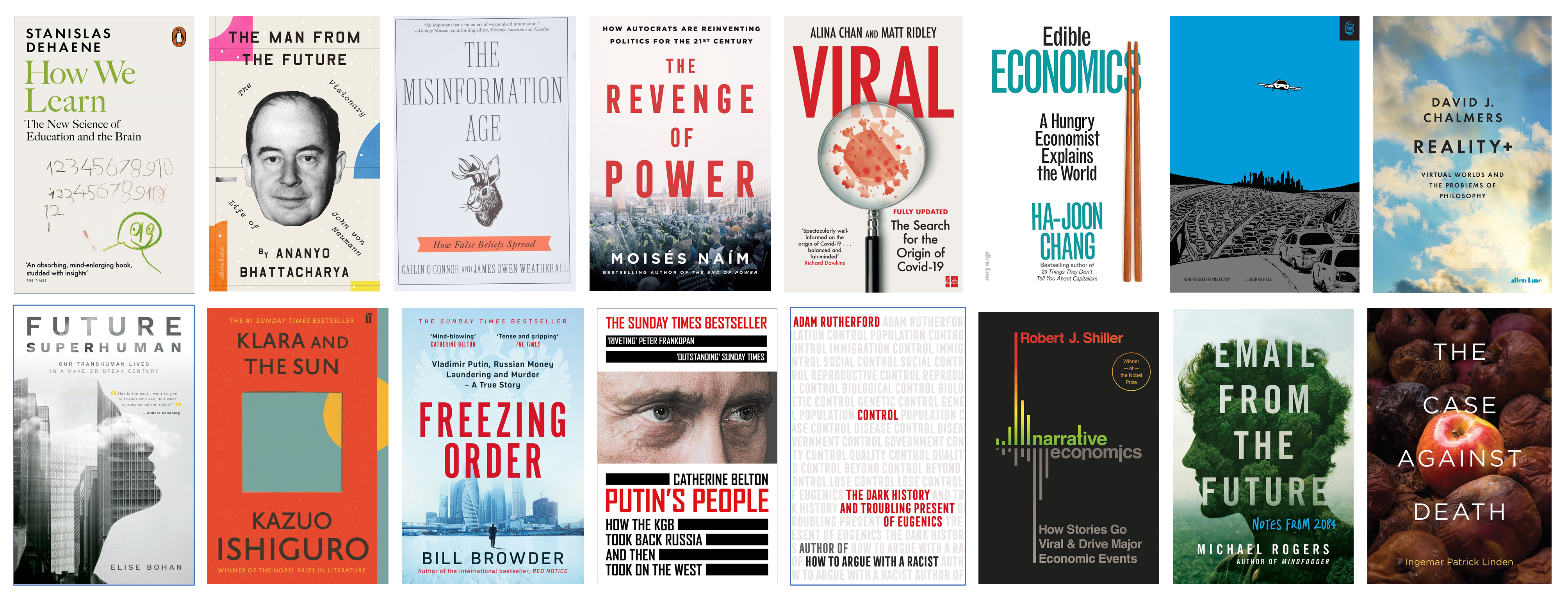
I’ve checked the records I’ve created over the year in Goodreads. I see that, out of the books I read all the way through in 2022, I was inspired to give sixteen the maximum Goodreads rating of five stars out of five.

(Actually mainly I listened to these books, as audio books, rather than read them.)

You can see their covers in the following image.

(Click on the image to enlarge it, to view the individual book covers more clearly.)

Each of these books gave me plenty to think about. I’m grateful in every case for the effort and inspiration of the authors.

But one of these books stands out as being even more impressive and impactful than all the others.

It’s The Revenge of Power, by Moisés Naím.

Here are some extracts from the Wikipedia page of the author:

Moisés Naím (born July 5, 1952, in Tripoli, Libya) is a Venezuelan journalist and writer. He is a Distinguished Fellow at the Carnegie Endowment for International Peace. In 2013, the British magazine Prospect listed Naím as one of the world’s leading thinkers. In 2014 and 2015, Dr. Naím was ranked among the top 100 influential global thought leaders by Gottlieb Duttweiler Institute (GDI).

He is the former Minister of Trade and Industry for Venezuela, Director of its Central bank, and Executive Director of the World Bank.

Naím studied at the Universidad Metropolitana in Caracas, Venezuela. Following his undergraduate studies, he attended the Massachusetts Institute of Technology, where he obtained both a master of science and doctorate degrees.

Naím was a professor of business strategy and industrial economics at Instituto de Estudios Superiores de Administración (IESA), Venezuela’s leading business school and research center located in Caracas. He also served as its Dean between 1979 and 1986.

Naím served as the editor-in-chief of Foreign Policy magazine for 14 years (1996-2010). Since 2012, he has directed and hosted Efecto Naím, a weekly televised news program on the economy and international affairs that airs throughout the Americas on NTN24. In 2011, he received the Ortega y Gasset Prize for his important contribution to journalism in the Spanish language.

Naím ably deploys that rich experience and expertise in the writing of his new book.

The book’s full title is “The Revenge of Power: The Global Assault on Democracy and How to Defeat It”.

Here are the reasons why the book particularly stands out for me, and why I believe you should read it too:

  • The subject has fundamental global importance. All our aspirations in other areas of life – health, education, sport, travel, technology, art – are subject to destruction if politics falls further into the hands of autocrats
  • Every single chapter was eye-opening, introducing important new material
  • The analysis covers threats from both the right and the left, and is full of captivating details about politics in numerous countries around the world
  • The book draws together its various ideas into a coherent overarching framework – the “three P’s” of populism, polarization and post-truth (you might think at first, like I did, that this sounds a bit trite; but be prepared to change your mind)
  • It clarifies what is different, today, compared to the threats posed by autocrats of previous generations
  • It also clarifies how new technological possibilities – compared to the newspapers and radio and TV of the past – pose further challenges to the maintenance of democracy
  • It vividly explains the concept of “status dissonance” that is one of several factors causing electorates to look favourably at potential autocrats
  • It provides a stirring defence of the principles of the separation of powers, and the maintenance of checks and balances.

Many parts of the book are truly frightening. This is not some abstract issue, nor some far-future concern. As the book highlights, it’s a live here-and-now issue. I confess that several episodes it covered left me hopping mad.

Finally, it has specific recommendations on what needs to be done, to ward off the threats posed to the wellbeing of politics around the world. These recommendations are “five battles we need to win” – against falsehoods, criminalized governments, foreign subversion, political cartels and narratives of illiberalism.

None of these battles will be easy. But they’re all winnable, with sufficient effort, intelligence, and collaboration.

Blog at WordPress.com.