dw2

5 October 2008

iWoz inspires iMAX

Filed under: Apple, books, collaboration, innovation, Psion — David Wood @ 8:57 am

Last Wednesday, Apple co-Founder Steve Wozniak addressed a gathering of several hundred business people in London’s large-format IMAX cinema, as part of a series of events organised by the London Business Forum. The theme was “Apple Innovation”. Since the IMAX is just 15 minutes walk from Symbian’s HQ, this opportunity was too good for me to miss. I hoped Wozniak’s account of Apple culture might shed some new light on the all-conquering iPhone. I was not disappointed.

Wozniak spoke for more than an hour, without slides, running through a smorgasbord of anecdotes from his own life history. It was rivetting and inspiring. Later I realised that most of the material has already been published in Wozniak’s 2006 book “iWoz: Computer geek to cult icon: How I invented the personal computer, co-founded Apple, and had fun doing it“, which was given out at the event.

I warmed to Wozniak early on in his talk, when he described one of his early experiments in software – writing a program to solve the “Knight’s tour” around a chessboard. I remembered writing a program to try to solve the same problem while at roughly the same age – and had a similar result. In my case, programs were sent off from school to the local Aberdeen University, where clerical staff typed them in and submitted them on behalf of children in neighbouring schools. This program was returned several days later with the comment that there was no output – operators had terminated it.

A few weeks later, there was a short residential course at the university for sixth form students, which I attended. I modified my program to tackle a 5×5 board instead, and was happy to see computer quickly spitting out numerous solutions. I changed the board size to 6×6 instead and waited … and waited … and after around 10 minutes, a solution was printed out. Wozniak’s experience was several years before mine. As he describes it, the computer he was using could do one million calculations a second – which sounded like a huge number. So the lack of any output from his program was a big disappointment – until he calculated that it would actually take the computer about 10^25 years to finish this particular calculation!

More than half the “iWoz” book covers Wozniak’s life pre-Apple. It’s in turn heart-warming and (when describing Wozniak’s pranks and phreaking) gob-smacking.

The episode about HP turning down the idea of the Apple I computer was particularly thought-provoking. Wozniak was working at HP before Apple was founded, and being loyal to his company (which he firmly admired for being led by engineers who in turn deeply respected other engineers) he offered them the chance to implement the ideas he had devised outside work time for what would become, in effect, the world’s first useful personal computer. Although his managers at HP showed considerable interest, they were not able to set aside their standard, well-honed processes in order to start work on what would have been a new kind of project. Wozniak says that HP turned him down five times, before he eventually resigned from the company to invest his energy full-time into Apple. It seems like a classic example of the Innovator’s Dilemma – in which even great companies can fail “by doing everything right”: their “successes and capabilities can actually become obstacles in the face of changing markets and technologies”.

Via numerous anecdotes, Wozniak describes a set of characteristics which are likely to lead to product success:

  • Technical brilliance coupled with patience and persistence. (Wozniak tells a fascinating account of how he and one helper – Randy Wigginton, at the time still at senior high school – created a brand new floppy disk drive controller in just two weeks, without any prior knowledge of disk drives);
  • A drive for simplicity of design (such as using a smaller number of parts, or a shorter algorithm) and superb efficiency of performance;
  • Users should feel an emotional attachment to the product: “Products should be obviously the best”;
  • Humanism: “The human has to be more important than the technology”.

There’s shades of the iPhone experience in all these pieces of advice – even though the book iWoz was written before the iPhone was created.

There’s even stronger shades of the iPhone experience in the following extracts from the book:

The Apple II was easy to program, in both BASIC (100 commands per second) and machine language (1M commands per second)… Within months dozens of companies started up and they were putting games on casette tape for the Apple II; these were all start-up companies, but thanks to our design and documentation, we made it easy to develop stuff that worked on our platform…

… the computer magazines had tons of Apple II product ads for software and hardware. Suddenly the Apple II name was everywhere. We didn’t have to buy an advertisement or do anything ourselves to get the name out. We were just out there, thanks to this industry of software programs and hardware devices that sprang up around the Apple II. We became the hot fad of the age, and all the magazines (even in the mainstream press) started writing great things about us. Everywhere you looked. I mean, we couldn’t buy that kind of publicity. We didn’t have to.

In this way, the Apple II quickly reached sales figures far higher than anyone had dared to predict. One other factor played a vital role:

VisiCalc was so powerful it could only run on the Apple II: only our computer had enough RAM to run it.

But sales bandwaggons can lose their momentum. The iPhone bandwaggon will falter, to the extent that other smartphones turn out to be more successful at running really valuable applications (such as, for example, applications that can run in background, in ways that aren’t possible on the iPhone).

Apple also lost some of its momentum in the less reliable Apple III product that followed the Apple II. Wozniak has no doubts about the root causes for the failure of the Apple III: “it was developed by committee, by the marketing dept”. This leads on to the disappointing advice that Wozniak gives in the final chapter of his book: “Work alone”!

Here, I part company with Wozniak. I’ve explained before my view that “design by committee” can achieve, with the right setup, some outstanding results. That was my experience inside Psion. However, I do agree that the process needs to involve some first-class product managers, who have a powerful and authentic vision for the product.

27 September 2008

Beyond smartphones

Filed under: MIDs, Psion, Symbian Foundation — David Wood @ 9:39 am

Smartphones constitute a huge market place. Bear in mind, not just the enormous number of smartphones sold each year, but also the fact that manufacturers earn considerably larger profits, for each smartphone sold, than they do for ordinary phones. Plausibly, although smartphones account for only around 10-15% by units of the 1B+ total annual market of all mobile phones, they provide upwards of 20-25% of the sales revenues for all mobile phones – and perhaps more than 40% of the profits. What’s more, users of smartphones typically run up significantly larger monthly usage bills than users of other kinds of mobile phones.

For this reason, the 1996 strategic decision by Psion Software to focus future development of the EPOC32 software system on smartphones turns out to have been marvellously prescient. I’m proud to have been part of that strategic review. The easy decision at the time would have been to continue to focus on the category of devices where EPOC software had historically flourished (in both its 16-bit and 32-bit variants) – in smart handheld organisers, known as “palmtops” or “PDAs”. But the decision was taken to target a market that did not exist at the time, and which was expected in due course to dwarf the PDA market. This sowed the seeds for the corporate transformation, 18 months later, of Psion Software into Symbian.

As is often the case with market transformations, the new device category took longer to materialise than had been anticipated. But eventually smartphone sales exceeded all our expectations. It’s as computing pioneer Joseph Licklider, stated back in 1965:

“People tend to overestimate what can be done in one year and to underestimate what can be done in five or ten years.”

However, the concept of palmtop computing devices has not gone away. It keeps re-emerging, with new names, such as subnotebooks, UMPCs (Ultra Mobile Personal Computers), and MIDs (Mobile Internet Devices), or in new variants such as PNDs (Personal Navigation Devices) or Kindle-like mobile e-book readers. On the LinkedIn forums discussing the forthcoming 2008 Symbian Smartphone Show, Malik Kamal Saadi of Informa raises the following question:

What OSs will be addressing Mobile-Internet-Devices and UMPCs?

Operators and vendors are now looking to extend their opportunities beyond the traditional mobile handsets market by adding new device categories to their portfolios: MIDs and UMPCs. Silicon suppliers such as Qualcomm, Intel, and TI see these devices as the next big convergent device segment. However it is not clear yet which OS type will be more suitable for this type of devices: ARM based (e.g. Symbian, mobile Linux such Android, maemo, etc)? or X86 based (e.g. light version of Microsoft Windows, or Apple MAC)?

Symbian is more suitable for mobile phones but I was wondering if , with Symbian Foundation, this OS could be upgraded to address the MID and UMPC market?

For simplicity, for now, I’ll use the term “MID” to cover all of these emerging categories of smart handheld devices which major on functionality other than phone communications (in other words, they aren’t smartphones). As I see it, the question of MIDs breaks down into three:

  1. After many previous false starts, are there reasons for us to take MIDs seriously as a device category in the foreseeable future?
  2. Even if the market for MIDs grows in absolute terms, will it be significant enough to warrant distracting resources onto that market, away from other growth areas that might be even more significant?
  3. What operating system is the likely winner in the MID space?

1. The history of false starts with MIDs

The ill-fated Palm Foleo (which was cancelled before it came to market) and Sony mylo are but two of many examples of devices in this same general space:

  • Announced with a lot of fanfare
  • Pitched as finding an exciting new “sweet spot” in between laptop computers and smartphones
  • But failing to live up to the vision – achieving at best lack-lustre market success.

As another example, it’s no secret that Nokia’s maemo-powered Internet Tablet devices, although providing a great learning experience for working with open source, make only a limited contribution to Nokia’s overall revenues.

However, I see the delays with market success of MIDs as being temporary – akin, in fact, to the delays before the eventual market success of smartphones:

  • The declining cost of key items of hardware, which has led to smartphones becoming ever more affordable, will likewise move many types of MIDs inside the budget range of larger and larger pools of potential purchasers;
  • Some specific technical and ergonomic problems needed to be solved, before the appeal of a device can extend beyond the early technology enthusiasts; these include better screens (for mobile e-book readers), improved GPS fix technology, and better mobile internet browsing;
  • Just as smartphones grow in numbers as a result of increased word-of-mouth recommendations by users of these devices, various MIDs will benefit from similar crescendos of user endorsement;
  • An industry that is dedicated to the creation and marketing of these devices takes some time to come into being and establish itself (in the analysis of Bhaskar Chakravorti, this takes roughly twice as long to happen, as you might expect from just looking at Moore’s Law technology curves) ; but virtuous cycle effects do eventually emerge.

I have one other reason for believing in the commercial future of MIDs – particulary those which are PDAs. I’ve personally derived great utility from the Psion Series 5mx that I’ve been using virtually every waking hour for the last nine years. The device supplements my memory, keeps track of my appointments, gathers my thoughts and ideas, marshalls my to-do items, and much, much more. There’s no doubt in my mind that there are many other people who would, similarly, benefit from the highly useful PIM (personal information management) capabilities of such devices:

  • A proportion of users will be satisfied by the PIM capabilities of a single multi-purpose smartphone device. These users will just carry one smart mobile device.
  • But a significant proportion of users will prefer to carry a separate PDA-like device, in addition to a smartphone. They’ll value the additional benefits from a device with a larger screen and larger keyboard.

2. Other directions beyond smartphones

MIDs are one potential direction of market expansion beyond existing smartphones. But they’re not the only one. Indeed, there are two other directions which have consistently held higher importance in Symbian’s thinking:

  • The drive towards mass-market smartphones – in which smartphone technology is used inside ordinary-looking phones used by larger and larger numbers of consumers;
  • The drive towards super-smartphones – in which additional computing powers, new peripherals and sensors, and other hardware and software enhancements combine to provide new experiences and services for sophisticated and demanding users at the always-fluid yet lucrative top end of the market.

It would have been a major strategic error for Symbian to lose focus on either of these two growth areas. What merit an additional 10-20 million units of sales of PDA-like devices, if this diversion of attention caused us to miss the chance of the next 200-500 million units of smartphones?

On the other hand, these markets (MIDs and smartphones) are not separate. They’ve had elements in common in the past, and they’re becoming increasingly connected. An important meaning of the word “convergence” that is (rightly) oft-applied to the smart mobile device industry, is that the technology and solutions applicable to one type of smart mobile device will increasingly be applicable to all other types of smart mobile device. There’s less need for highly optimised distinct solutions: Moore’s Law and faster network speeds mean there’s less need to worry over every jot and tittle of hardware and network capacity. Even though various devices look quite different from each other and are operated differently by users, the underlying hardware and software can be similar.

In other words, it can be argued that the days when hardware and software had to be uniquely tailored to each different mobile device category are receding. If that’s true, then benefits of scale, in developing the same technology solution for different kinds of smart mobile devices (both smartphones and MIDs), may outweigh the advantages of having the best solution for each different device. And if that is true, we can expect the same mobile operating system to take the lead in all these different areas. So Symbian can no longer stand aside from the general MID category.

Happily, the creation of the Symbian Foundation come at exactly the right time, changing industry dynamics to make it much more likely that Symbian platform software will be adopted, not just in standard smartphones, mass-market smartphones, and super-smartphones, but also in various kinds of MID. What Symbian itself could not do, the newly enlarged and newly empowered Symbian ecosystem will take in its stride.

3. Picking the winning operating system for MIDs

In selecting the software system for their devices (MIDs, smartphones, or otherwise), manufacturers generally have four kinds of criteria in mind:

  • Technology factors: which software delivers superior performance, battery life, security, low defect count, improved user experience, etc?
  • Commercial factors: which software results in low total cost of development, manufacture, deployment, and maintenance; and which provides good opportunities for value-adding differentiation?
  • Political factors: which software is least likely to have its evolution controlled by corporations or organisations that fail to share common goals with the manufacturer?
  • Reliability factors: which software is likely to be delivered on schedule and to pre-agreed quality levels, in fulfilment of a multi-year evolutionary roadmap of changes?

An operating system will need to score well on all four counts, before it is adopted for any large (“bet the farm”) projects in commercially mature companies.

The planned creation of the independent Symbian Foundation, with royalty-free licensing of the Symbian platform software, increases the attractiveness of this software to manufacturers considering MIDs:

  • The commercial and contractual barriers of entry will be lowered
  • If a manufacturer finds a need to change some part of the software system, to address a specific niche device need, that will be much easier than before, given the open access to the source code
  • The improved openness will attract a larger ecosystem than before, which will in turn be able to assist with the development and customisation of MID-specific distributions of Symbian platform software.

These changes allow the various technical merits and reliability merits of Symbian software to shine through more clearly, freed from any cloud of uncertainty over commercial or political questions:

  • These technical merits include long battery life, platform security, networking bearer mobility, real-time services, and support for multiple different models of application development;
  • The reliability merits include an admirable track record of shipping software on time.

Both these sorts of merits count for a great deal, even in a world where the hardware and network capabilities have increased substantially from just several years ago. That applies for MIDs as well as for smartphones. Indeed, these increases in hardware and network capacity bring more stress and strain onto the software, and make it all the more important that the software is fully fit for purpose. For all these reasons, I believe that Symbian can be the winning operating system for MIDs, as well as for smartphones.

12 August 2008

Audacious goals

Filed under: BHAG, Psion, Symbian Foundation, vision — David Wood @ 8:02 pm

Martin Sauter asks: Which BHAGs are held by companies in the wireless space?

BHAG (Big Hairy Audacious Goal) is a memorable term introduced by Jim Collins and Jerry Poras in their watershed book, “Built to last: successful habits of visionary companies”. This book was widely read (and debated) within Psion in the mid 1990s. I vividly remember Psion Chairman and CEO David Potter giving an internal talk on themes from that book relevant to Psion. That talk had a lasting effect.

As Martin mentions, Symbian has been driven for many years by the audacious idea that, one day, Symbian OS will be the most widely used software platform on the planet. But that’s only one of several BHAGs in my mind.

Personally I prefer to say that Symbian’s goal is to be the most widely used and most widely liked software platform on the planet. That’s because I see the latter element as being a key contributor towards the former element. My vision is that people of all dispositions and from all social groups the world over will have good reason to want to use devices running this software – and will be able to afford them.

Here’s another BHAG. Looking towards the activities of the Symbian Foundation (assuming that the regulatory authorities approve the deal that creates this foundation), I envision a time when the ten or so principal package owners for the Symbian Platform will be among the most widely admired and respected software engineers on the planet. Books and articles will frequently write about each of these principal package owners and their finely honed skills in software architecture, software quality, software usability, and large-scale software integration. These articles will celebrate the different backgrounds and different sponsor-companies of these principal package owners (and will no doubt also delve into the multi-faceted inter-personal relationships among this group of world-striding individuals). These individuals will be the pin-up superstars who inspire new generations of emerging world-class software engineers.

I have other large-scale aspirations concerning the future of the Symbian Foundation, but it’s not appropriate to talk about these for the moment. However, what I am happy to share is some audacious ideas for the evolution of the products that I expect to be created, based on Symbian OS, in the 15-25 years ahead:

  • The human-computer interaction will sooner or later evolve to become a far more efficient brain-computer interaction. Instead of device owners needing to type in requests and then view the results on a physical screen, it will be possible for them to think requests and then (in effect) intuit the results via inner mental vision. (Just as we all had to learn to type, we’ll have to learn to think anew, to use these improved interfaces, if you see what I mean.) So the rich information world of the internet and beyond will become available for direct mental introspection;
  • The smartphone devices of the future will be more than information stores and communications pathways; they will have powerful intelligence of their own. Take the ideas of a spell-checker and grammar-checker and magnify them to consider an idea-checker and an internal coach. So the smartphone will become, for those who wish it, like a trusted best friend;
  • Adding these two ideas together, I foresee a time when human IQ and EQ are both radically boosted by the support of powerful mobile always-connected electronic brains and their nano-connections into our biological brains. To be clear, such devices ought to make us wiser as well as smarter, and kinder as well as stronger. For a glimpse of what this might mean, I suggest you take the time to find out what happens to one of the key characters in Kevin Bohacz’s awkwardly titled but engrossing and audacious (I think that’s the right word in this context) novel “Immortality”.

There’s more. In addition to far-reaching ideas about the products that the operation of the Symbian Foundation will eventually enable, it’s also worth considering some far-reaching ideas about the problem-solving capabilities of the robust yet transparent open collaborative methods expected to be deployed by the Symbian Foundation (methods that build on best practice established in the first ten years of Symbian’s history). In other words, the potential benefits of richly skilled open collaboration go far beyond the question of how to create world-beating smartphones. As highlighted in the tour-de-force “The upside of down” by the deeply thoughtful Canadian researcher Thomas Homer Dixon, the profound structural issues facing the future of our society (including climate change, energy shortage, weapons proliferation, market instability, fundamentalist abdication of rationality, and changing population demographics) are so inter-twined and so pervasive that they will require a new level of worldwide collaboration to solve them. Towards the end of his book, Homer-Dixon points to the transformative potential of open-source software mechanisms for inspiration for how this new level of collaboration can be achieved. It’s an intriguing analysis. Can open source save the world? Watch this space.

Footnote: Having the right BHAG is an important first step towards a company making a dent in the universe. But it’s only one of many steps. Although “Built to last” is a fine book, I actually prefer Jim Collin’s later work, “From good to great: why some companies make the leap … and others don’t”. In effect, “From good to great” is full of acutely insightful ideas on how companies can make progress towards their BHAGs.

29 June 2008

The enhancement of the dream

Filed under: collaboration, Psion, Symbian Story — David Wood @ 12:49 pm

Did this week’s announcements about the Symbian Foundation herald “The end of the dream“, as Michael Mace suggests?

No matter how it works out in the long run, the purchase of Symbian by Nokia marks the end of a dream — the creation of a new independent OS company to be the mobile equivalent of Microsoft. Put a few beers into former Symbian employees and they’ll get a little wistful about it, but the company they talk about most often is Psion, the PDA company that spawned Symbian. …

What makes the Psion story different is that many of the Psion veterans had to leave the UK, or join non-UK companies, in order to become successful. Some are in other parts of Europe, some are in the US, and some are in London but working for foreign companies. This is a source of intense frustration to the Psion folks I’ve talked with. They feel like not only their company failed, but their country failed to take advantage of the expertise they had built.

I understand the thrust of this argument, but I take a different point of view. Rather than seeing this week’s announcement as “the end of the dream”, I see it as enabling “the enhancement of the dream”.

During the second half of 2007, Symbian’s executive team led a company-wide exercise to find a set of evocative, compelling words that captured what we called “The Symbian Story”. Some of the words we came up with were new, but the sentiment they conveyed was widely recognised as deriving from the deep historic roots of the company. Here are some extracts:

  • The world is seeing a revolution in smarter mobile devices
  • Convergence is real, happening now and coming to everyone, everywhere
  • Our mission is to be the OS chosen for the converged mobile world
  • No one else can seize it like we can
  • Our talented people, building highly complex software, have established a smartphone OS that leads the industry
  • We welcome rapid change as the way to stay ahead
  • We’ll work together to fulfill our potential to be the most widely used software on the planet, at the heart of an inspiring, exciting and rewarding success story.

This story – which we might also call a dream, or a vision – has by no means ended with this week’s announcements. On the contrary, these steps should accelerate the outcome that’s been in our minds for so long. There will be deeper collaboration and swifter innovation – making it even more likely that the Symbian platform will become in due course the most widely used on the planet.

But what about the dream that Symbian (or before it, Psion) could be “the next Microsoft”?

In terms of software influence, and setting de facto standards, this dream still holds. In terms of boosting the productivity and enjoyment of countless people around the world, through the careful deployment of smart software which we write, the dream (again) still holds. In terms of the founders of the company joining the ranks of the very richest people in the world, well, that’s a different story, but that fantasy was never anything like so high in our motivational hierarchy.

What about the demise of “British control” over the software? Does the acquisition of UK-based Symbian by Finland-based Nokia indicate yet another “oh what might have been” for the United Kingdom plc?

Once again, I prefer to take a different viewpoint. In truth, the software team has long ago ceased to be dominated by home-bred British talent. The present Symbian Leadership Team has one person from Holland and one from Norway. 50% of the Research department that I myself head were born overseas (in Russia, Greece, and Canada). And during the Q&A with Symbian’s Nigel Clifford and Nokia’s Kai Oistamo that took place in London at all-hands meetings of Symbian employees on the 24th of June, questions were raised using almost every accent under the sun. So rather than Symbian being a British-run company, it’s better to see us as a global company that happens to be headquartered in London, and which benefits mightily from talent born all over the world.

Not only do we benefit from employees born worldwide, we also benefit (arguably even more highly) from our interactions with customers and partners the world over. As Symbian morphs over the next 6-9 months into a new constellation of organisations (including part that works inside Nokia, and part that has an independent existence as the Symbian Foundation), these collaborative trends should intensify. That’s surely a matter for celebration, not for remorse.

13 June 2008

It was twenty years ago, today

Filed under: Psion, Symbian — David Wood @ 7:34 am


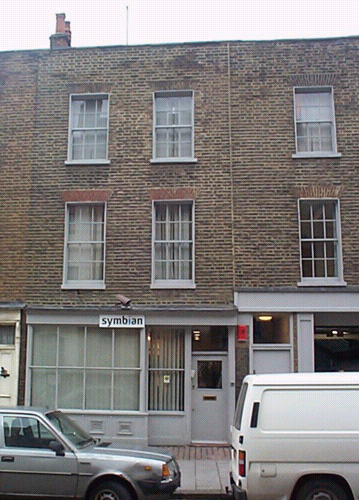
13th June 1988 – twenty years ago today – was the day I started work at Psion. I arrived at the building at 17 Harcourt Street, with its unimpressive facade that led most visitors to wonder whether they had come to the wrong place. When the photo on the left was taken, the premises were used by Symbian, and a “Symbian” sign had been affixed outside. But on my first visits, I noticed no signage at all – although I later discovered the letters of the word “Psion” barely visible in faded yellow paint.

Unimpressive from the outside, the building looked completely different on the inside. Everyone joked about the “tardis effect” – since it seemed impossible for such a small exterior to front a considerably larger interior. In fact, Psion had constructed a set of offices running behind several of the houses in the street – but planning regulations had prevented any change in the house fronts themselves. Apparently, as grade two listed buildings, their original exteriors could not be altered. Or so the story went.

I worked under the guidance of Richard Harrison and Charles Davies on software to be included in a word processor application on Psion’s forthcoming “Mobile Computer” laptop device. My very first programming task was an optimised Find routine. After two weeks, I found myself thinking to myself, “Don’t these people realise I’m capable of working harder?” But I soon had more than enough tough software tasks to handle, and I’ve spent the next twenty years very far from a state of boredom. On the contrary, it’s been a roller-coaster adventure.

Back in 1988, the software development team in Harcourt Street had fewer than 20 people in it. Eight years later, when Psion Software was formed as a separate business unit, there were 88 in the team – which, by that time, also occupied floors in the nearby Sentinel House. Two more years saw the headcount grow to 155 by the time Psion Software turned into Symbian (24 June 1998). Today, our headcount is around 1600. It’s a growth I could not imagine during my first few years of work. Nor could I imagine that descendants of the software from the venerable “Mobile Computer” (MC400) would be powering hundreds of millions of smartphones worldwide.

(You can read more about the long and interesting evolution of Psion’s software team, in my book “Symbian for software leaders: principles of successful smartphone development projects“.)

« Newer Posts

Blog at WordPress.com.