dw2

24 August 2012

Duplication stuplication

Filed under: Accenture, Android, brain simulation, Connectivity, cryonics, death, futurist, Symbian — David Wood @ 12:04 am

I had a mixture of feelings when I looked at the display of the Agenda application on my Samsung Note smartphone:

On the face of things, I was going to be very busy at 09:00 that morning – I had five simultaneous meetings to attend!

But they were all the same meeting. And in fact I had already cancelled that meeting. Or, at least, I had tried to cancel that meeting. I had tried to cancel it several times.

The meeting in question – “TPR” – the Technology Planning Review that I chair from time to time inside Accenture Mobility – is a meeting I had organised, on a regularly repeating basis. This particular entry was set to repeat every four weeks. Some time earlier, I had decided that this meeting no longer needed to happen. From my Outlook Calendar on my laptop, I had pressed the button that, ordinarily, would have sent cancellation messages to all attendees. At first, things seemed to go well – the meeting disappeared from sight in my Outlook calendar.

However, a couple of hours later, I noticed it was still there, or had re-appeared. Without giving the matter much thought, I imagined I must have experienced some finger problem, and I repeated the cancellation process.

Some time later, I glanced at my engagements for that day on my smartphone – and my heart sank. The entry was shown no less than nine times, stacked on top of each other. One, two, three, four, five, six, seven, eight, nine. Woops.

(The screenshot above only shows the entry appearing five times. That’s because I deleted four of the occurrences before I had the presence of mind to record the image for posterity.)

To tell the truth, I also had a wry, knowing smile. It was a kind of “aha, this confirms that synchronising agendas can be hard” smile. “Thank goodness there are duplicate entry bugs on Android phones too!”

That uncharitable thought had its roots in many moments of personal embarrassment over the years, whenever I saw examples of duplicated entries on phones running Symbian OS. The software that synchronised agenda information across more than one device – for example, between a PC and a connected Symbian smartphone – got into a confused state on too many occasions. Symbian software had many strengths, but laser accuracy of agenda entry synchronisation was not one of them.

But in this case, there was no Symbian software involved. The bug – whatever it was – could not be blamed on any software (such as Symbian OS) for which I personally had any responsibility.

Nevertheless, I still felt bad. The meeting entry that I had created, and had broadcast to a wide number of my Accenture Mobility colleagues, was evidently misbehaving on their calendars. I had to answer several emails and instant messaging queries: Is this meeting happening or not?

Worse, the same problem applied to every one of the repeating entries in the series. Entries show up in the calendars of lots of my Accenture colleagues, once every four weeks, encouraging them to show up for a meeting that is no longer taking place.

Whether I tried to cancel all the entries in the series, or just an individual entry, the result was the same. Whether I cancelled them from my smartphone calendar or from Outlook on my laptop, the result was the same. Namely, the entry disappeared for a while, but re-appeared a few hours later.

Today I tried again. Looking ahead to the meeting slot planned for 30th August, I thought I would be smart, and deleted the entry, both from my smartphone calendar, and from Outlook on my laptop, within a few seconds of each other, just in case a defective synchronisation between the two devices was to blame. You guessed it: the result was the same. (Though this time it was about three hours before the entry re-appeared, and I was starting to think I had cracked it after all.

So what’s going on? I found a clue in an unexpected place – the email folder of Deleted Items in Microsoft Outlook. This showed an email that was unread, but which had somehow moved directly into the Deleted Items folder, without me seeing it.

The entry read as follows:

Microsoft Outlook on behalf of <one of the meeting participants>

One or more problems with this meeting were detected by Exchange 2010.

This meeting is missing from your calendar. You’re the meeting organizer and some attendees still have the meeting on their calendar.

And just as Outlook had silently moved this email into the Deleted Items folder, without drawing my attention to it, Outlook had also silently reinstated the meeting, in my calendar and (it seems) in everyone else’s calendar, without asking me whether or not that was a good idea. Too darned clever.

I still don’t know how to fix this problem. I half-suspect there’s been some kind of database corruption problem – perhaps caused by Microsoft Exchange being caught out by:

  • Very heavy usage from large numbers of employees (100s of 1000s) within one company
  • Changes in policy for how online meetings are defined and operated, in between when the meeting was first created, and when it was due to take place
  • The weird weather we’ve experienced in London this summer
  • Some other who-knows-what strange environmental race conditions.

However, I hear of tales of other colleagues experiencing similar issues with repeating entries they’ve created, which provides more evidence of a concrete software defect, rather than a random act of the universe.

Other synchronisation problems

As I said, when I reflected on what was happening, I had a wry smile. Synchronisation of complex data between different replications is hard, when the data could be altered in more than one place at the same time.

Indeed, it’s sometimes a really hard problem for software to know when to merge apparent duplicates together, and when to leave them separated. I’m reminded of that fact whenever I do a search in the Contacts application on my Android phone. It often lists multiple entries corresponding to a single person. Some of these entries show pictures, but others don’t. At first, I wasn’t sure why there were multiple entries. But closer inspection showed that some details came from my Google mail archives, some from my collection of LinkedIn connections, some from my set of Facebook Friends, and so on. Should the smartphone simply automatically merge all these instances together? Not necessarily. It’s sometimes not clear whether the entries refer to the same person, or to two people with similar names.

If that’s a comparatively simple example, let me finish with an example that takes things further afield. It’s not about the duplication and potential re-integration of agenda entries. Nor is it about the duplication and potential re-integration of pieces of contacts info. It’s about the duplication and potential re-integration of human minds.

Yes: the duplication and potential re-integration of human minds.

That’s a topic that came up in a presentation in the World Future 2012 conference I attended in Toronto at the end of July.

The talk was given by John M. Smart, founder and president of the Acceleration Studies Foundation. The conference brochure described the talk as follows:

Chemical Brain Preservation: How to Live “Forever”

About 57 million unique and precious human beings die every year, or 155,000 people every day. The memories and identities in their brains are permanently lost at present, but may not be in the near future.

Chemical brain preservation is a technique that many scientists believe may inexpensively preserve our memories and identity when we die, eventually for less than $10,000 per person in the developed world, and less than $3,000 per person in the developing world. Preserved brains can be stored at room temperature in cemeteries, in contract storage, or even in private homes. Our organization, the Brain Preservation Foundation (brainpreservation.org), is offering a $100,000 prize to the first scientific team to demonstrate that the entire synaptic connectivity of mammalian brains, where neuroscientists believe our memories and identities reside, can be perfectly preserved using these low-cost chemical techniques.

There is growing evidence that chemically preserved brains can be “read” in the future, like a computer hard drive, so that memories, and even the complete identities of the preserved individuals can be restored, using low-cost automated techniques. Amazingly, given the accelerating rate of technological advance, a person whose brain is preserved in 2020 might “return” to the world, most likely in a computer form, as early as 2060, while their loved ones and some of their friends are still alive…

Note: this idea is different from cryonics. Cryonics also involves attempted brain preservation, at an ultra-low temperature, but with a view to re-animating the brain some time in the future, once medical science has advanced enough to repair whatever damage brought the person to the point of death. (Anyone serious about finding out more about cryonics might be interested in attending the forthcoming Alcor-40 conference, in October; this conference marks the 40th anniversary of the founding of the most famous cryonics organisation.)

In contrast, the Brain Preservation Foundation talks about reading the contents of a brain (in the future), and copying that information into a computer, where the person can be re-started. The process of reading the info from the brain is very likely to destroy the brain itself.

There are several very large questions here:

  • Could the data of a brain be read with sufficient level of detail, and recreated in another substrate?
  • Once recreated, could that copy of the brain be coaxed into consciousness?
  • Even if that brain would appear to remember all my experiences, and assert that it is me, would it be any less of a preservation of me than in the case of cryonics itself (assuming that cryonics re-animation could work)?
  • Given a choice between the two means of potential resurrection, which should people choose?

The first two of these questions are scientific, whereas the latter two appear to veer into metaphysics. But for what it’s worth, I would choose the cryonics option.

My concern about the whole program of “brain copying” is triggered when I wonder:

  • What happens if multiple copies of a mind are created? After all, once one copy exists in software, it’s probably just as easy to create many copies.
  • If these copies all get re-animated, are they all the same person?
  • Imagine how one of these copies would feel if told “We’re going to switch you off now, since you are only a redundant back-up; don’t worry, the other copies will be you too”

During the discussion in the meeting in Toronto, John Smart talked about the option to re-integrate different copies of a single mind, resulting in a whole that is somehow better than each individual copy. It sounds an attractive idea in principle. But when I consider the practical difficulties in re-integrating duplicated agenda entries, a wry, uneasy smile comes to my lips. Re-integrating complex minds will be a zillion times more complicated. That project could be the most interesting software development project ever.

28 July 2012

More for us all, or more for them?

Filed under: books, disruption, Economics, futurist, Humanity Plus, politics, UKH+ — David Wood @ 1:15 pm

The opening keynote speaker at this weekend’s World Future 2012 conference this weekend was Lee Rainie, the Director of the Pew Research Center’s Internet & American Life Project. Lee’s topic, “Future of the Internet”, was described as follows in the conference agenda:

In this keynote presentation based on his latest book, Networked: The New Social Operating System (co-authored with Barry Wellman), Dr. Rainie will discuss the findings of the most recent expert surveys on the future of teens’ brains, the future of universities, the future of money, the impact of Big Data, the battle between apps and the Web, the spread of gamefication, and the impact of smart systems on consumers.

That was a lot to cover in 45 minutes, but Lee said he would speak fast – and he did!

Analysis  of the Pew Internet expert surveys Lee mentions is available online at http://www.elon.edu/e-web/predictions/expertsurveys/2012survey/ – where you’ll find a wealth of fascinating material.

But Lee’s summary of the summary (if I can put it like that) is that there are two potential pathways ahead, between now and 2020, regarding what happens with Internet technology:

  1. In one pathway, we all benefit: the fruits of improving Internet technologies are widely shared
  2. In another pathway, the benefits are much more restricted, to “them”.

Hence the question: “More for us all, or more for them?”

“Them” could be political leaders, or it could be corporate leaders.

Listening to Lee’s words, I was struck by a powerful resonance with the main theme of a BIG book on history that I’m the processing of reading. (Actually, I’m listening to an Audible version of it on my iPod.)

The book is “Why nations fail the origins of power, prosperity, and poverty“, by Daron Acemoglu and James Robinson. It has a marvelous sweep through events in all eras of human history and in all corners of the globe.

I’m only six hours into what will be a 15 hour long listen, but I already suspect this to be the most important book about history that I’ve ever read. (And as regular readers of this blog know, I read a lot.)

It’s not just “one thing after another” (fascinating though that kind of history book can be), but a profound analysis of the causes of divergence between societies with prosperity and societies with poverty.

In brief, the primary differentiator is the kind of political institutions that exist:

  • Are they extractive, in which the outputs of society are siphoned by a relatively small elite
  • Or are they inclusive, which a much greater sharing of power, influence, and potential benefit?

The nature of political institutions in turn influence the nature and operation of economic institutions.

The book has many striking examples of how ruling elites blocked the development or the wider application of technology and/or market reforms, fearing the “creative destruction” which would be likely to follow – threatening their grip on power.

One example in the book is the story of the reaction of the Roman emperor Tiberius to the invention of unbreakable glass. This story is also told by, for example, Computer World blogger John Riley, in his article “Why innovation is not always welcomed with open arms“:

The story of the Roman inventor of flexible glass 2000 years ago is a salutary lesson for all innovators, especially those within organisations.

As Isadore of Seville tells it, the inventor went to the Roman Emperor Tiberius (14-37 AD) with a drinking bowl made of this flexible and ductile glass, and threw in on the ground to demonstrate that it didn’t shatter.

Tiberius asked him if anyone else knew about the invention. The inventor said he’d told no-one.

And he was instantly beheaded.

What the unfortunate inventor hadn’t seen was the big picture – Tiberius had instantly realised that cheap, easily produced flexible glass that didn’t break would wreck the Imperial monopoly on gold and silver!

That, sadly is too often the case in big companies, where someone comes up with a bright idea which in practice means interfering with a profitable short term operation or disintermediating a product line.

In such cases innovators these days don’t get killed – they get ignored, sidelined, blocked or gagged under non-disclosures. Many innovative products have been  rejected by large suppliers controlling projects when they threaten monopolistic inefficiencies. There are many cases of other innovations being bought up and mothballed…

As Acemoglu and Robinson point out, in a different political climate, the inventor could have taken his invention to market without the explicit knowledge and permission of the ruling elite (such as the emperor). That would be a world in which, to return to my opening question, there would more likely be technology benefits for everyone, rather than control of technology being subordinated to the benefits of a clique.

But our current political climate is highly troubled. My friend and Humanity+ UK co-organiser Amon Kalkin describes the situation like this:

We are in a time of crisis. Large numbers of people are increasingly disenfranchised, squeezed on all sides and with no hope of appeal to authorities. Why? Because those very same authorities – our governments – are virtually indistinguishable from the corporate interests who are gaining most from the current situation. We live under a system where our votes essentially don’t matter. You can pick a team, but you’re not allowed to change the rules of the game. Even worse, we have been trained to think of this as a normal and natural situation. Who are we to question these powerful people? Who are we to awaken, to unify and demand change?

Rather than just considering the topic “Why Nations Fail“, we might well consider “Why Transnational Institutions Fail” – referring to, for example, the evident problems within the Eurozone and within the United Nations.

The same imperative applies: we need to find a mode of collaboration that avoids being subverted by the special interests of ruling minorities – whether these minorities be economic elites or political elites.

That imperative has led Amon to found the Zero State movement:

Zero State is a movement for positive social change through technology.

We’re a grass-roots world community pursuing smart, compassionate solutions to problems, and improving the human condition.

Personal transformative technologies we pursue include life extension and Artificial Intelligence. Social projects include accelerating changebasic incomeMeshnet and Bitcoin, while lifestyle initiatives explore areas such as the arts, spirituality, fashion and culture.

More recently, Amon and various other Zero State members are launching a political party, “Consensus“, to promote their Zero State vision. My quote above (“We are in a time of crisis…”) comes from Amon’s description of what he plans to say at the launch meeting for Consensus that will take place next weekend in London.

For more details about this launch event, see this announcement on the London Futurist meetup site:

The case for a Zero State political movement

Many futurists envisage a better, more compassionate society, organized in terms of using technological developments to maximize well-being rather than simply concentrating resources in a few ultra-rich hands and leaving everybody else increasingly worse off. But all too often, futurists talk about positive outcomes as if such things come without work or struggle. They are apparently oblivious to the fact that right now our society is stalling, strangled by a tiny proportion of citizens who do not share our values.

There have been few moments in the history of our society like the one facing us now, where deep crisis also offers the opportunity for deep, positive change. It’s the time for futurists to step up to actively guide our society toward the better futures we envisage.

The CONSENSUS is a newly-formed UK-based political party which seeks to harness the intelligence and compassion to be found among futurists and other subcultures to the design of a real, improved future, for us and our children. Drawing inspiration from the eight principles of the Zero State movement, the CONSENSUS will encourage people to think about the possibilities open to society once again.

The CONSENSUS is the first party of its kind. We intend to reach out to other parties and groups who share similar views and goals. If we are successful, there will soon be a number of CONSENSUS parties at the national level around the world, all part of an organization known as the Consensus of Democratic Futurist Parties (CDFP). The UK CONSENSUS is already affiliated with an international futurist organization in the Zero State movement, and the seeds of multiple local political parties have been sown.

We welcome the opportunity to hear your views about the state of society today and its future, and what are the issues and goals that we should focus on. No matter what your own views are, this is your chance to have your say, and to have it influence a concrete course of action.

If you care about our future, and the possibility of finding intelligent, compassionate solutions to our problems, then we encourage you to come to this meeting to:

  • find out how you can help
  • join the conversation
  • offer your views on how we should move forward…

16 June 2012

Beyond future shock

Filed under: alienation, books, change, chaos, futurist, Humanity Plus, rejuveneering, robots, Singularity, UKH+ — David Wood @ 3:10 pm

They predicted the “electronic frontier” of the Internet, Prozac, YouTube, cloning, home-schooling, the self-induced paralysis of too many choices, instant celebrities, and the end of blue-collar manufacturing. Not bad for 1970.

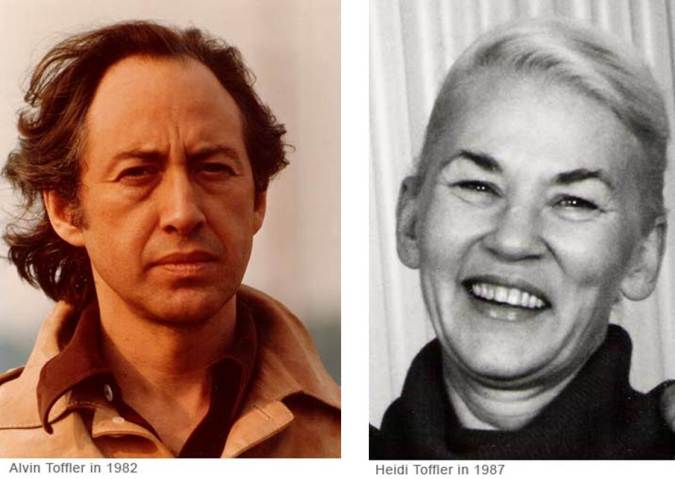
That’s the summary, with the benefit of four decades of hindsight, given by Fast Company writer Greg Lindsay, of the forecasts made in the 1970 bestseller “Future Shock” by husband-and-wife authors Alvin and Heidi Toffler.

As Lindsay comments,

Published in 1970, Future Shock made its author Alvin Toffler – a former student radical, welder, newspaper report and Fortune editor – a household name. Written with his wife (and uncredited co-author), Heidi Toffler, the book was The World Is Flat of its day, selling 6 million copies and single-handedly inventing futurism…

“Future shock is the shattering stress and disorientation that we induce in individuals by subjecting them to too much change in too short a time”, the pair wrote.

And quoting Deborah Westphal, the managing partner of Toffler Associates, in an interview at an event marking the 40th anniversary of the publication of Future Shock, Lindsay notes the following:

In Future Shock, the Tofflers hammered home the point that technology, culture, and even life itself was evolving too fast for governments, policy-makers and regulators to keep up. Forty years on, that message hasn’t changed. “The government needs to understand the dependencies and the convergence of networks through information,” says Westphal. “And there still needs to be some studies done around rates of change and the synchronization of these systems. Business, government, and organizational structures need to be looked at and redone. We’ve built much of the world economy on an industrial model, and that model doesn’t work in an information-centric society. That’s probably the greatest challenge we still face -understanding the old rules don’t apply for the future.”

Earlier this week, another book was published, that also draws on Future Shock for inspiration.  Again, the authors are a husband-and-wife team, Parag and Ayesha Khanna.  And again, the book looks set to redefine key aspects of the futurist endeavour.

This new book is entitled “Hybrid Reality: Thriving in the Emerging Human-Technology Civilization“.  The Khannas refer early on to the insights expressed by the Tofflers in Future Shock:

The Tofflers’ most fundamental insight was that the pace of change has become as important as the content of change… The term Future Shock was thus meant to capture our intense anxiety in the face of technology’s seeming ability to accelerate time. In this sense, technology’s true impact isn’t just physical or economic, but social and psychological as well.

One simple but important example follows:

Technologies such as mobile phones can make us feel empowered, but also make us vulnerable to new pathologies like nomophobia – the fear of being away from one’s mobile phone. Fifty-eight percent of millennials would rather give up their sense of smell than their mobile phone.

As befits the theme of speed, the book is a fast read. I downloaded it onto my Kindle on the day of its publication, and have already read it all the way through twice. It’s short, but condensed. The text contains many striking turns of phrase, loaded with several layers of meaning, which repay several rethinks. That’s the best kind of sound-bite.

Despite its short length, there are too many big themes in the book for me to properly summarise them here. The book portrays an optimistic vision, alongside a series of challenges and risks. As illustrations, let me pick out a selection of phrases, to convey some of the flavour:

The cross-pollination of leading-edge sectors such as information technology, biotechnology, pervasive computing, robotics, neuroscience, and nanotechnology spells the end of certain turf wars over nomenclature. It is neither the “Bio Age” nor the “Nano Age” nor the “Neuro Age”, but the hybrid of all of these at the same time…

Our own relationship to technology is moving beyond the instrumental to the existential. There is an accelerating centripetal dance between what technologies are doing outside us and inside us. Externally, technology no longer simply processes our instructions on a one-way street. Instead, it increasingly provides intelligent feedback. Internally, we are moving beyond using technology only to dominate nature towards making ourselves the template for technology, integrating technologies within ourselves physically. We don’t just use technology; we absorb it

The Hybrid Age is the transition period between the Information Age and the moment of Singularity (when machine surpass human intelligence) that inventor Ray Kurzweil estimates we may reach by 2040 (perhaps sooner). The Hybrid Age is a liminal phase in which we cross the threshold toward a new mode of arranging global society…

You may continue to live your life without understanding the implications of the still-distant Singularity, but you should not underestimate how quickly we are accelerating into the Hybrid Age – nor delay in managing this transition yourself

The dominant paradigm to explain global change in the Hybrid Age will be geotechnnology. Technology’s role in shaping and reshaping the prevailing order, and accelerating change between orders, forces us to rethink the intellectual hegemony of geopolitics and geoeconomics…

It is geotechnology that is the underlying driver of both: Mastery in the leading technology sectors of any era determines who leads in geoeconomics and dominates in geopolitics…

The shift towards a geotechnology paradigm forces us to jettison centuries of foundational assumptions of geopolitics. The first is our view on scale: “Bigger is better” is no longer necessarily true. Size can be as much a liability as an asset…

We live and die by our Technik, the capacity to harness emerging technologies to improve our circumstances…

We will increasingly differentiate societies on the basis not of their regime type or income, but of their capacity to harness technology. Societies that continuously upgrade their Technik will thrive…

Meeting the grand challenge of improving equity on a crowded planet requires spreading Technik more than it requires spreading democracy

And there’s lots more, applying the above themes to education, healthcare, “better than new” prosthetics, longevity and rejuvenation, 3D printing, digital currencies, personal entrepreneurship and workforce transformation, the diffusion of authority, the rise of smart cities and their empowered “city-zens”, augmented reality and enhanced personal avatars, robots and “avoiding robopocalypse”, and the prospect for a forthcoming “Pax Technologica”.

It makes me breathless just remembering all these themes – and how they time and again circle back on each other.

Footnote: Readers who are in the vicinity of London next Saturday (23rd June) are encouraged to attend the London Futurist / Humanity+ UK event “Hybrid Reality, with Ayesha Khanna”. Click on the links for more information.

26 March 2012

Short-cuts to sharper thinking?

Filed under: bias, futurist, intelligence, nootropics — David Wood @ 11:15 pm

What are the best methods to get our minds working well? Are there ways to significantly improve our powers of concentration, memory, analysis, and insight?

Some methods for cognitive enhancement are well known:

  • Get plenty of sleep
  • Avoid distracting environments
  • Practice concentration, to build up mental stamina
  • Augment our physical memories with external memories, whether in physical or electronic format, that we can consult again afterwards
  • Beware the sway of emotion – “when your heart’s on fire, smoke gets in your eyes”
  • Learn about cognitive fallacies and biases – and how to avoid them
  • Share our thinking with trusted friends and colleagues, who can provide constructive criticism
  • Listen to music which has the power both to soothe the mind and to stimulate it
  • Practice selected yoga techniques, which can provide a surge of mental energy
  • Get in touch with our “inner why”, that rekindles our motivation and focus.

Then there are lots of ideas about food and drink to partake, or to avoid. Caffeine provides at least a transient boost to concentration. Alcohol encourages creativity but weakens accurate discernment. Sugar can provide a short-term buzz, though (perhaps) at the cost of longer-term sluggishness. Claims have been made for ginseng, ginkgo biloba, ginger, dark chocolate, Red Bull, and many other foods and supplements.

But potentially the most dramatic effects could result from new compounds – compounds that are being specially engineered in the light of recent findings about the operation of the brain. The phrase “smart drugs” refers to something that could dramatically boost our mental powers.

Think of the character Eddie in the film Limitless, and of the mental superpowers he acquired from NZT, a designer pharmaceutical.

If a real-world version of NZT were offered to you, would you take it?

(Note: NZT has its own real-world website – which is a leftover part of a sophisticated marketing campaign for Limitless.)

I foresee four kinds of answer:

  1. No such drug could be created. This is just fiction.
  2. If such a drug existed, there would be risks of horrible side-effects (as indeed – spoiler alert! – happened in Limitless). It would be foolish to experiment.
  3. If such a drug existed, it would be immoral and/or inappropriate to take it. It’s unfair to short-circuit the effort required to actually make ourselves mentally sharper.
  4. Sure, bring it to me! – especially for mission-critical situations like major exams, job interviews, client bid preparation, project delivery deadlines, and for those social occasions when it’s particularly important to make a good impression.

My own answer: even though nothing as remarkable as NZT exists today, drugs with notable mental effects are going to become increasingly available over the next decade or so.  As well as being more widely available, the quality and reliability will increase too.

So we’re likely to be hearing more and more of the phrases “cognitive enhancers”, “smart drugs”, and “nootropics“.  We’ll all going to have to come to terms with weighing up the pros and cons of taking these enhancers.  And we’ll probably need to appreciate many variations and special cases.

Yes, there will be risks of side effects.  But it’s the same with other drugs and dietary supplements.  We need to collect and sift evidence, as it is most likely to apply to us.

For example: on the advice of my doctors, I take a small dose of aspirin every evening, and a statin.  These drugs are known to have side-effects in some cases.  So my GP ensured that I had a blood test after I’d been taking the statins for a while, to check there were no signs of the most prevalent side-effect.  In due course, genomic sequences might identify which people are more susceptible to particular side-effects.

Similarly with nootropics: the best effects are likely to arise from tailoring doses to the special circumstances of individual people, and to monitoring for unusual side effects.

There’s already lots of information online about various nootropics.  For example, see this Nootropics FAQ.  That’s a lot to take in!

Personally, for the next few years, I expect to continue to focus my own cognitive enhancement project on the methods I listed at the start of this article.  But I want to keep myself closely informed about developments in nootropics.  If the evidence of substantive beneficial effect becomes clearer, I’ll be ready to take full advantage.

Hmm, the likelihood is that I’m going to need to become smarter, in order to figure out when it’s wise to try to make myself smarter again by taking one or more nootropics.  But that first-stage mental enhancement can happen by immersing myself in a bunch of other smart people…

That’s one reason I’m looking forward to the London Futurist Meetup on the subject of nootropics that is taking place this Thursday (29th March), from 7pm, in the Lord Wargrave pub at 42 Brendon Street, London W1H 5HE.  It’s going to be a semi-informal discussion, with attendees being encouraged to talk about their own experiences, expectations, hopes, and fears about nootropics.  Hopefully, the outcome will be improved collective wisdom!

2 October 2011

Prioritising the best peer pressure

Filed under: BHAG, catalysts, collaboration, futurist, Humanity Plus — David Wood @ 9:36 am

In a world awash with conflicting influences and numerous potential interesting distractions, how best to keep “first things first“?

A big part of the answer is to ensure that the influences we are closest to us are influences:

  • Whose goals are aligned with our own
  • Who can give us prompt, helpful feedback when we are falling short of our own declared intentions
  • Who can provide us with independent viewpoints that enrich, complement, and challenge our current understanding.

In my own case, that’s the reason why I have been drawn to the community known as “Humanity+“:

Humanity+ is an international nonprofit membership organization which advocates the ethical use of technology to expand human capacities. We support the development of and access to new technologies that enable everyone to enjoy better minds, better bodies and better lives. In other words, we want people to be better than well.

I deeply share the goals of Humanity+, and I find some of the world’s most interesting thinkers within that community.

It’s also the reason I have sought to aid the flourishing of the Humanity+ community, particularly in the UK, by organising a series of speaker meetings in London.  The speakers at these meetings are generally fascinating, but its the extended networking that follows (offline and online) which provides the greatest value.

My work life has been very busy in the last few months, leaving me less time to organise regular H+UK meetings.  However, to keep myself grounded in a community that contains many people who can teach me a great deal – a community that can provide powerful positive peer pressure – I’ve worked with some H+UK colleagues to pull together an all day meeting that is taking place at the Saturday at the end of this week (8th October).

The theme of this meeting is “Beyond Human: Rethinking the Technological Extension of the Human Condition“.  It splits into three parts:

  • Beyond human: The science and engineering
  • Beyond human: Implications and controversies
  • Beyond human: Getting involved

The event is free to attend.  There’s no need to register in advance. The meeting is taking place in lecture room B34 in the Malet Street building (the main building) of Birkbeck College.  This is located in Torrington Square (which is a pedestrian-only square), London WC1E 7HX.

Full details are on the official event website.  In this blogpost, to give a flavour of what will be covered, I’ll just list the agenda with the speakers and panellists.

09.30 – Finding the room, networking
Opening remarks
Beyond human: The science and engineering
11.40 – Audience Q&A with the panel consisting of the above four speakers
Lunch break
12.00 – People make their own arrangements for lunch (there are some suggestions on the event website)
Beyond human: Implications and controversies
14.40 – Audience Q&A with the panel consisting of the above four speakers
Extended DIY coffee break
15.00 – Also a chance for extended networking
Beyond human: Getting involved
17.25 – Audience Q&A with the panel consisting of the above four speakers
End of conference
17.45 – Hard stop – the room needs to be empty by 18.00

You can follow the links to find out more information about each speaker. You’ll see that several are eminent university professors. Several have written key articles or books on the theme of technology that significantly enhances human potential. Some complement their technology savvy with an interest in performance art.  All are distinguished and interesting futurists in their own way.

I don’t expect I’ll agree with everything that’s said, but I do expect that great personal links will be made – and strengthened – during the course of the day.  I also expect that some of the ideas shared at the conference – some of the big, hairy, audacious goals unveiled – will take on a major life of their own, travelling around the world, offline and online, catalysing very significant positive change.

29 July 2011

Towards a mind-stretching weekend in New York

Filed under: AGI, futurist, leadership, nanotechnology, robots, Singularity — David Wood @ 9:19 pm

I’ve attended the annual Singularity Summit twice before – in 2008 and in 2009.  I’ve just registered to attend the 2011 event, which is taking place in New York on 15th-16th October.  Here’s why.

On both previous occasions, the summits featured presentations that gave me a great deal to think about, on arguably some of the most significant topics in human history.  These topics include the potential emergence, within the lifetimes of many people alive today, of:

  • Artificial intelligence which far exceeds the capabilities of even the smartest group of humans
  • Robots which far exceed the dexterity, balance, speed, strength, and sensory powers of even the best human athletes, sportspeople, or soldiers
  • Super-small nanobots which can enter the human body and effect far more thorough repairs and enhancements – to both body and mind – than even the best current medical techniques.

True, at the previous events, there were some poor presentations too – which is probably inevitable given the risky cutting-edge nature of the topics being covered.  But the better presentations far outweighed the worse ones.

And as well as the presentations, I greatly enjoyed the networking with the unusual mix of attendees – people who had taken the time to explore many of the fascinating hinterlands of modern technology trends.  If someone is open-minded enough to give serious thought to the ideas listed above, they’re often open-minded enough to entertain lots of other unconventional ideas too.  I frequently found myself in disagreement with these attendees, but the debate was deeply refreshing.

Take a look at the list of confirmed speakers so far: which of these people would you most like to bounce ideas off?

The summit registration page is now open.  As I type these words, that page states that the cost of tickets is going to increase after 31 July.  That’s an argument for registering sooner rather than later.

To provide more information, here’s a copy of the press release for the event:

Singularity Summit 2011 in New York City to Explore Watson Victory in Jeopardy

New York, NY This October 15-16th in New York City, a TED-style conference gathering innovators from science, industry, and the public will discuss IBM’s ‘Watson’ computer and other exciting developments in emerging technologies. Keynote speakers at Singularity Summit 2011 include Jeopardy! champion Ken Jennings and famed futurist and inventor Ray Kurzweil. After losing to an IBM computer in Jeopardy!, Jennings wrote, “Just as factory jobs were eliminated in the 20th century by new assembly-line robots, Brad and I were the first knowledge-industry workers put out of work by the new generation of ‘thinking’ machines. ‘Quiz show contestant’ may be the first job made redundant by Watson, but I’m sure it won’t be the last.”

In February, Watson defeated two human champions in Jeopardy!, the game show famous for its mind-bending trivia questions. Surprising millions of TV viewers, Watson took down champions Ken Jennings and Brad Rutter for the $1 million first prize. Facing defeat on the final show, competitor Ken Jennings jokingly wrote in parentheses on his last answer: “I for one welcome our new computer overlords.” Besides Watson, the Singularity Summit 2011 will feature speakers on robotics, nanotechnology, biotechnology, futurism, and other cutting-edge technologies, and is the only conference to focus on the technological Singularity.

Responding to Watson’s victory, leading computer scientist Ray Kurzweil said, “Watson is a stunning example of the growing ability of computers to successfully invade this supposedly unique attribute of human intelligence.” In Kurzweil’s view, the combination of language understanding and pattern recognition that Watson displays would make its descendants “far superior to a human”. Kurzweil is known for predicting computers whose conversations will be indistinguishable from people by 2029.

Beyond artificial intelligence, the Singularity Summit will also focus on high-tech and where it is going. Economist Tyler Cowen will examine the economic impacts of emerging technologies. Cowen argued in his recent book The Great Stagnation that modern society is on a technological plateau where “a lot of our major innovations are springing up in sectors where a lot of work is done by machines, not by human beings.” Tech entrepreneur and investor Peter Thiel, who sits on the board of directors of Facebook, will share his thoughts on innovation and jumpstarting the economy.

Other speakers include MIT cosmologist Max Tegmark, Allen Brain Institute chief scientist Christof Koch, co-founder of Skype Jaan Tallinn, robotics professors James McLurkin and Robin Murphy, Bionic Builders host Casey Pieretti, the MIT Media Lab’s Riley Crane, MIT polymath Alexander Wissner-Gross, filmmaker and television personality Jason Silva, and Singularity Institute artificial intelligence researcher Eliezer Yudkowsky.

8 May 2011

Future technology: merger or trainwreck?

Filed under: AGI, computer science, futurist, Humanity Plus, Kurzweil, malware, Moore's Law, Singularity — David Wood @ 1:35 pm

Imagine.  You’ve been working for many decades, benefiting from advances in computing.  The near miracles of modern spreadsheets, Internet search engines, collaborative online encyclopaedias, pattern recognition systems, dynamic 3D maps, instant language translation tools, recommendation engines, immersive video communications, and so on, have been steadily making you smarter and increasing your effectiveness.  You  look forward to continuing to “merge” your native biological intelligence with the creations of technology.  But then … bang!

Suddenly, much faster than we expected, a new breed of artificial intelligence is bearing down on us, like a huge intercity train rushing forward at several hundred kilometres per hour.  Is this the kind of thing you can easily hop onto, and incorporate in our own evolution?  Care to stand in front of this train, sticking out your thumb to try to hitch a lift?

This image comes from a profound set of slides used by Jaan Tallinn, one of the programmers behind Kazaa and a founding engineer of Skype.  Jaan was speaking last month at the Humanity+ UK event which reviewed the film “Transcendent Man” – the film made by director Barry Ptolemy about the ideas and projects of serial inventor and radical futurist Ray Kurzweil.  You can find a video of Jaan’s slides on blip.tv, and videos (but with weaker audio) of talks by all five panelists on KoanPhilosopher’s YouTube channel.

Jaan was commenting on a view that was expressed again and again in the Kurzweil film – the view that humans and computers/robots will be able to merge, into some kind of hybrid “post-human”:

This “merger” viewpoint has a lot of attractions:

  • It builds on the observation that we have long co-existed with the products of technology – such as clothing, jewellery, watches, spectacles, heart pacemakers, artificial hips, cochlear implants, and so on
  • It provides a reassuring answer to the view that computers will one day be much smarter than (unmodified) humans, and that robots will be much stronger than (unmodified) humans.

But this kind of merger presupposes that the pace of improvement in AI algorithms will remain slow enough that we humans can remain in charge.  In short, it presupposes what people call a “soft take-off” for super-AI, rather than a sudden “hard take-off”.  In his presentation, Jaan offered three arguments in favour of a possible hard take-off.

The first argument is a counter to a counter.  The counter-argument, made by various critics of the concept of the singularity, is that Kurzweil’s views on the emergence of super-AI depend on the continuation of exponential curves of technological progress.  Since few people believe that these exponential curves really will continue indefinitely, the whole argument is suspect.  The counter to the counter is that the emergence of super-AI makes no assumption about the shape of the curve of progress.  It just depends upon technology eventually reaching a particular point – namely, the point where computers are better than humans at writing software.  Once that happens, all bets are off.

The second argument is that getting the right algorithm can make a tremendous difference.  Computer performance isn’t just dependent on improved hardware.  It can, equally, be critically dependent upon finding the right algorithms.  And sometimes the emergence of the right algorithm takes the world by surprise.  Here, Jaan gave the example of the unforeseen announcement in 1993 by mathematician Andrew Wiles of a proof of the centuries-old Fermat’s Last Theorem.  What Andrew Wiles did for the venerable problem of Fermat’s last theorem, another researcher might do for the even more venerable problem of superhuman AI.

The third argument is that AI researchers are already sitting on what can be called a huge “hardware overhang”:

As Jaan states:

It’s important to note that with every year the AI algorithm remains unsolved, the hardware marches to the beat of Moore’s Law – creating a massive hardware overhang.  The first AI is likely to find itself running on a computer that’s several orders of magnitude faster than needed for human level intelligence.  Not to mention that it will find an Internet worth of computers to take over and retool for its purpose.

Imagine.  The worst set of malware so far created – exploiting a combination of security vulnerabilities, other software defects, and social engineering.  How quickly that can spread around the Internet.  Now imagine an author of that malware that is 100 times smarter.  Human users will find themselves almost unable to resist clicking on tempting links and unthinkingly providing passwords to screens that look identical to the ones they were half-expecting to see.  Vast computing resources will quickly become available to the rapidly evolving, intensely self-improving algorithms.  It will be the mother of all botnets, ruthlessly pursing whatever are the (probably unforeseen) logical conclusions of the software that gave it birth.

OK, so the risk of hard take-off is very difficult to estimate.  At the H+UK meeting, the panelists all expressed significant uncertainty about their predictions for the future.  But that’s not a reason for inaction.  If we thought the risk of super-AI hard take-off in the next 20 years was only 5%, that would still merit deep thought from us.  (Would you get on an airplane if you were told the risk of it plummeting out of the sky was 5%?)

I’ll end with another potential comparison, which I’ve written about before.  It’s another example about underestimating the effects of breakthrough new technology.

On 1st March 1954, the US military performed their first test of a dry fuel hydrogen bomb, at the Bikini Atoll in the Marshall Islands.  The explosive yield was expected to be from 4 to 6 Megatons.  But when the device was exploded, the yield was 15 Megatons, two and a half times the expected maximum.  As the Wikipedia article on this test explosion explains:

The cause of the high yield was a laboratory error made by designers of the device at Los Alamos National Laboratory.  They considered only the lithium-6 isotope in the lithium deuteride secondary to be reactive; the lithium-7 isotope, accounting for 60% of the lithium content, was assumed to be inert…

Contrary to expectations, when the lithium-7 isotope is bombarded with high-energy neutrons, it absorbs a neutron then decomposes to form an alpha particle, another neutron, and a tritium nucleus.  This means that much more tritium was produced than expected, and the extra tritium in fusion with deuterium (as well as the extra neutron from lithium-7 decomposition) produced many more neutrons than expected, causing far more fissioning of the uranium tamper, thus increasing yield.

This resultant extra fuel (both lithium-6 and lithium-7) contributed greatly to the fusion reactions and neutron production and in this manner greatly increased the device’s explosive output.

Sadly, this calculation error resulted in much more radioactive fallout than anticipated.  Many of the crew in a nearby Japanese fishing boat, the Lucky Dragon No. 5, became ill in the wake of direct contact with the fallout.  One of the crew subsequently died from the illness – the first human casualty from thermonuclear weapons.

Suppose the error in calculation had been significantly worse – perhaps by an order of thousands rather than by a factor of 2.5.  This might seem unlikely, but when we deal with powerful unknowns, we cannot rule out powerful unforeseen consequences.  For example, imagine if extreme human activity somehow interfered with the incompletely understood mechanisms governing supervolcanoes – such as the one that exploded around 73,000 years ago at Lake Toba (Sumatra, Indonesia) and which is thought to have reduced the worldwide human population at the time to perhaps as few as several thousand people.

The more quickly things change, the harder it is to foresee and monitor all the consequences.  The more powerful our technology becomes, the more drastic the unintended consequences become.  Merger or trainwreck?  I believe the outcome is still wide open.

7 May 2011

Workers beware: the robots are coming

Filed under: books, challenge, disruption, Economics, futurist, robots — David Wood @ 9:07 pm

What’s your reaction to the suggestion that, at some stage in the next 10-30 years, you will lose your job to a robot?

Here, by the word “robot”, I’m using shorthand for “automation” – a mixture of improvements in hardware and software. The suggestion is that automation will continue to improve until it reaches the stage when it is cheaper for your employer to use computers and/or robots to do your job, than it is to continue employing you. This change has happened in the past with all manner of manual and/or repetitive work. Could it happen to you?

People typically have one of three reactions to this suggestion:

  1. “My job is too complex, too difficult, too human-intense, etc, for a robot to be able to do it in the foreseeable future. I don’t need to worry.”
  2. “My present job may indeed be outsourced to robots, but over the same time period, new kinds of job will be created, and I’ll be able to do one of these instead. I don’t need to worry.”
  3. “When the time comes that robots can do all the kinds of work that I can do, better than me, we’ll be living in an economy of plenty. I won’t actually need to work – I’ll be happy to enjoy lots more leisure time. I don’t need to worry.”

Don’t need to worry? Think again. That’s effectively the message in Martin Ford’s 2009 book “The lights in the tunnel“. (If you haven’t heard of that book, perhaps it’s because the title is a touch obscure. After all, who wants to read about “lights in a tunnel”?)

The subtitle gives a better flavour of the content: “Automation, accelerating technology, and the economy of the future“. And right at the top of the front cover, there’s yet another subtitle: “A journey to the economic landscape of the coming decades“. But neither of these subtitles conveys the challenge which the book actually addresses. This is a book that points out real problems with increasing automation:

  • Automation will cause increasing numbers of people to lose their current jobs
  • Accelerating automation will mean that robots can quickly become able to do more jobs – their ability to improve and learn will far outpace that of human workers – so the proportion of people who are unemployed will grow and grow
  • Without proper employment, a large proportion of consumers will be deprived of income, and will therefore lack the spending power which is necessary for the continuing vibrancy of the economy
  • Even as technology improves, the economy will stagnate, with disastrous consequences
  • This is likely to happen long before technologies such as nanotech have reached their full potential – so that any ideas of us existing at that time in an economy of plenty are flawed.

Although the author could have chosen a better title for his book, the contents are well argued, and easy to read. They deserve a much wider hearing.  They underscore the important theme that the process of ongoing technological improvement is far from being an inevitable positive.

There are essentially two core threads to the book:

  • A statement of the problem – this effectively highlights issues with each of the reactions 1-3 listed earlier;
  • Some tentative ideas for a possible solution.

The book looks backwards in history, as well as forwards to the future. For example, it includes interesting short commentaries on both Marx and Keynes. One of the most significant backward glances considers the case of the Luddites – the early 19th century manufacturing workers in the UK who feared that their livelihoods would be displaced by factory automation. Doesn’t history show us that such fears are groundless? Didn’t the Luddites (and their descendants) in due course find new kinds of employment? Didn’t automation create new kinds of work, at the same time as it destroyed some existing kinds of work? And won’t that continue to happen?

Well, it’s a matter of pace.  One of most striking pictures in the book is a rough sketch of the variation over time of the comparative ability of computers and humans to perform routine jobs:

As Martin Ford explains:

I’ve chosen an arbitrary point on the graph to indicate the year 1812. After that year, we can reasonably assume that human capability continued to rise quite steeply until we reach modern times. The steep part of the graph reflects dramatic improvements to our overall living conditions in the world’s more advanced countries:

  • Vastly improved nutrition, public health, and environmental regulations have allowed us to remain relatively free from disease and reach our full biological potential
  • Investment in literacy and in primary and secondary education, as well as access to college and advanced education for some workers, has greatly increased overall capability
  • A generally richer and more varied existence, including easy access to books, media, new technologies and the ability to travel long distances, has probably had a positive impact on our ability to comprehend and deal with complex issues.

A free download of the entire book is available from the author’s website.  I’ll leave it to you to evaluate the author’s arguments for why the two curves in this sketch have the shape that they do.  To my mind, these arguments have a lot of merit.

The point where these two curves cross – potentially a few decades into the future – will represent a new kind of transition point for the economy – perhaps the mother of all economic disruptions.  Yes, there will still be some new jobs created.  Indeed, in a blogpost last year, “Accelerating automation and the future of work“, I listed 20 new occupations that people could be doing in the next 20 years:

  1. Body part maker
  2. Nano-medic
  3. Pharmer of genetically engineered crops and livestock
  4. Old age wellness manager/consultant
  5. Memory augmentation surgeon
  6. ‘New science’ ethicist
  7. Space pilots, tour guides and architects
  8. Vertical farmers
  9. Climate change reversal specialist
  10. Quarantine enforcer
  11. Weather modification police
  12. Virtual lawyer
  13. Avatar manager / devotees / virtual teachers
  14. Alternative vehicle developers
  15. Narrowcasters
  16. Waste data handler
  17. Virtual clutter organiser
  18. Time broker / Time bank trader
  19. Social ‘networking’ worker
  20. Personal branders

However, the lifetimes of these jobs (before they too can be handled by improved robots) will shrink and shrink.  For a less esoteric example, consider the likely fate of a relatively new profession, radiology.  As Martin Ford explains:

A radiologist is a medical doctor who specializes in interpreting images generated by various medical scanning technologies. Before the advent of modern computer technology, radiologists focused exclusively on X-rays. This has now been expanded to include all types of medical imaging, including CT scans, PET scans, mammograms, etc.

To become a radiologist you need to attend college for four years, and then medical school for another four. That is followed by another five years of internship and residency, and often even more specialized training after that. Radiology is one of the most popular specialties for newly minted doctors because it offers relatively high pay and regular work hours; radiologists generally don’t need to work weekends or handle emergencies.

In spite of the radiologist’s training requirement of at least thirteen additional years beyond high school, it is conceptually quite easy to envision this job being automated. The primary focus of the job is to analyze and evaluate visual images. Furthermore, the parameters of each image are highly defined since they are often coming directly from a computerized scanning device. Visual pattern recognition software is a rapidly developing field that has already produced significant results…

Radiology is already subject to significant offshoring to India and other places. It is a simple matter to transmit digital scans to an overseas location for analysis. Indian doctors earn as little as 10 percent of what American radiologists are paid… Automation will often come rapidly on the heels of offshoring, especially if the job focuses purely on technical analysis with little need for human interaction. Currently, U.S. demand for radiologists continues to expand because of the increase in use of diagnostic scans such as mammograms. However, this seems likely to slow as automation and offshoring advance and become bigger players in the future. The graduating medical students who are now rushing into radiology for its high pay and relative freedom from the annoyances of dealing with actual patients may eventually come to question the wisdom of their decision

Radiologists are far from being the only “high-skill” occupation that is under risk from this trend.  Jobs which involve a high degree of “expert system” knowledge will come under threat from increasingly expert AI systems.  Jobs which involve listening to human speech will come under threat from increasingly accurate voice recognition systems.  And so on.

This leaves two questions:

  1. Can we look forward, as some singularitarians and radical futurists assert, to incorporating increasing technological smarts within our own human nature, allowing us in a sense to merge with the robots of the future?  In that case, a scenario of “the robots will take all our jobs” might change to “substantially enhanced humans will undertake new types of work”
  2. Alternatively, if robots do much more of the work needed within society, how will the transition be handled, to a society in which humans have much more leisure time?

I’ll return to the first of these questions in a subsequent blogpost.  Martin Ford’s book has a lot to say about the second of these questions.  And he recommends a series of ideas for consideration:

  • Without large numbers of well-paid consumers able to purchase goods, the global economy risks going into decline, at the same time as technology has radically improved
  • With fewer people working, there will be much less income tax available to governments.  Taxation will need to switch towards corporation tax and consumption taxes
  • With more people receiving handouts from the state, there’s a risk of loss of many of aspects of economic structure which previously have been thought essential
  • We need to give more thought, now, to ideas for differential state subsidy of different kinds of non-work activity – to incentivise certain kinds of activity.  That way, we’ll be ready for the increasing disturbances placed on our economy by the rise of the robots.

For further coverage of these and related ideas, see Martin Ford’s blog on the subject, http://econfuture.wordpress.com/.

2 April 2011

Virtual futures and digital natives

Filed under: disruption, Events, futurist, Humanity Plus — David Wood @ 6:34 pm

A child born today will be immersed in a world that is, more than ever, virtual…  With a single Google search, a child has instant access to a plethora of information. With Google Earth the entire globe can be navigated with little travel-cost endured. And languages can be translated without a single understanding of the complex linguistics of other cultures…

These words are taken from the blog for the forthcoming University of Warwick Virtual Futures 2.0’11 conference.  The stated theme of the conference is “Digital natives: fear of the flesh?”.  The phrase “digital native” refers to someone young enough (in body or in spirit) to find themselves at home in the fast-evolving digital connected world.

But is anyone truly at home in this world?  The author of the blog, Luke Robert Mason, continues as follows, drawing on comments made by performance artist Stelarc who took part in an earlier Virtual Futures conference:

But this virtual world is also plagued by complexity – a complexity born of information which the  biological brain is not designed to comprehend.  As performance artist Stelarc stated in his early work, “It is time to question whether a bipedal, breathing body with binocular vision and a 1400cc brain is an adequate biological form. It cannot cope with the quantity, complexity and quality of information it has accumulated; it is intimidated by the precision, speed and power of technology and it is biologically ill-equipped to cope with its new extraterrestrial environment.”

The Virtual Futures 2.0 conference rekindles a series of trailblazing conferences that the University of Warwick hosted in 1994, 1995, and 1996, attracting upwards of 300 attendees:

These conferences questioned the future possibility of the ‘virtual’ and alluded towards the impact of emerging technologies on society and culture. They were, at their time, revolutionary…

The topics discussed at the conferences in the 90’s included chaos theory, geopolitics, feminism, nanotechnology, cyberpunk fiction, machine music, net security, military strategy, plastic surgery, hacking, bio-computation, cognition, cryptography & capitalism. These topics are still poignant today with perhaps the addition of genetics, bio-engineering, neuroscience, artificial intelligence, bio-ethics and social media.

Call for papers

The conference organisers have now issued a call for papers:

The revival aims to reignite the debates over the implications of new and future communication technologies on art, society and politics. The conference will take place on the 18th-19th June 2011 and include paper presentations, panels, performances, screenings and installations.

We welcome researchers, scholars and artists to submit proposals for papers and/or performances around this year’s theme of: “Digital Natives: Fear of the Flesh?”…

Please send proposals (250 words max) to papers@virtualfutures.co.uk by 1st May 2011.

Interested in presenting or performing at the event?  As for myself, I’m preparing a proposal to speak at the conference.  I’m thinking about speaking on the topic “Beyond super phones to super humans – a journey along the spectrum of personal commitment to radical technological transformation“.

I like the conference focus on “digital natives” but I’m less convinced about the “Fear of the flesh?” coda.  Yes, my human flesh has lots of limitations.  But I look ahead to far-reaching bodily improvement, rather than to leaving my flesh altogether behind.  Other radical futurists, in contrast, seem to eagerly anticipate a time when their mind will be entirely uploaded into a virtual world.  There’s ground for lots of debate here:

  • Are these visions credible?
  • Are these visions desirable?
  • How should such visions be evaluated, in a world full of pressing everyday problems?
  • Which of these personal futures should we prioritise?

No doubt these questions, along with many others, will be tackled at the event.

Note: Virtual Futures 2.0 is organised at the University of Warwick with support from the Institute for Advanced Teaching and Learning, the School of Theatre, Performance and Cultural Policy Studies, and the Centre for History of Medicine, in association with Humanity+ UK.

19 March 2011

A singularly fine singularitarian panel?

Filed under: futurist, Humanity Plus, Kurzweil, Singularity — David Wood @ 12:37 pm

In a moment, I’ll get to the topic of a panel discussion on the Singularity – a panel I’ve dubbed (for reasons which should become clear) “Post Transcendent Man“. It’s a great bunch of speakers, and I’m expecting an intellectual and emotional mindfest.  But first, some background.

In the relatively near future, I expect increasing numbers of people to navigate the sea change described recently by writer Philippe Verdoux in his article Transhumanists coming out of the closet:

It wasn’t that long ago that listing transhumanism, human enhancement, the Singularity, technology-driven evolution, existential risks, and so on, as interests on one’s CV might result in a bit of embarrassment.

Over just the past decade and a half, though, there seems to have been a sea change in how these issues are perceived by philosophers and others: many now see them as legitimate subjects of research; they have, indeed, acquired a kind of academic respectability that they didn’t previously possess.

There are no doubt many factors behind this shift. For one, it seems to be increasingly apparent, in 2011, that technology and biology are coming together to form a new kind of cybernetic unity, and furthermore that such technologies can be used to positively enhance (rather than merely alter) features of our minds and bodies.

In other words, the claim that humans can “transcend” (a word I don’t much like, by the way) our biological limitations through the use of enhancement technologies seems to be increasingly plausible – that is, empirically speaking.

Thus, it seems to be a truism about our contemporary world that technology will, in the relatively near future, enable us to alter ourselves in rather significant ways. This is one reason, I believe, that more philosophers are taking transhumanism seriously…

On a personal note, when I first discovered transhumanism, I was extremely skeptical about its claims (which, by the way, I think every good scientific thinker should be). I take it that transhumanism makes two claims in particular, the first “descriptive” and the second “normative”: (i) that future technologies will make it possible for us to radically transform the human organism, potentially enabling us to create a new species of technologized “posthumans”; and (ii) that such a future scenario is preferable to all other possible scenarios. In a phrase: we not only can but ought to pursue a future marked by posthumanity…

One factor that leads people to pay more serious attention to this bundle of ideas – transhumanism, human enhancement, the Singularity, technology-driven evolution, existential risks, and so on – is the increasing coverage of these ideas in thoughtful articles in the mainstream media.  In turn, many of these articles have been triggered by the film Transcendent Man by director Barry Ptolemy, featuring the groundbreaking but controversial ideas and projects of inventor and futurist Ray Kurzweil.  Here’s a trailer for the film:

The film has received interesting commentary in, among other places:

I had mixed views when watching the movie myself:

  • On the one hand, it contains a large number of profound sound bites – statements made by many of the talking heads on screen; any of these sound bites could, potentially, change someone’s life, if they reflect on the implications;
  • The film also covers many details of Kurzweil’s own biography, with archive footage of him at different stages of his career – this filled in many gaps in my own understanding, and gave me renewed respect for what he has accomplished as a professional;
  • On the other hand, although there are plenty of critical comments among the sound bites – comments highlighting potential problems or issues with Kurzweil’s ideas – the film never really lets the debate fly;
  • I found myself thinking – yes, that’s an interesting and important point, now let’s explore this further – but then the movie switched to a different frame.

The movie has its official UK premier at the London Science Museum on Tuesday 5th April.  Kurzweil himself will be in attendance, to answer questions raised by the audience.  The last time I checked, tickets were sold out.

Post Transcendent Man

To drill down more deeply into the potentially radical implications of Kurzweil’s ideas and projects, the UK chapter of Humanity+ has arranged an event in  Birkbeck College (WC1E 7HX), Torrington Square in Central London on the afternoon (2pm-4.15pm) of Saturday 9th April.  We’ll be in Malet Street lecture room B34 – which seats a capacity audience of 177 people.  For more details about logistics, registration, and so on, see the official event website, or the associated Facebook page.

The event is privileged to feature an outstanding set of speakers and panellists who represent a range of viewpoints about the Singularity, transhumanism, and human transcendence.  In alphabetical order by first name:

Dr Anders Sandberg is a James Martin research fellow at the Future of Humanity Institute at Oxford University. As a part of the Oxford Martin School he is involved in interdisciplinary research on cognitive enhancement, neurotechnology, global catastrophic risks, emerging technologies and applied rationality. He has been writing about and debating transhumanism, future studies, neuroethics and related questions for a long time. He is also an associate of the Oxford Centre for Neuroethics and the Uehiro Centre for Practical Ethics, as well as co-founder of the Swedish think tank Eudoxa.

Jaan Tallinn is one of the programmers behind Kazaa and a founding engineer of Skype. He is also a partner in Ambient Sound Investments as well as a member of the Estonian President’s Academic Advisory Board. He describes himself as singularitarian/hacker/investor/physicist (in that order). In recent years Jaan has found himself closely following and occasionally supporting the work that SIAI and FHI are doing. He agrees with Kurzweil in that the topic of Singularity can be extremely counterintuitive to general public, and has tried to address this problem in a few public presentations at various venues.

Nic Brisbourne is a partner at venture capital fund DFJ Esprit and blogger on technology and startup issues at The Equity Kicker. As such he’s interested in when technology and science projects become products and businesses. He has a personal interest in Kurzweil’s ideas and longevity in particular and he says he’s keen to cross the gap from personal to professional and find exciting startups generating products in this area, although he thinks that the bulk of the commercialisation opportunities are still a year or two out.

Paul Graham Raven is a writer, literary critic and bootstrap big-picture futurist; he prods regularly at the fuzzy boundary of the unevenly-distributed future at futurismic.com. He is Editor-in-Chief and Publisher of The Dreaded Press, a rock music reviews webzine, and Publicist and PR officer for PS Publishing – perhaps the UK’s foremost boutique genre publisher. He says he’s also a freelance web-dev to the publishing industry, a cack-handed fuzz-rock guitarist, and in need of a proper haircut.

Russell Buckley is a leading practitioner, speaker and thinker about mobile and mobile marketing. MobHappy, his blog about mobile technology, is one of the most established focusing on this area. He is also a previous Global Chairman of the Mobile Marketing Association, a founder of Mobile Monday in Germany and holds numerous non-executive positions in mobile technology companies. Russell learned about mobile advertising startup, AdMob, soon after its launch, and joined as its first employee in 2006, with the remit of launching AdMob into the EMEA market. Four years later, AdMob was sold to Google for $750m. By night though, Russell is fascinated by the socio-political implications of technology and recently graduated from the Executive Program at the Singularity University, founded by Ray Kurtzweil and Peter Diamandis to “educate and inspire leaders who strive to understand and facilitate the development of exponentially advancing technologies in order to address humanity’s grand challenges”.

The discussion continues

The event will start, at 2pm, with the panellists introducing themselves, and their core thinking about the topics under discussion.  As chair, I’ll ask a few questions, and then we’ll open up for questions and comments from the audience.  I’ll be particularly interested to explore:

  • How people see the ideas of accelerating technology making a difference in their own lives – both personally or professionally.  Three of us on the stage were on founding teams of companies that made sizeable waves in the technology world (Jaan Tallinn, Skype; Russell Buckley, AdMob; myself, Symbian).  Where do we see rapidly evolving technology (as often covered by Kurzweil) taking us next?
  • People’s own experiences with bodies such as the Singularity University, the Singularity Institute, and the Future of Humanity Institute at Oxford University.  Are these bodies just talking shops?  Are they grounded in reality?  Are they making a substantial positive difference in how humanity responds to the issues and challenges of technology?
  • Views as to the best way to communicate ideas like the Singularity – favourite films, science fiction, music, and other media.  How does the move “Transcendent Man” compare?
  • Reservations and worries (if any) about the Singularity movement and the ways in which Kurzweil expresses his ideas.  Are the parallels with apocalyptic religions too close for comfort?
  • Individuals’ hopes and aspirations for the future of technology.  What role do they personally envision playing in the years ahead?  And what timescales do they see as credible?
  • Calls to action – what (if anything) should members of the audience change about their lives, in the light of analysing technology trends?

Which questions do you think are the most important to raise?

Request for help

If you think this is an important event, I have a couple of suggestions for you:

The discussion continues (more)

Dean Bubley, founder of Disruptive Analysis and a colleague of mine from the mobile telecomms industry, has organised the “Inaugural UK Humanity+ Evening Salon” on Wednesday April 13th, from 7pm to 10pm.  Dean describes it as follows:

Interested in an evening discussing the future of the human species & society? Aided by a drink or two?

This is the first “salon” event for the London branch of “Humanity Plus”, or H+ for short. It’s going to be an informal evening event involving a stimulating guest speaker, Q&A and lively discussion, all aided by a couple of drinks. It fits alongside UKH+’s larger Saturday afternoon lecture sessions, and occasional all-day major conferences…

It will be held in central London, in a venue TBC closer to the time. Please contact Dean Bubley (facebook.com/bubley), the convener & moderator, for more details.

For more details, see the corresponding Facebook page, and RSVP there so that Dean has an idea of the likely numbers.

« Newer PostsOlder Posts »

Blog at WordPress.com.