dw2

3 July 2013

Preparing for driverless vehicles

Filed under: driverless vehicles, futurist, Humanity Plus, robots, safety, sensors, vision, Volvo — David Wood @ 10:56 am

It’s not just Google that is working on autonomous, self-driving cars. Take a look at this recent Atutoblog video showing technology under development by Swedish manufacturer Volvo:

This represents another key step in the incorporation of smart wireless technology into motor vehicles.

Smart wireless technology already has the potential to reduce the number of lives lost in road accidents. A memo last month from the EU commission describes the potential effect of full adoption of the 112 eCall system inside cars:

The 112 eCall automatically dials Europe’s single emergency number 112 in the event of a serious accident and communicates the vehicle’s location to the emergency services. This call to 112, made either automatically by means of the activation of in-vehicle sensors or manually, carries a standardised set of data (containing notably the type and the location of the vehicle) and establishes an audio channel between the vehicle and the most appropriate emergency call centre via public mobile networks.

Using a built-in acceleration sensor, the system detects when a crash has occurred, and how serious it is likely to be. For example, it can detect whether the car has rolled over onto its roof. Then it transmits the information via a built-in wireless SIM. As the EU commission memo explains:

  • In 2012 around 28,000 people were killed and more than 1.5 million injured in 1.1 million traffic accidents on EU roads.
  • Only around 0.7% of vehicles are currently equipped with private eCall systems in the EU, with numbers barely rising. These proprietary systems do not offer EU-wide interoperability or continuity.
  • In addition to the tragedy of loss of life and injury, this also carries an economic burden of around EUR 130 billion in costs to society every year.
  • 112 eCall can speed up emergency response times by 40% in urban areas and 50% in the countryside. Fully deployed, it can save up to 2500 lives a year and alleviate severity of road injuries. In addition, thanks to improved accident management, it is expected to reduce congestion costs caused by traffic accidents.

That’s 9% fewer fatalities, as a result of emergency assistance being contacted more quickly.

But what if the number of accidents could themselves be significantly reduced? Here it’s important to know the predominant factors behind road accidents. A landmark investigation of 700,000 road accidents in the UK over 2005-2009 produced some surprising statistics. As reported by David Williams in the Daily Telegraph,

Vehicle defects are a factor in only 2.8 per cent of fatals, with tyres mostly to blame (1.5 per cent) followed by dodgy brakes (0.7 per cent).

The overriding message? It’s not your car or the “road conditions” that are most likely to kill you. It’s your own driving.

In more detail:

The biggest cause of road accidents in the UK today? The statistics are quite clear on this and it’s “driver error or reaction”. It’s listed by police as a factor in more than 65 per cent of fatal crashes and the heading covers a multitude of driving sins many of which you’re probably on first-name terms with. Topping the charge sheet is failing to look properly (the Smidsy factor – “Sorry mate, I didn’t see you’, relevant in 20.5 per cent of fatals involving driver error), followed by “loss of control” (34 per cent) which, says Greig, often means leaving yourself with “nowhere to go” after entering a bend or other situation, too quickly. Other errors include “poor turn or manoeuvre” (12 per cent) and “failed to judge other person’s path or speed” (11.6 per cent.).

Second biggest cause of fatal accidents, to blame for 31 per cent, is the “injudicious action”, an umbrella term for “travelled too fast for the conditions’ (15.9 per cent of those labelled injudicious), “exceeded speed limit” (13.9 per cent) or “disobeyed give-way or stop sign” (2.1 per cent)?

Third culprit in the daily gamble on who lives and who dies is “behaviour or inexperience” (28 per cent), which covers faults such as “careless, reckless or in a hurry” (17 per cent), “aggressive driving” (8.3 per cent) and “learner/inexperienced” (5.3 per cent).

The fourth main category is “impairment or distraction” (to blame for 19.6 per cent of fatal accidents) covering “alcohol” (a factor in 9.6 per cent of fatal accidents) and “distraction in vehicle” (2.6 per cent).

(The numbers add up to more than 100% because accidents are often attributed to more than one factor.)

These statistics give strength to the remark by Eric Schmidt, Executive Chairman of Google:

Your car should drive itself. It’s amazing to me that we let humans drive cars. It’s a bug that cars were invented before computers.

This suggestion commonly gives rise to three objections:

  1. The technology will never become good enough
  2. Even if the raw technology inside cars becomes better and better, there will need to be lots of changes in roadways, which will take a very long time to achieve
  3. Even if the technology did become good enough, legal systems will never catch up. Who’s going to accept liability for crashes caused by bugs in software?

The first objection is heard less often these days. As noted in a 2011 New York Times interview by Erik Brynjolfsson and Andrew P. McAfee of the M.I.T. Center for Digital Business, and authors of the book Race Against the Machine,

In 2004, two leading economists, Frank Levy and Richard J. Murnane, published “The New Division of Labor,”which analyzed the capabilities of computers and human workers. Truck driving was cited as an example of the kind of work computers could not handle, recognizing and reacting to moving objects in real time.

But last fall, Google announced that its robot-driven cars had logged thousands of miles on American roads with only an occasional assist from human back-seat drivers. The Google cars are but one sign of the times.

The third objection will surely fall away soon too. There are already mechanisms whereby some degree of liability can be accepted by car manufacturers, in cases where software defects (for example, in braking and accelerating systems) contribute to accidents. Some examples are covered in the CNN Money review “Toyota to pay $1.1 billion in recall case”.

Another reason the third objection will fall away is because the costs of not changing – that is, of sticking with human drivers – may be much larger than the costs of adopting driverless vehicles. So long as we continue to allow humans to drive cars, there will continue to be driver-induced accidents, with all the physical and social trauma that ensues.

That still leaves the second objection: the other changes in the environment that will need to take place, before driverless vehicles can be adopted more widely. And what other changes will take place, possibly unexpectedly, once driverless cars are indeed adopted?

That’s one of the topics that will be covered in this Saturday’s London Futurists event: The future of transport: Preparing for driverless vehicles? With Nathan Koren.

Nathan_Koren_PhotoAs explained by the speaker at the event, Nathan Koren,

The robots have arrived. Driverless transport pods are now in operation at Heathrow Terminal 5 and several other locations around the world. Driver-assist technologies are becoming commonplace. Many believe that fully driverless cars will be commercially available before the decade is out. But what will the broader impact of driverless transport be?

Automobiles were once called “horseless carriages,” as though the lack of a horse was their most important feature. In reality, they changed the way we work, live, and play; changed the way we design cities; and altered the global economy, political landscape, and climate.

It will be the same with driverless vehicles: we can expect their impact to be go far beyond simply being able to take our hands off the wheel.

This presentation and discussion goes into depth about how automated transport will affect our lives and reshape the the world’s cities.

Nathan is a London-based, American-born architect, transport planner, and entrepreneur. He is widely recognised as a leading authority on Automated Transit Networks, and designed what is scheduled to become the world’s first urban-scale system, in Amritsar, India. He works as a Transport Technology & Planning Consultant for Capita Symonds, and recently founded Podaris, a cloud-based platform for the collaborative design of Automated Transit Networks. Nathan holds an Architecture degree from Arizona State University, and an MBA from the University of Oxford.

I hope to see some readers of this blog, who are based in or near London, at the meeting this Saturday. It’s an important topic!

For additional background inspiration, I recommend the three short videos in the article “The future of travel: Transportation confronts its ‘Kodak moment'”. (Thanks to Nathan for drawing this article to my attention.)

Speakers in these videos talk about the industries that are liable to radical disruption (and perhaps irrelevance) due to the rise of collision-proof driverless vehicles. The airbag industry is one; car collision insurance might be another. I’m sure you can think of more.

13 June 2013

Previewing Global Future 2045

Filed under: futurist, GF2045, robots — David Wood @ 4:32 am

The website for this weekend’s Global Future 2045 international congress has the following bold headline:

Towards a new strategy for human evolution

gf2045-logo

By many measures, the event is poised to be a breakthrough gathering: check the list of eminent speakers and the provocative list of topics to be addressed.

The congress is scheduled to start at 9am on Saturday morning. However, I’ve been chatting with some of the attendees, and we’ve agreed we’ll meet the previous evening, to help kick-start the conversation.

The venue we’ve agreed is Connolly’s Pub and Restaurant. Note that there are several different buildings: we’ll be in the one at 121 W 45th St, from 6.30pm onwards.

Anyone who is in New York to attend the congress is welcome to join us. To find us inside the building:

  • Look for a table with a futurist book on it (“Abundance” by Peter Diamandis)
  • Alternatively, ring my temporary US mobile number, 1 347-562-3920, or that of Chris Smedley, 1 773-432-5712.

There’s no fixed agenda. However, here are several topics that people might want to discuss:

  1. GF2045 foresees the potential future merger of humans and robots (“avatars”). How credible is this vision?
  2. What hard questions are people inclined to ask, to some of the speakers at the event?
  3. Some speakers at the conference believe that mind is deeply linked to quantum effects or other irreducible processes. Will progress with technology and/or philosophy ever resolve these questions?
  4. Speakers at GF2045 include religious and spiritual leaders. Was that a good decision?
  5. What should we and can we do, as interested global citizens, to help support the positive goals of the GF2045 project?
  6. GF2045 took place in Moscow in 2012 and in New York in 2013. Where should it be held in 2014?

I’m open to other suggestions!

milestones_small_en

Footnote:

I’ll also be involved in a couple of post-GF2045 review meetings:

If you’d like to attend either of these reviews, please click on the corresponding link above and register.

21 March 2013

The burning need for better supra-national governance

International organisations have a bad reputation these days. The United Nations is widely seen as ineffective. There’s a retreat towards “localism”: within Britain, the EU is unpopular; within Scotland, Britain is unpopular. And any talk of “giving up sovereignty” is deeply unpopular.

However, lack of effective international organisations and supra-national governance is arguably the root cause of many of the biggest crises facing humanity in the early 21st century.

That was the thesis which Ian Goldin, Oxford University Professor of Globalisation and Development, very ably shared yesterday evening in the Hong Kong Theatre in the London School of Economics. He was quietly spoken, but his points hit home strongly. I was persuaded.

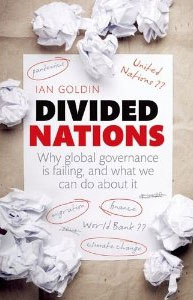
DividedNationsThe lecture was entitled Divided Nations: Why global governance is failing and what we can do about it. It coincided with the launch of a book with the same name. For more details of the book, see this blogpost on the website of the Oxford Martin School, where Ian Goldin holds the role of Director.

It’s my perception that many technology enthusiasts, futurists, and singularitarians have a blind spot when it comes to the topic of the dysfunction of current international organisations. They tend to assume that technological improvements will automatically resolve the crises and risks facing society. Governments and regulators should ideally leave things well alone – so the plea goes.

My own view is that smarter coordination and regulation is definitely needed – even though it will be hard to set that up. Professor Goldin’s lecture amply reinforced that view.

On the train home from the lecture, I downloaded the book onto my Kindle. I recommend anyone who is serious about the future of humanity to read it. Drawing upon the assembled insights and wisdom of the remarkable set of scholars at the Oxford Martin School, in addition to his own extensive experience in the international scene, Professor Goldin has crystallised state-of-the-art knowledge regarding the pressing urgency, and options, for better supra-national governance.

In the remainder of this blogpost, I share some of the state-of-consciousness notes that I typed while listening to the lecture. Hopefully this will give a flavour of the hugely important topics covered. I apologise in advance for any errors introduced in transcription. Please see the book itself for an authoritative voice. See also the live tweet stream for the meeting, with the hash-tag #LSEGoldin.

What keeps Oxford Martin scholars awake at night

The fear that no one is listening. The international governance system is in total gridlock. There are failures on several levels:

  • Failure of governments to lift themselves to a higher level, instead of being pre-occupied by local, parochial interests
  • Failure of electorates to demand more from their governments
  • Failure of governments for not giving clearer direction to the international institutions.

Progress with international connectivity

80 countries became democratic in the 1990s. Only one country in the world today remains disconnected – North Korea.

Over the last few decades, the total global population has increased, but the numbers in absolute poverty have decreased. This has never happened before in history.

So there are many good aspects to the increase in the economy and inter-connectivity.

However, economists failed to think sufficiently far ahead.

What economists should have thought about: the global commons

What was rational for the individuals and for national governments was not rational for the whole world.

Similar problems exist in several other fields: antibiotic resistance, global warming, the markets. He’ll get to these shortly.

The tragedy of the commons is that, when everyone does what is rational for them, everyone nevertheless ends up suffering. The common resource is not managed.

The pursuit of profits is a good thing – it has worked much better than central planning. But the result is irrationality in aggregate.

The market alone cannot provide a response to resource allocation. Individual governments cannot provide a solution either. A globally coordinated approach is needed.

Example of several countries drawing water from the Aral Sea – which is now arid.

That’s what happens when nations do the right thing for themselves.

The special case of Finance

Finance is by far the most sophisticated of the resource management systems:

  • The best graduates go into the treasury, the federal reserve, etc
  • They are best endowed – the elite organisation
  • These people know each other – they play golf together.

If even the financial bodies can’t understand their own system, this has black implications for other systems.

The growth of the financial markets had two underbellies:

  1. Growing inequality
  2. Growing potential for systemic risk

The growing inequality has actually led to lobbying that exaggerates inequality even more.

The result was a “Race to the bottom”, with governments being persuaded to get out of the regulation of things that actually did need to be regulated.

Speaking after the crisis, Hank Paulson, US Treasury Secretary and former CEO of Goldman Sachs, in effect said “we just did not understand what was happening” – even with all the high-calibre people and advice available to him. That’s a shocking indictment.

The need for regulation

Globalisation requires regulation, not just at the individual national level, but at an international level.

Global organisations are weaker now than in the 1990s.

Nations are becoming more parochial – the examples of UK (thinking of leaving EU) and Scotland (thinking of leaving UK) are mirrored elsewhere too.

Yes, integration brings issues that are hard to control, but the response to withdraw from integration is terribly misguided.

We cannot put back the walls. Trying to withdraw into local politics is dreadfully misguided.

Five examples

His book has five examples as illustrations of his general theme (and that’s without talking in this book about poverty, or nuclear threats):

  1. Finance
  2. Pandemics
  3. Migration
  4. Climate change
  5. Cyber-security

Many of these problems arise from the success of globalisation – the extraordinary rise in incomes worldwide in the last 25 years.

Pandemics require supra-national attention, because of increased connectivity:

  • The rapid spread of swine flu was correlated tightly with aircraft travel.
  • It will just take 2 days for a new infectious disease to travel all the way round the world.

The idea that you can isolate yourself from the world is a myth. There’s little point having a quarantine regime in place in Oxford if a disease is allowed to flourish in London. The same applies between countries, too.

Technology developments exacerbate the problem. DNA analysis is a good thing, but the capacity to synthesise diseases has terrible consequences:

  • There’s a growing power for even a very small number of individuals to cause global chaos, e.g. via pathogens
  • Think of something like Waco Texas – people who are fanatical Armageddonists – but with greater technical skills.

Cyber-security issues arise from the incredible growth in network connectivity. Jonathan Zittrain talks about “The end of the Internet”:

  • The Internet is not governed by governments
  • Problems to prosecute people, even when we know who they are and where they are (but in a different jurisdiction)
  • Individuals and small groups could destabilise whole Internet.

Migration is another “orphan issue”. No international organisation has the authority to deal with it:

  • Control over immigration is, in effect, an anarchic, bullying system
  • We have very bad data on migration (even in the UK).

The existing global institutions

The global institutions that we have were a response to post-WW2 threats.

For a while, these institutions did well. The World Bank = Bank for reconstruction. It did lead a lot of reconstruction.

But over time, we became complacent. The institutions became out-dated and lost their vitality.

The recent financial crisis shows that the tables have been turned round: incredible scene of EU taking its begging bowl to China.

The tragedy is that the lessons well-known inside the existing institutions have not been learned. There are lessons about the required sequencing of reforms, etc. But with the loss of vitality of these institutions, the knowledge is being lost.

The EU has very little bandwidth for managing global affairs. Same as US. Same as Japan. They’re all preoccupied by local issues.

The influence of the old G7 is in decline. The new powers are not yet ready to take over the responsibility: China, Russia, India, Indonesia, Brazil, South Africa…

  • The new powers don’t actually want this responsibility (different reasons for different countries)
  • China, the most important of the new powers, has other priorities – managing their own poverty issues at home.

The result is that no radical reform happens, of the international institutions:

  • No organisations are killed off
  • No new ones created
  • No new operating principles are agreed.

Therefore the institutions remain ineffective. Look at the lack of meaningful progress towards solving the problems of climate change.

He has been on two Bretton Woods reform commissions, along with “lots of wonderfully smart, well-meaning people”. Four prime ministers were involved, including Gordon Brown. Kofi Annan received the report with good intentions. But no actual reform of UN took place. Governments actually want these institutions to remain weak. They don’t want to give up their power.

It’s similar to the way that the UK is unwilling to give up power to Brussels.

Sleep-walking

The financial crisis shows what happens when global systems aren’t managed:

  • Downwards spiral
  • Very hard to pull it out afterwards.

We are sleep-walking into global crises. The financial crisis is just a foretaste of what is to come. However, this need not be the case.

A positive note

He’ll finish the lecture by trying to be cheerful.

Action on global issues requires collective action by both citizens and leaders who are not afraid to relinquish power.

The good news:

  • Citizens are more connected than ever before
  • Ideologies that have divided people in the past are reducing in power
  • We can take advantage of the amplification of damage to reputation that can happen on the Internet
  • People can be rapidly mobilised to overturn bad legislation.

Encouraging example of SOPA debate in US about aspects of control of the Internet:

  • 80 million people went online to show their views, in just two days
  • Senate changed their intent within six hours.

Some good examples where international coordination works

  • International plane travel coordination (air traffic control) is example that works very well – it’s a robust system
  • Another good example: the international postal system.

What distinguishes the successes from the failures:

  • In the Air Traffic Control case, no one has a different interest
  • But in other cases, there are lots of vested interest – neutering the effectiveness of e.g. the international response to the Syrian crisis
  • Another troubling failure example is what happened in Iraq – it was a travesty of what the international system wanted and needed.

Government leaders are afraid that electorate aren’t ready to take a truly international perspective. To be internationalist in political circles is increasingly unfashionable. So we need to change public opinion first.

Like-minded citizens need to cooperate, building a growing circle of legitimacy. Don’t wait for the global system to play catch-up.

In the meantime, true political leaders should find some incremental steps, and should avoid excuse of global inaction.

Sadly, political leaders are often tied up addressing short-term crises, but these short-term crises are due to no-one satisfactorily addressing the longer-term issues. With inaction on the international issues, the short-term crises will actually get worse.

Avoiding the perfect storm

The scenario we face for the next 15-20 years is “perfect storm with no captain”.

He calls for a “Manhattan project” for supra-national governance. His book is a contribution to initiating such a project.

He supports the subsidiarity principle: decisions should be taken at the most local level possible. Due to hyper-globalisation, there are fewer and fewer things that it makes sense to control at the national level.

Loss of national sovereignty is inevitable. We can have better sovereignty at the global level – and we can influence how that works.

The calibre of leaders

Example of leader who consistently took a global perspective: Nelson Mandela. “Unfortunately we don’t have many Mandelas around.”

Do leaders owe their power bases with electorates because they are parochial? The prevailing wisdom is that national leaders have to shy away from taking a global perspective. But the electorate actually have more wisdom. They know the financial crisis wasn’t just due to bankers in Canary Wharf having overly large bonuses. They know the problems are globally systemic in nature, and need global approaches to fix them.

ian goldin

12 March 2013

The coming revolution in mental enhancement

Filed under: entrepreneurs, futurist, intelligence, neuroengineering, nootropics, risks, UKH+ — David Wood @ 2:50 pm

Here’s a near-future scenario: Within five years, 10% of people in the developed world will be regularly taking smart drugs that noticeably enhance their mental performance.

It turns out there may be a surprising reason for this scenario to fail to come to pass. I’ll get to that shortly. But first, let’s review why the above scenario would be a desirable one.

nbpicAs so often, Nick Bostrom presents the case well. Nick is Professor at the Faculty of Philosophy & Oxford Martin School, Director at the Future of Humanity Institute, and Director of the Programme on the Impacts of Future Technology, all at the University of Oxford. He wrote in 2008,

Those who seek the advancement of human knowledge should [consider] kinds of indirect contribution…

No contribution would be more generally applicable than one that improves the performance of the human brain.

Much more effort ought to be devoted to the development of techniques for cognitive enhancement, be they drugs to improve concentration, mental energy, and memory, or nutritional enrichments of infant formula to optimize brain development.

Society invests vast resources in education in an attempt to improve students’ cognitive abilities. Why does it spend so little on studying the biology of maximizing the performance of the human nervous system?

Imagine a researcher invented an inexpensive drug which was completely safe and which improved all‐round cognitive performance by just 1%. The gain would hardly be noticeable in a single individual. But if the 10 million scientists in the world all benefited from the drug the inventor would increase the rate of scientific progress by roughly the same amount as adding 100,000 new scientists. Each year the invention would amount to an indirect contribution equal to 100,000 times what the average scientist contributes. Even an Einstein or a Darwin at the peak of their powers could not make such a great impact.

Meanwhile others too could benefit from being able to think better, including engineers, school children, accountants, and politicians.

This example illustrates the enormous potential of improving human cognition by even a tiny amount…

The first objection to the above scenario is that it is technically infeasible. People imply that no such drug could possibly exist. Any apparent evidence offered to the contrary is inevitably suspect. Questions can be raised over the anecdotes shared in the Longecity thread “Ten months of research condensed – A total newbies guide to nootropics” or in the recent Unfinished Man review “Nootropics – The Facts About ‘Smart Drugs'”. After all, the reasoning goes, the brain is too complex. So these anecdotes are likely to involve delusion – whether it is self-delusion (people not being aware of placebo effects and similar) or delusion from snake oil purveyors who have few scruples in trying to sell products.

A related objection is that the side-effects of such drugs are unknown or difficult to assess. Yes, there are substances (take alcohol as an example) which can aid our creativity, but with all kinds of side-effects. The whole field is too dangerous – or so it is said.

These objections may have carried weight some years ago, but increasingly they have less force. Other complex aspects of human functionality can be improved by targeted drugs; why not also the brain? Yes, people vary in how they respond to specific drug combinations, but that’s something that can be taken into account. Indeed, more data is being collected all the time.

Evidence of progress in the study of these smart drugs is one thing I expect to feature in an event taking place in central London this Wednesday (13th March).

next big thingThe event, The Miracle Pill: What do brain boosting drugs mean for the future? is being hosted by Nesta as part of the Policy Exchange “Next big thing” series.

Here’s an extract from the event website:

If you could take a drug to boost your brain-power, would you?

Drugs to enhance human performance are nothing new. Long-haul lorry drivers and aircraft pilots are known to pop amphetamines to stay alert, and university students down caffeine tablets to ward off drowsiness during all-nighters. But these stimulants work by revving up the entire nervous system and the effect is only temporary.

Arguments over smart drugs are raging. If a drug can improve an individual’s performance, and they do not experience side-effects, some argue, it cannot be such a bad thing.

But where will it all stop? Ambitious parents may start giving mind-enhancing pills to their children. People go to all sorts of lengths to gain an educational advantage and eventually success might be dependent on access to these mind-improving drugs…

This event will ask:

  • What are the limits to performance enhancement drugs, both scientifically and ethically? And who decides?
  • Is there a role for such pills in developing countries, where an extra mental boost might make a distinct difference to those in developing countries?
  • Does there need to be a global agreement to monitor the development of these pills?
  • Should policymakers give drug companies carte blanche to develop these products or is a stricter regulatory regime required?

The event will be chaired by Louise Marston, Head of Innovation and Economic Growth, Nesta. The list of panelists is impressive:

  • Dr Bennett Foddy, Deputy Director and Senior Research Fellow, Institute for Science and Ethics, Oxford Martin School, University of Oxford
  • Dr Anders Sandberg, James Martin Fellow, Future of Humanity Institute, Oxford Martin School, University of Oxford
  • Dr Hilary Leevers, Head of Education & Learning, the Wellcome Trust
  • Dame Sally Davies, Chief Medical Officer for England.

Under-currents of mistrust

From my own experience in discussing smart drugs that could enhance mental performance, I’m aware that objections to their use often run more deeply than the technical questions covered above. There are often under-currents of mistrust:

  • Reliance of smart drugs is viewed as irresponsible, self-indulgent, or as cheating
  • There’s an association with the irresponsible advocacy of so-called “recreational” mind-altering drugs
  • Surely, it is said, there are more reliable and more honourable ways of enhancing our mental powers
  • Besides, what is the point of simply being able to think faster?

I strongly reject the implication of irresponsibility or self-indulgence. Increased mental capability can be applied to all sorts of important questions, resulting in scientific progress, technological breakthrough, more elegant product development, and social benefit. The argument I quoted earlier, from Nick Bostrom, applies here.

I also strongly reject the “either/or” implication, when people advocate pursuit of more traditional methods of mental enhancement instead of reliance of modern technology. Why cannot we do both? When considering our physical health, we pay attention to traditional concerns, such as diet and rest, as well as to the latest medical findings. It should be the same for our mental well-being.

No, the real question is: does it work? And once it becomes clearer that certain combinations of smart drugs can make a significant difference to our mental prowess, with little risk of unwelcome side effects, the other objections to their use will quickly fade away.

It will be similar to the rapid change in attitudes towards IVF (“test tube babies”). I remember a time when all sorts of moral and theological hand-wringing took place over the possibility of in-vitro fertilisation. This hubristic technology, it was said, might create soul-less monstrosities; only wickedly selfish people would ever consider utilising the treatment. That view was held by numerous devout observers – but quickly faded away, in the light of people’s real-world experience with the resulting babies.

Timescales

This brings us back to the question: how quickly can we expect progress with smart drugs? It’s the 64 million dollar question. Actually it might be a 640 million dollar question. Possibly even more. The entrepreneurs and companies who succeed in developing and marketing good products in the field of mental enhancement stand to tap into very sizeable revenue streams. Pfizer, the developer of Viagra, earned revenues of $509 million in 2008 alone, from that particular enhancement drug. The developers of a Viagra for the mind could reasonably imagine similar revenues.

The barriers here are regulatory as well as technical. But with a rising public interest in the possibility of significant mental enhancement, the mood could swing quickly, enabling much more vigorous investment by highly proficient companies.

The biophysical approach

But there’s one more complication.

Actually this is a positive complication rather than a negative one.

Critics who suggest that there are better approaches to enhancing mental powers than smart drugs, might turn out to be right in a way they didn’t expect. The candidate for a better approach is to use non-invasive electrical and magnetic stimulation of the brain, targeted to specific functional areas.

headset-renderA variety of “helmets” are already available, or have been announced as being under development.

The start-up website Flow State Engaged raises and answers a few questions on this topic, as follows:

Q: What is tDCS?

A: Transcranial direct-current stimulation (tDCS) is one of the coolest health/self improvement technologies available today. tDCS is a form of neurostimulation which uses a constant, low current delivered directly to the brain via small electrodes to affect brain function.

Q: Is this for real?

A: The US Army and DARPA both currently use tDCS devices to train snipers and drone pilots, and have recorded 2.5x increases in learning rates. This incredible phenomenon of increased learning has been documented by multiple clinical studies as well.

Q: You want one?

A: Today if you want a tDCS machine it’s nearly impossible to find one for less than $600, and you need a prescription to order one. We wanted a simpler cheaper option. So we made our own kit, for ourselves and for all you body hackers out there…

AndrewVSomeone who has made a close personal study of the whole field of nootropics and biophysical approaches (including tDCS) is London-based researcher Andrew Vladimirov.

Back in November, Andrew gave a talk to the London Futurists on “Hacking our wetware: smart drugs and beyond”. It was a well-attended talk that stirred up lots of questions, both in the meeting itself, and subsequently online.

The good news is that Andrew is returning to London Futurists on Saturday 23rd March, where his talk this time will focus on biophysical approaches to “hacking our wetware”.

You can find more details of this meeting here – including how to register to attend.

Introducing the smart-hat

In advance of the meeting, Andrew has shared an alternative vision of the ways in which many people in the not-so-distant future will pursue mental enhancement.

He calls this vision “Towards digital nootropics”:

You are tired, anxious and stressed, and perhaps suffer from a mild headache. Instead of reaching for a pack from Boots the local pharmacists, you put on a fashionable “smarthat” (a neat variation of an “electrocap” with a comfortable 10-20 scheme placement for both small electrodes and solenoids) or, perhaps, its lighter version – a “smart bandana”.

Your phone detects it and a secure wireless connection is instantly established. A Neurostimulator app opens. You select “remove anxiety”, “anti-headache” and “basic relaxation” options, press the button and continue with your business. In 10-15 minutes all these problems are gone.

However, there is still much to do, and an important meeting is looming. So, you go to the “enhance” menu of the Neurostimulator and browse through the long list of options which include “thinking flexibility”, “increase calculus skills”, “creative imagination”, “lateral brainstorm”, “strategic genius”, “great write-up”, “silver tongue” and “cram before exam” amongst many others. There is even a separate night menu with functionality such as “increase memory consolidation while asleep”. You select the most appropriate options, press the button and carry on the meeting preparations.

There are still 15 minutes to go, which is more than enough for the desired effects to kick in. If necessary, they can be monitored and adjusted via the separate neurofeedback menu, as the smarthat also provides limited EEG measurement capabilities. You may use a tablet or a laptop instead of the phone for that.

A new profession: neuroanalyst

Entrepreneurs reading this article may already have noticed the very interesting business-development opportunities this whole field offers. These same entrepreneurs may pay further attention to the next stage of Andrew Vladimirov’s “Towards digital nootropics” vision of the not-so-distant future:

Your neighbour Jane is a trained neuroanalyst, an increasingly popular trade that combines depth psychology and a variety of advanced non-invasive neurostimulation means. Her machinery is more powerful and sophisticated than your average smartphone Neurostim.

While you lie on her coach with the mindhelmet on, she can induce highly detailed memory recall, including memories of early childhood to go through as a therapist. With a flick of a switch, she can also awake dormant mental abilities and skills you’ve never imagined. For instance, you can become a savant for the time it takes to solve some particularly hard problem and flip back to your normal state as you leave Jane’s office.

Since she is licensed, some ethical modulation options are also at her disposal. For instance, if Jane suspects that you are lying and deceiving her, the mindhelmet can be used to reduce your ability to lie – and you won’t even notice it.

Sounds like science fiction? The bulk of necessary technologies is already there, and with enough effort the vision described can be realised in five years or so.

If you live in the vicinity of London, you’ll have the opportunity to question Andrew on aspects of this vision at the London Futurists meetup.

Smart drugs or smart hats?

Will we one day talk as casually about our smarthats as we currently do about our smartphones? Or will there be more focus, instead, on smart drugs?

Personally I expect we’ll be doing both. It’s not necessarily an either/or choice.

And there will probably be even more dramatic ways to enhance our mental powers, that we currently can scarcely conceive.

22 February 2013

Controversies over singularitarian utopianism

I shouldn’t have been surprised at the controversy that arose.

The cause was an hour-long lecture with 55 slides, ranging far and wide over a range of disruptive near-future scenarios, covering both upside and downside. The basic format of the lecture was: first the good news, and then the bad news. As stated on the opening slide,

Some illustrations of the enormous potential first, then some examples of how adding a high level of ambient stupidity might mean we might make a mess of it.

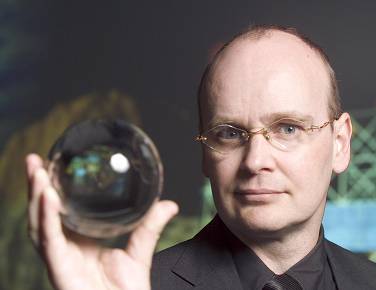
Ian PearsonThe speaker was Ian Pearson, described on his company website as “futurologist, conference speaker, regular media guest, strategist and writer”. The website continues, boldly,

Anyone can predict stuff, but only a few get it right…

Ian Pearson has been a full time futurologist since 1991, with a proven track record of over 85% accuracy at the 10 year horizon.

Ian was speaking, on my invitation, at the London Futurists last Saturday. His chosen topic was audacious in scope:

A Singularitarian Utopia Or A New Dark Age?

We’re all familiar with the idea of the singularity, the end-result of rapid acceleration of technology development caused by positive feedback. This will add greatly to human capability, not just via gadgets but also through direct body and mind enhancement, and we’ll mess a lot with other organisms and AIs too. So we’ll have superhumans and super AIs as part of our society.

But this new technology won’t bring a utopia. We all know that some powerful people, governments, companies and terrorists will also add lots of bad things to the mix. The same technology that lets you enhance your senses or expand your mind also allows greatly increased surveillance and control, eventually to the extremes of direct indoctrination and zombification. Taking the forces that already exist, of tribalism, political correctness, secrecy for them and exposure for us, and so on, it’s clear that the far future will be a weird mixture of fantastic capability, spoiled by abuse…

There were around 200 people in the audience, listening as Ian progressed through a series of increasingly mind-stretching technology opportunities. Judging by the comments posted online afterwards, some of the audience deeply appreciated what they heard:

Thank you for a terrific two hours, I have gone away full of ideas; I found the talk extremely interesting indeed…

I really enjoyed this provocative presentation…

Provocative and stimulating…

Very interesting. Thank you for organizing it!…

Amazing and fascinating!…

But not everyone was satisfied. Here’s an extract from one negative comment:

After the first half (a trippy sub-SciFi brainstorm session) my only question was, “What Are You On?”…

Another audience member wrote his own blogpost about the meeting:

A Singularitanian Utopia or a wasted afternoon?

…it was a warmed-over mish-mash of technological cornucopianism, seasoned with Daily Mail-style reactionary harrumphing about ‘political correctness gone mad’.

These are just the starters of negative feedback; I’ll get to others shortly. As I review what was said in the meeting, and look at the spirited ongoing exchange of comments online, some thoughts come to my mind:

  • Big ideas almost inevitably provoke big reactions; this talk had a lot of particularly big ideas
  • In some cases, the negative reactions to the talk arise from misunderstandings, due in part to so much material being covered in the presentation
  • In other cases, Isee the criticisms as reactions to the seeming over-confidence of the speaker (“…a proven track record of over 85% accuracy”)
  • In yet other cases, I share the negative reactions the talk generated; my own view of the near-future landscape significantly differs from the one presented on stage
  • In nearly all cases, it’s worth taking the time to progress the discussion further
  • After all, if we get our forecasts of the future wrong, and fail to make adequate preparations for the disruptions ahead, it could make a huge difference to our collective well-being.

So let’s look again at some of the adverse reactions. My aim is to raise them in a way that people who didn’t attend the talk should be able to follow the analysis.

(1) Is imminent transformation of much of human life a realistic scenario? Or are these ideas just science fiction?

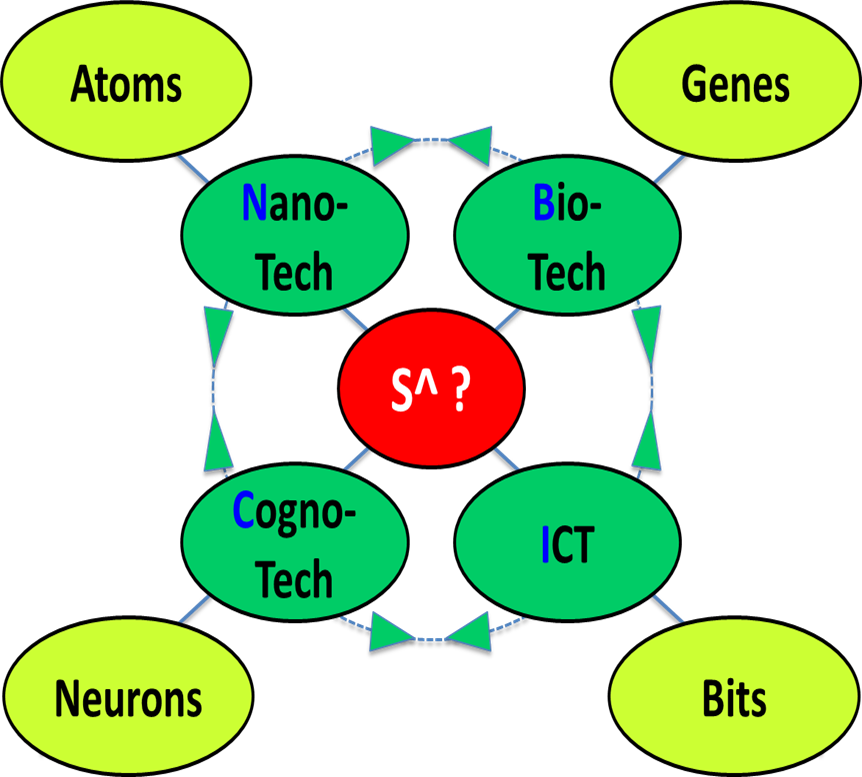
NBIC SingularityThe main driver for belief in the possible imminent transformation of human life, enabled by rapidly changing technology, is the observation of progress towards “NBIC” convergence.

Significant improvements are taking place, almost daily, in our capabilities to understand and control atoms (Nano-tech), genes and other areas of life-sciences (Bio-tech), bits (Info-comms-tech), and neurons and other areas of mind (Cogno-tech). Importantly, improvements in these different fields are interacting with each other.

As Ian Pearson described the interactions:

  • Nanotech gives us tiny devices
  • Tiny sensors help neuroscience figure out how the mind works
  • Insights from neuroscience feed into machine intelligence
  • Improving machine intelligence accelerates R&D in every field
  • Biotech and IT advances make body and machine connectable

Will all the individual possible applications of NBIC convergence described by Ian happen in precisely the way he illustrated? Very probably not. The future’s not as predictable as that. But something similar could well happen:

  • Cheaper forms of energy
  • Tissue-cultured meat
  • Space exploration
  • Further miniaturisation of personal computing (wearable computing, and even “active skin”)
  • Smart glasses
  • Augmented reality displays
  • Gel computing
  • IQ and sensory enhancement
  • Dream linking
  • Human-machine convergence
  • Digital immortality: “the under 40s might live forever… but which body would you choose?”

(2) Is a focus on smart cosmetic technology an indulgent distraction from pressing environmental issues?

Here’s one of the comments raised online after the talk:

Unfortunately any respect due was undermined by his contempt for the massive environmental challenges we face.

Trivial contact lens / jewellery technology can hang itself, if our countryside is choked by yoghurt factory fumes.

The reference to jewellery took issue with remarks in the talk such as the following:

Miniaturisation will bring everyday IT down to jewellery size…

Decoration; Social status; Digital bubble; Tribal signalling…

In contrast, the talk positioned greater use of technology as the solution to environmental issues, rather than as something to exacerbate these issues. Smaller (jewellery-sized) devices, created with a greater attention to recyclability, will diminish the environmental footprint. Ian claimed that:

  • We can produce more of everything than people need
  • Improved global land management could feed up to 20 billion people
  • Clean water will be plentiful
  • We will also need less and waste less
  • Long term pollution will decline.

Nevertheless, he acknowledged that there are some short-term problems, ahead of the time when accelerating NBIC convergence can be expected to provide more comprehensive solutions:

  • Energy shortage is a short to mid term problem
  • Real problems are short term.

Where there’s room for real debate is the extent of these shorter-term problems. Discussion on the threats from global warming brought these disagreements into sharp focus.

(3) How should singularitarians regard the threat from global warming?

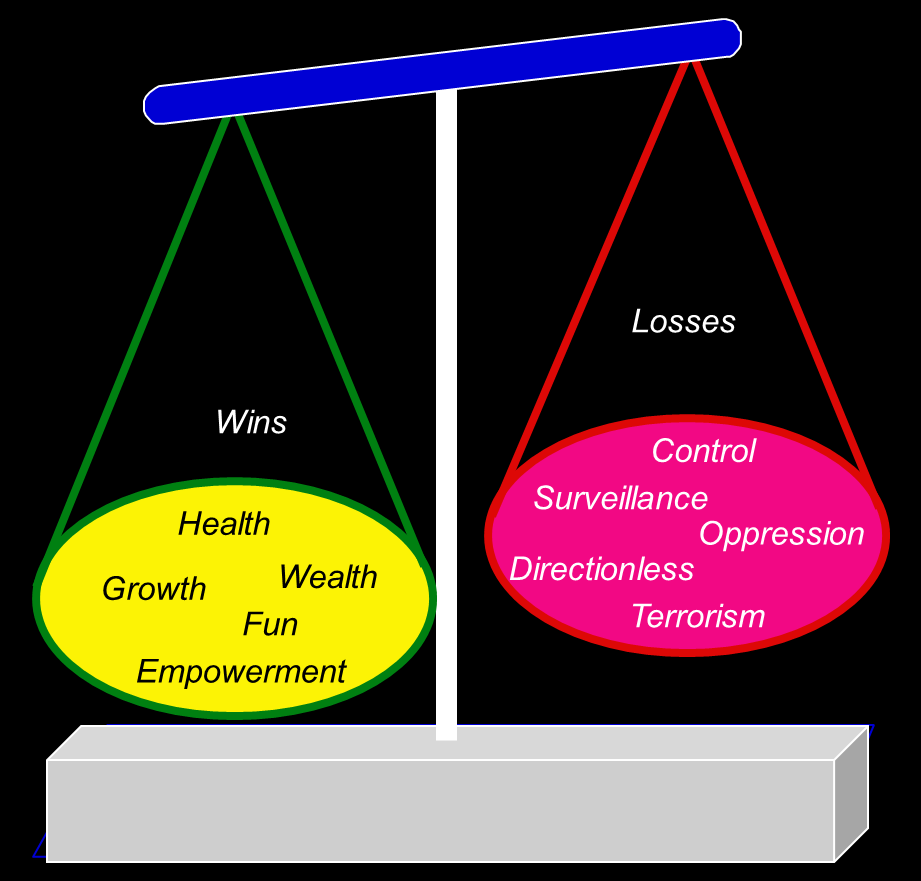
BalanceTowards the end of his talk, Ian showed a pair of scales, weighing up the wins and losses of NBIC technologies and a potential singularity.

The “wins” column included health, growth, wealth, fun, and empowerment.

The “losses” column included control, surveillance, oppression, directionless, and terrorism.

One of the first questions from the floor, during the Q&A period in the meeting, asked why the risk of environmental destruction was not on the list of possible future scenarios. This criticism was echoed by online comments:

The complacency about CO2 going into the atmosphere was scary…

If we risk heading towards an environmental abyss let’s do something about what we do know – fossil fuel burning.

During his talk, I picked up on one of Ian’s comments about not being particularly concerned about the risks of global warming. I asked, what about the risks of adverse positive feedback cycles, such as increasing temperatures triggering the release of vast ancient stores of methane gas from frozen tundra, accelerating the warming cycle further? That could lead to temperature increases that are much more rapid than presently contemplated, along with lots of savage disturbance (storms, droughts, etc).

Ian countered that it was a possibility, but he had the following reservations:

  • He thought these positive feedback loops would only kick into action when baseline temperature rose by around 2 degrees
  • In the meantime, global average temperatures have stopped rising, over the last eleven years
  • He estimates he spends a couple of hours every day, keeping an eye on all sides of the global warming debate
  • There are lots of exaggerations and poor science on both sides of the debate
  • Other factors such as the influence of solar cycles deserve more research.

Here’s my own reaction to these claims:

  • The view that global average temperatures  have stopped rising, is, among serious scientists, very much a minority position; see e.g. this rebuttal on Carbon Brief
  • Even if there’s only a small probability of a runaway spurt of accelerated global warming in the next 10-15 years, we need to treat that risk very seriously – in the same way that, for example, we would be loath to take a transatlantic flight if we were told there was a 5% chance of the airplane disintegrating mid-flight.

Nevertheless, I did not want the entire meeting to divert into a debate about global warming – “that deserves a full meeting in its own right”, I commented, before moving on to the next question. In retrospect, perhaps that was a mistake, since it may have caused some members of the audience to mentally disengage from the meeting.

(4) Are there distinct right-wing and left-wing approaches to the singularity?

Here’s another comment that was raised online after the talk:

I found the second half of the talk to be very disappointing and very right-wing.

And another:

Someone who lists ‘race equality’ as part of the trend towards ignorance has shown very clearly what wing he is on…

In the second half of his talk, Ian outlined changes in norms of beliefs and values. He talked about the growth of “religion substitutes” via a “random walk of values”:

  • Religious texts used to act as a fixed reference for ethical values
  • Secular society has no fixed reference point so values oscillate quickly.
  • 20 years can yield 180 degree shift
  • e.g. euthanasia, sexuality, abortion, animal rights, genetic modification, nuclear energy, family, policing, teaching, authority…
  • Pressure to conform reinforces relativism at the expense of intellectual rigour

A complicating factor here, Ian stated, was that

People have a strong need to feel they are ‘good’. Some of today’s ideological subscriptions are essentially secular substitutes for religion, and demand same suspension of free thinking and logical reasoning.

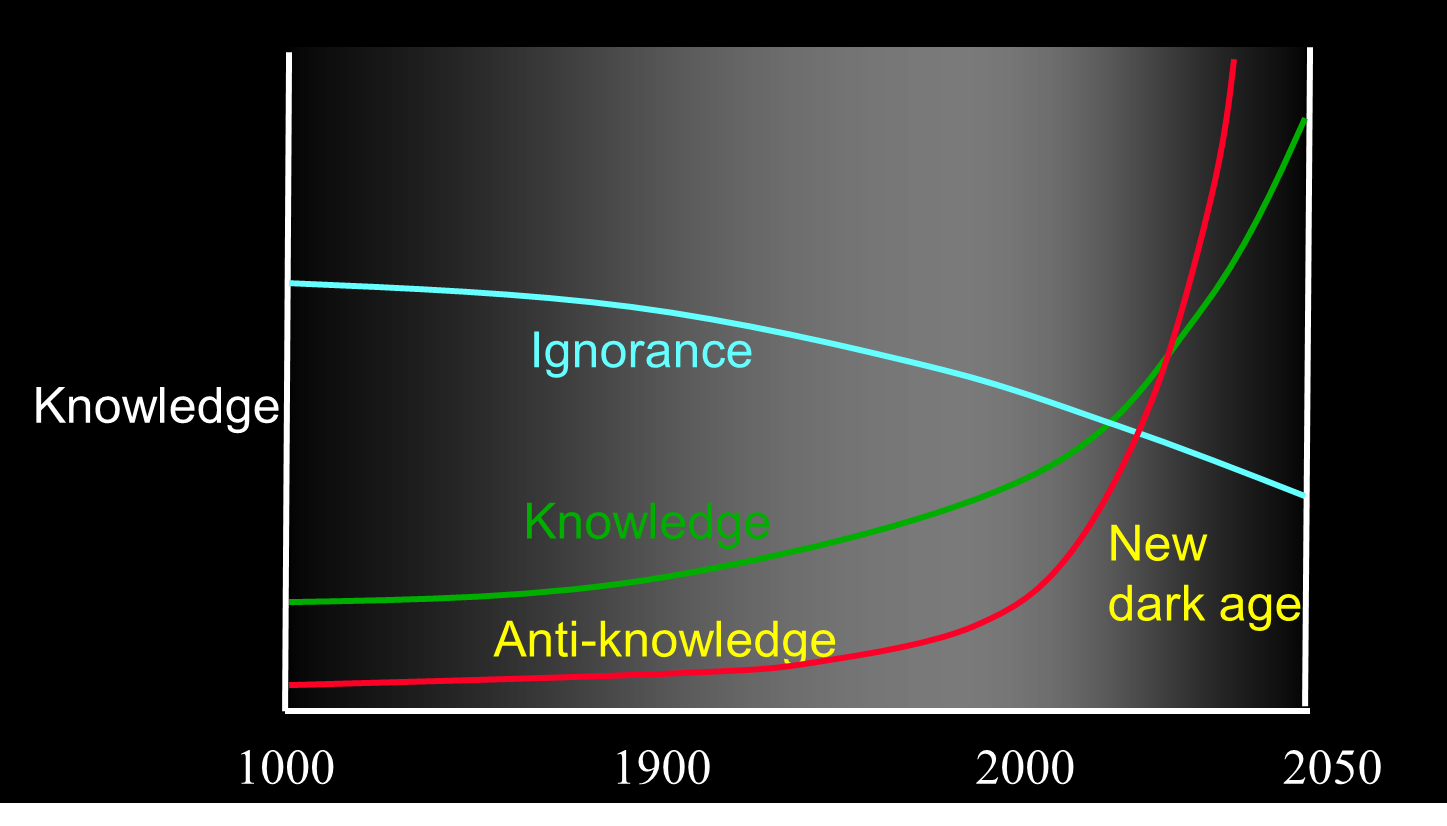
Knowledge GraphA few slides later, he listed examples of “the rise of nonsense beliefs”:

e.g. new age, alternative medicine, alternative science, 21st century piety, political correctness

He also commented that “99% are only well-informed on trivia”, such as fashion, celebrity, TV culture, sport, games, and chat virtual environments.

This analysis culminated with a slide that personally strongly resonated with me: a curve of “anti-knowledge” accelerating and overtaking a curve of “knowledge”:

In pursuit of social compliance, we are told to believe things that are known to be false.

With clever enough spin, people accept them and become worse than ignorant.

So there’s a kind of race between “knowledge” and “anti-knowledge”.

One reason this resonated with me is that it seemed like a different angle on one of my own favourite metaphors for the challenges of the next 15-30 years – the metaphor of a dramatic race:
Race

  • One runner in the race is “increasing rationality, innovation, and collaboration”; if this runner wins, the race ends in a positive singularity
  • The other runner in the race is “increasing complexity, rapidly diminishing resources”; if this runner wins, the race ends in a negative singularity.

In the light of Ian’s analysis, I can see that the second runner is aided by the increase of anti-knowledge: over-attachment to magical, simplistic, ultimately misleading worldviews.

However, it’s one thing to agree that “anti-knowledge” is a significant factor in determining the future; it’s another thing to agree which sets of ideas count as knowledge, and which as anti-knowledge! One of Ian’s slides included the following list of “religion substitutes”:

Animal rights, political correctness, pacifism, vegetarianism, fitness, warmism, environmentalism, anti-capitalism

It’s no wonder that many of the audience felt offended. Why list “warmism” (a belief in human-caused global warming), but not “denialism” (denial of human-caused global warming? Why list “anti-capitalism” but not “free market fundamentalism”? Why list “pacifism” but not “militarism”?

One online comment made a shrewd observation:

Ian raised my curiosity about ‘false beliefs’ (or nonsense beliefs as Ian calls them) as I ‘believe’ we all inhabit different belief systems – so what is true for one person may be false for another… at that exact moment in time.

And things can change. Once upon a time, it was a nonsense belief that the world was round.

There may be 15% of truth in some nonsense beliefs…or possibly even 85% truth. Taking ‘alternative medicine’ as an example of one of Ian’s nonsense beliefs – what if two of the many reasons it was considered nonsense were that (1) it is outside the world (the system) of science and technology and (2) it cannot be controlled by the pharmaceutical companies (perhaps our high priests of today)?

(5) The role of corporations and politicians in the approach to the singularity

One place where the right-wing / left-wing division becomes more acute in the question of whether anything special needs to be done to control the behaviour of corporations (businesses).

One of Ian’s strong positive recommendations, at the end of his presentation, was that scientists and engineers should become more actively involved in educating the general public about issues of technology. Shortly afterward, the question came from the floor: what about actions to educate or control corporations? Ian replied that he had very little to recommend to corporations, over and above his recommendations to the individuals within these corporations.

My own view is different. From my life inside industry, I’ve seen numerous cases of good people who are significantly constrained in their actions by the company systems and metrics in which they find themselves enmeshed.

Indeed, just as people should be alarmed about the prospects of super-AIs gaining too much power, over and above the humans who created them, we should also be alarmed about the powers that super-corporations are accumulating, over and above the powers and intentions of their employees.

The argument to leave corporations alone finds its roots in ideologies of freedom: government regulation of corporations often has undesirable side-effects. Nevertheless, that’s just an argument for being smarter and more effective in how the regulation works – not an argument to abstain from regulation altogether.

The question of the appropriate forms of collaborative governance remains one of the really hard issues facing anyone concerned about the future. Leaving corporations to find their own best solutions is, in my view, very unlikely to be the optimum approach.

In terms of how “laissez-faire” we should be, in the face of potential apocalypse down the road, I agree with the assessment near the end of Jeremy Green’s blogpost:

Pearson’s closing assertion that in the end our politicians will always wake up and pull us back from the brink of any disaster is belied by many examples of civilisations that did not pull back and went right over the edge to destruction.

Endnote:

After the presentation in Birkbeck College ended, around 40-50 of the audience regrouped in a nearby pub, to continue the discussion. The discussion is also continuing, at a different tempo, in the online pages of the London Futurists meetup. Ian Pearson deserves hearty congratulation for stirring up what has turned out to be an enlightening discussion – even though there’s heat in the comments as well as light!

Evidently, the discussion is far from complete…

4 February 2013

Responding to the call for a new Humanity+ manifesto

Filed under: BHAG, futurist, Humanity Plus, leadership, risks — David Wood @ 7:37 am

I’ve been pondering the call, on Transhumanity.net, to upgrade the Transhumanist Declaration.

This endeavour needs the input of many minds to be successful. Below, please find a copy of a submission from me, to add into the mix. I’ll welcome feedback!

Humanity is on the brink of a momentous leap forwards in evolution. If we are wise and strong, we can – and should – make that leap.

This evolutionary transformation takes advantage of rapidly improving technology – technology that arises from positive virtuous cycles and unprecedented interdisciplinary convergence. This technology will grant us awesome powers: the power to capture ample energy from the Sun, the atom, and beyond; the power to synthesise new materials to rejuvenate our environment and fuel our societies; the power to realise an unparalleled abundance of health, security, vigour, vitality, creativity, knowledge, and experience; the power to consciously, thoughtfully, proactively remake Humanity.

Through imminently available technology, our lives can be radically enhanced, expanded, and extended. We can be the generation that banishes disease, destitution, decay, and death. Our societies can become marvels of autonomy and inclusion, featuring splendid variety and harmony. We can move far beyond the earth, spreading ever higher consciousness in both inner and outer space. We can transcend our original biological nature, and become as if divine; we’ll be as far ahead of current human capabilities as current humans exceed the prowess of our ape forebears.

But technology is a two-edged sword. Alongside the potential for transcendent improvement lies the potential for existential destruction. We face fearsome perils of environmental catastrophe, unstoppable new plagues and pathogens, rampant unemployment and alienation, the collapse of world financial markets, pervasive systems of unresponsive computers and moronically intelligent robots that act in frustration to human desires, horrific new weaponry that could easily fall into the wrong hands and precipitate Armageddon, and intensive mechanisms for draconian surveillance and thought control.

Continuing the status quo is not an option. Any quest for sustainability of current lifestyles is a delusion. We cannot stay still, and we cannot retreat. The only way to survive is radical enhancement – moving from Humanity to Humanity+.

We’ll need great wisdom and strength to successfully steer the acceleration of converging technology for a positive rather than a negative outcome. We’ll need to take full advantage of the best of current Humanity, to successfully make the leap to Humanity+.

Grand battles of ideas lie ahead. In all these grand battles, smart technology can be our powerful ally – technology that can unlock and enhance our human capacities for insight, innovation, compassion, kindness, and solidarity.

We’ll need to transcend worldviews that insist on viewing humans as inherently diminished, incapable, flawed, and mortal. We’ll need to help individuals and societies rise above cognitive biases and engrained mistakes in reasoning. And we’ll need to accelerate a reformation of the political and economic environment, so that the outcomes that are rationally best are pursued, instead of those which are expedient and profitable for the people who currently possess the most power and influence.

As more and more people come to appreciate the tremendous attractiveness and the credibility of the Humanity+ future, they’ll collectively commit more of their energy, skills, and resources in support of realising that future. But the outcome is still far from clear.

Time is short, risks are high, and there is much to do. We need to open minds, raise awareness, transform the public mood, overturn prejudices, establish rights, build alliances, resist over-simplification, avoid the temptations of snake oil purveyors, dispel distractions, weigh up the best advice available, take hard decisions, and accelerate specific research and development. If we can navigate these slippery paths, with wisdom and strength, we will indeed witness the profound, glorious emergence of Humanity+.

20 December 2012

An absorbing, challenging vision of near-future struggles

nexus-75-dpiTechnology can cause carnage, and in the wake of the carnage, outrage.

Take the sickening example of the shooting dead of 20 young children and six adults at Sandy Hook Elementary School in Newtown, Connecticut. After that fearful carnage, it’s no surprise that there are insistent calls to restrict the availability of powerful automatic guns.

There are similar examples of carnage and outrage in the new science fiction novel “Nexus: mankind gets an upgrade”, by the noted futurist and writer Ramez Naam.

I met Ramez at the WorldFuture 2012 event in Toronto earlier this year, where he gave a presentation on “Can Innovation Save the Planet?” which I rated as one of the very best sessions in the midst of a very good conference. I’ve been familiar with the high calibre of his thinking for some time, so when I heard that his new book Nexus was available for download to my Kindle – conveniently just ahead of me taking a twelve-hour flight – I jumped at the chance to purchase a copy. It turned out to be a great impulse purchase decision. I finished the book just as the airplane wheels touched down.

The type of technology that is linked to carnage and outrage in Nexus can be guessed from the image on the front cover of the book – smart drugs. Of course, drugs, like guns, are already the source of huge public debate in terms of whether to restrict access. Events described in Nexus make it clear why certain drugs become even more controversial, a few short decades ahead, in this fictional but all-too-credible vision of the near future.

Back in the real world, public interest in smart drugs is already accelerating:

  • I hear more and more discussions when people talk about taking nootropics of one sort or another – to help them “pull an all-nighter”, or to be especially sharp and mentally focused for an important interview. These comments often get followed up by reflections on whether these drugs might convey an unfair advantage.
  • The 2011 film Limitless – which I reviewed in passing here – helped to raise greater public awareness of the potential of this technology.
  • Audience attendance (and the subsequent online debate) at the recent London Futurist event “Hacking our wetware, with Andrew Vladimirov”, convinced me that public appetite for information on smart drugs is about to greatly intensify.

And as discussion of the technology of smart drugs increases, so (quite rightly) does discussion of the potential downsides and drawbacks of that technology.

Nexus is likely to ratchet this interest even higher. The technology in the novel doesn’t just add a few points of IQ, in a transitory basis, to the people who happen to take it. It goes much further than that. It has the potential to radically upgrade humans – with as big a jump in evolution (in the course of a few decades) as the transition between apes and humans. And not everyone likes that potential, for reasons that the book gradually makes credible, through sympathetic portrayals of various kinds of carnage.

Nexus puts the ideas of transhumanism and posthumanism clearly on the map. And lots more too, which I shouldn’t say much about, to avoid giving away the plot and spoiling the enjoyment of new readers.

But I will say this:

  • My own background as a software engineer (a profession I share with Ramez Naam) made me especially attuned to the descriptions of the merging of computing science ideas with those of smart drugs; other software engineers are likely to enjoy these speculations too
  • My strong interest in the battle of ideas about progress made me especially interested in inner turmoil (and changes of mind) of various key characters, as they weighed up the upsides and downsides of making new technology more widely available
  • My sympathy for the necessity of an inner path to enlightenment, to happen in parallel with increasingly smart deployment of increasingly powerful technology, meant that I was intrigued by some of the scenes in the book involving meditative practices
  • My status as an aspiring author myself – I’m now about one third of the way through the book I’m writing – meant that I took inspiration from seeing how a good author can integrate important ideas about technology, philosophy, societal conflict, and mental enlightenment, in a cracking good read.

Ramez is to be congratulated on writing a book that should have wide appeal, and which will raise attention to some very important questions – ahead of the time when rapid improvements of technology might mean that we have missed our small window of opportunity to steer these developments in ways that augment, rather than diminish, our collective humanity.

Anyone who thinks of themselves as a futurist should do themselves a favour and read this book, in order to participate more fully in the discussions which it is bound to catalyse.

Footnote: There’s a lot of strong language in the book, and “scenes of an adult nature”. Be warned. Some of the action scenes struck me as implausible – but hey, that’s the same for James Bond and Jason Bourne, so that’s no showstopper. Which prompts the question – could Nexus be turned into a film? I hope so!

2 November 2012

The future of human enhancement

Is it ethical to put money and resources into trying to develop technological enhancements for human capabilities, when there are so many alternative well-tested mechanisms available to address pressing problems such as social injustice, poverty, poor sanitation, and endemic disease? Is that a failure of priority? Why make a strenuous effort in the hope of allowing an elite few individuals to become “better than well”, courtesy of new technology, when so many people are currently so “less than well”?

These were questions raised by Professor Anne Kerr at a public debate earlier this week at the London School of Economics: The Ethics of Human Enhancement.

The event was described as follows on the LSE website:

This dialogue will consider how issues related to human enhancement fit into the bigger picture of humanity’s future, including the risks and opportunities that will be created by future technological advances. It will question the individualistic logic of human enhancement and consider the social conditions and consequences of enhancement technologies, both real and imagined.

From the stage, Professor Kerr made a number of criticisms of “individualistic logic” (to use the same phrase as in the description of the event). Any human enhancements provided by technology, she suggested, would likely only benefit a minority of individuals, potentially making existing social inequalities even worse than at present.

She had a lot of worries about technology amplifying existing human flaws:

  • Imagine what might happen if various clever people could take some pill to make themselves even cleverer? It’s well known that clever people often make poor decisions. Their cleverness allows them to construct beguiling sophistry to justify the actions they already want to take. More cleverness could mean even more beguiling sophistry.
  • Or imagine if rapacious bankers could take drugs to boost their workplace stamina and self-serving brainpower – how much more effective they would become at siphoning off public money to their own pockets!
  • Might these risks be addressed by public policy makers, in a way that would allow benefits of new technology, without falling foul of the potential downsides? Again, Professor Kerr was doubtful. In the real world, she said, policy makers cannot operate at that level. They are constrained by shorter-term thinking.

For such reasons, Professor Kerr was opposed to these kinds of technology-driven human enhancements.

When the time for audience Q&A arrived, I felt bound to ask from the floor:

Professor Kerr, would you be in favour of the following examples of human enhancement, assuming they worked?

  1. An enhancement that made bankers more socially attuned, with more empathy, and more likely to use their personal wealth in support of philanthropic projects?
  2. An enhancement that made policy makers less parochial, less politically driven, and more able to consider longer-term implications in an objective manner?
  3. And an enhancement that made clever people less likely to be blind to their own personal cognitive biases, and more likely to genuinely consider counters to their views?

In short, would you support enhancements that would make people wiser as well as smarter, and kinder as well as stronger?

The answer came quickly:

No. They would not work. And there are other means of achieving the same effects, including progress of democratisation and education.

I countered: These other methods don’t seem to be working well enough. If I had thought more quickly, I would have raised examples such as society’s collective failure to address the risk of runaway climate change.

Groundwork for this discussion had already been well laid by the other main speaker at the event, Professor Nick Bostrom. You can hear what Professor Bostrom had to say – as well as the full content of the debate – in an audio recording of the event that is available here.

(Small print: I’ve not yet taken the time to review the contents of this recording. My description in this blogpost of some of the verbal exchanges inevitably paraphrases and extrapolates what was actually said. I apologise in advance for any mis-representation, but I believe my summary to be faithful to the spirit of the discussion, if not to the actual words used.)

Professor Bostrom started the debate by mentioning that the question of human enhancement is a big subject. It can be approached from a shorter-term policy perspective: what rules should governments set, to constrain the development and application of technological enhancements, such as genetic engineering, neuro-engineering, smart drugs, synthetic biology, nanotechnology, and artificial general intelligence? It can also be approached from the angle of envisioning larger human potential, that would enable the best possible future for human civilisation. Sadly, much of the discussion at the LSE got bogged down in the shorter-term question, and lost sight of the grander accomplishments that human enhancements could bring.

Professor Bostrom had an explanation for this lack of sustained interest in these larger possibilities: the technologies for human enhancement that are currently available do not work that well:

  • Some drugs give cyclists or sprinters an incremental advantage over their competitors, but the people who take these drugs still need to train exceptionally hard, to reach the pinnacle of their performance
  • Other drugs seem to allow students to concentrate better over periods of time, but their effects aren’t particularly outstanding, and it’s possible that methods such as good diet, adequate rest, and meditation, have results that are at least as significant
  • Genetic selection can reduce the risk of implanted embryos developing various diseases that have strong genetic links, but so far, there is no clear evidence that genetic selection can result in babies with abilities higher than the general human range.

This lack of evidence of strong tangible results is one reason why Professor Kerr was able to reply so quickly to my suggestion about the three kinds of technological enhancements, saying these enhancements would not work.

However, I would still like to press they question: what if they did work? Would we want to encourage them in that case?

A recent article in the Philosophy Now journal takes the argument one step further. The article was co-authored by Professors Julian Savulescu and Ingmar Persson, and draws material from their book “Unfit for the Future: The Need for Moral Enhancement”.

To quote from the Philosophy Now article:

For the vast majority of our 150,000 years or so on the planet, we lived in small, close-knit groups, working hard with primitive tools to scratch sufficient food and shelter from the land. Sometimes we competed with other small groups for limited resources. Thanks to evolution, we are supremely well adapted to that world, not only physically, but psychologically, socially and through our moral dispositions.

But this is no longer the world in which we live. The rapid advances of science and technology have radically altered our circumstances over just a few centuries. The population has increased a thousand times since the agricultural revolution eight thousand years ago. Human societies consist of millions of people. Where our ancestors’ tools shaped the few acres on which they lived, the technologies we use today have effects across the world, and across time, with the hangovers of climate change and nuclear disaster stretching far into the future. The pace of scientific change is exponential. But has our moral psychology kept up?…

Our moral shortcomings are preventing our political institutions from acting effectively. Enhancing our moral motivation would enable us to act better for distant people, future generations, and non-human animals. One method to achieve this enhancement is already practised in all societies: moral education. Al Gore, Friends of the Earth and Oxfam have already had success with campaigns vividly representing the problems our selfish actions are creating for others – others around the world and in the future. But there is another possibility emerging. Our knowledge of human biology – in particular of genetics and neurobiology – is beginning to enable us to directly affect the biological or physiological bases of human motivation, either through drugs, or through genetic selection or engineering, or by using external devices that affect the brain or the learning process. We could use these techniques to overcome the moral and psychological shortcomings that imperil the human species.

We are at the early stages of such research, but there are few cogent philosophical or moral objections to the use of specifically biomedical moral enhancement – or moral bioenhancement. In fact, the risks we face are so serious that it is imperative we explore every possibility of developing moral bioenhancement technologies – not to replace traditional moral education, but to complement it. We simply can’t afford to miss opportunities…

In short, the argument of Professors Savulescu and Persson is not just that we should allow the development of technology that can enhance human reasoning and moral awareness, but that we must strongly encourage it. Failure to do so would be to commit a grave error of omission.

These arguments about moral imperative – what technologies should we allow to be developed, or indeed encourage to be developed – are in turn strongly influenced by our beliefs about what technologies are possible. It’s clear to me that many people in positions of authority in society – including academics as well as politicians – are woefully unaware about realistic technology possibilities. People are familiar with various ideas as a result of science fiction novels and movies, but it’s a different matter to know the division between “this is an interesting work of fiction” and “this is a credible future that might arise within the next generation”.

What’s more, when it comes to people forecasting the likely progress of technological possibilities, I see a lot of evidence in favour of the observation made by Roy Amara, long-time president of the Institute for the Future:

We tend to overestimate the effect of a technology in the short run and underestimate the effect in the long run.

What about the technologies mentioned by Professors Savulescu and Persson? What impact will be possible from smart drugs, genetic selection and engineering, and the use of external devices that affect the brain or the learning process? In the short term, probably less than many of us hope; in the longer term, probably more than most of us expect.

In this context, what is the “longer term”? That’s the harder question!

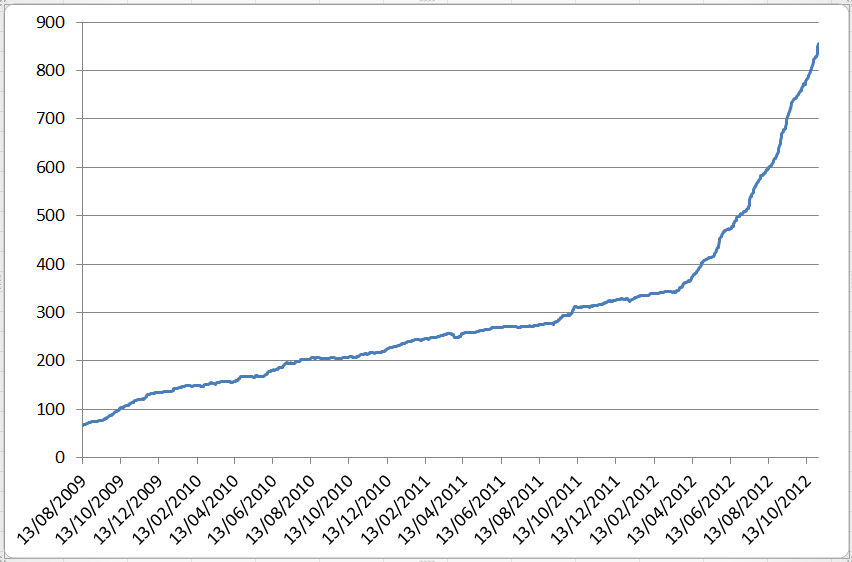
But the quest to address this kind of question, and then to share the answers widely, is the reason I have been keen to support the growth of the London Futurist meetup, by organising a series of discussion meetings with well-informed futurist speakers. Happily, membership has been on the up-and-up, reaching nearly 900 by the end of October.

The London Futurist event happening this weekend – on the afternoon of Saturday 3rd November – picks up the theme of enhancing our mental abilities. The title is “Hacking our wetware: smart drugs and beyond – with Andrew Vladimirov”:

What are the most promising methods to enhance human mental and intellectual abilities significantly beyond the so-called physiological norm? Which specific brain mechanisms should be targeted, and how?  Which aspects of wetware hacking are likely to grow in prominence in the not-too-distant future?

By reviewing a variety of fascinating experimental findings, this talk will explore:

  • various pharmacological methods, taking into account fundamental differences in Eastern and Western approaches to the development and use of nootropics
  • the potential of non-invasive neuro-stimulation using CES (Cranial Electrotherapy Stimulation) and TMS (Transcranial Magnetic Stimulation)
  • data suggesting the possibility to “awaken” savant-like skills in healthy humans without paying the price of autism
  • apparent means to stimulate seemingly paranormal abilities and transcendental experiences
  • potential genetic engineering perspectives, aiming towards human cognition enhancement.

The advance number of positive RSVPs for this talk, as recorded on the London Futurist meetup site, has reached 129 at the time of writing – which is already a record.

(From my observations, I have developed the rule of thumb that the number of people who actually turn up for a meeting is something like 60%-75% of the number of positive RSVPs.)

I’ll finish by returning to the question posed at the beginning of my posting:

  • Are these technological enhancements likely to increase human inequality (by benefiting only a small number of users),
  • Or are they instead likely to drop in price and grow in availability (the same as happened, for example, with smartphones, Internet access, and many other items of technology)?

My answer – which I believe is shared by Professor Bostrom – is that things could still go either way. That’s why we need to think hard about their development and application, ahead of time. That way, we’ll become better informed to help influence the outcome.

16 September 2012

Transcending the threat of the long emergency

The not-so-distant future (2030-2045) may turn out very different from how we commonly imagine. It may turn out very different from what we desire.

At that time, those of us who remain alive and who still have the faculty to think critically, may well bemoan the fact that we didn’t properly anticipate the intervening turn of events, and didn’t organise ourselves effectively to enable a better future to unfold. We may bitterly regret our present-day pre-occupations with celebrity gossip and 24×7 reality TV and rivalries between the latest superphones and by bickering over gullible interpretations of antiquated religious folk tales.

Why did we fiddle why Rome burned? Why did we not see the likelihood of Rome burning? Why were we so enthralled to the excitements of consumer goods and free-market economics and low-cost international travel and relentless technology innovation that we failed to give heed to the deeper stresses and strains portending what writer James Howard Kunstler has termed “The Long Emergency“?

The subtitle of Kunstler’s The Long Emergency book is “Surviving the end of oil, climate change, and other converging catastrophes of the twenty-first century“. His writing style is lively and unapologetic. He pays little respect to political correctness. His thesis is not just that supplies of oil are declining (despite vigorously growing demand), but that society fails to appreciate quite how difficult it’s going to be to replace oil with new sources of energy. Many, many aspects of our present-day civilisation depend in fundamental ways on by-products of oil. Therefore, we’re facing an almighty crisis.

Quoting Colin Tudge from The Independent, The Long Emergency carries an endorsement on its front cover:

If you give a damn, you should read this book

I echo that endorsement. Kunstler makes lots of important points about the likely near-future impact of diseases, shortages of fresh water, large multinationals in their runaway pursuit of profits and growth, the over-complexity of modern life, and the risks of cataclysmic wars over diminishing material resources.

I agree with around 80% of what Kunstler says. But even in the 20% where we part company, I find his viewpoint to be illuminating.

For example, I regard Kunstler’s discussion of both solar and wind energy as being perfunctory. He is too quick to dismiss the potential of these (and other) alternative energy sources. My own view is that the same kinds of compound improvements that have accelerated the information and communications hi-tech industries can also apply in alternative energy industries. Even though individual companies fail, and even though specific ideas for tech improvement are found wanting, there remains plenty of scope for cumulative overall improvement, with layers of new innovations all building on prior breakthroughs.

Kunstler’s first reply to this kind of rejoinder is that it confuses technology with energy. In a recent Rolling Stone interview, “James Howard Kunstler on Why Technology Won’t Save Us“, he responds to the following observation by journalist Jeff Goodell:

You write about visiting the Google campus in Silicon Valley, and how nobody there understood the difference between energy and technology.

Kunstler’s reply:

They are not substitutable. If you run out of energy, you can’t plug in technology. In this extremely delusional society right now, one of the reigning delusions is that if you run out of energy, you can just turn to technology. We completely don’t understand that. And the tragic thing is, the people who ought to understand it don’t get it. And if the people at Google don’t know the difference between energy and technology – well, then who does?

My own comment: the world is not facing a shortage of energy. An analysis published recently in Nature shows that wind energy could provide 20-100 times current global power demand. And as for solar energy, National Geographic magazine reports

Every hour the sun beams onto Earth more than enough energy to satisfy global energy needs for an entire year.

So the problem isn’t one of lack of energy. It’s a problem of harvesting the energy, storing it, and transporting it efficiently to where it needs to be used. That’s a problem to which technology can apply itself with a vengeance.

But as I said, Kunstler is insightful even when he is wrong. His complaint is that it is foolish to simply rely on some magical powers of a free-market economy to deliver the technology smarts needed to solve these energy-related problems. Due to the dysfunctions and failures of free-market economies, there’s no guarantee that industry will be able to organise itself to make the right longer-term investments to move from our current “local maximum” oil-besotted society to a better local maximum that is, however, considerably remote from where we are today. These are as much matters of economics and politics as they are of technology. Here, I agree with Kunstler.

Kunstler’s second reply is that, even if enough energy is made available from new sources, it won’t solve the problem of diminishing raw materials. This includes fresh water, rare minerals, and oil itself (which is used for much more than a source of energy – for example, it’s a core ingredient of plastics). Kunstler argues that these raw materials are needed in the construction and maintenance of alternative energy generators. So it will be impossible to survive the decline in the availability of oil.

My comment to this is that a combination of sufficient energy (e.g. from massive solar generators) and smart technology can be deployed to generate new materials. Fresh water can be obtained from sea water by desalination plants. Oil itself can be generated in due course by synthetic biology. And if it turns out that we really do lack a particular rare mineral, presently needed for a core item of consumer electronics, we can change the manufacturing process to swap in an alternative.

At least, these transformations are theoretically possible. But, again, they’ll probably require greater coordination than our present system of economics and politics enables, with its over-emphasis on short-termism.

Incidentally, for a particularly clear critique of the idea that untramelled free market economics is the best mechanism to ensure societal progress, I recommend “23 things they don’t tell you about capitalism“, by Cambridge University economics professor Ha-Joon Chang. This consists of 23 chapters which each follow the same form: a common tenet of free-market economics is presented (and is made to appear plausible), and then is thoroughly debunked, by means of a mixture of data and theory. Professor Chang isn’t opposed to markets, but he does believe in the necessity for key elements of state intervention to steer markets. He offers positive remedies as well as negative criticisms. Alternatively, you might also enjoy “What money can’t buy: the moral limits of markets“, by Harvard professor Michael J. Sandel. That takes a complementary path, with examples that are bound to make both proponents and opponents of free markets wince from time to time. They really get under the skin. And they really make you think.

Both books are (in my viewpoint) brilliantly written, though if you only have time to read one, I’d recommend the one by Ha-Joon Chang. His knowledge of real-world economics is both comprehensive and uplifting – and his writing style is blessedly straightforward. Being Korean born, his analysis of the economic growth in Korea is especially persuasive, but he draws insight from numerous other geographies too.

Putting the future on the agenda

As you can tell, I see the threat of self-induced societal collapse as real. The scenarios in The Long Emergency deserve serious attention. For that reason, I’m keen to put the future on the agenda. I don’t mean discussions of whether national GDPs will grow or shrink by various percentage points over the next one or two years, or whether unemployment will marginally rise or marginally fall. Instead, I want to increase focus on the question of whether we’re collectively able to transition away from our profligate dependence on oil (and away from other self-defeating aspects of our culture) in sufficient time to head off environmental and economic disaster.

That’s the reason I’m personally sponsoring a series of talks at the London Futurists called “The Next Golden Age Of Technology 2030-45“.

The first in that series of talks took place on Saturday at Birkbeck College in Central London: “Surfing The Sixth Wave: Modelling The Next Technology Boom“, with lead speaker Stephen Aguilar-Millan. Stephen is is the Director of Research at the European Futures Observatory, a futures think tank based in the UK.

The different talks in the series are taking different angles on what is a complex, multi-faceted subject. The different speakers by no means all agree with each other. After all, it’s clear that there’s no consensus on how the future is likely to unfold.

Rather than making specific predictions, Stephen’s talk focused more on the question of how to think about future scenarios. He distinguished three main approaches:

  1. Trends analysis – we can notice various trends, and consider extrapolating them into the future
  2. Modelling and systems thinking – we seek to uncover underlying patterns, that are likely to persist despite technology changes
  3. Values-based thinking – which elevates matters of human interest, and considers how human action might steer developments away from those predicted by previous trends and current models.

Stephen’s own approach emphasised models of change in

  • politics (a proposed cycle of concerns: community -> corporate -> individual -> atomistic -> community…),
  • economics (such as the Kondratieff Cycle),
  • and social (such as generational changes: boomer -> generation X -> millennial -> homeland -> scarcity),
  • as well as in technology per se.

For a model to understand long-term technological change, Stephen referred to the Venezuelan scholar Carlota Perez, whose book “Technological Revolutions and Financial Capital: The Dynamics of Bubbles and Golden Ages” is held in high regard. Perez describes recent history as featuring five major technical-economic cycles:

  1. From 1771: The First Industrial Revolution (machines, factories, and canals)
  2. From 1829: The Age of Steam, Coal, Iron, and Railways
  3. From 1875: The Age of Steel and Heavy Engineering (electrical, chemical, civil, naval)
  4. From 1908: The Age of the Automobile, Oil, Petrochemicals, and Mass Production
  5. From 1971: The Age of Information Technology and Telecommunications.

In this analysis, each such cycle takes 40-60 years to spread across the world and reach maturity. Each techno-economic paradigm shift involves “a change in the direction of change” and brings:

  • New industries
  • New infrastructure
  • New ways of transport and communication
  • New ways of producing
  • A new way of working
  • A new way of living.

Golden ages of technology – insight from Carlota Perez

Stephen’s slides will shortly be posted onto the London Futurist website. The potential interplay of the different models is important, but in retrospect, the area that it would have been good to explore further was the analysis by Carlota Perez. There are a number of videos on YouTube that feature her presenting her ideas. For example, there’s a four-part presentation “Towards a Sustainable Global Golden Age” – where she also mentions a potential sixth technical-economic wave:

  • The Age of Biotech, Bioelectronics, Nanotech, and new materials.


Unlike Kunstler, Perez offers an optimistic view of the future. Whereas Kunstler in effect takes wave four as being irretrievably central to modern society, Perez argues that the technology of wave five is already in the process of undoing many of the environmental problems introduced by wave four. This transformation is admittedly difficult to discern, Perez explains, because of factors which prolong the “energy intensive” culture of wave four (even though the “information intensive” wave five already enables significant reductions in energy usage):

  • The low price of oil in the 1980s and 1990s
  • The low price of labor in China and Asia
  • The persistence of “the American way of life” as the “model of well-being” that the world wishes to emulate.

On the other hand, a paradigm change in expectation is now accelerating (see slide 20 of the PDF accompanying the video):

  • Small is better than big
  • Natural materials are better than synthetic
  • Multipurpose is better than single function
  • ‘Gourmet’ food is better than standard
  • Fresh organic fruit and vegetables are healthier
  • Exercise is important for well-being
  • Global warming is a real danger
  • Not commuting to work is possible and preferable
  • Solar power is luxurious
  • Internet communications, shopping, learning and entertainment are better than the old ways.

Nevertheless, despite her optimism that “a sustainable positive-sum future is possible”, Perez states clearly (slide 23):

  • But it will not happen automatically: the market cannot do it alone
  • The state must come back into the picture

Her analysis proceeds:

  • Each technological revolution propagates in two different periods
  • The first half sets up the infrastructure and lets the markets pick the winners
  • The second half (“the Golden Age” of the wave) reaps the full economic and social potential
  • Each Golden Age has been facilitated by enabling regulation and policies for shaping and widening markets.

Scarcity resolved?

The next London Futurist talk in this series will pick up some of the above themes. It will take place on Saturday the 20th of October, with independent futures consultant Guy Yeomans as the lead speaker. To quote from the event page:

Many people regard technological invention as not just a key driving force in human evolution but as the primary source of historical change, profoundly influencing wider economic and social developments. Is this perspective valid? Does it enable us to fully explain the world we live in today, and may actively occupy tomorrow?

Specifically, will technological invention be the ‘saviour’ some believe for our collective future challenges? Can we rely on technology to resolve looming issues of scarcity?

To answer these questions, this talk re-examines the emergence of technology and its role in human affairs. It does this by reviewing the history of the discipline of futures thinking, including techniques such as trend analysis themes.

The talk begins by considering the conditions under which futures thinking formed in North America in the aftermath of World War II. From this, we’ll assess what contributions the methods and techniques created during this period have made to contemporary strategic planning. Using parts of this framework, we’ll formulate a perspective on the key issues likely to affect future technological needs, and assess the dynamics via which technologies may then emerge to meet these needs.

Crucial to all this will be our ability to identify and reveal the core assumptions underpinning such a perspective, thereby providing a more robust footing from which to investigate the ways in which technology might actually evolve over the coming decades. From this, we’ll finally ask:Will scarcity even emerge, let alone need to be overcome?

Later talks in the same series will be given by professional futurists Nick Price, Ian Pearson, and Peter Cochrane.

1 September 2012

The three most important questions about the future

Filed under: futurist, Humanity Plus, rejuveneering, risks, SENS, UKH+ — David Wood @ 2:51 pm

Futurism – the attempt at systematic, thoughtful speculation about the likely future – can be divided into smaller and larger questions.

Many of the ‘small’ questions are admittedly very interesting. Here are some examples.

Will China continue to grow in influence and strength? When will humans colonise Mars? Will increasing technological automation drive more and more people out of work? Will currencies converge (like a larger Euro-zone) or fragment? Is nuclear fusion ever going to prove viable? When will computers outplay humans at the game of Go, or drive cars better than humans, or create art better than humans? What will happen to the rate of population growth, and the rate of resource depletion? Will religion decline or resurge? Which of our present-day habits will our descendents look back on and regard as disdainfully as we now regard (say) slavery and cigarette smoking? Will money and campaign finance play an ever more domineering role in politics?

I call these questions ‘small’ only because there are even larger questions which frame any overall analysis of the future. In particular, I see three groups of questions as particularly pressing:

  1. The question of existential risk: Is it feasible that human civilisation could dramatically collapse within the next few decades – as a result of (e.g.) economic meltdown, rapidly changing climate, military or terrorist escapades, horrific weaponry or diseases, and/or rogue tech? Could we actually be living in the end times?
  2. The question of transhuman potential: Is it feasible that tech enhancements in the next few decades could radically transform and elevate human performance and experience – making us substantially smarter, stronger, healthier, longer-lived – potentially creating as big a step-up in capability as in the prehistoric jump from ape to human?
  3. The question of resource allocation: If transhuman potential lies within our grasp, should we indeed try to grasp it? Contrariwise, is any effort to accelerate transhumanism an indulgence, a distraction, or (even worse) a catalyst for disaster rather than progress? If there are credible risks of existential collapse, where should we actually be grasping? Which topics deserve the lion’s share of our collective attention, investment, analysis, and effort?

These questions are what I seek to see debated at the meetings of the London Futurists that I organise once every few weeks.

The questions defy any simple responses, but for what it’s worth, summary versions of my own answers are as follows:

  1. The threat of existential collapse is real. Human ingenuity and perseverance have led us through many major crises in the past, but there’s nothing guaranteed about our ability to survive even larger, more wicked, faster-breaking crises in the near future
  2. Technology is progressing at a remarkable rate, and the rate is likely to accelerate. Powerful combinations of nano-tech, AI, personal genetics, synthetic biology, robotics, and regenerative medicine, coupled with significantly improved understanding of diet and mental health (e.g. mindfulness), could indeed see the emergence of “Humanity+” amidst the struggles of the present-day. But there’s nothing inevitable about it
  3. Humanity+ (also known as “transhumanism”) is not only possible; it is highly desirable so long as the increased ‘external’ strengths of new human individuals and societies are balanced by matching increases in ‘internal’ strengths such as kindness, open-mindedness, and sociability. As I’ve written before, we need increased wisdom as well as increased smartness, and an increased desire for self-mastery as well as an increased ability to transcend limits.

The reason why Humanity+ is desirable (as well as being possible) is because I see the enhanced humans of the near future, with their much greater collective wisdom – improved versions of you and me – as being the best bet to guard against the very real threats of existential risk.

Speakers at the London Futurists meetings address different parts of this overall rich mix of existential risk and transhuman opportunity. As befits healthy debate, the speakers take different viewpoints. Some of these speakers are what can be called “professional futurists”, often hired by businesses to help them consider scenarios for evolution of technology, business, and products. Other speakers are what can be called “activists”, who personally commit large amounts of their time and energy to bringing about one or more aspects of a desirable transhuman future.

The speaker on Sunday 2nd September, Aubrey de Grey, falls into the second category. As noted on the webpage for the event,

Dr. Aubrey de Grey is a biomedical gerontologist based in Cambridge, UK and Mountain View, California, USA, and is the Chief Science Officer of SENS Foundation, a California-based 501(c)(3) charity dedicated to combating the aging process. He is also Editor-in-Chief of Rejuvenation Research, the world’s highest-impact peer-reviewed journal focused on intervention in aging.

Aubrey’s talk is entitled “Regenerative medicine for aging”. Note: this is not just about life extension – allowing longer lifespans. It is about health extension – allowing longer healthy lifespans, with resulting very positive benefits in reduced healthcare costs worldwide. As Aubrey writes,

In this talk I will explain why therapies that can add 30 healthy years to the remaining lifespan of typical 60-year-olds may well arrive within the next few decades.

If you’d like to find out more about Aubrey’s thinking and accomplishments, let me point you at two sources:

Alternatively, if you’re in or nearby London, by all means drop into the meeting 🙂

(We’re planning to record it and make the video available afterwards, for people unable to join on the day.)

« Newer PostsOlder Posts »

Blog at WordPress.com.