dw2

15 April 2012

Hope for healing healthcare

Filed under: books, change, Economics, healthcare, market failure, medicine, passion — David Wood @ 12:45 am

Within the space of the first few pages of his book “The Healing of America: A Global Quest for Better, Cheaper, and Fairer Health Care“, T.R. Reid had me chuckling at some of his descriptions of healthcare systems around the world. Within these same few pages, he also triggered in me a wave of anger and disbelief. He’s a veteran foreign correspondent for the Washington Post, and his writing skills shine throughout his book. Marshaling personal anecdotes from his experiences during visits to healthcare facilities in ten different countries, with historical accounts of how these healthcare systems came to have their current form, his writing addressed both my head and my heart.

Given the title of the book, it’s no spoiler for me to reveal that the episode in the first few pages that triggered my feeling of anger and disbelief was located in the USA. NY Times journalist Nicholas D. Kristof also read T.R. Reid’s book and had the same reaction as me. He retells the story in his article “The Body Count at Home“:

Nikki White was a slim and athletic college graduate who had health insurance, had worked in health care and knew the system. But she had systemic lupus erythematosus, a chronic inflammatory disease that was diagnosed when she was 21 and gradually left her too sick to work. And once she lost her job, she lost her health insurance.

In any other rich country, Nikki probably would have been fine, notes T. R. Reid in his important and powerful new book, “The Healing of America.” Some 80 percent of lupus patients in the United States live a normal life span. Under a doctor’s care, lupus should be manageable…

As Mr. Reid recounts, Nikki tried everything to get medical care, but no insurance company would accept someone with her pre-existing condition. She spent months painfully writing letters to anyone she thought might be able to help. She fought tenaciously for her life.

Finally, Nikki collapsed at her home in Tennessee and was rushed to a hospital emergency room, which was then required to treat her without payment until her condition stabilized. Since money was no longer an issue, the hospital performed 25 emergency surgeries on Nikki, and she spent six months in critical care.

“When Nikki showed up at the emergency room, she received the best of care, and the hospital spent hundreds of thousands of dollars on her,” her step-father, Tony Deal, told me. “But that’s not when she needed the care.”

By then it was too late. In 2006, Nikki White died at age 32. “Nikki didn’t die from lupus,” her doctor, Amylyn Crawford, told Mr. Reid. “Nikki died from complications of the failing American health care system.”...

Alas, the case of Nikki White is very far from being an exception. Kristof notes the estimates that “18,000 Die a Year for Lack of Insurance” each year in the US. (And numerous online responses to his blog post give other sad personal experiences.)

But here’s what I found really stomach-churning in the opening pages of T.R. Reid’s book:

Many Americans intensely dislike the idea that we might learn useful policy ideas from other countries, particularly in medicine. The leaders of the healthcare industry and the medical profession, not to mention the political establishment, have a single, all-purpose response they fall back on whenever someone suggests that the United States might usefully study foreign healthcare systems: “But it’s socialized medicine!”

This is supposed to end the argument. The contention is that the United States, with its commitment to free markets and low taxes, could never rely on big-government socialism the way other countries do. Americans have learned in school that the private sector can handle things better and more efficiently than government ever could.

In US policy debates, the term “socialized medicine” has been a powerful political weapon…  The term was popularized by a public relations firm working for the American Medical Association in 1947 to disparage President Truman’s proposal for a national healthcare system. It was a label, at the dawn of the cold war, meant to suggest that anybody advocating universal access to healthcare must be a communist. And the phrase has retained its political power for six decades…

I was reminded of the remarkable claims at the beginning of this year by would-be President Rick Santorum that the “NHS devastated Britain” and caused “the collapse of the British Empire”.

T.R. Reid had been bureau chief for the Washington Post in both London and Tokyo, and had lived in each of these cities for several years with his family. That gave him considerable first-hand experience of the healthcare systems in these two countries. The book arose from a wider set of visits, including France, Germany, Canada, India, Nepal, Switzerland, and Taiwan. He had two reasons for all these visits:

  1. To inquire about possible treatments for a shoulder injury he had sustained many years previously, but which had recently flared up again, becoming increasingly painful and hard to move. As he explained, “I could no longer swing a golf club. I could barely reach up to replace a lightbulb overhead or get the wine-glasses from the top shelf. Yearning for surcease from sorrow, I took that bum shoulder to doctors and clinics… in countries around the world”
  2. To seek, more generally, for “a solution to a much bigger medical problem… a prescription to fix the seriously ailing healthcare system” of the US.

He retells his diverse experiences with good humour and great insight. Along the way, he lists and punctures “Five Myths About Health Care in the Rest of the World” – myths that are widely believed in some parts of the US, but which have limited basis in actual practice:

  1. It’s all socialized medicine out there
  2. Overseas, care is rationed through limited choices or long lines
  3. Foreign health-care systems are inefficient, bloated bureaucracies
  4. Cost controls stifle innovation
  5. Health insurance has to be cruel

For example, on whether cost controls stifle innovation, he notes the following:

The United States is home to groundbreaking medical research, but so are other countries with much lower cost structures. Any American who’s had a hip or knee replacement is standing on French innovation. Deep-brain stimulation to treat depression is a Canadian breakthrough. Many of the wonder drugs promoted endlessly on American television, including Viagra, come from British, Swiss or Japanese labs.

Overseas, strict cost controls actually drive innovation. In the United States, an MRI scan of the neck region costs about $1,500. In Japan, the identical scan costs $98. Under the pressure of cost controls, Japanese researchers found ways to perform the same diagnostic technique for one-fifteenth the American price. (And Japanese labs still make a profit.)

And the facts and figures throughout the book are relentless and comprehensive:

  • Average life expectancy at birth in the United States is 77.85 years. “That means the world’s richest country ranks forty-seventh, just ahead of Cyprus and a little behind Bosnia and Herzegovina, in terms of longevity. The United States is among the worst of the industrialized nations on this score; for that matter, the average American can expect a shorter life than people in relatively poor countries like Jordan”
  • “For those Americans who are uninsured or under-insured, any bout with illness can be terrifying on two levels. In addition to the risk of disability or death due to the disease, there’s the risk of financial ruin due to the medical and pharmaceutical bills. This is a uniquely American problem. When I was traveling the world on my quest, I asked the health ministry of each country how many citizens had declared bankruptcy in the past year because of medical bills. Generally, the officials responded to this question with a look of astonishment, as if I had asked how many flying saucers from Mars landed in the ministry’s parking lot last week. How many people go bankrupt because of medical bills? In Britain, zero. In France, zero. In Japan, Germany, the Netherlands, Canada, Switzerland: zero. In the United States, according to a joint study by Harvard Law School and Harvard Medical School, the annual figure is around 700,000”
  • “The one area where the United States unquestionably leads the world is in spending. Even countries with considerably older populations, with more need for medical attention, spend much less than we do. Japan has the oldest population in the world, and the Japanese go to the doctor more than anybody – about fourteen office visits per year, compared with five for the average American. And yet Japan spends about $3,000 per person on health care each year; we burn through $7,000 per person”
  • “When a Harvard Medical School professor working at the World Health Organisation developed a complicated formula to rate the quality and fairness of national healthcare systems around the world, the richest nation on earth ranked thirty-seventh… just behind Dominica and Costa Rica, and just ahead of Slovenia and Cuba…”

(For more about the WHO comparative rankings of healthcare systems, see e.g. Wikipedia’s coverage. T.R. Reid addresses various criticisms of the methodology in an Appendix to his book.)

Rising above the facts and figures, and the various anecdotes, the book provides a handy framework for making sense of the different systems deployed around the world:

“Fortunately, for all the local variations, health care systems tend to follow general patterns. In some models, government is both the provider of health care and the payer. In others, doctors and hospitals are in the private sector but government pays the bills. In still other countries, both the providers and the payers are private.”

There are four basic models:

  1. The Bismarck Model: “Both health care providers and payers are private entities. The model uses private health insurance plans, usually financed jointly by employers and employees through payroll deduction. Unlike the U.S. health insurance industry, though, Bismarck-type plans are basically charities: They cover everybody, and they don’t make a profit”
  2. The Beveridge Model: “Health care is provided and financed by the government, through tax payments. There are no medical bills; rather, medical treatment is a public service, like the fire department or the public library. In Beveridge systems, many (sometimes all) hospitals and clinics are owned by the government; some doctors are government employees, but there are also private doctors who collect their fees from the government. These systems tend to have low costs per capita, because the government, as the sole payer, controls what doctors can do and what they can charge”
  3. The National Health Insurance Model: “The providers of health care are private, but the payer is a government-run insurance program that every citizens pays into. The national, or provincial, insurance plan collects monthly premiums and pays medical bills. Since there’s no need for marketing, no expensive underwriting offices to deny claims, and no profit, these universal insurance programs tend to be cheaper and much simpler administratively than American-style private insurance. As a single payer covering everybody, the national insurance plan tends to have considerable market power to negotiate for lower prices. NHI countries also control costs by limiting the medical services they will pay for or by making patients wait to be treated.”
  4. The Out-of-pocket model: “Most medical care is paid for by the patient, out of pocket, with no insurance or government plan to help”.

Which all these systems apply in the US? The answer, surprisingly, is: All of the above – but not done in an efficient way.

Chapter by chapter, the book highlights ways in which the various medical systems keep costs lower (e.g. through having simpler administration) and deliver generally higher quality than applies in the US.

But two examples are even more important than any mentioned so far. These are the examples of Switzerland and Taiwan. Both of these are countries where significant reforms in the healthcare system have recently taken place – putting the lie to any viewpoint that complicated healthcare systems are incapable of major improvement:

Neither of these countries looks much like the United States of America… Still, both countries have important parallels to the United States. Both are vigorous democracies marked by fierce competition between political parties that look a lot like our Republicans and Democrats. Both have finance and insurance industries that are rich and politically influential. Both are ferociously capitalist places, and both have jumped aboard the digital revolution to build advanced, high-tech economies. Most important, both Taiwan and Switzerland had fragmented and expensive health care, similar to the American system – until they launched their reform campaigns.

In both countries, payment for medical care was dominated by health insurance plans tied to employment; in both significant numbers of people were left with no coverage at all. Even with large numbers of people uninsured, both countries were pouring considerable amounts of money into health care. In both Taiwan and Switzerland, as in the United States…, a growing chorus of voices began demanding universal coverage, arguing that every sick person should have access to a doctor…

In both cases, the results of the reforms have been very positive. To take the case of Taiwan:

Almost overnight, some 11 million Taiwanese who had no medical insurance suddenly had access to doctors and hospitals, with the Bureau of National Health Insurance paying most of the bill. This created a flood of new demand for medical services. The market responded with a flood of new supply: Clinics, hospitals, dentists, optometrists, labs, hostels, and acupuncture centers sprang up everywhere…

The most striking result of Taiwan’s new system is a healthier population with a longer healthy life expectancy and much higher recovery rates from major diseases. This is particularly evident in rural areas, where it was difficult or impossible to see a doctor before the new system took place…

As a system started from scratch, with uniform rules and procedures for every doctor and patient and state-of-the-art paperless record-keeping, Taiwan’s new health insurance system is the most efficient in the world. The 1994 law seemed hopelessly optimistic when it set a limit of 3.5% for administrative costs; in fact, the system has done much better than that, with paperwork, etc. accounting for only 2% of costs most years (and sometimes less). That’s about… one-tenth as high as the administrative burden for America’s private health insurers. As a result, even with explosive growth in the consumption of medical services, national health spending in Taiwan remains at about 6% of gross domestic product (as opposed to about 17% of GDP in the United States). This has kept costs low for patients…

As for the healthcare reforms in the US, under President Obama, T.R. Reid points out that they miss various elements of the reforms undertaken in both Taiwan and Switzerland:

  • Even with the reform in place, there will still be around 23 million Americans without healthcare insurance in 2019
  • American health insurance companies will still be able to get away with various practices (for denying payments to patients) that are banned in every other rich democracy
  • Much of the argumentation in favour of the reform has emphasised economics (not a bad thing in itself), but the moral and ethical drivers which were at the forefront in the debates in Taiwan and Switzerland have had a much lower profile in the US.

The final passage in the main body of the book puts it like this:

The sad truth is that, even with this ambitious reform, the United States will still have the most complicated, the most expensive, and the most inequitable healthcare system of any developed nation. The new law won’t get to the destination all other industrialized democracies have reached: universal healthcare coverage at reasonable cost. To achieve that goal, the United States will still have to take some lessons from the other national healthcare systems described in this book.

I’ll touch on four points in my own conclusion:

1. The moral argument for healthcare reform

The time I’ve spent recently reading Jonathan Haidt’s “The Righteous Mind” and watching him speak at a couple of events in London, has made me more sensitive to the fact that different people have different moral “tastes”, and can assign different priorities to six major dimensions of moral sensibility:

  • care vs. harm
  • fairness vs. cheating
  • liberty vs. oppression
  • loyalty vs. betrayal
  • authority vs.subversion
  • sanctity vs. degradation.

Failure to appreciate this fact leads of lots of bewilderment, as summarised in William Saletan’s New York Times review “Why won’t they listen?” of Haidt’s book. As T.R. Reid highlights, the current US healthcare system may well fail important moral tests on grounds of care vs. harm, and by being “unfair”. However, the arguments of people like Rick Santorum against the reform act build on different moral dimensions – e.g. liberty vs. oppression. These arguments find it particularly objectionable that, under these reforms, many people will be obliged (“oppressed”) into purchasing healthcare insurance. That’s seen as a fundamental denial of liberty.

Another insight from Haidt is that, in these circumstances of conflicting moral intuitions, reasoning often fails. One of his key summary points is as follows:

Moral intuitions come first, strategic reasoning comes second, to justify the intuitions we have already reached.

That’s not to say further discussion is pointless. As William Saletan puts it:

Haidt believes in the power of reason, but the reasoning has to be interactive. It has to be other people’s reason engaging yours. We’re lousy at challenging our own beliefs, but we’re good at challenging each other’s. Haidt compares us to neurons in a giant brain, capable of “producing good reasoning as an emergent property of the social system.”

Our task, then, is to organize society so that reason and intuition interact in healthy ways. Haidt’s research suggests several broad guidelines. First, we need to help citizens develop sympathetic relationships so that they seek to understand one another instead of using reason to parry opposing views. Second, we need to create time for contemplation. Research shows that two minutes of reflection on a good argument can change a person’s mind. Third, we need to break up our ideological segregation. From 1976 to 2008, the proportion of Americans living in highly partisan counties increased from 27% to 48%. The Internet exacerbates this problem by helping each user find evidence that supports his views…

2. A surprisingly effective example of lower-cost healthcare

So, what happened to T.R. Reid’s shoulder? Out of the all the recommendations from different doctors around the world, which was the best?

Doctors in several countries – including the US – recommended expensive, invasive, reconstructive surgery – even though all these doctors noted that there was no guarantee the surgery would be successful.

But the advice T.R. Reid ultimately found most useful involved a very different kind of technology, with roots going far back into time. That treatment was in India, and was based on Ayurdveda – which, like yoga, is derived from ancient Hindu scripture. It included

  • Eating only bland food (lentils and rice, primarily) during the course of the treatment, on the theory that the body should be under minimal strain during treatment
  • Daily massages involving hot oils and powerful hand movements (“to smooth the bodily routes that the prana needs to follow”)
  • Six times each day, imbibing “a vile assortment of herbal medicines, most of which tasted like spoiled greens or aging mud”
  • Attending a temple within the hospital grounds, “to perform poojah, or reverence, tot he Hindu god of healing”
  • Undertaking various yogic exercises
  • Accepting advice to “relax, and to forget whatever stresses and worries”
  • Reading one of the key Hindu scriptures, the Bhagavad Gita.

After several weeks of this treatment, the results were unmistakable. The shoulder had a much greater range of movement than before, and the pains were much reduced:

To this day, I don’t know why it happened. Was it the massage, the medication, the meditation…? In any case, the timing was definitely propitious. Ayurveda worked for me. I didn’t have a miracle cure; my shoulder was not completely healed. But my pain decreased, my range of motion increased, and I was definitely better – and all without the trouble or cost of a total shoulder arthoplasty…

Note that the book also describes some alternative medical treatments that were not successful – including other herbal medicines in Nepal, and acupuncture in Taiwan. And as mentioned, the Ayurveda did not provide “complete” healing. What’s more, Ayurvedic clinics increasingly incorporate x-ray machines, stethoscopes, and other western tools. But this section of the book was an intriguing reminder to me that I’d love to dig more deeply into material such as William Broad’s “The science of yoga: the risks and the rewards“.

3. Every healthcare system is under increasing financial strain

Despite the many successes of healthcare systems covered in the book, T.R. Reid was clear that all these systems are under increasing financial stress. He quotes the (somewhat tongue-in-cheek) “Universal Laws of Healthcare Systems” as articulated by economist Tsung-Mei Cheng:

  1. No matter how good the health care in a particular country, people will complain about it.
  2. No matter how much money is spent on health care, the doctors and hospitals will argue it is not enough.
  3. The last reform always failed.

As the author states,

All national health systems, even those that do their job well, are fighting a desperate battle these days against rising costs.

We live in a technological age, and technology – in the form of new miracle drugs, new medical devices (e.g. man-made shoulders) and new procedures – plays a huge role in modern medicine. This is unquestionably a good thing… but it is also an expensive thing.

But good technology, wisely applied, can reduce healthcare costs, rather than simply make them more expensive. For example, as T.R. Reid points out, suitable early tests can do wonders in preventive medicine. One place I’ve covered this topic before is in “Smartphone technology, super-convergence, and the great inflection of medicine“.

4. The good news in American medicine

Lest it be thought that T.R. Reid, the author of “The healing of America”, is unduly negative about America, or unpatriotic, let me draw attention to a 53 minute PBS documentary he has recently released: “The good news in American medicine“.

Whereas “The healing of America” gathers inspiring examples of best practice from around the globe, “The good news in American medicine” gathers inspiring examples of best practice from around the US – and draws out some important economic and moral principles along the way. (Quote: “A whole lot of this is about doing the right thing“.) Just as I recommend the book, I also recommend the video.

27 July 2011

Eclectic guidance for big life choices

Filed under: books, challenge, Economics, evolution, leadership, market failure, psychology, risks, strategy — David Wood @ 10:34 pm

“If you’re too busy to write your normal blog posts, at least tell us what books you’ve liked reading recently.”

That’s a request I’ve heard in several forms over the last month or so, as I’ve been travelling widely on work-related assignments.  On these travels, I’ve met several people who were kind enough to mention that they enjoyed reading my blog posts – especially those postings recommending books to read.

In response to this suggestion, let me highlight four excellent books that I’ve read recently, which have each struck me as having something profound to say on the Big Topic of how to make major life choices.

Adapt: Why Success Always Starts with Failure, by Tim Harford

Adapt: Why Success Always Starts with Failure draws out all sorts of surprising “aha!” connections between different areas of life, work, and society.  The analysis ranges across the wars in Iraq, the comparative strengths and weaknesses of Soviet-style centrally planned economies, the unorthodox way the development of the Spitfire fighter airplane was funded, the “Innovator’s Dilemma” whereby one-time successful companies are often blindsided by emerging new technologies, different approaches to measuring the effectiveness of charitable aid donations, the risk of inadvertently encouraging perverse behaviours when setting grand over-riding incentives, the over-bearing complexity of modern technology, the causes of the great financial crash of 2008-2009, reasons why safety systems break down, approaches to tackling climate change, and the judicious use of prizes to encourage successful breakthrough innovation.  Yes, this is a real intellectual roller-coaster, with some unexpected twists along the way – revelations that had me mouthing “wow, wow” under my breath.

And as well as heroes, there are villains.  (Donald Rumsfeld comes out particularly badly in these pages – even though he’s clearly in some ways a very bright person.  That’s an awful warning to the others among us who rejoice in above-average IQs.)

The author, Tim Harford, is an economist, but this book is grounded in observations about Darwinian evolution.  Three pieces of advice pervade the analysis – advice that Harford dubs “Palchinsky Principles”, in honour of Peter Palchinsky, a Russian mining engineer who was incarcerated and executed by Stalin’s government in 1929 after many years of dissent against the human cost of the Soviet top-down command and control approach to industrialisation.  These principles are designed to encourage stronger innovation, better leadership, and more effective policies, in the face of complexity and unknowns.  The principles can be summarised as follows:

  1. Variation – seek out new ideas and try new ideas
  2. Survivability – when trying something new, do it on a scale where failure is survivable
  3. Selection – seek out feedback and learn from mistakes as you go along, avoiding an instinctive reaction of denial.

Harford illustrates these principles again and again, in the context of the weighty topics already listed, including major personal life choices as well as choices for national economies and international relations.  The illustrations are full of eye-openers.  The book’s subtitle is a succinct summary: “success always stars with failure”.  The notion that it’s always possible to “get it right the first time” is a profound obstacle to surviving the major crises that lie ahead of us.  We all need a greater degree of openness to smart experimentation and unexpected feedback.

The Moral Landscape: How Science Can Determine Human Values, by Sam Harris

That thought provides a strong link to the second book I wish to mention: The Moral Landscape: How Science Can Determine Human Values.  It’s written by Sam Harris, who I first came to respect when I devoured his barnstorming The End of Faith: Religion, Terror, and the Future of Reason a few years ago.

In some ways, the newer book is even more audacious.  It considers how we might go about finding answers to big questions such as “how should I live?” and “what makes some ways of life more moral than others?”  As some specific examples, how should we respond to:

  • The Taliban’s insistence that the education of girls is an abomination?
  • The stance by Jehovah’s Witnesses against blood transfusion?
  • The prohibition by the Catholic Church of the use of condoms?
  • The legalisation of same-sex relationships?
  • The use of embryonic stem cells in the search for cures of diseases such as Alzheimer’s and Parkinson’s?
  • A would-be Islamist suicide bomber who is convinced that his intended actions will propel him into a paradise of abundant mental well-being?

One response is that such questions are the province of religion.  The correct answers are revealed via prophets and/or holy books.  The answers are already clear, to those with the eye of faith.  It is a divine being that tells us, directly or indirectly, the difference between good and evil.  There’s no need for experimental investigations here.

A second response is that the main field to study these questions is that of philosophy.  It is by reason, that we can determine the difference between good and evil.

But Sam Harris, instead, primarily advocates the use of the scientific method.  Science enters the equation because it is increasingly able to identify:

  • Neural correlates (or other physical or social underpinnings) of sentient well-being
  • Cause-and-effect mechanisms whereby particular actions typically bring about particular changes in these neural correlates.

With the help of steadily improving scientific understanding, we can compare different actions based on their likely effects on sentient well-being.  Actions which are likely to magnify sentient well-being are good, and those which are likely to diminish it are evil.  It’s no defense of an action that it makes sense within an archaic, pre-scientific view of the world – a view in which misfortunes are often caused by witches’ spells, angry demons, or spiteful disembodied minds.

Here, “science” means more than the findings of any one branch of science, whether that is physics, biology, psychology, or sociology.  Instead, it is the general disciplined outlook on life that seeks to determine objective facts and connections, and which is open to making hypotheses, gathering data in support of these hypotheses, and refining hypotheses in the light of experimental findings.  As science finds out more about the causes of human well-being in a wide variety of circumstances, we can speak with greater confidence about matters which, formerly, caused people to defer to either religion or philosophy.

Unsurprisingly, the book has stirred up a raucous hornet’s nest of criticism.  Harris addresses most of these criticisms inside the book itself (which suggests that many reviewers were failing to pay attention) and picks up the discussion again on his blog. He summarises his view as follows:

Morality and values depend on the existence of conscious minds—and specifically on the fact that such minds can experience various forms of well-being and suffering in this universe. Conscious minds and their states are natural phenomena… fully constrained by the laws of Nature (whatever these turn out to be in the end). Therefore, there must be right and wrong answers to questions of morality and values that potentially fall within the purview of science. On this view, some people and cultures will be right (to a greater or lesser degree), and some will be wrong, with respect to what they deem important in life.

As Harris makes clear, this is far from being an abstract, other-worldly discussion.  Cultures are clashing all the time, with lots of dramatic consequences for human well-being.  Seeing these clashes, are we to be moral relativists (saying “different cultures are best for different peoples, and there’s no way to objectively compare them”) or are we to be moral realists (saying “some cultures promote significantly more human flourishing than others, and are to be objectively preferred as a result”)?  And if we are to be moral realists, do we resolve our moral arguments by deference to religious tradition, or by open-minded investigation of real-world connections (investigations such as those proposed, indeed,  by Tim Harford in “Adapt”)?  In the light of these questions, here are some arguments that deserve thought:

  • There’s a useful comparison between the science of human values (the project espoused by Harris), and a science of diets (what we should eat, in order to enjoy good health).  In both cases, we’re currently far from having all the facts.  And in both cases, there are frequently several right answers.  But not all diets are equally good.  Similarly, not all cultures are equally good.  And what makes one diet better than another will be determined by facts about the physical world – such as the likely effects (direct and indirect) of different kinds of fats and proteins and sugars and vitamins on our bodies and minds.  While people still legitimately disagree about diets, that’s not a reason to say that science can never answer such questions.  Likewise, present-day disagreements about specific causes of happiness, mental flourishing, and general sentient well-being, do not mean these causes fail to exist, or that we can never know them.
  • Likewise with the science of economics.  We’re still far from having a complete understanding of how different monetary and financial policies impact the long-term health of the economy.  But that doesn’t mean we should throw up our hands and stop searching for insight about likely cause and effect.  The discipline of economics, imperfect though it is, survives in an as-yet-incomplete state.  The same goes for political science too.  And, likewise, for the science of the moral landscape.
  • Attempts to reserve some special area of “moral insight” for religion are indefensible.  As Harris says, “How is it that most Jews, Christians, and Muslims are opposed to slavery? You don’t get this moral insight from scripture, because the God of Abraham expects us to keep slaves. Consequently, even religious fundamentalists draw many of their moral positions from a wider conversation about human values that is not, in principle, religious.”  (I especially recommend Harris’s excoriating demolition of surprisingly spurious arguments given by Francis Collins in his surprisingly widely respected book “The Language of God: A Scientist Presents Evidence for Belief“.)

Mindsight: The New Science of Personal Transformation, by Daniel Siegel

The next book on my list serves as a vivid practical illustration of the kind of scientifically-informed insight that Harris talks about – new insight about connections between the brain and mental well-being.  Mindsight: The New Science of Personal Transformation contains numerous case histories of people who:

  • Started off lacking one or more elements of mental well-being
  • Became a patient of the author, Dr Daniel Siegel – a Harvard-trained physician
  • Followed one or other program of mindfulness – awareness and monitoring of the patterns of energy and information flowing in the brain
  • Became more integrated and fulfilled as a result.

To quote from the book’s website:

“Mindsight” [is] the potent skill that is the basis for both emotional and social intelligence. Mindsight allows you to make positive changes in your brain–and in your life.

  • Is there a memory that torments you, or an irrational fear you can’t shake?
  • Do you sometimes become unreasonably angry or upset and find it hard to calm down?
  • Do you ever wonder why you can’t stop behaving the way you do, no matter how hard you try?
  • Are you and your child (or parent, partner, or boss) locked in a seemingly inevitable pattern of conflict?

What if you could escape traps like these and live a fuller, richer, happier life?  This isn’t mere speculation but the result of twenty-five years of careful hands-on clinical work by Daniel J. Siegel, M.D… one of the revolutionary global innovators in the integration of brain science into the practice of psychotherapy. Using case histories from his practice, he shows how, by following the proper steps, nearly everyone can learn how to focus their attention on the internal world of the mind in a way that will literally change the wiring and architecture of their brain.

Siegel is, of course, aware that drugs can often play a role in addressing mental issues.  However, his preference in many cases is for patients to learn and practice various skills in mental introspection.  His belief – which he backs up by reference to contemporary scientific findings – is that practices such as meditation can change the physical structure of brain in significant ways.  (And there are times when it can relieve recurring back pain too, as in one case history covered.)

Siegel defines the mind as “an embodied and relational process that regulates the flow of energy and information”.  He goes on to say:

So how would you regulate the mind?  By developing the ability to see mental activity with more clarity and then modify it with more effectiveness… there’s something about being able to see and influence your internal world that creates more health.

Out of the many books on psychotherapy that I’ve read over the years, this is one of the very best.  The case studies are described in sufficient depth to make them absorbing.  They’re varied, as well as unpredictable.  The neuroscience in the book is no doubt simplified at times, but gels well with what I’ve picked up elsewhere.  And the repeated emphasis on “integration” provides a powerful unifying theme:

[Integration is] a process by which separate elements are linked together into a working whole…  For example, integration is at the heart of how we connect to one another in healthy ways, honoring one another’s differences while keeping our lines of communication wide open. Linking separate entities to one another—integration—is also important for releasing the creativity that emerges when the left and right sides of the brain are functioning together.

Integration enables us to be flexible and free; the lack of such connections promotes a life that is either rigid or chaotic, stuck and dull on the one hand or explosive and unpredictable on the other. With the connecting freedom of integration comes a sense of vitality and the ease of well-being. Without integration we can become imprisoned in behavioral ruts—anxiety and depression, greed, obsession, and addiction.

By acquiring mindsight skills, we can alter the way the mind functions and move our lives toward integration, away from these extremes of chaos or rigidity. With mindsight we are able to focus our mind in ways that literally integrate the brain and move it toward resilience and health.

The sections in the book on meditation are particularly interesting.  As Siegel has become aware, the techniques he recommends have considerable alignment with venerable practices from various eastern traditions – such as the practice of “mindfulness“.  However, the attraction of these techniques isn’t that they are venerable.  It is that there’s a credible scientific explanation of why they work – an explanation that is bolstered by contemporary clinical experience.

Good Strategy Bad Strategy: The Difference and Why It Matters, by Richard Rumelt

From a great book on psychotherapy, let me finish by turning to a great book on strategy – perhaps the best book on strategy that I’ve ever read: Good Strategy Bad Strategy: The Difference and Why It Matters.  The author, Richard Rumelt, Professor of Business and Society at UCLA Anderson School of Management, is a veteran analyst of strategy, who gained his first degree as long ago as 1963 (in Electrical Engineering from the University of California, Berkeley).  He speaks with an accumulated lifetime of wisdom, having observed countless incidents of both “bad strategy” and “good strategy” over five decades of active participation in industry.

“Strategy” is the word which companies often use, when justifying their longer term actions.  They do various things, they say, in pursuit of their strategic objectives.  Here, “strategy” goes beyond “business case”.  Strategy is a reason for choosing between different possible business cases – and can provide reasons for undertaking projects even in the absence of a strong business case.  By the way, it’s not just companies that talk about strategy.  Countries can have them too, as well as departments within governments.  And the same applies to individuals: someone’s personal strategy can be an explicit reason for them choosing between different possible alternative courses of action.

It’s therefore a far from ideal situation that much of what people think of as a strategy is instead, in Rumelt’s words, “fluff” or “wishful thinking”:

It’s easy to tell a bad [strategy] from a good one. A bad one is full of fluff: fancy language covering up the lack of content. Enron’s so-called strategy was littered with meaningless buzzwords explaining its aim to evolve to a state of “sophisticated value extraction”. But in reality its chief strategies could be summed up as having an electronic trading platform, being an over-the-counter broker and acting as an information provider. These are not strategies, they are just names, like butcher, baker and candlestick maker…

Bad strategy is long on goals and short on policy or action.  It assumes that goals are all you need.  It puts forward strategic objectives that are incoherent and, sometimes, totally impractical.  It uses high-sounding words and phrases to hide these failings…

The core of [good] strategy work is always the same: discovering the critical factors in a situation and designing a way of coordinating and focusing actions to deal with those factors…

Bad strategy tends to skip over pesky details such as problems.  It ignores the power of choice and focus, trying instead of accommodate a multitude of conflicting demands and interests.  Like a quarterback whose only advice to teammates is “Let’s win”, bad strategy covers up its failure to guide by embracing the language of broad goals, ambition, vision, and values.  Each of these elements is, of course, an important part of human life.  But, by themselves, they are not substitutes for the hard work of strategy…

If you fail to identify and analyse the obstacles, you don’t have a strategy.  Instead, you have either a stretch goal, a budget, or a list of things you wish would happen.

The mention of a specific company above – Enron – is an example of a striking pattern Rumelt follows throughout his book: he names guilty parties.  Other “guilty parties” identified in the midst of fascinating narratives include CEOs of Lehman Brothers, International Harvester, Ford Motor Company, DEC, Telecom Italia, and metal box manufacturer Crown Cork & Seal.

Individuals that are highlighted, in contrast, as examples of good strategy include titans from military history – General Norman Schwarzkopf, Admiral Nelson, Hannibal, and Hebrew shepherd boy David (in his confrontation with Goliath) – as well as industry figures such as Sam Walton, Steve Jobs, Intel’s Andy Grove, IBM’s Lou Gerstner, and a range of senior managers at Cisco.  The tales recounted are in many ways already well known, but in each case Rumelt draws out surprising insight.  (Rumelt’s extended account of Hannibal’s victory over the Roman army at Cannae in 216 BC indicates many unexpected implications.)

Why do so many companies, government departments, and individuals have “bad strategy”?  Rumelt identifies four underlying reasons:

  • A psychological unwillingness or inability to make choices (this can be linked with an organisation being too decentralised)
  • A growing tide of “template style” strategic planning, which gives too much attention to vision, mission, and values, rather than to hard analysis of a company’s situation
  • An over-emphasis on charismatic qualities in leaders
  • The superficially appealing “positive thinking” movement.

Rumelt’s treatment of “positive thinking” is particularly illuminating – especially for a reader like me who harbours many sympathies for the idea that it’s important to maintain a positive, upbeat attitude.  Rumelt traces the evolution of this idea over more than a century:

This fascination with positive thinking, and its deep connection to inspirational and spiritual thought, was invented around 150 years ago in New England as a mutation of Protestant Christian individualism…

The amazing thing about [the ideology of positive thinking] is that it is always presented as if it were new!  And no matter how many times the same ideas are repeated, they are received by many listeners with fresh nods of affirmation.  These ritual recitations obviously tap into a deep human capacity to believe that intensely focused desire is magically rewarded…

I do not know whether meditation and other inward journeys perfect the human soul.  But I do know that believing … that by thinking only of success you can become a success, is a form of psychosis and cannot be recommended as an approach to management or strategy.  All [good] analysis starts with the consideration of what might happen, including unwelcome events.  I would not care to fly in an aircraft designed by people who focused only on an image of a flying machine and never considered modes of failure…

The doctrine that one can impose one’s visions and desires on the world by thought alone retains a powerful appeal to many people.  Its acceptance displaces critical thinking and good strategy.

As well as pointing out flaws in bad strategy, Rumelt provides wide-ranging clear advice on what good strategy contains:

A good strategy works by harnessing power and applying it where it will have the greatest effect.  In the short term, this may mean attacking a problem or rival with adroit combinations of policy, actions, and resources.  In the longer term, it may involve cleverly using policies or resource commitments to develop capabilities that will be of value in future contests.  In either case, a “good strategy” is an approach that magnifies the effectiveness of actions by finding and using sources of power…

Strategic leverage arises from a mixture of anticipation, insight into what is most pivotal or critical in a situation, and making a concentrated application of effort…

A much more effective way to compete is the discovery of hidden power in the situation.

Later chapters amplify these ideas by providing many illuminating suggestions for how to build an effective strategy.  Topics covered include proximate objectives, chain-link systems, design, focus (“pivot points”), competitive advantage, anticipation and exploitation of industry trends (“dynamics”), and inertia and entropy.  Here are just a few illustrative snippets from these later chapters:

In building sustained strategic advantage, talented leaders seek to create constellations of activities that are chain-linked.  This adds extra effectiveness to the strategy and makes competitive imitation difficult…

Many effective strategies are more designs than decisions – are more constructed than chosen..

When faced with a corporate success story, many people ask, “How much of the success was skill and how much was luck?”  The saga of Cisco Systems vividly illustrates that the mix of forces is richer than just skill and luck.  Absent the powerful waves of change sweeping through computing and telecommunications, Cisco would have remained a small niche player.  Cisco’s managers and technologists were very skillful at identifying and exploiting these waves of change…

An organisation’s greatest challenge may not be external threats or opportunities, but instead the effects of entropy and inertia.  In such a situation, organisational renewal becomes a priority.  Transforming a complex organisation is an intensely strategic challenge.  Leaders must diagnose the causes and effects of entropy and inertia, create a sensible guiding policy for effecting change, and design a set of coherent actions designed to alter routines, culture, and the structure of power and influence.

You can read more on the book’s website.

The book is addressed to people working within organisations, with responsibility for strategy in these organisations.  However, most of the advice is highly valid for individuals too.  Are the big personal goals we set ourselves merely “wishful thinking”, or are they grounded in a real analysis of our own personal situation?  Do they properly take account of our personal trends, inertia, entropy, and sources of competitive power?

7 May 2011

Workers beware: the robots are coming

Filed under: books, challenge, disruption, Economics, futurist, robots — David Wood @ 9:07 pm

What’s your reaction to the suggestion that, at some stage in the next 10-30 years, you will lose your job to a robot?

Here, by the word “robot”, I’m using shorthand for “automation” – a mixture of improvements in hardware and software. The suggestion is that automation will continue to improve until it reaches the stage when it is cheaper for your employer to use computers and/or robots to do your job, than it is to continue employing you. This change has happened in the past with all manner of manual and/or repetitive work. Could it happen to you?

People typically have one of three reactions to this suggestion:

  1. “My job is too complex, too difficult, too human-intense, etc, for a robot to be able to do it in the foreseeable future. I don’t need to worry.”
  2. “My present job may indeed be outsourced to robots, but over the same time period, new kinds of job will be created, and I’ll be able to do one of these instead. I don’t need to worry.”
  3. “When the time comes that robots can do all the kinds of work that I can do, better than me, we’ll be living in an economy of plenty. I won’t actually need to work – I’ll be happy to enjoy lots more leisure time. I don’t need to worry.”

Don’t need to worry? Think again. That’s effectively the message in Martin Ford’s 2009 book “The lights in the tunnel“. (If you haven’t heard of that book, perhaps it’s because the title is a touch obscure. After all, who wants to read about “lights in a tunnel”?)

The subtitle gives a better flavour of the content: “Automation, accelerating technology, and the economy of the future“. And right at the top of the front cover, there’s yet another subtitle: “A journey to the economic landscape of the coming decades“. But neither of these subtitles conveys the challenge which the book actually addresses. This is a book that points out real problems with increasing automation:

  • Automation will cause increasing numbers of people to lose their current jobs
  • Accelerating automation will mean that robots can quickly become able to do more jobs – their ability to improve and learn will far outpace that of human workers – so the proportion of people who are unemployed will grow and grow
  • Without proper employment, a large proportion of consumers will be deprived of income, and will therefore lack the spending power which is necessary for the continuing vibrancy of the economy
  • Even as technology improves, the economy will stagnate, with disastrous consequences
  • This is likely to happen long before technologies such as nanotech have reached their full potential – so that any ideas of us existing at that time in an economy of plenty are flawed.

Although the author could have chosen a better title for his book, the contents are well argued, and easy to read. They deserve a much wider hearing.  They underscore the important theme that the process of ongoing technological improvement is far from being an inevitable positive.

There are essentially two core threads to the book:

  • A statement of the problem – this effectively highlights issues with each of the reactions 1-3 listed earlier;
  • Some tentative ideas for a possible solution.

The book looks backwards in history, as well as forwards to the future. For example, it includes interesting short commentaries on both Marx and Keynes. One of the most significant backward glances considers the case of the Luddites – the early 19th century manufacturing workers in the UK who feared that their livelihoods would be displaced by factory automation. Doesn’t history show us that such fears are groundless? Didn’t the Luddites (and their descendants) in due course find new kinds of employment? Didn’t automation create new kinds of work, at the same time as it destroyed some existing kinds of work? And won’t that continue to happen?

Well, it’s a matter of pace.  One of most striking pictures in the book is a rough sketch of the variation over time of the comparative ability of computers and humans to perform routine jobs:

As Martin Ford explains:

I’ve chosen an arbitrary point on the graph to indicate the year 1812. After that year, we can reasonably assume that human capability continued to rise quite steeply until we reach modern times. The steep part of the graph reflects dramatic improvements to our overall living conditions in the world’s more advanced countries:

  • Vastly improved nutrition, public health, and environmental regulations have allowed us to remain relatively free from disease and reach our full biological potential
  • Investment in literacy and in primary and secondary education, as well as access to college and advanced education for some workers, has greatly increased overall capability
  • A generally richer and more varied existence, including easy access to books, media, new technologies and the ability to travel long distances, has probably had a positive impact on our ability to comprehend and deal with complex issues.

A free download of the entire book is available from the author’s website.  I’ll leave it to you to evaluate the author’s arguments for why the two curves in this sketch have the shape that they do.  To my mind, these arguments have a lot of merit.

The point where these two curves cross – potentially a few decades into the future – will represent a new kind of transition point for the economy – perhaps the mother of all economic disruptions.  Yes, there will still be some new jobs created.  Indeed, in a blogpost last year, “Accelerating automation and the future of work“, I listed 20 new occupations that people could be doing in the next 20 years:

  1. Body part maker
  2. Nano-medic
  3. Pharmer of genetically engineered crops and livestock
  4. Old age wellness manager/consultant
  5. Memory augmentation surgeon
  6. ‘New science’ ethicist
  7. Space pilots, tour guides and architects
  8. Vertical farmers
  9. Climate change reversal specialist
  10. Quarantine enforcer
  11. Weather modification police
  12. Virtual lawyer
  13. Avatar manager / devotees / virtual teachers
  14. Alternative vehicle developers
  15. Narrowcasters
  16. Waste data handler
  17. Virtual clutter organiser
  18. Time broker / Time bank trader
  19. Social ‘networking’ worker
  20. Personal branders

However, the lifetimes of these jobs (before they too can be handled by improved robots) will shrink and shrink.  For a less esoteric example, consider the likely fate of a relatively new profession, radiology.  As Martin Ford explains:

A radiologist is a medical doctor who specializes in interpreting images generated by various medical scanning technologies. Before the advent of modern computer technology, radiologists focused exclusively on X-rays. This has now been expanded to include all types of medical imaging, including CT scans, PET scans, mammograms, etc.

To become a radiologist you need to attend college for four years, and then medical school for another four. That is followed by another five years of internship and residency, and often even more specialized training after that. Radiology is one of the most popular specialties for newly minted doctors because it offers relatively high pay and regular work hours; radiologists generally don’t need to work weekends or handle emergencies.

In spite of the radiologist’s training requirement of at least thirteen additional years beyond high school, it is conceptually quite easy to envision this job being automated. The primary focus of the job is to analyze and evaluate visual images. Furthermore, the parameters of each image are highly defined since they are often coming directly from a computerized scanning device. Visual pattern recognition software is a rapidly developing field that has already produced significant results…

Radiology is already subject to significant offshoring to India and other places. It is a simple matter to transmit digital scans to an overseas location for analysis. Indian doctors earn as little as 10 percent of what American radiologists are paid… Automation will often come rapidly on the heels of offshoring, especially if the job focuses purely on technical analysis with little need for human interaction. Currently, U.S. demand for radiologists continues to expand because of the increase in use of diagnostic scans such as mammograms. However, this seems likely to slow as automation and offshoring advance and become bigger players in the future. The graduating medical students who are now rushing into radiology for its high pay and relative freedom from the annoyances of dealing with actual patients may eventually come to question the wisdom of their decision

Radiologists are far from being the only “high-skill” occupation that is under risk from this trend.  Jobs which involve a high degree of “expert system” knowledge will come under threat from increasingly expert AI systems.  Jobs which involve listening to human speech will come under threat from increasingly accurate voice recognition systems.  And so on.

This leaves two questions:

  1. Can we look forward, as some singularitarians and radical futurists assert, to incorporating increasing technological smarts within our own human nature, allowing us in a sense to merge with the robots of the future?  In that case, a scenario of “the robots will take all our jobs” might change to “substantially enhanced humans will undertake new types of work”
  2. Alternatively, if robots do much more of the work needed within society, how will the transition be handled, to a society in which humans have much more leisure time?

I’ll return to the first of these questions in a subsequent blogpost.  Martin Ford’s book has a lot to say about the second of these questions.  And he recommends a series of ideas for consideration:

  • Without large numbers of well-paid consumers able to purchase goods, the global economy risks going into decline, at the same time as technology has radically improved
  • With fewer people working, there will be much less income tax available to governments.  Taxation will need to switch towards corporation tax and consumption taxes
  • With more people receiving handouts from the state, there’s a risk of loss of many of aspects of economic structure which previously have been thought essential
  • We need to give more thought, now, to ideas for differential state subsidy of different kinds of non-work activity – to incentivise certain kinds of activity.  That way, we’ll be ready for the increasing disturbances placed on our economy by the rise of the robots.

For further coverage of these and related ideas, see Martin Ford’s blog on the subject, http://econfuture.wordpress.com/.

28 December 2010

Some suggested books for year-end reading

Looking for suggestions on books to read, perhaps over the year-end period of reflection and resolution for renewal?

Here are my comments on five books I’ve finished over the last few months, each of which has given me a lot to think about.

Switch: How to change things when change is hard – by Chip & Dan Heath

I had two reasons for expecting I would like this book:

I was not disappointed.  The book is full of advice that seems highly practical – advice that can be used to overcome all kinds of obstacles that people encounter when trying to change something for the better.  The book helpfully lists some of these obstacles in a summary chapter near its end.  They include:

  • “People here don’t see the need for change”
  • “People resist my idea because they say, ‘We’ve never done it like that before'”
  • “We should do doing something, but we’re getting bogged down in analysis”
  • “The environment has shifted, and we need to overcome our old patterns of behaviour”
  • “People here simply aren’t motivated to change”
  • “People here keep saying ‘It will never work'”
  • “I know what I should be doing, but I’m not doing it”
  • “I’ll change tomorrow”…

Each chapter has profound insights.  I particularly liked the insight that, from the right perspective, the steps to create a solution are often easier than the problem itself.  This is a pleasant antidote to the oft-repeated assertion that solutions need to be more profound, more complex, or more sophisticated, that the problems they address.  On the contrary, change efforts frequently fail because the change effort is focussing on the wrong part of the big picture.  You can try to influence either the “rider”, the “elephant”, or the “path” down which the elephant moves.  Spend your time trying to influence the wrong part of this combo, and you can waste a great deal of energy.  But get the analysis right, and even people who appear to hate change can embrace a significant transformation.  It all depends on the circumstance.

The book offers nine practical steps – three each for the three different parts of this model:

  • Direct the rider: Find the bright spots; Script the critical moves; Point to the destination
  • Motivate the elephant: Find the feeling; Shrink the change; Grow your people
  • Shape the path: Tweak the environment; Build habits; Rally the herd.

These steps may sound trite, but these simple words summarise, in each case, a series of inspirational examples of real-world change.

The happiness advantage: The seven principles of positive psychology that fuel success and performance at work – by Shawn Achor

“The happiness advantage” shares with “Switch” the fact that it is rooted in the important emerging discipline of positive psychology.  But whereas “Switch” addresses the particular area of change management, “The happiness advantage” has a broader sweep.  It seeks to show how a range of recent findings from positive psychology can be usefully applied in a work setting, to boost productivity and performance.  The author, Shawn Achor, describes many of these findings in the context of the 10 years he spent at Harvard.  These findings include:

  • Rather than the model in which people work hard and then achieve success and then become happy, the causation goes the other way round: people with a happy outlook are more creative, more resilient, and more productive, are able to work both harder and smarter, and are therefore more likely to achieve success in their work (Achor compares this reversal of causation to the “Copernican revolution” which saw the sun as the centre of the solar system, rather than the earth)
  • Our character (including our degree of predisposition to a happy outlook) is not fixed, but can be changed by activity – this is an example of neural plasticity
  • “The Tetris effect”: once you train your brain to spot positive developments (things that merit genuine praise), that attitude increasingly becomes second nature, with lots of attendant benefits
  • Rather than a vibrant social support network being a distraction from our core activities, it can provide us with the enthusiasm and the community to make greater progress
  • “Falling up”: the right mental attitude can gain lots of advantage from creative responses to situations of short-term failure
  • “The Zorro circle”: rather than focussing on large changes, which could take a long time to accomplish, there’s great merit in restricting attention to a short period of time (perhaps one hour, or perhaps just five minutes), and to a small incremental improvement on the status quo.  Small improvements can accumulate a momentum of their own, and lead on to big wins!
  • Will power is limited – and is easily drained.  So, follow the “20 second rule”: take the time to rearrange your environment – such as your desk, or your office – so that the behaviour you’d like to happen is the easiest (“the default”).  When you’re running on auto-pilot, anything that requires a detour of more than 20 seconds is much less likely to happen.  (Achor gives the example of taking the batteries out of his TV remote control, to make it less likely he would sink into his sofa on returning home and inadvertently watch TV, rather than practice the guitar as he planned.  And – you guessed it – he made sure the guitar was within easy reach.)

You might worry that this is “just another book about the power of positive thinking”.  However, I see it as a definite step beyond that genre.  This is not a book that seeks to paint on a happy face, or to pretend that problems don’t exist.  As Achor says, “Happiness is not the belief that we don’t need to change.  It is the realization that we can”.

Nonsense on stilts: how to tell science from bunk – by Massimo Pigliucci

Many daft, dangerous ideas are couched in language that sounds scientific.  Being able to distinguish good science from “pseudoscience” is sometimes called the search for a “demarcation principle“.

The author of this book, evolutionary biologist Massimo Pigliucci, has strong views about the importance of distinguishing science from pseudoscience.  To set the scene, he gives disturbing examples such as people who use scientific-sounding language to deny the connection between HIV and AIDS (and who often advocate horrific, bizarre treatments for AIDS), or who frighten parents away from vaccinating their children by quoting spurious statistics about links between vaccination and autism.  This makes it clear that the subject is far from being an academic one, just for armchair philosophising.  On the other hand, attempts by philosophers of science such as Karl Popper to identify a clear, watertight demarcation principle all seem to fail.  Science is too varied an enterprise to be capable of a simple definition.  As a result, it can take lots of effort to distinguish good science from bad science.  Nevertheless, this effort is worth it.  And this book provides a sweeping, up-to-date survey of the issues that arise.

The book brought me back to my own postgraduate studies from 1982-1986.  My research at that time covered the philosophy of mind, the characterisation of pseudo-science, creationism vs. Darwinism, and the shocking implications of quantum mechanics.  All four of these areas were covered in this book – and more besides.

It’s a book with many opinions.  I think it gets them about 85% right.  I particularly liked:

  • His careful analysis of why “Intelligent Design” is bad science
  • His emphasis on how pseudoscience produces no new predictions, but is intellectually infertile
  • His explanation of the problems of parapsychology (studies of extrasensory perception)
  • The challenges he lays down to various fields which appear grounded in mainstream science, but which are risking divergence away from scientific principles – fields such as superstring theory and SETI (the search for extraterrestrial intelligence).

Along the way, Pigliucci shares lots of fascinating anecdotes about the history of science, and about the history of philosophy of science.  He’s a great story-teller.

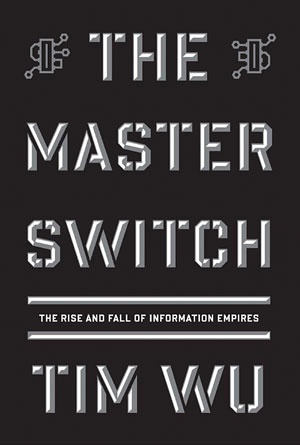
The master switch: the rise and fall of information empires – by Tim Wu

Whereas “Nonsense on stilts” surveys the history of science, and draws out lessons about the most productive ways to continue to find out deeper truths about the world, “The master switch” surveys many aspects of the modern history of business, and draws out lessons about the most productive ways to organise society so that information can be shared in the most effective way.

The author, Tim Wu, is a professor at Columbia Law School, and (if anything) is an even better story-teller than Pigliucci.  He gives rivetting accounts of many of the key episodes in various information businesses, such as those based on the telephone, radio, TV, cinema, cable TV, the personal computer, and the Internet.  Lots of larger-than-life figures stride across the pages.  The accounts fit together as constituents of an over-arching narrative:

  • Control over information technologies is particularly important for the well-being of society
  • There are many arguments in favour of centralised control, which avoids wasteful inefficiencies of competition
  • Equally, there are many arguments in favour of decentralised control, with open access to the various parts of the system
  • Many information industries went through one (or more phases) of decentralised control, with numerous innovators working independently, before centralisation took place (or re-emerged)
  • Government regulation sometimes works to protect centralised infrastructure, and sometimes to ensure that adequate competition takes place
  • Opening up an industry to greater competition often introduces a period of relative chaos and increased prices for consumers, before the greater benefits of richer innovation have a chance to emerge (often in unexpected ways)
  • The Internet is by no means the first information industry for which commentators had high, idealistic hopes: similar near-utopian visions also accompanied the emergence of broadcast radio and of cable television
  • A major drawback of centralised control is that too much power is vested in just one place – in what can be called a “master switch” – allowing vested interests to drastically interfere with the flow of information.

AT&T – the company founded by Bell – features prominently in this book, both as a hero, and as a villain.  Wu describes how AT&T suppressed various breakthrough technologies (including magnetic disk recording, usable in answering machines) for many years, out of a fear that they would damage the company’s main business.  Similarly, RCA suppressed FM radio for many years, and also delayed the adoption of electronic television.  Legal delays were often a primary means to delay and frustrate competitors, whose finances lacked such deep pockets.

Wu often highlights ways in which business history could have taken different directions.  The outcome that actually transpired was often a close-run thing, compared to what seemed more likely at the time.  This emphasises the contingent nature of much of history, rather than events being inevitable.  (I know this from my own experiences at Symbian.  Recent articles in The Register emphasise how Symbian nearly died at birth, well before powering more than a quarter of a billion smartphones.  Other stories, as yet untold, could emphasise how the eventual relative decline of Symbian was by no means a foretold conclusion either.)

But the biggest implications Wu highlights are when the stories come up to date, in what he sees as a huge conflict between powers that want to control modern information technology resources, and those that prefer greater degrees of openness.  As Wu clarifies, it’s a complex landscape, but Apple’s iPhone approach aims at greater centralised design control, whereas Google’s Android approach aims at enabling a much wider number of connections – connections where many benefits arise, without the need to negotiate and maintain formal partnerships.

Compared to previous information technologies, the Internet has greater elements of decentralisation built into it.  However, the lessons of the previous chapters in “The master switch” are that even this decentralisation is vulnerable to powerful interests seizing control and changing its nature.  That gives greater poignancy to present-day debates over “network neutrality” – a term that was coined by Wu in a paper he wrote in 2002.

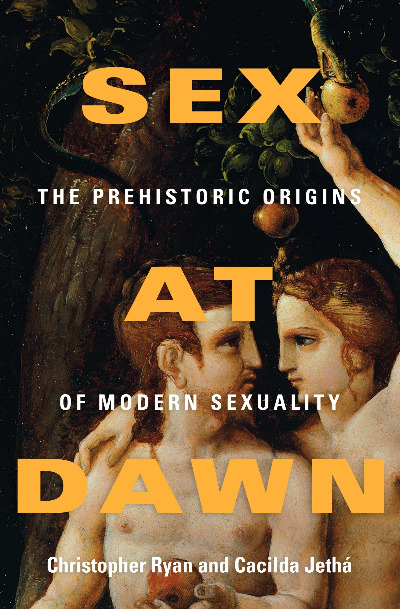
Sex at dawn: the prehistoric origins of modern sexuality – by Christopher Ryan and Cacilda Jetha

(Sensitive readers should probably stop reading now…)

In terms of historical sweep, this last book outdoes all the others on my list.  It traces the origins of several modern human characteristics far into prehistory – to the time before agriculture, when humans existed as nomadic hunter-gatherers, with little sense of personal exclusive ownership.

This book reminds me of this oft-told story:

It is said that when the theory of evolution was first announced it was received by the wife of the Canon of Worcester Cathedral with the remark, “Descended from the apes! My dear, we will hope it is not true. But if it is, let us pray that it may not become generally known.”

I’ve read a lot on evolution over the years, and I think the evidence husband and wife authors Christopher Ryan and Cacilda Jetha accumulate chapter after chapter, in “Sex at dawn”, is reasonably convincing – even though elements of present day “polite society” may well prefer this evidence not to become “generally known”.  The authors tell a story with many jaw-dropping episodes.

Among other things, the book systematically challenges the famous phrase from Thomas Hobbes in Leviathan that, absent a government, people would lead lives that were “solitary, poor, nasty, brutish, and short”.  On the contrary, the book marshals evidence, direct and indirect, that pre-agricultural people could enjoy relatively long lives, with ample food, and a strong sense of community.  Key to this mode of existence was “fierce sharing”, in which everyone felt a strong obligation to share food within the group … and not only food.  The X-rated claim in the book is that the sharing extended to “parallel multi-male, multi-female sexual relationships”, which bolstered powerful community identities.  Monogamy is, therefore, far from being exclusively “natural”.  Evidence in support of this conclusion includes:

  • Comparisons to behaviour in bonobos and chimps – the apes which are our closest evolutionary cousins
  • The practice in several contemporary nomadic tribes, in which children are viewed as having many fathers
  • Various human anatomical features, copulatory behaviour, aspects of sperm wars, etc.

In this analysis, human sexual nature developed under one set of circumstances for several million years, until dramatic changes in relatively recent times with the advent of agriculture, cities, and widespread exclusive ownership.  Social philosophies (including religions) have sought to change the norms of behaviour, with mixed success.

I’ll leave the last words to Ryan and Jetha, from their online FAQ:

We’re not recommending anything other than knowledge, introspection, and honesty. In fact, as we say in the book, we’re not really sure what to do with this information ourselves.

9 May 2010

Chapter completed: Crises and opportunities

Filed under: alienation, change, climate change, Economics, H+ Agenda, recession, risks, terrorism — David Wood @ 12:16 am

I’ve taken the plunge.  I’ve started writing another book, and I’ve finished the first complete draft of the first chapter.

The title I have in mind for the book is:

The Humanity+ Agenda: the vital priorities for the coming decade

The book is an extended version of the 10 minute opening presentation I gave a couple of weeks ago, at the Humanity+ UK 2010 event.  My reasons for writing this book are spelt out here.  The book will re-use and refine a lot of the material I’ve tried out from time to time in earlier posts on this blog, so you may find parts of it familiar.

I’ve had a few false starts, but I’m now happy with both the framework for the book (9 chapters in all) and a planned editing/review process.

Chapter 1 is called “Crises and opportunities”.  There’s a copy of the current draft below.

I’ll keep the latest drafts of all the chapters in the “Pages” section of this blog – accessible from the box on the right hand side.  From time to time – as in this posting – I’ll copy snapshots of the latest material into regular blogposts.

It’s my hope that the book will benefit from feedback and suggestions from readers.  Comments can be made, either to regular blogposts, or to the “pages”.  I’m also open to receiving emailed comments or contributions.  Unless someone tells me otherwise, I’ll assume that anything posted in response is intended as a potential contribution to the book.

(I’ll acknowledge, in the acknowledgements section of the book, all contributions that I use.)

========

1. Crises and opportunities

<Snapshot of material whose master copy is kept here>

The decade 2010-2019 will be a decade of crises for humanity:

  • As hundreds of millions of people worldwide significantly change their lifestyles, consuming ever more energy and generating ever more waste, the planet Earth faces increasingly great strains. “More of the same” is not an acceptable response.
  • Alongside the risk of environmental disaster, another risks looms: that of economic meltdown. The massive shocks to the global finance system at the end of the previous decade bear witness to powerful underlying tensions and problems with the operation of market economies.
  • The rapid rate of change causes widespread personal frustration and societal angst, driving a significant minority of people into the arms of beguiling ideologies such as fundamentalist Islam and the militant pursuit of terrorism. Relatively easy access to potential weapons of mass destruction – whether nuclear, biological, or chemical – transforms the threat of terrorism from an issue of national security into an issue of global survival.

In aggregation, these threats are truly fearsome.

To improve humanity’s chances of surviving, in good shape, to 2020 and beyond, we need new solutions.

I believe that these new solutions are emerging in part from improved technology, and in part from an important change in attitude towards technology. This book explains the basis for these beliefs.  This chapter summarises the crises, and the remaining chapters summarise the proposed solutions.

In the phrase “Humanity+”, the plus sign after the word “Humanity” emphasises that solutions to our present situation cannot be achieved by people continuing to do the same as before. Instead, a credible vision of wise application of new technologies can bring humans – both individually and collectively – to operate in dramatically enhanced ways:

  • Humans will be able, in stages, to break further free from the crippling constraints and debilitations of our evolutionary background and our historical experiences;
  • We will, individually and collectively, become smarter, wiser, stronger, kinder, healthier, calmer, brighter, more peaceful, and more fulfilled;
  • Instead of fruitless divisions and conflicts, we’ll find much better ways to cooperate, and build social systems for mutual benefit.

This is the vision of humanity fulfilling its true potential.

But there are many obstacles on the path to this fulfilment.  These obstacles could easily drive Humanity to “Humanity-” (humanity minus), or even worse (human annihilation), rather than Humanity+.  There’s nothing inevitable about the outcome.  As a reminder of the scale of the obstacles, let’s briefly review five interrelated pending crises.

1.1 The environmental crisis

Potential shortages of clean drinking water.  Rapid reductions in the available stocks of buried energy sources, such as coal, gas, and oil.  Crippling impacts on our environment from the waste products of our lifestyles.  These – and more – represent the oncoming environmental crisis.

With good reason, the aspect of the environmental crisis that is most widely discussed is the potential threat of runaway climate change.  Our accelerating usage of fossil fuels means that carbon dioxide (CO2) in the atmosphere has reached levels unprecedented in human history.  This magnifies the greenhouse effect of the atmosphere, tending to push the average global temperature higher.  This relationship is complex.  Forget simple ideas about increases in factor A invariably being the cause of increases in factor B.  Think instead about a dance of different factors that each influence the other, in different ways at different times.  (That’s a theme that you’ll notice throughout this book.)

In the case of climate change, the players in the dance include:

  • Variation in the amount of sunlight striking earth landmasses, due to changes over geological timescales in the axis of the earth, the eccentricity of the earth’s orbit, and the distribution of landmass over different latitudes;
  • Variation in the slow-paced transfer of heat between different parts of the ocean;
  • Variation in the speed of build-up or collapse of huge polar ice sheets;
  • Variation in numerous items in the atmosphere, including aerosols (which tend to lower average temperature) and greenhouse gases (which tend to raise it again);
  • Variation in the amounts of greenhouse gases, such as methane, being suddenly released into the atmosphere from buried frozen stores (for example, from tundra);
  • Variation in the sensitivity of the planet to the various “climate forcing agents” – sometimes a small change in one will lead to just small changes in the climate, but at other times the consequences are more severe.

What makes this dance potentially deadly is the twin risk of latent momentum and strong positive feedback:

  • More CO2 in the atmosphere raises the average temperature, which means there’s more H2O (water vapour) in the atmosphere too, raising the average temperature yet further;
  • Icesheets over the Antarctic and Greenland take a long time to start to disintegrate, but once the process gets under way, it can become essentially irreversible;
  • Less ice on the planet means less incoming sunlight is reflected to space; instead, larger areas of water absorb more of the sunlight, increasing ocean temperature further;
  • Rises in sea temperatures can trigger the sudden release of huge amounts of greenhouse gases from methane clathrate compounds buried in seabeds and permafrost – another example of rapid positive feedback.

Indeed, there is significant evidence that runaway methane clathrate breakdown may have caused drastic alteration of the ocean environment and the atmosphere of earth a number of times in the past, most notably in connection with the Permian extinction event, when 96% of all marine species became extinct about 250 million years ago.

Of course, predicting the future of the environment is hard.  There are three sorts of fogs of climate change uncertainty:

  1. Many of the technical interactions are still unknown, or are far from being fully understood.  We are continuing to learn more;
  2. Even where we believe we do understand the technical interactions, many of the detailed interactions are unpredictable.  Just as it’s hard to predict the weather itself, one month (say) into the future, it’s hard to predict the exact effect of ongoing climate forcing agents.  The effect that “a butterfly flapping its wings unpredictably causes a hurricane on the other side of the planet” applies for the chaos of climate as much as for the chaos of weather;
  3. There are huge numbers of vested interests, who (consciously or sub-consciously) twist and distort aspects of the argument over climate change.

The vested interests include:

  • Both anti-nuclear and pro-nuclear campaigners;
  • Both anti-oil and pro-oil campaigners, and anti-coal and pro-coal campaigners;
  • Both “small is beautiful” and “big is beautiful” campaigners;
  • Both “back to nature” and “pro-technology” campaigners;
  • Scientists and authors who have long supported particular theories, and who are loath to change their viewpoints;
  • Hardened political campaigners who look to extract maximum concessions, for the region or country they represent, before agreeing a point of negotiation.

Not only is it psychologically hard for individuals to objectively review data or theories that conflicts with their favoured opinions.  It is economically hard for companies (such as energy companies) to accept viewpoints that, if true, would cause major hurdles for their current lines of business, and significant loss of jobs.  On the other hand, just because researcher R has strong psychological reason P and/or strong economic incentive E in favour of advocating viewpoint V, it does not mean that viewpoint V is wrong.  The viewpoint could be correct, even though some of the support advanced in its favour is non-logical.  As I said, there’s lots of fog to navigate!

Despite all this uncertainty, I offer the following conclusions:

  • There is a wide range of possible outcomes, for the climate in the next few decades;
  • The probability of runaway global warming – with disastrous effects on sea levels, drought, agriculture, storms, species and ecosystem displacement, travel, business, and so on – is at least 20%, and likely higher;
  • Global warming won’t just make the temperature higher; it will make the weather more extreme – due to increased global temperature gradients, increased atmospheric water vapour, and higher sea temperatures that stir up more vicious storms.

A risk of at least 20% of a global environmental disaster deserves urgent attention and further analysis.  Who among us would enter an airplane with family and friends, if we believed there was a 20% probability of that airplane plummeting headlong out of the sky to the ground?

1.2 The economic crisis

The controversies and uncertainties over the potential threat of runaway climate change find parallels in discussions over a possible catastrophic implosion of the world economic system.  These discussions likewise abound with technical disagrements and vested interests.

Are governments, legislators, banks, and markets generally wise enough and capable to oversee the pressures of financial trading, and keep the systems afloat?  Was the recent series of domino-like collapses of famous banks around the world a “once in a lifetime” abnormality, that is most unlikely to repeat?  Or should we expect a recurrence of fundamental financial instability?  What is the risk of a larger financial crisis striking?  Indeed, what is the risk of adverse follow-on effects from the “tail end” of the 2008-2009 crisis, generating a so-called “double dip” in which the second dip is more drastic than the first?  On all these questions, opinions vary widely.

Despite the wide variation in opinions, some elements seem common.  All commentators are fearful of some potential causes of major disruption to global economics.  Depending on the commentator, these perceived potential causes include:

  • Clumsy regulation of financial markets;
  • Bankers who are able to take catastrophic risks in the pursuit of ever greater financial rewards;
  • The emergence of enormous monopoly powers that eliminate the benefits of marketplace competition;
  • Institutions that become “too big to fail” and therefore derail the appropriate workings of the market system;
  • Sky-high accumulation of debts, with individuals and countries living far beyond their means, for too long;
  • Austerity programmes that attempt to reduce debts quickly, but which could provoke spiraling industrial disputes and crippling strikes;
  • Bubbles that grow because “it’s temporarily rational for everyone to be irrational in their expectations” and then burst with tremendous damage.

We must avoid a feeling of overconfidence arising from the fact that previous financial crises were, in the end, survived, without the world of banking coming to an end.  First, these previous financial crises caused numerous local calamities – and the causes of major wars can be traced (in part) to these crises.  Second, there are reasons why future financial problems could have more drastic effects than previous ones:

  • There are numerous hidden interconnections between different parts of the global  economy, which accelerate negative feedback when individual parts fail;
  • The complexity of new financial products far outstrips the ability of senior managers and regulators to understand and appreciate the risks involved;
  • In an age of instant electronic connections, the speed of cascading events can catch us all flat-footed.

For these reasons, I tentatively suggest we assign a ballpark risk factor of about 20% to the probability of a major global financial meltdown during the 2010s.  (Yes, this is the same numeric figure as I picked for the environmental crisis too.)

Note some parallels between the two crises I’ve already discussed:

  • In each case, the devil is in the mix of weakly-understood powerful feedback systems;
  • Again in each case, our ability to discern what’s really happening is clouded by powerful non-rational factors and vested interests;
  • Again in each case, the probabilities of major disaster cannot be calculated in any precise way, but the risk appears large enough to warrant very serious investigation of solutions;
  • Again in each case, there is deep disagreement about the best solutions to deploy.

Worse, these two looming crises are themselves interconnected.  Shortage of resources such as clean energy could trigger large price hikes which throw national economies into tailspins.  Countries or regions which formerly cooperated could end up at devastating loggerheads, if an “abundance spirit” is replaced by a “scarcity spirit”.

1.3 The extreme terrorist crisis

What drives people to use bombs to inflict serious damage?  Depending on the cirumstance, it’s a combination of:

  • Positive belief, in support of some country, region, ideology, or religion;
  • Negative belief, in which a group of people (“the enemy”) are seen as despicable, inferior, or somehow deserving of destruction or punishment;
  • Peer pressure, where people feel constrained by those around them to follow through on a commitment (to become, for example, a suicide bomber);
  • Personal rage, such as a desire for revenge and humiliation;
  • Aspiration for personal glory and reward, in either the present life, or a presumed afterlife;
  • Failure of countervailing “pro-cooperation” and “pro-peace” instincts or systems.

Nothing here is new for the 2010s.  What is new is the increased ease of access, by would-be inflictors of damage, to so-called weapons of mass destruction.  There is a fair probability that the terrorists who piloted passenger jet airlines into the Twin Towers and the Pentagon would have willingly caused even larger amounts of turmoil and damage, if they could have put their hands on suitable weapons.

Technology itself is neutral.  A hammer which can be used to drive a nail into a piece of wood can equally be used to knock a fellow human unconscious.  Electricity can light up houses or fry someone in an electric chair.  Explosives can clear obstacles during construction projects or can obliterate critical infrastructure assets of so-called enemies.  Biochemical manipulation can yield wonderfully nutritious new food compounds or deadly new diseases.  Nuclear engineering can provide sufficient energy to free humanity from dependency on carbon-laden fossil fuels, or suitcase-sized portable weapons capable of tearing the heart out of major cities.

As technology becomes more widely accessible – via improved education worldwide, via cheaper raw materials, and via easy access to online information – the potential grows, both for good uses and for bad uses.  A saying attributed to Eliezer Yudkowsky gives us pause for thought:

The minimum IQ required to destroy the world drops by one point every 18 months.

(This saying is sometimes called “Moore’s Law of mad scientists“.)  The statement was probably not intended to be interpreted mathematically exactly, but we can agree that, over the course of a decade, the number of people capable of putting together a dreadful weapon of mass destruction will grow significantly.  The required brainpower will move from the rarified tails of the bell curve of intelligence distribution, in the direction of the more fully populated central region.

We can imagine similar “laws” of increasing likelihood of destructive capability:

The minimum IQ required to devise and deploy a weapon that wipes out the heart of a major city drops by one point every 18 months;

The minimum IQ required to poison the water table for a region drops by one point every 18 months;

The minimum IQ required to unleash a devastating plague drops by one point every 18 months…

Of course, the threat of nuclear annihilation has been with the world for half a century.  During my student days at Cambridge University, I participated in countless discussions about how best to avoid the risk of unintentional nuclear war.  Despite the forebodings of some of my contemporaries at the time, we reached the end of the 20th century unscathed.  Governments of nuclear-capable countries, regardless of their political hues and ideological positions, found good reason to avoid steps that could trigger any nuclear escalation.  What’s different with at least some fundamentalist terrorists is that they operate in a mental universe that is considerably more extreme:

  • They live for a life beyond the grave, rather than before it;
  • They believe that divine providence will take care of the outcome – any “innocents” caught up in the destruction will receive their own rewards in the afterlife, courtesy of an all-seeing, all-knowing deity;
  • They are nourished and inspired by apocalyptic writing that glorifies a vision of almighty destruction;
  • They operate with moral certainty: they seem to harbour no doubts or questions about the rightness of their course of action.

Mix this extreme mindset with sufficient raw brainpower and with weapons-grade materials that can be begged, bought, or stolen, and the stage is set for a terrorist outrage that will put 9/11 far into the shade.  In turn, the world’s reaction to that incident is likely to put the reaction to 9/11 far into its own shade.

It’s true, would-be terrorists are often incompetent.  Their explosives sometimes fail to detonate.  But that must give us no ground for complacency.  The same “incompetence” can sometimes result in unforeseen consequences that are even more destructive than those intended.

1.4 The sense of profound personal alienation

Environmental crisis.  Economic crisis.  Extreme terrorist crisis.  Added together, we might be facing a risk of around 50% that, sometime during the 2010s, we’ll collectively look back with enormous regret and say to ourselves:

That’s the worst thing that’s happened in our lifetime.  Why oh why didn’t we act to stop it happening?  But it’s too late to make amends now.  If only we could re-run history, and take wiser choices…

But there’s more.  Here’s a probability that I’ll estimate at 100%, rather than 50%.  It’s the probability that huge numbers of individuals will look at their lives with bitter regret, and say to themselves:

This outcome was very far from the best it could have been.  This human life has missed, by miles, the richness and quality of experience that was potentially available.  Why oh why did it turn out like this?  If only I could re-run my life, and take wiser choices, or benefit from improved circumstances…

The first three crises are global crises.  This fourth one is a personal crisis.  The first three are highly visible.  The fourth might just be an internal heartache.  It’s the realisation that:

  • Life provides, at least for some people, on at least some occasions, intense feelings of vitality, creativity, flow, rapport, ecstacy, and accomplishment;
  • These “peak experiences” are generally rare, or just glimpsed;
  • The majority of human experience is at a much lower level of quality than is conceivable.

The pervasive video broadcast communications of the modern age make it all the more obvious, to increasing numbers of people, that the quality of their lives fall short of what could be imagined and desired.  These same communications also strongly hint that technology is advancing to the point where it could soon free people from the limitations of their current existence, and enable levels of experience previously only imagined for deities.  Just around the corner lies the potential of lives that are much extended, expanded, and enhanced.  How frustrating to miss out on this potential!  It brings to mind the lamentations of a venerable French noblewoman from 1783, as noted in Lewis Lapham’s 2003 Commencement speech at St. John’s College Annapolis:

[A] French noblewoman, a duchess in her eighties, …, on seeing the first ascent of Montgolfier’s balloon from the palace of the Tuilleries in 1783, fell back upon the cushions of her carriage and wept. “Oh yes,” she said, “Now it’s certain. One day they’ll learn how to keep people alive forever, but I shall already be dead.”

Acts of gross destruction are often motivated by deep feelings of dissatisfaction or frustration: the world is perceived as containing significant wrongs, that need righting.  So there’s a connection between the crisis of profound personal alienation and the crisis of extreme terrorism.  Thankfully, people who experience dissatisfaction or frustration don’t all react in the same way.  But even if the reaction is only (as I suggested earlier) an internal heartache, the shortcoming between potential and reality is nonetheless profound.  Life could, and should, be so much better.

We can re-state the four crises as four huge opportunities:

  1. The opportunity to nurture an amazingly pleasant, refreshing, and intriguing environment;
  2. The opportunity to guide global economic development to sustainably create sufficient resources for everyone’s needs;
  3. The opportunity to utilise personal passions for constructive projects;
  4. The opportunity to enable individuals to persistently experience qualities of human life far, far higher than at present.

I see Humanity+ as addressing all four of these opportunities.  And it does so with an eye on one more crisis, which is the most uncertain one of the lot.

1.5 The existential crisis of accelerating change and deepening complexity

Time and again, changes have consequences that are unforeseen and unintended.  The more complex the system, the greater the likelihood of changes leading to unintended consequences.

However, human society is becoming more complex all the time:

  • Multiple different cultures and sub-cultures overlap, co-exist, and influence each other;
  • Worldwide travel is nowadays commonplace;
  • Increasing numbers of channels exist for communication and influence ;
  • Society is underpinned by a rich infrastructure of multi-layered technology.

Moreover, the rate of change is increasing:

  • New products sweep around the world in ever shorter amounts of time;
  • Larger numbers of people are being educated to levels never seen before, and are entering the worlds of research, development, manufacturing, and business;
  • Online collaboration mechanisms, including social networks, wikis, and open source software, mean it is easier for innovation in one part of the world to quickly influence and benefit subsequent innovation elsewhere;
  • The transformation of more industries from “matter-dominated” to “information-dominated” means that the rapid improvement cycle of semiconductors transforms the speed of progress.

These changes bring many benefits.  They also bring drawbacks, and – due to the law of unintended consequences – they bring lots of unknowns and surprises.  The risk is that we’ll waken up one morning and realise that we deeply regret one of the unforeseen side-effects.  For example, there are risks:

  • That some newly created microscopic-scale material will turn out to have deleterious effects on human life, akin (but faster acting) to the problems arising to exposure from asbestos;
  • That some newly engineered biochemical organism will escape into the wild and turn out to have an effect like that of a plague;
  • That well-intentioned attempts at climate “geo-engineering”, to counter the risk of global warming, will trigger unexpected fast-moving geological phenomenon;
  • That state-of-the-art high-energy physics experiments will somehow create unanticipated exotic new particles that destroy all nearby space and time;
  • That software defects will spread throughout part of the computing infrastructure of modern life, rendering it useless.

Here’s another example, from history.  On 1st March 1954, the US military performed their first test of a dry fuel hydrogen bomb, at the Bikini Atoll in the Marshall Islands.  The explosive yield was expected to be from 4 to 6 Megatons.  But when the device was exploded, the yield was 15 Megatons, two and a half times the expected maximum.  As the Wikipedia article on this test explosion explains:

The cause of the high yield was a laboratory error made by designers of the device at Los Alamos National Laboratory.  They considered only the lithium-6 isotope in the lithium deuteride secondary to be reactive; the lithium-7 isotope, accounting for 60% of the lithium content, was assumed to be inert…

Contrary to expectations, when the lithium-7 isotope is bombarded with high-energy neutrons, it absorbs a neutron then decomposes to form an alpha particle, another neutron, and a tritium nucleus.  This means that much more tritium was produced than expected, and the extra tritium in fusion with deuterium (as well as the extra neutron from lithium-7 decomposition) produced many more neutrons than expected, causing far more fissioning of the uranium tamper, thus increasing yield.

This resultant extra fuel (both lithium-6 and lithium-7) contributed greatly to the fusion reactions and neutron production and in this manner greatly increased the device’s explosive output.

Sadly, this calculation error resulted in much more radioactive fallout than anticipated.  Many of the crew in a nearby Japanese fishing boat, the Lucky Dragon No. 5, became ill in the wake of direct contact with the fallout.  One of the crew subsequently died from the illness – the first human casualty from thermonuclear weapons.

Suppose the error in calculation had been significantly worse – perhaps by an order of thousands rather than by a factor of 2.5.  This might seem unlikely, but when we deal with powerful unknowns, we cannot rule out powerful unforeseen consequences.  Imagine if extreme human activity somehow interfered with the incompletely understood mechanisms governing supervolcanoes – such as the one that exploded around 73,000 years ago at Lake Toba (Sumatra, Indonesia) and which is thought to have reduced the worldwide human population at the time to perhaps as few as one thousand breeding pairs.

It’s not just gargantuan explosions that we need fear.  As indicated above, the list of so-called “existential risks” includes highly contagious diseases, poisonous nano-particles, and catastrophic failures of the electronics infrastructure that underpins modern human society.  Add to these “known unknowns” the risk of “unknown unknowns” – the factors which we currently don’t even know that we should be considering.

The more quickly things change, the harder it is to foresee and monitor all the consequences.  There’s a great deal that deserves our attention.  How should we respond?

>> Next chapter >>

15 April 2010

Accelerating automation and the future of work

Filed under: AGI, Economics, futurist, Google, politics, regulation, robots — David Wood @ 2:45 am

London is full of pleasant surprises.

Yesterday evening, I travelled to The Book Club in Shoreditch, EC2A, and made my way to the social area downstairs.  What’s your name? asked the person at the door.  I gave my name, and in return received a stick-on badge saying

Hi, I’m David.

Talk to me about the future of humanity!

I was impressed.  How do they know I like to talk to people about the future of humanity?

Then I remembered that the whole event I was attending was under the aegis of a newly formed group calling itself “Future Human“.  It was their third meeting, over the course of just a few weeks – but the first I had heard about (and decided to attend).  Everyone’s badge had the same message.  About 120 people crammed into the downstairs room – making it standing room only (since there were only around 60 seats).  Apart from the shortage of seats, the event was well run, with good use of roaming mikes from the floor.

The event started with a quick-fire entertaining presentation by author and sci-fi expert Sam Jordison.  His opening question was blunt:

What can you do that a computer can’t do?

He then listed lots of occupations from the past which technology had rendered obsolete.  Since one of my grandfathers was the village blacksmith, I found a personal resonance with this point.  It will soon be the same for many existing professions, Sam said: computers are becoming better and better at all sorts of tasks which previously would have required creative human input.  Journalism is particularly under threat.  Likewise accountancy.  And so on, and so on.

In general terms, that’s a thesis I agree with.  For example, I anticipate a time before long when human drivers will be replaced by safer robot alternatives.

I quibble with the implication that, as existing jobs are automated, there will be no jobs left for humans to do.  Instead, I see that lots of new occupations will become important.  “Shape of Jobs to Come”, a report (PDF) by Fast Future Research, describes 20 jobs that people could be doing in the next 20 years:

  1. Body part maker
  2. Nano-medic
  3. Pharmer of genetically engineered crops and livestock
  4. Old age wellness manager/consultant
  5. Memory augmentation surgeon
  6. ‘New science’ ethicist
  7. Space pilots, tour guides and architects
  8. Vertical farmers
  9. Climate change reversal specialist
  10. Quarantine enforcer
  11. Weather modification police
  12. Virtual lawyer
  13. Avatar manager / devotees / virtual teachers
  14. Alternative vehicle developers
  15. Narrowcasters
  16. Waste data handler
  17. Virtual clutter organiser
  18. Time broker / Time bank trader
  19. Social ‘networking’ worker
  20. Personal branders

(See the original report for explanations of some of these unusual occupation names!)

In other words, as technology improves to remove existing occupations, new occupations will become significant – occupations that build in unpredictable ways on top of new technology.

But only up to a point.  In the larger picture, I agree with Sam’s point that even these new jobs will quickly come under the scope of rapidly improving automation.  The lifetime of occupations will shorten and shorten.  And people will typically spend fewer hours working each week (on paid tasks).

Is this a worry? Yes, if we assume that we need to work long hours, to justify our existence, or to earn sufficient income to look after our families.  But I disagree with these assumptions. Improved technology, wisely managed, should be able to result, not just in less labour left over for humans to do, but also in great material abundance – plenty of energy, food, and other resources for everyone.  We’ll become able – at last – to spend more of our time on activities that we deeply enjoy.

The panel discussion that followed touched on many of these points. The panellists – Peter Kirwan from Wired, Victor Henning from Mendeley, and Carsten Sorensen and Jannis Kallinikos from the London School of Economics – sounded lots of notes of optimism:

  • We shouldn’t create unnecessary distinctions between “human” and “machine”.  After all, humans are kinds of machines too (“meat machines“);
  • The best kind of intelligence combines human elements and machine elements – in what Google have called “hybrid intelligence“;
  • Rather than worrying about computers displacing humans, we can envisage computers augmenting humans;
  • In case computers become troublesome, we should be able to regulate them, or even to switch them off.

Again, in general terms, these are points I agree with.  However, I believe these tasks will be much harder to accomplish than the panel implied. To that extent, I believe that the panel were too optimistic.

After all, if we can barely regulate rapidly changing financial systems, we’ll surely find it even harder to regulate rapidly changing AI systems.  Before we’ve been able to work out if such-and-such an automated system is an improvement on its predecessors, that system may have caused too many rapid irreversible changes.

Worse, there could be a hard-to-estimate “critical mass” effect.  Rapidly accumulating intelligent automation is potentially akin to accumulating nuclear material until it unexpectedly reaches an irreversible critical mass.  The resulting “super cloud” system will presumably state very convincing arguments to us, for why such and such changes in regulations make great sense.  The result could be outstandingly good – but equally, it could be outstandingly bad.

Moreover, it’s likely to prove very hard to “switch off the Internet” (or “switch off Google”).  We’ll be so dependent on the Internet that we’ll be unable to disconnect it, even though we recognise there are bad consequences,

If all of this happens in slow motion, we would be OK.  We’d be able to review it and debug it in real time.  However, the lessons from the recent economic crisis is that these changes can take place almost too quickly for human governments to intervene.  That’s why we need to ensure, ahead of time, that we have a good understanding of what’s happeningAnd that’s why there should be lots more discussions of the sort that took place at Future Human last night.

The final question from the floor raised a great point: why isn’t this whole subject receiving prominence in the current UK general election debates?  My answer: It’s down to those of us who do see the coming problems to ensure that the issues get escalated appropriately.

Footnote: Regular readers will not be surprised if I point out, at this stage, that many of these same topics will be covered in the Humanity+ UK2010 event happening in Conway Hall, Holborn, London, on Saturday 24 April.  The panellists at the Future Human event were good, but I believe that the H+UK speakers will be even better!

5 April 2010

The ascent of money: huge opportunities and huge risks

Filed under: books, Economics, predictability — David Wood @ 9:36 pm

The turning point of the American Civil War.  The defeat of Napoleon.  The lead-up to the French Revolution.  The decline of Imperial Spain.  These chapters of history all have intriguing back stories – according to Harvard professor Niall Ferguson, in his book “The Ascent of Money: A Financial History of the World“.

The back stories, each time, refer to the strengths and weakness of evolving financial systems.

Appreciating these back stories isn’t just an intellectual curiosity.  It provides rich context for the view that financial systems are sophisticated and complex entities that deserve much wider understanding.  Without this understanding, it’s all too easy for people to hold one or other overly-simplistic understanding of financial systems, such as:

  • Financial systems are all fundamentally flawed;
  • Financial systems are all fundamentally beneficial;
  • There are “sure thing” investments which people can learn about;
  • Financial systems should be picked apart – the world would be better off without them;
  • Markets are inherently insane;
  • Markets are inherently sane;
  • Bankers (and their ilk) deserve our scorn;
  • Bankers (and their ilk) deserve our deep gratitude.

As the book progresses, Ferguson sweeps forwards and backwards throughout history, gradually building up a fuller picture of evolving financial systems:

  • The banking system;
  • Government bonds;
  • Stock markets;
  • Insurance and securities;
  • The housing market;
  • Hedge funds;
  • Globalisation;
  • The growing role of China in financial systems.

Like me, Ferguson was born in Scotland.  I was struck by the number of Scots-born heroes and villains the book introduces, including an infamous Glaswegian loan shark, the creators of the first true insurance company, officers of the companies involved in the Anglo-China “Opium Wars”, and Andrew Law – instigator in France of one of history’s first great stock market bubbles.  Of course, many non-Scots have starring roles too – including Shakespeare’s Shylock, the Medicis, the Rothschilds, George Soros, the managers of Enron, Milton Friedman, and John Maynard Keynes.

Time and again, Ferguson highlights lessons for the present day.  Yes, new financial systems can liberate great amounts of creativity.  Innovation in financial systems can provide significant benefits for society.  But, at the same time, financial systems can be mis-managed, with dreadful consequences.  One major contributory cause of mis-managing these systems is when people lack a proper historical perspective – for example, when the experience of leading financiers is just of times of growth, rather than times of savage decline.

Among many fascinating episodes covered in the book, I found two to be particularly chilling:

  • The astonishing (in retrospect) over-confidence of observers in the period leading up to the First World War, that any such war could not possibly happen;
  • The astonishing (in retrospect) over-confidence of the managers of the Long Term Capital Management (LTCM) hedge fund, that their fund could not possibly fail.

Veteran journalist Hamish McRae describes some of the pre-WWI thinking in his review of Ferguson’s book in The Independent:

The 19th-century globalisation ended with the catastrophe of the First World War. It is really scary to realise how unaware people were of the fragility of those times. In 1910, the British journalist Norman Angell published The Great Illusion, in which he argued that war between the great powers had become an economic impossibility because of “the delicate interdependence of international finance”.

In spring 1914 an international commission reported on the Balkan Wars of 1912-13. The British member of the commission, Henry Noel Brailsford, wrote: “In Europe the epoch of conquest is over and save in the Balkans perhaps on the fringes of the Austrian and Russian empires, it is as certain as anything in politics that the frontiers of our national states are finally drawn. My own belief is that there will be no more war among the six powers.”

And Ferguson re-tells the story of LTCM in his online article “Wall Street Lays Another Egg” (which also covers many of the other themes from his book):

…how exactly do you price a derivative? What precisely is an option worth? The answers to those questions required a revolution in financial theory. From an academic point of view, what this revolution achieved was highly impressive. But the events of the 1990s, as the rise of quantitative finance replaced preppies with quants (quantitative analysts) all along Wall Street, revealed a new truth: those whom the gods want to destroy they first teach math.

Working closely with Fischer Black, of the consulting firm Arthur D. Little, M.I.T.’s Myron Scholes invented a groundbreaking new theory of pricing options, to which his colleague Robert Merton also contributed. (Scholes and Merton would share the 1997 Nobel Prize in economics.) They reasoned that a call option’s value depended on six variables: the current market price of the stock (S), the agreed future price at which the stock could be bought (L), the time until the expiration date of the option (t), the risk-free rate of return in the economy as a whole (r), the probability that the option will be exercised (N), and—the crucial variable—the expected volatility of the stock, i.e., the likely fluctuations of its price between the time of purchase and the expiration date (s). With wonderful mathematical wizardry, the quants reduced the price of a call option to this formula (the Black-Scholes formula).

Feeling a bit baffled? Can’t follow the algebra? That was just fine by the quants. To make money from this magic formula, they needed markets to be full of people who didn’t have a clue about how to price options but relied instead on their (seldom accurate) gut instincts. They also needed a great deal of computing power, a force which had been transforming the financial markets since the early 1980s. Their final requirement was a partner with some market savvy in order to make the leap from the faculty club to the trading floor. Black, who would soon be struck down by cancer, could not be that partner. But John Meriwether could. The former head of the bond-arbitrage group at Salomon Brothers, Meriwether had made his first fortune in the wake of the S&L meltdown of the late 1980s. The hedge fund he created with Scholes and Merton in 1994 was called Long-Term Capital Management.

In its brief, four-year life, Long-Term was the brightest star in the hedge-fund firmament, generating mind-blowing returns for its elite club of investors and even more money for its founders. Needless to say, the firm did more than just trade options, though selling puts on the stock market became such a big part of its business that it was nicknamed “the central bank of volatility” by banks buying insurance against a big stock-market sell-off. In fact, the partners were simultaneously pursuing multiple trading strategies, about 100 of them, with a total of 7,600 positions. This conformed to a second key rule of the new mathematical finance: the virtue of diversification, a principle that had been formalized by Harry M. Markowitz, of the Rand Corporation. Diversification was all about having a multitude of uncorrelated positions. One might go wrong, or even two. But thousands just could not go wrong simultaneously.

The mathematics were reassuring. According to the firm’s “Value at Risk” models, it would take a 10-s (in other words, 10-standard-deviation) event to cause the firm to lose all its capital in a single year. But the probability of such an event, according to the quants, was 1 in 10^24—or effectively zero. Indeed, the models said the most Long-Term was likely to lose in a single day was $45 million. For that reason, the partners felt no compunction about leveraging their trades. At the end of August 1997, the fund’s capital was $6.7 billion, but the debt-financed assets on its balance sheet amounted to $126 billion, a ratio of assets to capital of 19 to 1.

There is no need to rehearse here the story of Long-Term’s downfall, which was precipitated by a Russian debt default. Suffice it to say that on Friday, August 21, 1998, the firm lost $550 million—15 percent of its entire capital, and vastly more than its mathematical models had said was possible. The key point is to appreciate why the quants were so wrong.

The problem lay with the assumptions that underlie so much of mathematical finance. In order to construct their models, the quants had to postulate a planet where the inhabitants were omniscient and perfectly rational; where they instantly absorbed all new information and used it to maximize profits; where they never stopped trading; where markets were continuous, frictionless, and completely liquid. Financial markets on this planet followed a “random walk,” meaning that each day’s prices were quite unrelated to the previous day’s, but reflected no more and no less than all the relevant information currently available. The returns on this planet’s stock market were normally distributed along the bell curve, with most years clustered closely around the mean, and two-thirds of them within one standard deviation of the mean. On such a planet, a “six standard deviation” sell-off would be about as common as a person shorter than one foot in our world. It would happen only once in four million years of trading.

But Long-Term was not located on Planet Finance. It was based in Greenwich, Connecticut, on Planet Earth, a place inhabited by emotional human beings, always capable of flipping suddenly and en masse from greed to fear. In the case of Long-Term, the herding problem was acute, because many other firms had begun trying to copy Long-Term’s strategies in the hope of replicating its stellar performance. When things began to go wrong, there was a truly bovine stampede for the exits. The result was a massive, synchronized downturn in virtually all asset markets. Diversification was no defense in such a crisis. As one leading London hedge-fund manager later put it to Meriwether, “John, you were the correlation.”

There was, however, another reason why Long-Term failed. The quants’ Value at Risk models had implied that the loss the firm suffered in August 1998 was so unlikely that it ought never to have happened in the entire life of the universe. But that was because the models were working with just five years of data. If they had gone back even 11 years, they would have captured the 1987 stock-market crash. If they had gone back 80 years they would have captured the last great Russian default, after the 1917 revolution. Meriwether himself, born in 1947, ruefully observed, “If I had lived through the Depression, I would have been in a better position to understand events.” To put it bluntly, the Nobel Prize winners knew plenty of mathematics but not enough history.

These episodes should remind us of the fragility of our current situation.  Indeed, as one of many potential future scenarios, Ferguson candidly discusses the prospects for a serious breakdown in relations between China and the west, akin to the breakdown of relations that precipitated the First World War.

In summary: I recommend this book, not only because it is full of intriguing anecdotes, but because it will help to raise awareness of the complex impacts of financial systems.  It will help boost general literacy about all aspects of money – and should, therefore, help us to be more effective in how collectively manage financial innovation.

Note: There are two editions of this book: one released in 2008, and one released in 2009.  The latter has a fuller account of the recent global financial crisis, and for that reason, is the better one to read.

18 March 2010

Animal spirits – a richer understanding of economics

Filed under: books, Economics, irrationality, recession — David Wood @ 3:41 pm

It’s no secret that some of the fundamental assumptions of economic theory are faulty.

Specifically, the primary model in economics is that individuals invariably take actions which make good economic sense.  The mythical “Homo economicus” (“Economic Man”) is motivated at all times:

  • To purchase goods and services that have lower cost;
  • To create goods and services that they can sell at higher price;
  • To minimise the amount of effort that they have to expend to create these goods and services.

Real world people, of course, deviate from this model in numerous ways.  Lots of other things motivate us, beyond purely economic concerns.

Indeed, we can arrange human decisions on a two-by-two matrix:

  • On one dimension, decisions vary between economic motivations and non-economic movitations;
  • On the other dimension, decisions vary between rational and irrational.

Theories of classical economics take their lead from just one of the resulting four fields of life – the field of economic motivations that are pursued rationally.  But what impact do the other three fields have on overall economic questions, such as booms and busts, inflation, employment, savings, and inequality?

Many classicial economists give the strong impression that these other three fields have limited impact – somehow their effects average out, or can be discounted.  More recently, the rise of behavioural economics has challenged this conclusion, by increasingly providing evidence and analysis of factors such as:

  • Irrational biases in human decision making;
  • Herd mentality;
  • Limits of information;
  • The motivational importance of factors other than economic ones.

The best account I’ve encountered of this whole topic is the book “Animal Spirits: How Human Psychology Drives the Economy, and Why It Matters for Global Capitalism“.

This book was authored last year by two eminent economists, George A. Akerlof and Robert J. Shiller.  Their phrase “Animal Spirits” is taken from Keynes – from a part of the thinking of Keynes that, they believe, has been too often neglected (even by people who describe themselves as followers of Keynes):

The markets are moved by animal spirits, and not by reason

(paraphrased from Keynes’ 1935 book “The General Theory of Employment Interest and Money”)

Akerlof and Shiller provide five chapters that explain each of five important contributors to “animal spirits”:

  • Confidence and Its Multipliers
  • Fairness
  • Corruption and Bad Faith
  • Money Illusion
  • Stories.

These explanations interweave many accounts of economic episodes over the decades, adding to the plausibility of the fact that these factors matter a great deal.

Next, Akerlof and Shiller show how considerations of these “animal spirits” provide deeper insight into each of eight key questions of economic theory:

  • Why Do Economies Fall into Depression?
  • Why Do Central Bankers Have Power over the Economy (Insofar as They Do)?
  • Why Are There People Who Cannot Find a Job?
  • Why Is There a Trade-off between Inflation and Unemployment in the Long Run?
  • Why Is Saving for the Future So Arbitrary?
  • Why Are Financial Prices and Corporate Investments So Volatile?
  • Why Do Real Estate Markets Go through Cycles?
  • Why Is There Special Poverty among Minorities?

To my mind, the analysis is devastating: any serious discussion of eonomics needs to take account of these findings.

Footnote: Amazon.com contains a whole series of nasty and devious reviews of this book.  Don’t be misled by them!  The motivations of the people writing these reviews would be a worthy subject for an analysis in its own right.  There are other kinds of “animal spirits” afoot here.

17 March 2010

Complementary currencies

Filed under: Economics, sustainability, vision, Zeitgeist — David Wood @ 11:49 pm

Recently, I mused about a world economy without money.

Two replies – from Peter Jackson and from Marios Gerogiokas – independently drew my attention to a different notion: complementary currencies.

In brief:

  • Rather than seeking to fix our current economic and social dilemmas by reducing the number of monetary systems from one to zero – as proposed by the Zeitgeist Movement – this alternative idea proposes increasing the number of monetary systems, from one to more-than-one.

Marios drew my attention to a TEDxBerlin talk by Belgian economist Bernard Lietaer, “Why this crisis? And what to do about it?“:

The talk takes a bit of time to get going, but it makes an increasingly interesting series of points:

  • We need resilience in our economic structures, as well as efficiency;
  • One way to achieve resilience is to avoid mono-culture;
  • Having “complementary” currency systems running in parallel is one way to avoid monetary mono-culture;
  • Without adoption of complementary currencies, we risk repetitions of the recent economic crash.

Here’s one quote that struck me:

Complementary currencies are now where open source software and microfinance were 10 years ago.

And another:

It would be crazy to believe that we’re going into the information age, and the most important information system – our money – will not change.

Personally, I see it as much more likely that our monetary system will evolve and improve rather than it will be removed altogether.

Of course, there are risks in any such evolution (just as there are risks with the status quo).  Some of the reasons for the recent economic crash, after all, were the innovative financial systems (with an alphabet soup of acronym names) that turned out to be insufficiently understood.

Footnote: There’s more about the concept of complementary currency on Wikipedia.

15 March 2010

Imagining a world without money

Filed under: Economics, futurist, motivation, politics, Singularity, vision, Zeitgeist — David Wood @ 11:48 am

On Saturday, I attended “London Z Day 2010” – described as

presentations about futurism and technology, the singularity and the current economic landscape, activism and how to get involved…

Around 300 people were present in the Oliver Thompson Lecture Theatre of London’s City University.  That’s testimony to good work by the organisers – the UK chapter of the worldwide “Zeitgeist Movement“.

I liked a lot of what I heard – a vision that advocates greater adoption of:

  • Automation: “Using technology to automate repetitive and tedious tasks leads to efficiency and productivity. It is also socially responsible as people are freed from labor that undermines their intelligence”
  • Artificial intelligence: “machines can take into account more information”
  • The scientific method: “a proven method that has stood the test of time and leads to discovery. Scientific method involves testing, getting feedback from natural world and physical law, evaluation of results, sharing data openly and requirement to replicate the test results”
  • Technological unification: “Monitoring planetary resources is needed in order to create an efficient system, and thus technology should be shared globally”.

I also liked the sense of urgency and activism, to move swiftly from the current unsustainable social and economic frameworks, into a more rational framework.  Frequent references of work of radical futurists like Ray Kurzweil emphasised the plausibility of rapid change, driven by accelerating technological innovation.  That makes good sense.

I was less convinced by other parts of the Zeitgeist worldview – in particular, its strong “no money” and “no property” messages.

Could a society operate without money?  Speakers from the floor seemed to think that, in a rationally organised society, everyone would be able to freely access all the goods and services they need, rather than having to pay for them.  The earth has plenty of resources, and we just need to look after them in a sensible way.  Money has lots of drawbacks, so we should do without it – so the argument went.

One of the arguments made by a speaker, against a monetary basis of society, was the analysis from the recent book “The Spirit Level: Why More Equal Societies Almost Always Do Better” by Richard Wilkinson and Kate Pickett.  Here’s an excerpt of a review of this book from the Guardian:

We are rich enough. Economic growth has done as much as it can to improve material conditions in the developed countries, and in some cases appears to be damaging health. If Britain were instead to concentrate on making its citizens’ incomes as equal as those of people in Japan and Scandinavia, we could each have seven extra weeks’ holiday a year, we would be thinner, we would each live a year or so longer, and we’d trust each other more.

Epidemiologists Richard Wilkinson and Kate Pickett don’t soft-soap their message. It is brave to write a book arguing that economies should stop growing when millions of jobs are being lost, though they may be pushing at an open door in public consciousness. We know there is something wrong, and this book goes a long way towards explaining what and why.

The authors point out that the life-diminishing results of valuing growth above equality in rich societies can be seen all around us. Inequality causes shorter, unhealthier and unhappier lives; it increases the rate of teenage pregnancy, violence, obesity, imprisonment and addiction; it destroys relationships between individuals born in the same society but into different classes; and its function as a driver of consumption depletes the planet’s resources.

Wilkinson, a public health researcher of 30 years’ standing, has written numerous books and articles on the physical and mental effects of social differentiation. He and Pickett have compiled information from around 200 different sets of data, using reputable sources such as the United Nations, the World Bank, the World Health Organisation and the US Census, to form a bank of evidence against inequality that is impossible to deny.

They use the information to create a series of scatter-graphs whose patterns look nearly identical, yet which document the prevalence of a vast range of social ills. On almost every index of quality of life, or wellness, or deprivation, there is a gradient showing a strong correlation between a country’s level of economic inequality and its social outcomes. Almost always, Japan and the Scandinavian countries are at the favourable “low” end, and almost always, the UK, the US and Portugal are at the unfavourable “high” end, with Canada, Australasia and continental European countries in between.

This has nothing to do with total wealth or even the average per-capita income. America is one of the world’s richest nations, with among the highest figures for income per person, but has the lowest longevity of the developed nations, and a level of violence – murder, in particular – that is off the scale. Of all crimes, those involving violence are most closely related to high levels of inequality – within a country, within states and even within cities. For some, mainly young, men with no economic or educational route to achieving the high status and earnings required for full citizenship, the experience of daily life at the bottom of a steep social hierarchy is enraging…

The anxiety in this book about our current economic system was reflected in anxiety expressed by all the Zeitgeist Movement speakers.  However, the Zeitgeist speakers drew a more radical conclusion.  It’s not just that economic inequalities have lots of bad side effects.  They say, it’s money-based economics itself that causes these problems.  And that’s a hard conclusion to swallow.

They don’t argue for reforming the existing economic system.  Rather, they argue for replacing it completely.  Money itself, they say, is the root problem.

The same dichotomy arose time and again during the day.  Speakers highlighted many problems with the way the world currently operates.  But instead of advocating incremental reforms – say, for greater equality, or for oversight of the market – they advocated a more radical transformation: no money, and no property.  What’s more, the audience seemed to lap it all up.

Of course, money has sprung up in countless societies throughout history, as something that allows for a more efficient exchange of resources than simple bartering.  Money provides a handy intermediate currency, enabling more complex transactions of goods and services.

In answer, the Zeitgeist speakers argue that use of technology and artificial intelligence would allow for more sensible planning of these goods and services.  However, horrible thoughts come to mind of all the failures of previous centrally controlled economies, such as in Soviet times.  In answer again, the Zeitgeist speakers seem to argue that better artificial intelligence will, this time, make a big difference.  Personally, I’m all in favour of gradually increased application of improved automatic decision systems.  But I remain deeply unconvinced about removing money:

  1. Consumer desires can be very varied.  Some people particularly value musical instruments, others foreign travel, others sports equipment, others specialist medical treatment, and so on.  What’s more, the choices are changing all the time.  Money is a very useful means for people to make their own, individual choices
  2. A speaker from the floor suggested that everyone would have access to all the medical treatment they needed.  That strikes me as naive: the amount of medical treatment potentially available (and potentially “needed” in different cases) is unbounded
  3. Money-based systems enable the creation of loans, in which banks lend out more money than they have in their assets; this has downsides but also has been an important spring to growth and development;
  4. What’s more, without the incentive of being able to earn more money, it’s likely that a great deal of technological progress would slow down; many people would cease to work in such a focused and determined way to improve the products their company sells.

For example, the Kurzweil curves showing the projected future improvements in technology – such as increased semiconductor density and computational capacity – will very likely screech to a halt, or dramatically slow down, if money is removed as an incentive.

So whilst the criticism offered by the Zeitgeist movement is strong, the positive solution they advocate lacks many details.

As Alan Feuer put it, in his New York Times article reviewing last year’s ZDay, “They’ve Seen the Future and Dislike the Present“:

The evening, which began at 7 with a two-hour critique of monetary economics, became by midnight a utopian presentation of a money-free and computer-driven vision of the future, a wholesale reimagination of civilization, as if Karl Marx and Carl Sagan had hired John Lennon from his “Imagine” days to do no less than redesign the underlying structures of planetary life.

Idealism can be a powerful force for positive social change, but can be deeply counterproductive if it’s based on a misunderstanding of what’s possible.  I’ll need a lot more convincing about the details of the zero-money “resource based economy” advocated by Zeitgeist before I could give it any significant support.

I’m a big fan of debating ideas about the future – especially radical and counter-intuitive ideas.  There’s no doubt that, if we are to survive, the future will need to be significantly different from the past.  However, I believe we need to beware the kind of certainty that some of the Zeitgeist speakers showed.  The Humanity+, UK2010 conference, to be held in London on 24th April, will be an opportunity to review many different ideas about the best actions needed to create a social environment more conducive to enabling the full human potential.

Footnote: an official 86 page PDF “THE ZEITGEIST MOVEMENT – OBSERVATIONS AND RESPONSES: Activist Orientation Guide” is available online.

The rapid growth of the Zeitgeist Movement has clearly benefited from popular response to two movies, “Zeitgeist, the Movie” (released in 2007) and “Zeitgeist: Addendum” (released in 2008).  Both these movies have gone viral.  There’s a great deal in each of these movies that makes me personally uncomfortable.  However, one learning is simply the fact that well made movies can do a great deal to spread a message.

For an interesting online criticism of some of the Zeitgeist Movements ideas, see “Zeitgeist Addendum: The Review” by Stefan Molyneux from Freedomain Radio.

« Newer PostsOlder Posts »

Blog at WordPress.com.