dw2

11 August 2009

The future of energy

Filed under: books, Energy, innovation, UKTA — David Wood @ 11:03 pm

On Saturday afternoon (15th August), I’ll be chairing a meeting in Central London on the topic, “The future of energy: Leadership and technological innovation”.

The speaker is James Woudhuysen, Professor of Forecasting & Innovation, De Montfort University, Leicester, UK. I’ve seen James speak several times over the years, and he’s always both entertaining and thought-provoking.

The talk will cover some of the same ground as the recent book “Energise – A future for energy innovation” which James co-authored with Joe Kaplinksy.
Energise

Some extracts from the back cover convey the flavour of the book:

  • The way to deal with global warming is to build a bigger, better energy supply, not to invite the state to meter your family’s every use of energy at home and in the car;
  • This book shows you… why there’s still time to fix global warming without downgrading your lifestyle;
  • Energise! sets out a programme for innovation in nuclear, carbon-based and renewable energy.  The programme is one in which governments and industry do what they are supposed to do: enable people to get on with their lives;
  • Energise is a challenge to climate zealots, climate sceptics, and government moralisers alike;
  • This is a refreshing and a required read for anybody … bored with the idea of merely surviving, and confident that human beings can still make a much better world.

I’m expecting a lively debate!  The future of energy is a critically important topic, for all kinds of reason.

If you think you might like to attend, there are more details on the event blog.

20 July 2009

An engaging family-friendly vision of the future

Filed under: books, cryonics, futurist — David Wood @ 7:59 pm

When I was around 11-15 years old, I devoured almost all the science fiction books in the local village library. The experience not only inspired me and stretched my imagination, but pre-disposed me to be open-minded about possible large impacts by technology on how life would be lived in the future.

Much of the technology that will have the biggest impact on the 21st century remains as yet undiscovered. Some of these discoveries will, presumably, be made by people who are currently still children. My hope is that these children will take interest in the kinds of ideas that permeate Shannon Vyff’s fine book “21st century kids: a trip from the future to you”.

The majority of the action in this book is set 180 years in the future – although there are several loop-backs to the present day. Here are just a few of the themes that are woven together in this fast-moving book:

  • Cryonic suspension, and the problems of eventual re-animation;
  • Brain implants, that enable a kind of telepathic communication;
  • Implications if human brains and human bodies could be dramatically improved;
  • Options for improving the brains of other animal species, even to the point of enabling rich communications between these creatures and humans;
  • Humans co-existing with self-aware robots and other AIs;
  • Friendly versus unfriendly AI;
  • Transferring human consciousness into robots (and back again);
  • Coping with the drawbacks of environmental degradation;
  • Future modes of manufacturing, transport, recreation, education, and religion;
  • Circumstances in which alien civilisations might take an active interest in developments on the Earth.

Adults can enjoy reading “21st century kids”, but there are parts of the book that speak more directly to children as the primary intended readership. Since I’ve long left my own adolescent days behind, I’m not able to fully judge the likely reactions of that target audience. My expectation is that many of them will find the contents engaging, thought-provoking, and exciting. It’s family-friendly throughout.
One unusual aspect of the book is that several of the main characters have the same names (and early life histories) as three of the author’s own children: Avianna, Avryn, and Avalyse. The author herself features in the book, as the (unnamed) “Mom”. I found this occasionally unsettling, but it adds to the book’s vividness and immediacy.

As regards the vision the book paints of the future, it’s certainly possible to take issue with some of the details. However, the bigger picture is that the book is sufficiently interesting that it is highly likely to provoke a lot of valuable debate and discussion. Hopefully it will stretch the imagination of many potential future technologists and engineers, and inspire them to keep an open mind about what innovative technology can accomplish.

10 April 2009

The future: neuroengineering and virtual minds

Filed under: books, futurist, neuroengineering — David Wood @ 8:25 pm

Because things have been so absorbing and demanding at work, during the setup phase of the Symbian Foundation, I’ve had little time over the last few months for a couple of activities that I usually greatly enjoy.

First, I’ve had little time to write articles for this blog (my personal blog). Any time and energy that I’ve had available for blogging has tended to go, instead, to postings in my work blog. For example, over the last fortnight I’ve written work-related postings entitled A new software journey, Collaboration at the heart, The first hardware reference design, Who wants to join a movement?, and Simpler and cleaner code. In principle, this blog here is for more personal reflections, and for matters removed from my day-to-day work responsibilities.

Second, I’ve had little time to read books. Last year, I probably finished on average at least one book and/or audio-book every two weeks. This year, so far, I’ve only made it to the end of one book: Darwin’s Cathedral: Evolution, Religion, and the Nature of Society, by David Sloan Wilson. (It’s a fine book, which is both intellectually challenging and intellectually satisfying, and which also happens to be very relevant to the ongoing debates over “the new atheism”. My review of it can be found on the LivingSocial site.)

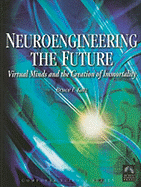
However, earlier today, in the course of a long flight, I took the time to open a book I’ve been carrying with me on several previous trips, and I made a good start on it. From what I’ve read so far, it already seems clear to me that this is a tremendous piece of work, about a field that deserves a significant increase in attention. The author is Bruce F. Katz, adjunct professor at Drexel University, and Chief Artificial Intelligence Scientist at ColdLight. The book is Neuroengineering the future: virtual minds and the creation of immortality.

Wikipedia gives the following definition of the term “Neuroengineering”:

Neural engineering also known as Neuroengineering is a discipline that uses engineering techniques to understand, repair, replace, enhance, or treat the diseases of neural systems. Neural engineers are uniquely qualified to solve design problems at the interface of living neural tissue and non-living constructs… Prominent goals in the field include restoration and augmentation of human function via direct interactions between the nervous system and artificial devices.

That’s an ambitious set of goals, but Bruce sets out an even grander vision. To give a flavour, here’s an extract from the Preface of his book:

I am not the first, and certainly will not be the last, to stress the importance of coming developments in neural engineering. This field has all the hallmarks of a broad technological revolution, but larger in scope and with deeper tentacles than those accompanying both computers and the Internet…

To modify the brain is to modify not only how we perceive but what we are, our consciousnesses and our identities. The power to be able to do so cannot be over-stated, and the consequences can scarcely be imagined, especially with our current unmodified evolutionarily provided mental apparatuses…

Here are just a few topics that we will cover…

  1. Brain-machine interfaces to control computers, exoskeletons, robots, and other devices with thought alone;
  2. Mind-reading devices that will project the conscious contents of one’s brain onto a screen as if it was a movie;
  3. Devices to enhance intellectual ability and to increase concentration;
  4. Devices to enhance creativity and insight;
  5. Mechanisms to upload the mind to a machine, thus preserving it from bodily decay and bodily death.

Other writers have addressed these topics before – both in science fiction and in technology review books. But it looks to me that Bruce brings a greater level of rigour and a wider set of up-to-date research information. To continue quoting from the Preface:

The book is divided into three sections:

  1. The first develops the neurophysiological as well as philosophical foundations on which these advances may be made;
  2. The second describes the current state of the art, and neuroengineering developments that will be with us in the near term;
  3. The final part of the book speculates on what will happen in the long-term, and what it will be like to be a post-evolutionary entity…

The futurist will naturally be drawn to the final section, but in their case it is all the more imperative that the initial development be mastered, especially the chapters with a philosophical bent. The uploading of the soul to a chine is not just a matter of creating the proper technology; it is first and foremost figuring out what it means to have a soul…

As an unabashed futurist, I’m greatly looking forward to finding more time (somehow!) to read further into this book!

28 December 2008

The best book I read in 2008

Filed under: books, culture, happiness, psychology — David Wood @ 1:56 pm

I’ve had the pleasure to read through several dozen fine books in 2008 – here’s a partial list of reviews. (One reason this list is “partial” is because I often neglected to assign the label “books” to relevant postings.)

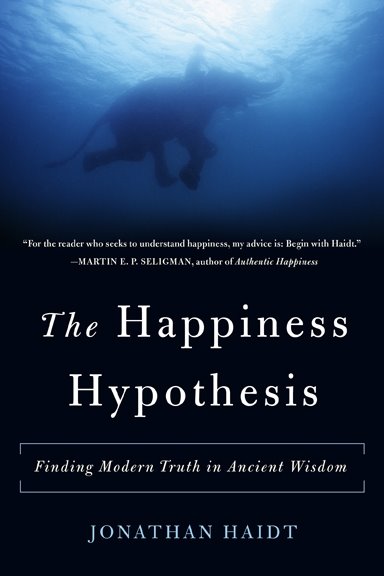
As the year draws to a close, I’m ready to declare one book as being the most memorable and thought-provoking that I’ve read in the entire year: “The Happiness Hypothesis: Finding Modern Truth in Ancient Wisdom” by University of Virginia Associate Professor Jonathan Haidt. It’s a tour de force in positive psychology.

The endorsement printed on the front cover is probably reason enough for anyone to read this book: “For the reader who seeks to understand happiness, my advice is: Begin with Haidt“. The endorsement is from Martin Seligman, Professor of psychology, University of Pennsylvania.

The stated purpose of the book is to consider “ten great ideas” about morality and ethics, drawn from Eastern and Western religious and philosophical traditions, and to review these ideas in the light of the latest scientific findings about the human condition. Initially, I was sceptical about how useful such an exercise might be. But the book quickly led me to set aside my scepticism. The result is greater than the sum of the ten individual reviews, since the different ideas overlap and reinforce.

Haidt declares himself to be both an atheist and a liberal, but with a lot of sympathy for what both theists and conservatives try to hold dear. In my view, he does a grand job of bridging these tough divides.

Haidt seems deeply familiar with a wide number of diverse traditional thinking systems, from both East and West. He also shows himself to be well versed in many modern (including very recent) works on psychology, sociology, and evolutionary theory. The synthesis is frequently remarkable. I found myself re-thinking lots of my own worldwide.

Here are some of the age-old themes that Haidt evaluates:

  • The mind is divided against itself – “the spirit is willing but the flesh is weak”
  • Perception is more important than external substance – “Life itself is but what we deem it”
  • Humans tend to be rank hypocrites – we notice the speck in others’ eyes, without paying attention to the plank in our own
  • The golden rule of “reciprocity” lies at the heart of all morality
  • Personal fulfilment depends on giving up attachments
  • Personal happiness is best pursued by seeking to cultivate “virtues”
  • Lives need suffering and setbacks to allow people to reach higher states of development
  • Religion plays a unique role in creating cohesive cultures.

To be clear, the evaluation of these themes typically shows both their prevailing strengths and their limitations. (It was a bit of a jolt every time I read a sentence in the book that said something like “What the Buddha failed to appreciate is…“)

The ideas that I have taken away from the book include the following:

  • A vivid metaphor of the mind as being a stubborn elephant of automatic desires, with a small conscious rider sat on top of it (as illustrated in the picture on the front cover of at least some editions of the book);
  • In any battle of wills, the elephant is bound to win – but there are mechanisms through which the rider can distract and train the elephant;
  • The most reliable mechanisms for improving our mood are meditation, cognitive therapy, and Prozac;
  • There are hazards (as well as benefits) to promoting self-esteem;
  • Although each person has a “happiness set point” to which their emotional status tends to return after some time, there are measures that people can take to drive their general happiness level higher – this includes the kind of personal relations we achieve, the extent to which we can reach “flow” in our work, and the extent to which different “levels” of our lives “cohere”;
  • Alongside the universally recognised human emotions like happiness, sadness, surprise, fear, disgust and anger, that have typically been studied by psychologists, there is an important additional emotion of “elevation” that also deserves study and strengthening;
  • The usual criticisms of religion generally fail to do justice to the significant beneficial feelings of community, purity, and divinity, that participation in religious activities can nurture – this draws upon some very interesting work by David Sloan Wilson on the role of religions as enabling group selection between different human societies.

Despite providing a lot of clarity, the book leaves many questions unresolved. I see that Haidt is working on a follow-up, entitled “The Righteous Mind: Why good people are divided by politics and religion“. I’m greatly looking forward to it.

Footnote: “The happiness hypothesis” has its own website, here.

25 December 2008

Why good people fail to change bad things

Filed under: books, change, complacency, leadership, urgency — David Wood @ 3:22 pm

2008 has been a year of great change in the Symbian world. Important change initiatives that were kicked off in previous years have gathered speed.

2008 has also seen change and trauma at many other levels, throughout the mobile industry and beyond. And the need for widespread change still remains. Daily – perhaps hourly – we encounter items that lead us to wonder: Why isn’t someone getting this changed? Why isn’t someone taking proper care of such-and-such a personal issue, family issue, social issue, organisational issue, political issue, educational issue, environmental issue, operating system issue, ecosystem management issue, usability issue, and so on?

I’ve attended quite a few “change facilitation workshops” and similar over the last 24 months. One thinker who has impressed me greatly, with his analysis of the causes of failure of change initiatives – even when good people are involved in these initiatives – is Harvard Business School Professor John Kotter. Kotter describes a series of eight steps which he recommends all significant change initiatives to follow:

  1. Build a sense of urgency
  2. Establish an effective guiding coalition
  3. Create a clear, appealing vision
  4. Communicate, communicate, communicate
  5. Remove obstacles (“empower”)
  6. Celebrate small wins
  7. Follow through with wave after wave of change
  8. Embed the change at the cultural level.

Lots of other writers and speakers have their own different ways of describing the processes of successful change initiatives, but I find Kotter’s analysis to be the most insightful and inspiring.

The main book that covers this eight stage process is “Leading Change” – a book that must rank high in the list of the most valuable business books ever written.

Subsequently, Kotter used the mechanism of an easily-read “cartoon book”, “Our Iceberg Is Melting: Changing and Succeeding Under Any Conditions“, in order to provide a gentle but compelling introduction to his ideas. It’s a fable about penguins. But it’s a fable with real depth. (I noticed it and purchased a copy in the Inverness airport bookshop one day, and had finished reading it by the time my plane south landed at Gatwick. I was already resolved to find my copy of “Leading Change” and re-read it.)

As Kotter emphasises, the steps in the eight-stage change leadership process have mirror images which are the main eight reasons why change initiatives stumble:

  1. Lack of a sufficient sense of urgency;
  2. Lack of an effective guiding coalition for the change (an aligned team with the ability to make things happen);
  3. Lack of a clear appealing vision of the outcome of the change (otherwise it may seem too vague, having too many unanswered questions);
  4. Lack of communication for buy-in, keeping the change in people’s mind (otherwise people will be distracted back to other issues);
  5. Lack of empowerment of the people who can implement the change (lack of skills, wrong organisational structure, wrong incentives, cumbersome bureaucracy);
  6. Lack of celebration of small early wins (failure to establish momentum);
  7. Lack of follow through (it may need wave after wave of change to stick);
  8. Lack of embedding the change at the cultural level (otherwise the next round of management changes can unravel the progress made).

A few months ago, Kotter released yet another book on the subject of change initiatives that go wrong. Like “Our Iceberg Is Melting”, this is another slim book – only having 128 pages, and with large typeface, making it another very quick read. But, again, the ideas have real merit. This book is called “A sense of urgency“.

As the name implies, this book focuses more fully on the first stage of change initiatives. The biggest reason why significant change initiatives fail, in Kotter’s considered view, is because of a lack of:

a real sense of urgency – a distinctive attitude and gut-level feeling that lead people to grab opportunities and avoid hazards, to make something important happen today, and constantly shed low-priority activities to move faster and smarter, now.

Instead, most organisations (and most people) become stuck in a combination of complacency and what Kotter describes as “false urgency”:

  • Complacency is frequently fuelled by past successes and time-proven strengths – that may, however, prevent organisations from being fully aware of changes in circumstances, technologies, and markets;
  • False urgency involves more activity than productivity: “It is frenetic. It is more mindless running to protect themselves or attack others, than purposive focus on critical problems and opportunities. Run-run, meet-meet, talk-talk, defend-defend, and go home exhausted.”

Kotter provides a helpful list of questions to help organisations realise if they are suffering from over-complacency and/or false urgency:

  • Are critical issues delegated to consultants or task forces with little involvement of key people?
  • Do people have trouble scheduling meetings on important initiatives (“Because, well, my agenda is so full”)?
  • Is candour lacking in confronting the bureaucracy and politics that are slowing down important initiatives?
  • Do meetings on key issues end with no decisions about what must happen immediately (except the scheduling of another meeting)?
  • Are discussions very inwardly focused and not about markets, emerging technologies, competitors, and the like? …
  • Do people run from meeting to meeting, exhausting themselves and rarely if ever focusing on the most critical hazards or opportunities? …
  • Do people regularly blame others for any significant problems, instead of taking responsibility and changing? …

The centrepiece of “A sense of urgency” is a set of four tactics to increase a true sense of urgency:

  1. Bring the outside in. Reconnect internal reality with external opportunities and hazards. Bring in emotionally compelling data, people, video, sights, and sounds.
  2. Behave with urgency every day. Never act content, anxious, or angry. Demonstrate your own sense of urgency always in meetings, one-on-one interactions, memos, and email, and do so as visibly as possible to as many people as possible.
  3. Find opportunity in crises. Always be alert to see if crises can be a friend, not just a dreadful enemy, in order to destroy complaceny. But proceed with caution, and never be naive, since crises can be deadly.
  4. Deal with the NoNos. Remove or neutralise all the relentless urgency-killers: people who are not skeptics but who are determined to keep a group complacent or, if needed, to create destructive urgency.

The rest of the book fleshes out these tactics with examples (taken from Kotter’s extensive consulting and research experience) and additional checklists. To my mind, there’s a great deal to learn from here.

Footnote: Kotter’s emphasis on the topic of “real urgency” may seem to fly in opposition to one of the most celebrated messages of the literature on effectiveness, namely the principle that people should focus on matters that are important rather than matters that are merely urgent. In the renowned “first things first” language of Stephen Covey, people ought to prioritise “Quadrant two” (activities which are important but not urgent) over “Quadrant three” (activities with are urgent but not important).

To my mind, both Kotter and Covey are correct. We do need to start out by figuring what are the most important activities. And then we have to ensure that we keep giving sufficient attention to these activities. Kotter’s insight is that organisations and people can address this latter task by means of the generation of a sufficient sense of urgency around these activities. In other words, we should drive certain key targets out of Quadrant two into Quadrant one. That way, we’ll be more likely to succeed with our key change initiatives.

14 December 2008

The starfish and the spider

Filed under: books, catalysts, ecosystem management, Open Source — David Wood @ 11:43 pm

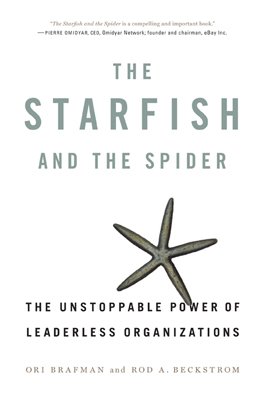
In my quest to understand the full potential of open and collaborative methods of working, I recently found myself re-reading “The Starfish and the Spider: The unstoppable power of leaderless organisations” by Ori Brafman and Rod Beckstrom.

I found this book to be utterly engrossing. I expect that its metaphor of the starfish vs. the spider will increasingly enter common parlance – the same way as “Tipping Point” did. In short:

  • A starfish has a fully de-centralised nervous system, and can survive and prosper when it undergoes an apparent “head-on” attack;
  • A spider has a CEO and a corporate headquarters, without which it cannot function.

The examples in the book show why there’s a great deal at stake behind this contrast: issues of commercial revenues, the rise and fall of businesses, the operation of the Internet, and the rise and fall of change movements within society – where the change movements include such humdingers as Slave Emancipation, Female Equality, Animal Liberation, and Al Qaeda.

There are many stories running through the book, chosen both from history and from contemporary events. The stories are frequently picked up again from chapter to chapter, with key additional insights being drawn out. I found some of the stories to be familiar, but others were not. In all cases, the starfish/spider framework cast new light.

The book contains many implications for the question of how best to inspire and guide an open source ecosystem. Each chapter brought an important additional point to the analysis. For example:

  • Factors allowing de-centralised organisations to flourish;
  • The importance of self-organising “circles”;
  • The significance of so-called “catalyst” personalities;
  • How successful de-centralised organisations often piggy-back pre-existing networks;
  • How centralised organisations can go about combatting de-centralised opponents;
  • Issues about combining aspects of both approaches.

Regarding hybrid approaches: the book argues that smart de-centralisation moves by both GE and Toyota are responsible for significant commercial successes in these companies. EBay is another example of a hybrid. Managing an open source community surely also falls into this category.

The book spoke personally to me on another level. As it explains, starfish organisations depend upon so-called “catalyst” figures, who may lack formal authority, and who are prepared to move into the background without clinging to power:

  • Catalysts enable major reactions to take place, that would otherwise remain dormant;
  • They trigger the deployments of huge resources from the environment;
  • They make things happen, not by direct power, but by force of influence and inspiration.

There’s a big difference between catalysts and CEOs. Think “Mary Poppins” rather than “Maria from Sound of Music”. That gave me a handy new way of thinking about my own role in organisations. (I’m like Mary Poppins, rather than Maria! I tend to move on from the departments that I build up, rather than remaining in place.)

6 December 2008

Discovering the adaptive unconscious

Filed under: books, motivation, unconscious — David Wood @ 3:19 pm

Like most people, I sometimes behave in ways that surprise and disappoint either myself or other people who are observing me. I’m occasionally dimly aware of strong under-currents of passion, that seem to have a life of their own. Of course I wonder to mysef, what’s going on?

The anicent Greek Delphic injunction is “know thyself”. Modern writers use the phrase “Emotional intelligence” to cover some of the same ground. As these modern writers point out, people who are manifestly unaware of their own emotions are unlikely to be promoted to positions of major responsibility within modern corporations or organisations.

Timothy Wilson’s fascinating 2002 book “Strangers to ourselves – discovering the adaptive unconscious” takes a slightly different tack. Reading this book recently, I quickly warmed to its theme that – as implied in its title – our attempts to perceive and understand our own motivations can be a lot more difficult or counter-productive than we expect.

Through many examples, the book makes a convincing case that, in addition to our conscious mind, we have a powerful, thoughtful, intelligent, feelingful “adaptive unconscious” that frequently operates outside the knowledge of the conscious mind. It can be just as inaccessible to introspection by the conscious mind as is the operation of our digestive system. Because it is inaccessible, we can often be misled about why we do things (subsequently “fabricating” reasons to explain our behaviour, without realising that we are deceiving ourselves in the process). We can also be seriously misled about what we’re feeling, and about what will make us happy.

This adaptive unconscious can often be at odds with our conscious mind:

  • Experiments described in the book show how people, who in their conscious mind are sincerely unprejudiced against (eg) people of other races, can harbour latent prejudices that result in significant discrimation against certain job applicants.
  • These unnoticed prejudices can even have fatal effects – if, for example, policemen have to react super-quickly to a potentially life-threatening situation, and mistakenly infer that (say) a black person is reaching for a gun in his pocket.

Of course, psychologists such as Freud have written widely on this general topic already. But the great merit of this book is that it provides a very balanced and thoughtful review of experimentation and analysis that has taken place throughout the 20th century into the unconscious mind. It puts Freud’s ideas into a fuller context. For example, it shows the limitations of the idea that it is “repression” that keeps the activities of the unconscious mind hidden from conscious reflection. Repression is indeed one factor, but it’s by no means the only one.

This book contains lots of thought-provoking examples about people’s attempts to understand the well-springs of what motivates them. Here’s one, from near the end of the book:

“When Sarah met Peter at a party, she did not think she liked him very much; in many ways he was not her type. However, afterwards, she found herself thinking about him a lot, and when Peter telephoned and asked her out for a date, she said yes. Now that she has agreed to the date, she discovers that she likes him more than she knew. This looks like an example of self-perception as self-revelation, because Sarah uses her behaviour to bring to light a prior feeling of which she was unaware, until she agreed to go our with Peter…

“But another possibility is that Sarah really did not like Peter at all when she first met him. She felt obligated to go out with him because he is the son of her mother’s best friend, and her mother thought they would be a good match. Sarah does not fully realise this is the reason she said yes, and she mistakenly thinks. ‘Hm, I guess I like Peter more than I thought I did, if I agreed to go out with him.’ This would be an example of self-fabrication: Sarah misses the real reason for her behaviour…

“The difference between self-revelation and self-fabrication is crucial from the point of view of gaining self-knowledge. Inferring our internal states from our behaviour can be a good strategy if it reveals feelings of which we were previously unaware. It is not such a good strategy if it results in the fabrication of new feelings.”

Another issue with gaining greater self-knowledge is that it can damage our self-confidence. The author argues that it can sometimes be beneficial to us to have a slightly inflated view about our talents. That way, we gain the energy to go about difficult tasks. (However, if the discrepancy between our own view and the reality is too great, that’s another matter.)

The book concludes by urging that we follow another piece of advice from ancient times. He quotes Aristotle approvingly: “We acquire [virtues] by first having put them into action… we become just by the practice of just actions, self-controlling by exercising self-control, and courageous by performing acts of courage”. In short, “do good, to be good”.

He goes on to say, “If we are dissatisfied with some aspect of our lives, one of the best approaches is to act more like the person we want to be, rather than sitting around analyzing ourselves.”

The book has struck a real chord with me, but it leaves many questions in my mind. Next on my reading list on this same general field is “The Happiness Hypothesis: finding modern truth in ancient wisdom” by Jonathan Haidt.

16 November 2008

Schrodinger’s Rabbits

Filed under: books, multiverse, philosophy, quantum mechanics — David Wood @ 9:22 pm

Long before I ever heard of smartphones, or the C++ programming language, or even C, I was intrigued by quantum mechanics. In November 1979, as a sophomore undergraduate, I was fascinated to read an article in the latest edition of the Scientific American: “The Quantum Theory and Reality”, written by French theoretical physicist Bernard d’Espagnat. As recorded in the Wikipedia article on d’Espagnat, this article contains the stunning quote,

The doctrine that the world is made up of objects whose existence is independent of human consciousness turns out to be in conflict with quantum mechanics and with facts established by experiment.

What particularly struck me was the claim that “facts established by experiment” were at odds with common-sense ideas about reality. These experiments involved the now-famous “correlation at a distance” experiments inspired by a paper originally authored in 1935 by Albert Einstein and two co-workers: Boris Podolsky and Nathan Rosen. The initials of the authors – EPR – became synonymous with these experiments. Particularly when viewed through the analysis of John Bell, who devised some surprisingly counter-intuitive inequalities applicable to correlations between results in EPR experiments, these experiments seemed to defy all explanation.

Early in 1980, Professor Mary Hesse of the History and Philosophy of Science department at Cambridge, gave one of the then-frequent lunchtime presentations on mathematical topics, to students (like me) sufficiently interested in such topics to give up their free time in pursuit of greater understanding of mathematics. Prof Hesse chose the philosophical problems of quantum mechanics as her subject for the meeting. I listened carefully, to find out if there were any good rebuttals to the claims made by d’Espagnat. My conclusion was that the whole area was decidedly weird. As months passed, I also asked various maths lecturers about this – but their advice was generally not to think about these questions!

Several years later, I chose Philosophy of Science as the area for my postgraduate studies, with a particular focus on trying to make sense of quantum mechanics. During that time, I even made my first trip to Finland – not to visit Nokia (since I had never heard of them at that time), but to attend a conference in 1985 in pictureseque Joensuu. It was a conference to commemorate 50 years since the publication of the EPR paper. Nathan Rosen, then aged 76, was the guest of honour.

The more I studied the philosophical problems of quantum mechanics, the more I came to respect what initially seemed to be the weirdest and most unlikely solution of all. This is the so-called “Many worlds” interpretation (though, as it turns out, the name is misleading):

  • Originally proposed by Hugh Everett III, in 1957;
  • It refuses to introduce some kind of demarcation between the quantum realm, where superposition (“wavelike behaviour”) is allowed, and the classical realm, where things need to be more definite;
  • Instead, it takes very seriously the idea that macroscopically large objects also spread out over a range of diverse states – in a so-called quantum superposition;
  • This includes the shocking and apparently absurd notion that even we humans end up (all the time) in a superposition of different states;
  • For example, although I subjectively feel, as I type these words now, that this is the unique instance of myself, there are countless other instances of myself, spread out in a wider multiverse, all having diverged from this particular instance as a result of cascading quantum interactions;
  • In some of these other instances, I am employed by companies other than Symbian (my employer for the last ten years in this instance); in yet other instances, Symbian was never created, or I remained in academia instead of joining the world of business, or human civilisation was destroyed when the Cuban missile crisis went wrong, or the values of physical constants were not capable of giving rise to complex mater – and so on.

If objections to this idea come to your mind, it’s very likely that the same objections came to my mind during the years I pursued my postgraduate studies. For example, to the objection “why don’t we feel ourselves splitting”, comes the reply given by Hugh Everett himself:

Well, Copernicus made the analysis that the Earth was moving around the sun, undoing thousands of years of belief that the sun was going around the Earth, and people asked him, If the Earth is moving around the sun, then why don’t I feel the Earth move?

In time, I deprioritised my postgraduate studies, to take a series of jobs, first as a part-time university supervisor, then as a maths tutor at a sixth form college, and then (from 1988) as a software engineer. But occasionally, I come across a link that re-awakens my fascination with quantum theory and the many worlds interpretation. Recently, there have been quite a lot of these links:

  • The son of Hugh Everett is a reasonably famous singer and guitarist in his own right – Mark Everett, also sometimes known as “Mr E” or just “E”;
  • Mark Everett has just released an autobiography “Things the Grandchildren Should Know” which addresses his growing awareness of his father’s remarkable thinking (Hugh Everett died, of a heart attack, in 1982, when Mark was just 19);
  • There has also been a PBS documentary on this same topic, “Parallel worlds, parallel lives“, which has generated considerable media interest (such as this piece in the Scientific American);
  • Coincidentally, various conferences have taken place in the last year or so, commemorating the fiftieth anniversary of Everett’s original thesis;
  • For example, several people I remember from my own postgraduate studies days took part in a conference “Everett at 50” at Oxford.

With this growing abundance of material about Everett’s ideas, I’d like to highlight what I believe to be among the best book on the subject. It’s “Schrodinger’s Rabbits: The Many Worlds of Quantum“, written by Colin Bruce. It deserves to be a lot better known:

  • The author has a pleasant writing style, mixing in detective story writing and references to science fiction stories, with analysis of philosophical ideas;
  • There’s no complex maths to surmount – though the reader will have to think carefully, going through various passages (the effort is worth it!);
  • Unlike many books which seem to repeat the same few themes spread over many chapters, each chapter in this book introduces important new concepts – which is another reason why it’s rewarding to read it;
  • The book highlights some significant difficulties faced by the many worlds theories, but still (in my view) makes it clear that these theories are more likely to be true than false.

Alternatively, for a book that is even wider in its scope (though less convincing in some of its arguments), try “The Fabric of Reality: The Science of Parallel Universes and Its Implications” by David Deutsch – who in addition to breaking new ground in thinking about the philosophy of quantum mechanics, also happens to be a pioneer of the theory of quantum computing.

Finally, for a book that generally leaves readers in no doubt that any “common sense” interpretation of quantum mechanics fails, take a look at the stunningly well-written “Quantum Reality: Beyond the New Physics” by Nick Herbert.

31 October 2008

Watching Google watching the world

Filed under: books, collaboration, Google, infallibility, mobile data — David Wood @ 6:07 pm

If there was a prize for the best presentation at this week’s Informa “Handsets USA” forum in San Diego, it would have to go to Sumit Agarwal, Product Manager for Mobile from Google. Although there were several other very good talks there, Sumit’s was in a class of its own.

In the first place, Sumit had the chutzpah to run his slides directly on a mobile device – an iPhone – with a camera relaying the contents of the mobile screen to the video projector. Second, the presentation included a number of real-time demos – which worked well, and even the ways in which they failed to work perfectly became a source of more insight for the audience (I’ll come back to this point later). The demos were spread among a number of different mobile devices: an Android G1, the iPhone, and a BlackBerry Bold. (Sumit rather cheekily said that the main reason he carried the Bold was for circumstances in which the G1 and the iPhone run out of battery power.)

One reason the talk oozed authority was because Sumit could dig into actual statistics, collected on Google’s servers.

For example, the presentation included a graph showing the rate of Google search inquiries from mobile phones on different (anonymised) North American network operators. In September 2007, one of the lines started showing an astonishing rhythm, with rapid fluctuations in which the rate of mobile search inquiries jumped up sevenfold – before dropping down again a few days later. The pattern kept repeating, on a weekly basis. Google investigated, and found that the network operator in question had started an experiment with “free data weekends”: data usage would be free of charge on Saturday and Sunday. As Sumit pointed out:

  • The sharp usage spikes showed the latent demand of mobile users for carrying out search enquiries – a demand that was previously being inhibited by fear of high data charges;
  • Even more interesting, this line on the graph, whilst continuing to fluctuate drastically at weekends, also showed a gradual overall upwards curve, finishing up with data usage signifcantly higher than the national average, even away from weekends;
  • The takeaway message here is that “users get hooked on mobile data”: once they discover how valuable it can be to them, they use it more and more – provided (and this is the kicker) the user experience is good enough.

Another interesting statistic involved the requests received by Google’s servers for new “map tiles” to provide to Google maps applications. Sumit said that, every weekend, the demand from mobile devices for map tiles reaches the same level as the demand from fixed devices. Again, this is evidence of strong user interest for mobile services.

As regards the types of textual search queries received: Google classifies all incoming search queries, into categories such as sports, entertainment, news, and so on. Sumit showed spider graphs for the breakdown of search queries into categories. The surprising thing is that the spider graph for mobile-originated search enquiries had a very similar general shape to that for search enquiries from fixed devices. In other words, people seem to want to search for the same sorts of things – in the same proportion of times – regardless of whether they are using fixed devices or mobile ones.

It is by monitoring changes in server traffic that Google can determine the impacts of various changes in their applications – and decide where to prioritise their next efforts. For example, when the My Location feature was added to Google’s Mobile Maps application, it had a “stunning impact” on the usage of mobile maps. Apparently (though this could not be known in advance), many users are fascinated to track how their location updates in near real-time on map displays on their mobile devices. And this leads to greater usage of the Google Maps product.

Interspersed among the demos and the statistics, Sumit described elements of Google’s underlying philosophy for success with mobile services:

  • “Ignore the limitations of today”: don’t allow your thinking to be constrained by the shortcomings of present-day devices and networks;
  • “Navigate to where the puck will be”: have the confidence to prepare services that will flourish once the devices and networks improve;
  • “Arm users with the data to make decisions”: instead of limiting what users are allowed to do on their devices, provide them with information about what various applications and services will do, and leave it to the users to decide whether they will install and use individual applications;
  • “Dare to delight” the user, rather than always seeking to ensure order and predictability at all times;
  • “Accept downside”, when experiments occasionally go wrong.

As an example of this last point, there was an amusing moment during one of the (many) demos in the presentation, when two music-playing applications each played music at the same time. Sumit had just finished demoing the remarkable TuneWiki, which allows users to collaborate in supplying, sharing, and correcting lyrics to songs, for a Karaoke-like mobile experience without users having to endure the pain of incorrect lyrics. He next showed an application that searched on YouTube for videos matching a particular piece of music. But TuneWiki continued to play music through the phone speakers whilst the second application was also playing music. Result: audio overlap. Sumit commented that an alternative design philosophy by Google might have ensured that no such audio overlap could occur. But such a constraint would surely impede the wider flow of innovation in mobile applications.

And there was a piece of advice for application developers: “emphasise simplicity”. Sumit demoed the “AroundMe” application by TweakerSoft, as an illustration of how a single simple idea, well executed, can result in large numbers of downloads. (Sumit commented: “this app was written by a single developer … who has probably quintupled his annual income by doing this”.)

Google clearly have a lot going for them. Part of their success is no doubt down to the technical brilliance of their systems. The “emphasise simplicity” message has helped a great deal too. Perhaps their greatest asset is how they have been able to leverage all the statistics their enormous server farms have collected – not just statistics about links between websites, but also statistics about changes in user activity. By watching the world so closely, and by organising and analysing the information they find in it, Google are perhaps in a unique position to identify and improve new mobile services.

Just as Google has benefited from watching the world, the rest of the industry can benefit from watching Google. Happily, there’s already a great deal of information available about how Google operates. Anyone concerned about whether Google might eat their lunch can become considerably wiser from taking the time to read some of the fascinating books that have been written about both the successes and (yes) the failures of this company:

I finished reading the Stross book a couple of weeks ago. I found it an engrossing easy-to-read account of many up-to-date developments at Google. It confirms that Google remains an utterly intriguing company:

  • For example, one thought-provoking discussion was the one near the beginning of the book, about Google, Facebook, and open vs. closed;
  • I also valued the recurring theme of “algorithm-driven search” vs. “human-improved search”.

It was particularly interesting to read what Stross had to say about some of Google’s failures – eg Google Answers and Google Video (and arguably even YouTube), as a balance to its better-known string of successes. It’s a reminder that no company is infallible.

Throughout most of the first ten years of Symbian’s history, commentators kept suggesting that it was only a matter of time before the mightiest software company of that era – Microsoft – would sweep past Symbian in the mobile phone operating system space (and, indeed, would succeed – perhaps at the third attempt – in every area they targeted). Nowadays, commentators often suggest the same thing about Google’s Android solution.

Let’s wait and see. And in any case, I personally prefer to explore the collaboration route rather than the head-on compete route. Just as Microsoft’s services increasingly run well on Symbian phones, Google’s services can likewise flourish there.


5 October 2008

iWoz inspires iMAX

Filed under: Apple, books, collaboration, innovation, Psion — David Wood @ 8:57 am

Last Wednesday, Apple co-Founder Steve Wozniak addressed a gathering of several hundred business people in London’s large-format IMAX cinema, as part of a series of events organised by the London Business Forum. The theme was “Apple Innovation”. Since the IMAX is just 15 minutes walk from Symbian’s HQ, this opportunity was too good for me to miss. I hoped Wozniak’s account of Apple culture might shed some new light on the all-conquering iPhone. I was not disappointed.

Wozniak spoke for more than an hour, without slides, running through a smorgasbord of anecdotes from his own life history. It was rivetting and inspiring. Later I realised that most of the material has already been published in Wozniak’s 2006 book “iWoz: Computer geek to cult icon: How I invented the personal computer, co-founded Apple, and had fun doing it“, which was given out at the event.

I warmed to Wozniak early on in his talk, when he described one of his early experiments in software – writing a program to solve the “Knight’s tour” around a chessboard. I remembered writing a program to try to solve the same problem while at roughly the same age – and had a similar result. In my case, programs were sent off from school to the local Aberdeen University, where clerical staff typed them in and submitted them on behalf of children in neighbouring schools. This program was returned several days later with the comment that there was no output – operators had terminated it.

A few weeks later, there was a short residential course at the university for sixth form students, which I attended. I modified my program to tackle a 5×5 board instead, and was happy to see computer quickly spitting out numerous solutions. I changed the board size to 6×6 instead and waited … and waited … and after around 10 minutes, a solution was printed out. Wozniak’s experience was several years before mine. As he describes it, the computer he was using could do one million calculations a second – which sounded like a huge number. So the lack of any output from his program was a big disappointment – until he calculated that it would actually take the computer about 10^25 years to finish this particular calculation!

More than half the “iWoz” book covers Wozniak’s life pre-Apple. It’s in turn heart-warming and (when describing Wozniak’s pranks and phreaking) gob-smacking.

The episode about HP turning down the idea of the Apple I computer was particularly thought-provoking. Wozniak was working at HP before Apple was founded, and being loyal to his company (which he firmly admired for being led by engineers who in turn deeply respected other engineers) he offered them the chance to implement the ideas he had devised outside work time for what would become, in effect, the world’s first useful personal computer. Although his managers at HP showed considerable interest, they were not able to set aside their standard, well-honed processes in order to start work on what would have been a new kind of project. Wozniak says that HP turned him down five times, before he eventually resigned from the company to invest his energy full-time into Apple. It seems like a classic example of the Innovator’s Dilemma – in which even great companies can fail “by doing everything right”: their “successes and capabilities can actually become obstacles in the face of changing markets and technologies”.

Via numerous anecdotes, Wozniak describes a set of characteristics which are likely to lead to product success:

  • Technical brilliance coupled with patience and persistence. (Wozniak tells a fascinating account of how he and one helper – Randy Wigginton, at the time still at senior high school – created a brand new floppy disk drive controller in just two weeks, without any prior knowledge of disk drives);
  • A drive for simplicity of design (such as using a smaller number of parts, or a shorter algorithm) and superb efficiency of performance;
  • Users should feel an emotional attachment to the product: “Products should be obviously the best”;
  • Humanism: “The human has to be more important than the technology”.

There’s shades of the iPhone experience in all these pieces of advice – even though the book iWoz was written before the iPhone was created.

There’s even stronger shades of the iPhone experience in the following extracts from the book:

The Apple II was easy to program, in both BASIC (100 commands per second) and machine language (1M commands per second)… Within months dozens of companies started up and they were putting games on casette tape for the Apple II; these were all start-up companies, but thanks to our design and documentation, we made it easy to develop stuff that worked on our platform…

… the computer magazines had tons of Apple II product ads for software and hardware. Suddenly the Apple II name was everywhere. We didn’t have to buy an advertisement or do anything ourselves to get the name out. We were just out there, thanks to this industry of software programs and hardware devices that sprang up around the Apple II. We became the hot fad of the age, and all the magazines (even in the mainstream press) started writing great things about us. Everywhere you looked. I mean, we couldn’t buy that kind of publicity. We didn’t have to.

In this way, the Apple II quickly reached sales figures far higher than anyone had dared to predict. One other factor played a vital role:

VisiCalc was so powerful it could only run on the Apple II: only our computer had enough RAM to run it.

But sales bandwaggons can lose their momentum. The iPhone bandwaggon will falter, to the extent that other smartphones turn out to be more successful at running really valuable applications (such as, for example, applications that can run in background, in ways that aren’t possible on the iPhone).

Apple also lost some of its momentum in the less reliable Apple III product that followed the Apple II. Wozniak has no doubts about the root causes for the failure of the Apple III: “it was developed by committee, by the marketing dept”. This leads on to the disappointing advice that Wozniak gives in the final chapter of his book: “Work alone”!

Here, I part company with Wozniak. I’ve explained before my view that “design by committee” can achieve, with the right setup, some outstanding results. That was my experience inside Psion. However, I do agree that the process needs to involve some first-class product managers, who have a powerful and authentic vision for the product.

« Newer PostsOlder Posts »

Blog at WordPress.com.