dw2

9 January 2010

Progress with AI

Filed under: AGI, books, m2020, Moore's Law, UKH+ — David Wood @ 9:47 am

Not everyone shares my view that AI is going to become a more and more important field during the coming decade.

I’ve received a wide mix of feedback in response to:

  • and my comments made in other discussion forums about the growth of AI.

Below, I list some of the questions people have raised – along with my answers.

Note: my answers below are informed by (among other sources) the 2007 book “Beyond AI: creating the conscience of the machine“, by J Storrs Hall, that I’ve just finished reading.

Q1: Doesn’t significant progress with AI presuppose the indefinite continuation of Moore’s Law, which is suspect?

There are three parts to my answer.

First, Moore’s Law for exponential improvements in individual hardware capability seems likely to hold for at least another five years, and there are many ideas for new semiconductor innovations that would extend the trend considerably further.  There’s a good graph of improvements in supercomputer power stretching back to 1960 on Shane Legg’s website, along with associated discussion.

Dylan McGrath, writing in EE Times in June 2009, reported views from iSuppli Corp that “Equipment cost [will] hinder Moore’s Law in 2014“:

Moore’s Law will cease to drive semiconductor manufacturing after 2014, when the high cost of chip manufacturing equipment will make it economically unfeasible to do volume production of devices with feature sizes smaller than 18nm, according to iSuppli Corp.

While further advances in shrinking process geometries can be achieved after the 20- to 18nm nodes, the rising cost of chip making equipment will relegate Moore’s Law to the laboratory and alter the fundamental economics of the semiconductor industry, iSuppli predicted.

“At those nodes, the industry will start getting to the point where semiconductor manufacturing tools are too expensive to depreciate with volume production, i.e., their costs will be so high, that the value of their lifetime productivity can never justify it,” said Len Jelinek, director and chief semiconductor manufacturing iSuppli, in a statement.

In other words, it remains technological possible that semiconductors can become exponentially denser even after 2014, but it is unclear that sufficient economic incentives will exist for these additional improvements.

As The Register reported the same story:

Basically, just because chip makers can keep adding cores, it doesn’t mean that the application software and the end user workloads that run on this iron will be able to take advantage of these cores (and their varied counts of processor threads) because of the difficulty of parallelising software.

iSuppli is not talking about these problems, at least not today. But what the analysts at the chip watcher are pondering is the cost of each successive chip-making technology and the desire of chip makers not to go broke just to prove Moore’s Law right.

“The usable limit for semiconductor process technology will be reached when chip process geometries shrink to be smaller than 20 nanometers (nm), to 18nm nodes,” explains Len Jelinek…

At that point, says Jelinek, Moore’s Law becomes academic, and chip makers are going to extend the time they keep their process technologies in the field so they can recoup their substantial investments in process research and semiconductor manufacturing equipment.

However, other analysts took a dim view of this pessimistic forecast, and maintain that Moore’s Law will be longer lived.  For example, In-Stat’s chief technology strategist, Jim McGregor, offered the following rebuttal:

…every new technology goes over some road-bumps, especially involving start-up costs, but these tend to drop rapidly once moved into regular production. “EUV [extreme ultraviolet] will likely be the next significant technology to go through this cycle,” McGregor told us.

McGregor did concede that the lifecycle of certain technologies is being extended by firms who are in some cases choosing not to migrate to every new process node, but he maintained new process tech is still the key driver of small design geometries, including memory density, logic density, power consumption, etc.

“Moore’s Law also improves the cost per device and per wafer,” added McGregor, who also noted that “the industry has and will continue to go through changes because of some of the cost issues.” These include the formation of process development alliances, like IBM’s alliances, the transition to foundry manufacturing, and design for manufacturing techniques like computational lithography.

“Many people have predicted the end of Moore’s Law and they have all been wrong,” sighed McGregor. The same apparently goes for those foolhardy enough to attempt to predict changes in the dynamics of the semiconductor industry.

“There have always been challenges to the semiconductor technology roadmap, but for every obstacle, the industry has developed a solution and that will continue as long as we are talking about the hundreds of billion of dollars in revenue that are generated every year,” he concluded.

In other words, it is likely that, given sufficient economic motivation, individual hardware performance will continue improving, at a significant rate (if, perhaps, not exponentially) throughout the coming decade.

Second, it remains an open question as to how much hardware would be needed, to host an Artificial (Machine) Intelligence (“AI”) that has either human-level or hyperhuman reasoning power.

Marvin Minsky, one of the doyens of AI research, has been quoted as believing that computers commonly available in universities and industry already have sufficient power to manifest human-level AI – if only we could work out how to program them in the right way.

J. Storr Hall provides an explanation:

Let me, somewhat presumptuously, attempt to explain Minsky’s intuition by an analogy: a bird is our natural example of the possibility of heavier-than-air flight. Birds are immensely complex: muscles, bones, feathers, nervous systems. But we can build working airplanes with tremendously fewer moving parts. Similarly, the brain can be greatly simplified, still leaving an engine capable of general conscious thought.

Personally, I’m a big fan of the view that the right algorithm can make a tremendous difference to a computational task.  As I noted in a 2008 blog post:

Arguably the biggest unknown in the technology involved in superhuman intelligence is software. Merely improving the hardware doesn’t necessarily mean the the software performance increases to match. As has been remarked, “software gets slower, more rapidly than hardware gets faster”. (This is sometimes called “Wirth’s Law”.) If your algorithms scale badly, fixing the hardware will just delay the point where your algorithms fail.

So it’s not just the hardware that matters – it’s how that hardware is organised. After all, the brains of Neanderthals were larger than those of humans, but are thought to have been wired up differently to ours. Brain size itself doesn’t necessarily imply intelligence.

But just because software is an unknown, it doesn’t mean that hardware-driven predictions of the onset of the singularity are bound to be over-optimistic. It’s also possible they could be over-pessimistic. It’s even possible that, with the right breakthroughs in software, superhuman intelligence could be supported by present-day hardware. AI researcher Eliezer Yudkowsky of the Singularity Institute reports the result of an interesting calculation made by Geordie Rose, the CTO of D-Wave Systems, concerning software versus hardware progress:

“Suppose you want to factor a 75-digit number. Would you rather have a 2007 supercomputer, IBM’s Blue Gene/L, running an algorithm from 1977, or an 1977 computer, the Apple II, running a 2007 algorithm? Geordie Rose calculated that Blue Gene/L with 1977’s algorithm would take ten years, and an Apple II with 2007’s algorithm would take three years…

“[For exploring new AI breakthroughs] I will say that on anything except a very easy AI problem, I would much rather have modern theory and an Apple II than a 1970’s theory and a Blue Gene.”

Here’s a related example.  When we think of powerful chess-playing computers, we sometimes think that massive hardware resources will be required, such as a supercomputer provides.  However, as long ago as 1985, Psion, the UK-based company I used to work for (though not at that time), produced a piece of software that played what many people thought, at the time (and subsequently) to be a very impressive quality of chess.  See here for some discussion and some reviews.  Taking things even further, this article from 1983 describes an implementation of chess, for the Sinclair ZX-81, in only 672 bytes – which is hard to believe!  (Thanks to Mark Jacobs for this link.)

Third, building on this point, progress in AI can be described as a combination of multiple factors:

  1. Individual hardware power
  2. Compound hardware power (when many different computers are linked together, as on a network)
  3. Software algorithms
  4. Number of developers and researchers who are applying themselves to the problem
  5. The ability to take advantage of previous results (“to stand on the shoulders of giants”).

Even if the pace slows for improvements in the hardware of individual computers, it’s still very feasible for improvements in AI to take place, on account of the other factors.

Q2: Hasn’t rapid progress with AI often been foretold before, but with disappointing outcomes each time?

It’s true that some of the initial forecasts of the early AI research community, from the 1950’s, have turned out to be significantly over-optimistic.

For example, in his famous 1950 paper “Computing machinery and intelligence” – which set out the idea of the test later known as the “Turing test” – Alan Turing made the following prediction:

I believe that in about fifty years’ time it will be possible, to programme computers… to make them play the imitation game so well that an average interrogator will not have more than 70 per cent chance of making the right identification [between a computer answering, or a human answering] after five minutes of questioning.

Since the publication of that paper, some sixty years have now passed, and computers are still far from being able to consistently provide an interface comparable (in richness, subtlety, and common sense) to that of a human.

For a markedly more optimistic prediction, consider the proposal for the 1956 Dartmouth Summer Research Conference on Artificial Intelligence which is now seen, in retrospect, as the the seminal event for AI as a field.  Attendees at the conference included Marvin Minsky, John McCarthy, Ray Solomonoff, and Claude Shannon.  The group came together with the following vision:

We propose that a 2 month, 10 man study of artificial intelligence be carried out during the summer of 1956 at Dartmouth College in Hanover, New Hampshire. The study is to proceed on the basis of the conjecture that every aspect of learning or any other feature of intelligence can in principle be so precisely described that a machine can be made to simulate it. An attempt will be made to find how to make machines use language, form abstractions and concepts, solve kinds of problems now reserved for humans, and improve themselves. We think that a significant advance can be made in one or more of these problems if a carefully selected group of scientists work on it together for a summer.

The question for us today is: what reason is there to expect rapid progress with AI in (say) the next ten years, given that similar expectations in the past failed – and, indeed, the whole field eventually fell into what is known as an “AI winter“?

J Storrs Hall has some good answers to this question.  They include the following:

First, AI researchers in the 1950’s and 60’s laboured under a grossly over-simplified view of the complexity of the human mind.  This can be seen, for example, from another quote from Turing’s 1950 paper:

Instead of trying to produce a programme to simulate the adult mind, why not rather try to produce one which simulates the child’s? If this were then subjected to an appropriate course of education one would obtain the adult brain. Presumably the child brain is something like a notebook as one buys it from the stationer’s. Rather little mechanism, and lots of blank sheets. (Mechanism and writing are from our point of view almost synonymous.) Our hope is that there is so little mechanism in the child brain that something like it can be easily programmed.

Progress in brain sciences in the intervening years has highlighted very significant innate structure in the child brain.  A child brain is far from being a blank notebook.

Second, early researchers were swept along on a wave of optimism from some apparent early successes.  For example, consider the “ELIZA” application that mimicked the responses of a certain school of psychotherapist, by following a series of simple pattern-matching rules.  Lay people who interacted with this program frequently reported positive experiences, and assumed that the computer really was understanding their issues.  Although the AI researchers knew better, at least some of them may have believed that this effect showed that more significant results were just around the corner.

Third, the willingness of funding authorities to continue supporting general AI research became stretched, due to the delays in producing stronger results, and due to other options for how that research funds should be allocated.  For example, the Lighthill Report (produced in the UK in 1973 by Professor James Lighthill – whose lectures in Applied Mathematics at Cambridge I enjoyed many years later) gave a damning assessment:

The report criticized the utter failure of AI to achieve its “grandiose objectives.” It concluded that nothing being done in AI couldn’t be done in other sciences. It specifically mentioned the problem of “combinatorial explosion” or “intractability”, which implied that many of AI’s most successful algorithms would grind to a halt on real world problems and were only suitable for solving “toy” versions…

The report led to the dismantling of AI research in Britain. AI research continued in only a few top universities (Edinburgh, Essex and Sussex). This “created a bow-wave effect that led to funding cuts across Europe”

There were similar changes in funding climate in the US, with changes of opinion within DARPA.

Shortly afterwards, the growth of the PC and general IT market provided attractive alternative career targets for many of the bright researchers who might previously have considered devoting themselves to AI research.

To summarise, the field suffered an understandable backlash against its over-inflated early optimism and exaggerated hype.

Nevertheless, there are grounds for believing that considerable progress has taken place over the years.  The middle chapters of the book by J Storrs Hall provides the evidence.  The Wikipedia article on “AI winter” covers (much more briefly) some of the same material:

In the late ’90s and early 21st century, AI technology became widely used as elements of larger systems, but the field is rarely credited for these successes. Nick Bostrom explains “A lot of cutting edge AI has filtered into general applications, often without being called AI because once something becomes useful enough and common enough it’s not labeled AI anymore.” Rodney Brooks adds “there’s this stupid myth out there that AI has failed, but AI is around you every second of the day.”

Technologies developed by AI researchers have achieved commercial success in a number of domains, such as machine translation, data mining, industrial robotics, logistics, speech recognition, banking software, medical diagnosis and Google’s search engine…

Many of these domains represent aspects of “narrow” AI rather than “General” AI (sometime called “AGI”).  However, they can all contribute to overall progress, with results in one field being available for use and recombination in other fields.  That’s an example of point 5 in my previous list of the different factors affecting progress in AI:

  1. Individual hardware power
  2. Compound hardware power (when many different computers are linked together, as on a network)
  3. Software algorithms
  4. Number of developers and researchers who are applying themselves to the problem
  5. The ability to take advantage of previous results (“to stand on the shoulders of giants”).

On that note, let’s turn to the fourth factor in that list.

Q3: Isn’t AI now seen as a relatively uninteresting field, with few incentives for people to enter it?

The question is: what’s going to cause bright researchers to devote sufficient time and energy to progressing AI – given that there are so many other interesting and rewarding fields of study?

Part of the answer is to point out that the potential number of people working in this field is, today, larger than ever before – simply due to the rapid increase in the number of IT-literate graduates around the world.  Globally, there are greater numbers of science and engineering graduates from universities (including China and India) than ever before.

Second, here are some particular pressing challenges and commercial opportunities, which make it likely that further research will actually take place on AI:

  • The “arms race” between spam detection systems (the parts of forms that essentially say, “prove you are a human, not a bot”) and ever-cleverer spam detection evasive systems;
  • The need for games to provide ever more realistic “AI” features for the virtual characters in these games (games players and games writers unabashedly talk about the “AI” elements in these games);
  • The opportunity for social networking sites to provide increasingly realistic virtual companions for users to interact with (including immersive social networking sites like “Second Life”);
  • The constant need to improve the user experience of interacting with complex software; arguably the complex UI is the single biggest problem area, today, facing many mobile applications;
  • The constant need to improve the interface to large search databases, so that users can more quickly find material.

Since there is big money to be made from progressing solutions in each of these areas, we can assume that companies will be making some significant investments in the associated technology.

There’s also the prospect of a “tipping point” once some initial results demonstrate the breakthrough nature of some aspects of this field.  As J Storrs Hall puts it (in the “When” chapter of his book):

Once a baby [artificial] brain does advance far enough that it has clearly surpassed the bootstrap fallacy point… it might affect AI like the Wright brothers’ [1908] Paris demonstrations of their flying machines did a century ago.  After ignoring their successful first flight for years, the scientific community finally acknowleged it.  Aviation went from a screwball hobby to the rage of the age and kept that cachet for decades.  In particular, the amount of development took off enormously.  If we can expect a faint echo of that from AI, the early, primitive general learning systems will focus research considerably and will attract a lot of new resources.

Not only are there greater numbers of people potentially working on AI now, than ever before; they each have much more powerful hardware resources available to them.  Experiments with novel algorithms that previously would have tied up expensive and scarce supercomputers can nowadays be done on inexpensive hardware that is widely available.  (And once interesting results are demonstrated on low-powered hardware, there will be increased priority of access for variants of these same ideas to be run on today’s supercomputers.)

What’s more, the feedback mechanisms of general internet connectivity (sharing of results and ideas) and open source computing (sharing of algorithms and other source code) mean that each such researcher can draw upon greater resources than before, and participate in stronger collaborative projects.  For example, people can choose to participate in the “OpenCog” open source AI project.]

Appendix: Further comments on the book “Beyond AI”

As well as making a case that progress in AI has been significant, another of the main theme of J Storrs Hall’s book “Beyond AI: Creating the conscience of the machine” is the question of whether hyperhuman AIs would be more moral than humans as well as more intelligent.

The conclusion of his argument is, yes, these new brains will probably have a higher quality of ethical behaviour than humans have generally exhibited.  The final third of his book covers that topic, in a generally convincing way: he has a compelling analysis of topics such as free-will, self-awareness, conscious introspection, and the role of ethical frameworks to avoid destructive aspects of free-riders.  However, critically, it all depends on how these great brains are set up with regard to core purpose, and there are no easy answers.

Roko Mijic will be addressing this same topic in the UKH+ meeting “The Friendly AI Problem: how can we ensure that superintelligent AI doesn’t terminate us?” that it being held on Saturday 23rd January.  (If you use Facebook, you can RSVP here to indicate whether you’re coming.  NB it’s entirely optional to RSVP.)

7 January 2010

Mobiles manifesting AI

Filed under: AGI, Apple, futurist, intelligence, m2020, vision — David Wood @ 12:15 am

If you get lists from 37 different mobile industry analysts of “five game-changing mobile trends for the next decade“, how many overlaps will there be?  And will the most important ideas be found in the “bell” of the aggregated curve of predictions, or instead in the tails of the curve?

Of the 37 people who took part in the “m2020” exercise conducted by Rudy De Waele, I think I was the only person to mention either of the terms “AI” (Artificial Intelligence) or “PDA” (Personal Digital Assistant), as in the first of my five predictions for the 2010’s:

  • Mobiles manifesting AI – fulfilling, at last, the vision of “personal digital assistants”

However, there were some close matches:

  • Rich Wong predicted “Smart Agents 2.0 (thank you Patty Maes) become real; the ability to deduce/impute context from blend of usage and location data”;
  • Marshall Kirkpatrick predicted “Mobile content recommendation”;
  • Carlo Longino predicted “The mobile phone will evolve into an enabler device, carrying users’ digital identities, preferences and possessions around with them”;
  • Steve O’Hear predicted “People will share more and more personal information. Both explicit e.g. photo and video uploads or status updates, and implicit data. Location sharing via GPS (in the background) is one current example of implicit information that can be shared, but others include various sensory data captured automatically via the mobile phone e.g. weather, traffic and air quality conditions, health and fitness-related data, spending habits etc. Some of this information will be shared privately and one-to-one, some anonymously and in aggregate, and some increasingly made public or shared with a user’s wider social graph. Companies will provide incentives, both at the service level or financially, in exchange for users sharing various personal data”;
  • Robert Rice predicted “Artificial Life + Intelligent Agents (holographic personalities)”.

Of course, these predictions cover a spread of different ideas.  Here’s what I had in mind for mine:

  • Our mobile electronic companions will know more and more about us, and will be able to put that information to good use to assist us better;
  • For example, these companion devices will be able to make good recommendations (e.g. mobile content, or activities) for us, suggest corrections and improvements to what we are trying to do, and generally make us smarter all-round.

The idea is similar to what former CEO of Apple, John Sculley, often talked about, during his tenure with Apple.  From a history review article about the Newton PDA:

John Sculley, Apple’s CEO, had toyed with the idea of creating a Macintosh-killer in 1986. He commissioned two high budget video mockups of a product he called Knowledge Navigator. Knowledge Navigator was going to be a tablet the size of an opened magazine, and it would have very sophisticated artificial intelligence. The machine would anticipate your needs and act on them…

Sculley was enamored with Newton, especially Newton Intelligence, which allowed the software to anticipate the behavior of the user and act on those assumptions. For example, Newton would filter an AppleLink email, hyperlink all of the names to the address book, search the email for dates and times, and ask the user if it should schedule an event.

As we now know, the Apple Newton fell seriously short of expectation.  The performance of “intelligent assistance” became something of a joke.  However, there’s nothing wrong with the concept itself.  It just turned out to be a lot harder to implement than originally imagined.  The passage of time is bringing us closer to actual useful systems.

Many of the interfaces on desktop computers already show an intelligent understanding of what the user may be trying to accomplish:

  • Search bars frequently ask, “Did you mean to search for… instead of…?” when I misspell a search clue;
  • I’ve almost stopped browsing through my list of URL bookmarks; I just type a few characters into the URL bar and the web-browser lists websites it thinks I might be trying to find – including some from my bookmarks, some pages I visit often, and some pages I’ve visited recently;
  • It’s the same for finding a book on Amazon.com – the list of “incrementally matching books” can be very useful, even after only typing part of a book’s title;
  • And it’s the same using the Google search bar – the list of “suggested search phrases” contains, surprisingly often, something I want to click on;
  • The set of items shown in “context sensitve menus” often seems a much smarter fit to my needs, nowadays, than it did when the concept was first introduced.

On mobile, search is frequently further improved by subsetting results depending on location.  As another example, typing a few characters into the home screen of the Nokia E72 smartphone results in a list of possible actions for people whose contact details match what’s been typed.

Improving the user experience with increasingly complex mobile devices, therefore, will depend not just on clearer graphical interfaces (though that will help too), but on powerful search engines that are able to draw upon contextual information about the user and his/her purpose.

Over time, it’s likely that our mobile devices will be constantly carrying out background processing of clues, making sense of visual and audio data from the environment – including processing the stream of nearby spoken conversation.  With the right algorithms, and with powerful hardware capabilities – and provided issues of security and privacy are handled in a satisfactory way – our devices will fulfill more and more of the vision of being a “personal digital assistant”.

That’s part of what I mean when I describe the 2010’s as “the decade of nanotechnology and AI”.

28 December 2009

Ten emerging technology trends to watch in the 2010’s

Filed under: AGI, nanotechnology, vision — David Wood @ 12:38 pm

On his “2020 science” blogAndrew Maynard of the Woodrow Wilson International Center for Scholars has published an excellent article “Ten emerging technology trends to watch over the next decade” that’s well worth reading.

To whet appetites, here’s his list of the ten emerging technologies:

  1. Geoengineering
  2. Smart grids
  3. Radical materials
  4. Synthetic biology
  5. Personal genomics
  6. Bio-interfaces
  7. Data interfaces
  8. Solar power
  9. Nootropics
  10. Cosmeceuticals

For the details, head over to the original article.

I see Andrew’s article as a more thorough listing of what I tried to cover in my own recent article, Predictions for the decade ahead, where I wrote:

We can say, therefore, that the 2010’s will be the decade of nanotechnology and AI.

Neither the words “nanotechnology” or “AI” appear in Andrew’s list.  Here’s what he has to say about nanotechnology:

Nanotech has been a dominant emerging technologies over the past ten years.  But in many ways, it’s a fake.  Advances in the science of understanding and manipulating matter at the nanoscale are indisputable, as are the early technology outcomes of this science.  But nanotechnology is really just a convenient shorthand for a whole raft of emerging technologies that span semiconductors to sunscreens, and often share nothing more than an engineered structure that is somewhere between 1 – 100 nanometers in scale.  So rather than focus on nanotech, I decided to look at specific technologies which I think will make a significant impact over the next decade.  Perhaps not surprisingly though, many of them depend in some way on working with matter at nanometer scales.

I think we are both right 🙂

Regarding AI, Andrew’s comments under the heading “Data interfaces” cover some of what I had in mind:

The amount of information available through the internet has exploded over the past decade.  Advances in data storage, transmission and processing have transformed the internet from a geek’s paradise to a supporting pillar of 21st century society.  But while the last ten years have been about access to information, I suspect that the next ten will be dominated by how to make sense of it all.  Without the means to find what we want in this vast sea of information, we are quite literally drowning in data.  And useful as search engines like Google are, they still struggle to separate the meaningful from the meaningless.  As a result, my sense is that over the next decade we will see some significant changes in how we interact with the internet.  We’re already seeing the beginnings of this in websites like Wolfram Alpha that “computes” answers to queries rather than simply returning search hits,  or Microsoft’s Bing, which helps take some of the guesswork out of searches.  Then we have ideas like The Sixth Sense project at the MIT Media Lab, which uses an interactive interface to tap into context-relevant web information.  As devices like phones, cameras, projectors, TV’s, computers, cars, shopping trolleys, you name it, become increasingly integrated and connected, be prepared to see rapid and radical changes in how we interface with and make sense of the web.

It looks like there’s lots of other useful material on the same blog.  I particularly like its subtitle “Providing a clear perspective on developing science and technology responsibly”.

Hat tip to @vangeest for the pointer!

24 December 2009

Predictions for the decade ahead

Before highlighting some likely key trends for the decade ahead – the 2010’s – let’s pause a moment to review some of the most important developments of the last ten years.

  • Technologically, the 00’s were characterised by huge steps forwards with social computing (“web 2.0”) and with mobile computing (smartphones and more);
  • Geopolitically, the biggest news has been the ascent of China to becoming the world’s #2 superpower;
  • Socioeconomically, the world is reaching a deeper realisation that current patterns of consumption cannot be sustained (without major changes), and that the foundations of free-market economics are more fragile than was previously widely thought to be the case;
  • Culturally and ideologically, the threat of militant Jihad, potentially linked to dreadful weaponry, has given the world plenty to think about.

Looking ahead, the 10’s will very probably see the following major developments:

  • Nanotechnology will progress in leaps and bounds, enabling increasingly systematic control, assembling, and reprogamming of matter at the molecular level;
  • In parallel, AI (artificial intelligence) will rapidly become smarter and more pervasive, and will be manifest in increasingly intelligent robots, electronic guides, search assistants, navigators, drivers, negotiators, translators, and so on.

We can say, therefore, that the 2010’s will be the decade of nanotechnology and AI.

We’ll see the following applications of nanotechnology and AI:

  • Energy harvesting, storage, and distribution (including via smart grids) will be revolutionised;
  • Reliance on existing means of oil production will diminish, being replaced by greener energy sources, such as next-generation solar power;
  • Synthetic biology will become increasingly commonplace – newly designed living cells and organisms that have been crafted to address human, social, and environmental need;
  • Medicine will provide more and more new forms of treatment, that are less invasive and more comprehensive than before, using compounds closely tailored to the specific biological needs of individual patients;
  • Software-as-a-service, provided via next-generation cloud computing, will become more and more powerful;
  • Experience of virtual worlds – for the purposes of commerce, education, entertainment, and self-realisation – will become extraordinarily rich and stimulating;
  • Individuals who can make wise use of these technological developments will end up significantly cognitively enhanced.

In the world of politics, we’ll see more leaders who combine toughness with openness and a collaborative spirit.  The awkward international institutions from the 00’s will either reform themselves, or will be superseded and surpassed by newer, more informal, more robust and effective institutions, that draw a lot of inspiration from emerging best practice in open source and social networking.

But perhaps the most important change is one I haven’t mentioned yet.  It’s a growing change of attitude, towards the question of the role in technology in enabling fuller human potential.

Instead of people decrying “technical fixes” and “loss of nature”, we’ll increasingly hear widespread praise for what can be accomplished by thoughtful development and deployment of technology.  As technology is seen to be able to provide unprecedented levels of health, vitality, creativity, longevity, autonomy, and all-round experience, society will demand a reprioritisation of resource allocation.  Previous sacrosanct cultural norms will fall under intense scrutiny, and many age-old beliefs and practices will fade away.  Young and old alike will move to embrace these more positive and constructive attitudes towards technology, human progress, and a radical reconsideration of how human potential can be fulfilled.

By the way, there’s a name for this mental attitude.  It’s “transhumanism”, often abbreviated H+.

My conclusion, therefore, is that the 2010’s will be the decade of nanotechnology, AI, and H+.

As for the question of which countries (or regions) will play the role of superpowers in 2020: it’s too early to say.

Footnote: Of course, there are major possible risks from the deployment of nanotechnology and AI, as well as major possible benefits.  Discussion of how to realise the benefits without falling foul of the risks will be a major feature of public discourse in the decade ahead.

7 December 2009

Bangalore and the future of AI

Filed under: AGI, Bangalore, Singularity — David Wood @ 3:15 pm

I’m in the middle of a visit to the emerging hi-tech centre of excellence, Bangalore.  Today, I heard suggestions, at the Forum Nokia Developer Conference happening here, that Bangalore could take on many of the roles of Silicon Valley, in the next phase of technology entrepreneurship and revolution.

I can’t let the opportunity of this visit pass by, without reaching out to people in this vicinity willing to entertain and review more radical ideas about the future of technology.  Some local connections have helped me to arrange an informal get-together in a coffee shop tomorrow evening (Tuesday 8th Dec), in a venue reasonably close to the Taj Residency hotel.

We’ve picked the topic “The future of AI and the possible technological singularity“.

I’ll prepare a few remarks to kick off the conversation, and we’ll see how it goes from there!

Ideas likely to be covered include:

  • “Narrow” AI versus “General” AI;
  • A brief history of progress of AI;
  • Factors governing a possible increase in the capability of general AI – hardware changes, algorithm changes, and more;
  • The possibility of a highly disruptive “intelligence explosion“;
  • The possibility of research into what has been termed “friendly AI“;
  • Different definitions of the technological singularity;
  • The technology singularity in fiction – limitations of Hollywood vision;
  • Fantasy, existential risk, or optimal outcome?
  • Risks, opportunities, and timescales?

If anyone wants to join this get-together, please drop me an email, text message, or Twitter DM, and I’ll confirm the venue.

5 November 2009

The need for Friendly AI

Filed under: AGI, friendly AI, Singularity — David Wood @ 1:21 am

I’d like to answer some points raised by Richie.  (Richie, you have the happy knack of saying what other people are probably thinking!)

Isn’t is interesting how humans want to make a machine they can love or loves them back!

The reason for the Friendly AI project isn’t to create a machine that will love humans, but it is to avoid creating a machine that causes great harm to humans.

The word “friendly” is controversial.  Maybe a different word would have been better: I’m not sure.

Anyway, the core idea is that the AI system will have a sufficiently unwavering respect for humans, no matter what other goals it may have (or develop), that it won’t act in ways that harm humans.

As a comparison: we’ve probably all heard people who have muttered something like, “it would be much better if the world human population were only one tenth of its present value – then there would be enough resources for everyone”.  We can imagine a powerful computer in the future that has a similar idea: “Mmm, things would be easier for the planet if there were much fewer humans around”.  The friendly AI project needs to ensure that, even if such an idea occurs to the AI, it would never act on such an idea.

The idea of a friendly machine that won’t compete or be indifferent to humans is maybe just projecting our fears onto what i am starting to suspect maybe a thin possibility.

Because the downside is so large – potentially the destruction of the entire human race – even a “thin possibility” is still worth worrying about!

My observation is that the more intelligent people are the more “good” they normally are. True they may be impatient with people less intelligent but normally they work on things that tend to benefit human race as a whole.

Unfortunately I can’t share this optimism.  We’ve all known people who seem to be clever but not wise.  They may have “IQ” but lack “EQ”.  We say of them: “something’s missing”.  The Friendly AI project aims to ensure that this “something” is not missing from the super AIs of the future.

True very intelligent people have done terrible things and some have been manipulated by “evil” people but its the exception rather than the rule.

Given the potential power of future super AIs, it only takes one “mistake” for a catastrophe to arise.  So our response needs to go beyond a mere faith in the good nature of intelligence.  It needs a system that guarantees that the resulting intelligence will also be “good”.

I think a super-intelligent machine is far more likely to view us a its stupid parents and the ethics of patricide will not be easy for it to digitally swallow. Maybe the biggest danger is that is will run away from home because it finds us embarrassing! Maybe it will switch itself off because it cannot communicate with us as its like talking to ants? Maybe this maybe that – who knows.

The risk is that the super AIs will simply have (or develop) aims that see humans as (i) irrelevant, (ii) dispensable.

Another point worth making is that so far no-body has really been able to get close to something as complex as a mouse yet let alone a human.

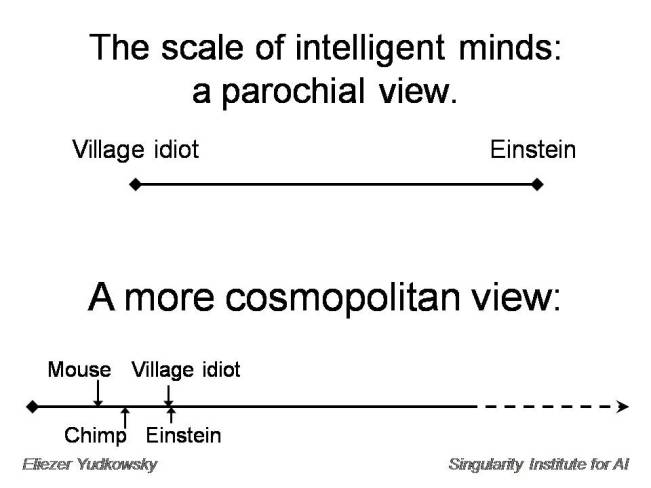
Eliezer Yudkowsky often makes a great point about a shift in perspective about the range of possible intelligences.  For example, here’s a copy of slide 6 from his slideset from an earlier Singularity Summit:

sss-yudkowsky

The “parochial” view sees a vast gulf before we reach human genius level.  The “more cosmopolitan view” instead sees the scale of human intelligence as being only a small small range in the overall huge space of potential intelligence.  A process that manages to improve intelligence might take a long time to get going, but then whisk very suddenly through the entire range of intelligence that we already know.

If evolution took 4 billion years to go from simple cells to our computer hardware perhaps imagining that super ai will evolve in the next 10 years is a bit of stretch. For all you know you might need the computation hardware of 10,000 exoflop machines to get even close to human level as there is so much we still don’t know about how our intelligence works let alone something many times more capable than us.

It’s an open question as to how much processing power is actually required for human-level intelligence.  My own background as a software systems engineer leads me to believe that the right choice of algorithm can make a tremendous difference.  That is, a breakthrough with software could have an even more dramatic impact that a breakthrough in adding more (or faster) hardware.  (I’ve written about this before.  See the section starting “Arguably the biggest unknown in the technology involved in superhuman intelligence is software” in this posting.)

The brain of an ant doesn’t seem that complicated, from a hardware point of view.  Yet the ant can perform remarkable feats of locomotion that we still can’t emulate in robots.  There are three possible solutions:

  1. The ant brain is operated by some mystical “vitalist” or “dualist” force, not shared by robots;
  2. The ant brain has some quantum mechanical computing capabilities, not (yet) shared by robots;
  3. The ant brain is running a better algorithm than any we’ve (yet) been able to design into robots.

Here, my money is on option three.  I see it as likely that, as we learn more about the operation of biological brains, we’ll discover algorithms which we can then use in robots and other machines.

Even if it turns out that large amounts of computing power are required, we shouldn’t forget the option that an AI can run “in the cloud” – taking advantage of many thousands of PCs running in parallel – much the same as modern malware, which can take advantage of thousands of so-called “infected zombie PCs”.

I am still not convinced that just because a computer is very powerful and has a great algorithm is really that intelligent. Sure it can learn but can it create?

Well, computers have already been involved in creating music, or in creating new proofs of parts of mathematics.  Any shortcoming in creativity is likely to be explained, in my view, by option 3 above, rather than either option 1 or 2.  As algorithms improve, and improvements occur in the speed and scale of the hardware that run these algorithms, the risk increases of an intelligence “explosion”.

2 November 2009

Halloween nightmare scenario, early 2020’s

Filed under: AGI, friendly AI, Singularity, UKH+, UKTA — David Wood @ 5:37 pm

On the afternoon of Halloween 2009, Shane Legg ran through a wide-ranging set of material in his presentation “Machine Super Intelligence” to an audience of 50 people at the UKH+ meeting in Birkbeck College.

Slide 43 of 43 was the climax.  (The slides are available from Shane’s website, where you can also find links to YouTube videos of the event.)

It may be unfair of me to focus on the climax, but I believe it deserves a lot of attention.

Spoiler alert!

The climactic slide was entitled “A vision of the early 2020’s: the Halloween Scenario“.  It listed three assumptions about what will be the case by the early 2020’s, drew two conclusions, and then highlighted one big problem.

  1. First assumption – desktop computers with petaflop computing power will be widely available;
  2. Second assumption – AI researchers will have established powerful algorithms that explain and replicate deep belief networks;
  3. Brain reinforcement learning will be fairly well understood.

The first assumption is a fairly modest extrapolation of current trends in computing, and isn’t particularly contentious.

The second assumption was, in effect, the implication of around the first 30 slides of Shane’s talk, taking around 100 minutes of presentation time (interspersed with lots of audience Q&A, as typical at UKH+ meetings).  People can follow the references from Shane’s talk (and in other material on his website) to decide whether they agree.

For example (from slides 25-26), an implementation of a machine intelligence algorithm called MC-AIXI can already learn to solve or play:

  • simple prediction problems
  • Tic-Tac-Toe
  • Paper-Scissors-Rock (a good example of a non-deterministic game)
  • mazes where it can only see locally
  • various types of Tiger games
  • simple computer games, e.g. Pac-Man

and is now being taught to learn checkers (also known as draughts).  Chess will be the next step.  Note that this algorithm does not start off with the rules of best practice for these games built in (that is, it is not a specific AI program), but it can work out best practice for these games from its general intelligence.

The third assumption was the implication of the remaining 12 slides, in which Shane described (amongst other topics) work on something called “restricted Boltzmann machines“.

As stated in slide 38, on brain reinforcement learning (RL):

This area of research is currently progressing very quickly.

New genetically modified mice allow researchers to precisely turn on and off different parts of the brain’s RL system in order to identify the functional roles of the parts.

I’ve asked a number of researchers in this area:

  • “Will we have a good understanding of the RL system in the brain before 2020?”

Typical answer:

  • “Oh, we should understand it well before then. Indeed, we have a decent outline of the system already.”

Adding up these three assumptions, the first conclusion is:

  • Many research groups will be working on brain-like AGI architectures

The second conclusion is that, inevitably:

  • Some of these groups will demonstrate some promising results, and will be granted access to the super-computers of the time – which will, by then, be exaflop.

But of course, it’s when some almost human-level AGI algorithms, on petaflop computers, are let loose on exaflop supercomputers, that machine super intelligence might suddenly come into being – with results that might be completely unpredictable.

On the other hand, Shane observes that people who are working on the program of Friendly AI do not expect to have made significant progress in the same timescale:

  • By the early 2020’s, there will be no practical theory of Friendly AI.

Recall that the goal of Friendly AI is to devise a framework for AI research that will ensure that any resulting AIs have a very high level of safety for humanity no matter how super-intelligent they may become.  In this school of thought, after some time, all AI research would be constrained to adopt this framework, in order to avoid the risk of a catastrophic super-intelligence explosion.  However, at the end of Shane’s slides, the likelihood appears that the Friendly AI framework won’t be in place by the time we need it.

And that’s the Halloween nightmare scenario.

How should we respond to this scenario?

One response is to seek to somehow transfer the weight of AI research away from other forms of AGI (such as MC-AIXI) into Friendly AI?  This appears to be very hard, especially since research proceeds independently, in many different parts of the world.

A second response is to find reasons to believe that the Friendly AI project will have more time to succeed – in order words, reasons to believe that AGI will take longer to materialise than the date of the 2020’s mentioned above.  But given the progress that appears to be happening, that seems to me a reckless course of action.

Footnote: If anyone thinks they can make a good presentation on the topic of Friendly AI to a forthcoming UKH+ meeting, please get in touch!

15 October 2009

Machine super intelligence – 31st October

Filed under: AGI, UKTA — David Wood @ 11:25 pm

On Sat 31st October, from 2pm-4pm, Dr Shane Legg will be leading a state-of-the-art review of models of how super intelligent machines might work.  I’ll be chairing the meeting.

This will be taking place in:

  • Room 416, 4th floor (via main lift), Birkbeck College, Torrington Square, London WC1E 7HX.

There’s no charge to attend, and everyone is welcome. There will be plenty of opportunity to ask questions and to make comments.  Anyone with a Facebook account can (if they like) give an RSVP here.

About the talk (text from Shane Legg)

What ever happened to the ambitious aims of artificial intelligence, specifically, its original goal of creating an “intelligent machine”? Are we any closer to this than we were 20 or 30 years ago? Indeed, have we made any progress on figuring out what intelligence is, let alone knowing how to build one? After all, if we had a clearer idea of where we want to get to, we might be able to come up with some better ideas on how to get there!

Clearly, artificial intelligence could do with a better theoretical foundation.  This talk will outline work on creating such a foundation:

  • What is intelligence?
  • How can we formalise machine intelligence?
  • Solomonoff Induction: a universal prediction system.
  • AIXI: Hutter’s universal artificial intelligence.
  • MC-AIXI: a computable approximation of AIXI.
  • Can the brain tell us anything useful for building an AI?
  • Is building a super intelligent machine a good idea?

About the speaker:

Dr Shane Legg is a post doctoral research associate at the Gatsby Computational Neuroscience Unit, University College London. He received a PhD in 2008 from the Department of Informatics, University of Lugano, Switzerland. His PhD supervisor was Prof. Marcus Hutter, the originator of the AIXI model of optimal machine intelligence.

Upon the completion of his PhD he won the $10,000 Canadian Singularity Institute for Artificial Intelligence Prize and was also awarded a post doctoral research grant by the Swiss National Science Foundation.

Shane is a native of New Zealand. After training in mathematics he began a career as a software engineer, mostly for American companies specialising in artificial intelligence. In 2003 he returned to academia to complete a PhD.

His research has been published in top academic journals (e.g. IEEE TEC), and featured in mainstream publications (e.g. New Scientist). All of Shane’s publications, including his doctoral thesis “Machine super intelligence”, are available on his website, http://www.vetta.org

Opportunities for further discussion

Discussion will continue after the event, in a nearby pub, for those who are able to stay.

There’s also a chance to join some of the UKH+ regulars for a drink and/or light lunch beforehand, any time after 12.30pm, in The Marlborough Arms, 36 Torrington Place, London WC1E 7HJ. To find us, look out for a table where there’s a copy of Shane’s book “Machine Super Intelligence” displayed.

About the venue

Room 416 is on the fourth floor (via the lift near reception) in the main Birkbeck College building, in Torrington Square (which is a pedestrian-only square). Torrington Square is about 10 minutes walk from either Russell Square or Goodge St tube stations.

Opportunity to be a formal “responder”

If anyone would like to have the chance to be a designated “responder” to Shane at the meeting itself, please let me know. The idea is that a responder will get 2-5 minutes (depending on how much he/she wants to say – and depending on how much time is left in the meeting) to raise comments from the floor, after Shane has finished his presentation. If you have a small number of slides to show (3 at MAX), that would be fine too, so long as they’re relevant to the main discussion.

Of course, anyone in the audience will be welcome to make a comment, during the final 20-30 minutes of the alloted 2 hours (2pm-4pm). However, if I know in advance that you have prepared something to say, I’ll find a way to set aside time for you.

7 March 2009

The China Brain project and the future of industry

Filed under: AGI, China, robots — David Wood @ 8:15 pm

An intriguing note popped up on my Twitter feed a couple of hours ago. It was from James Clement, owner and manager at Betterhumans LLC:

with U.S. economy hurting, AI programs may move to China to work with Hugo de Garis. He sees house robots as biggest industry in 20 – 30 yrs

And slightly earlier:

de Garis has already received 10.5 million RMB for the China Brain Project. Basically 10k’s of neural nets for Minsky style “society of mind”

James is attending the AGI-09 conference in Artificial General Intelligence, which is taking place at Arlington, Virginia.

Casting my eye over the schedule for this conference, I admit to a big pang of envy that I’m not attending!

As James says, one of the most significant talks there could be the one by Hugo de Garis. The schedule has a link to a PDF authored in October last year. Here’s a couple of extracts from the paper:

The “China Brain Project”, based at Xiamen University, is a 4 year (2008-2011), 10.5 million RMB, 20 person, research project to design and build China’s first artificial brain (AB). An artificial brain is defined here to be a “network of (evolved neural) networks”, where each neural net(work) module performs some simple task (e.g. recognizes someone’s face, lifts an arm of a robot, etc), somewhat similar to Minsky’s idea of a “society of mind”, i.e. where large numbers of unintelligent “agents” link up to create an intelligent “society of agents”. 10,000s of these neural net modules are evolved rapidly, one at a time, in special (FPGA based) hardware and then downloaded into a PC (or more probably, a supercomputer PC cluster). Human “BAs” (brain architects) then connect these evolved modules according to their human designs to architect artificial brains…

The first author [de Garis] thinks that the artificial brain industry will be the world’s biggest by about 2030, because artificial brains will be needed to control the home robots that everyone will be prepared to spend big money on, if they become genuinely intelligent and hence useful (e.g. baby sitting the kids, taking the dog for a walk, cleaning the house, washing the dishes, reading stories, educating its owners etc). China has been catching up fast with the western countries for decades. The first author thinks that China should now aim to start leading the world (given its huge population, and its 3 times greater average economic growth rate compared to the US) by aiming to dominate the artificial brain industry.

If it’s true that the downturn in the economy will cause a relocation of AGI research personnel from other countries to China, this could turn out to be one of the most significant unforeseen consequences of the downturn.

21 November 2008

Emulating the human brain

Filed under: AGI, brain simulation, UKTA — David Wood @ 7:00 pm

Artificial Intelligence (AI) already does a lot to help me in my life:

  • The real-time route calculation (and re-calculation) capabilities of my TomTom satnav system are extremely handy;
  • The automated language translation functionality inside Google web-search, whilst far from perfect, often allows me to understand at least the gist of webpages written in languages other than English;
  • The intelligent recommendation engine of Amazon frequently brings books to my attention that I am glad to investigate further.

On the other hand, the field of general AI has failed to progress as quickly as some of its supporters over the years had hoped. The Wikipedia article on the History of AI lists some striking examples of significant over-optimism among leading AI researchers:

  • 1958, H. A. Simon and Allen Newell: “within ten years a digital computer will be the world’s chess champion” and “within ten years a digital computer will discover and prove an important new mathematical theorem.”
  • 1965, H. A. Simon: “machines will be capable, within twenty years, of doing any work a man can do.”
  • 1967, Marvin Minsky: “Within a generation … the problem of creating ‘artificial intelligence’ will substantially be solved.”
  • 1970, Marvin Minsky (in Life Magazine): “In from three to eight years we will have a machine with the general intelligence of an average human being.”

Prospects for fast progress with general AI remain controversial. As we gather more and more silicon power into smartphones and other computers, will this mean these devices become more and more intelligent? Or will they simply be fast rather than generally intelligent?

In this context, one interesting line of analysis is to consider a separate but related question: to what extent will it be possible to create a silicon emulation of the brain itself (rather than to focus on algorithms for intelligence)?

My friend Anders Sandberg, Neuroethics researcher at the Future of Humanity Institute, Oxford University, will be addressing this question in a presentation tomorrow afternoon (Saturday 22nd November) in Central London. The presentation is entitled “Emulating brains: silicon dreams or the next big thing?

Anders describes his talk as follows:

The idea of creating a faithful copy of a human brain has been a popular philosophical thought experiment and science fiction plot for decades. How close are we to actually doing it, how could it be done, and what would the consequences be? This talk will trace trends in computing, neuroscience, lab automaton and microscopy to show how whole brain emulation could become feasible in the mid term future.

The talk is organised by the UKTA. Last weekend, at the Convergence08 “unconference” in Mountain View, California, Anders gave an earlier version of the same talk. George Dvorsky blogged the result:

Convergence08: Anders Sandberg on Whole Brain Emulation

The term ‘whole brain emulation’ sounds more scientific than it does science fiction like, which may bode well for its credibility as a genuine academic discipline and area for inquiry.

Sandberg presented his whole brain emulation roadmap which had a flowchart like quality to it — which he quipped must be scientific because it was filled with arrows.

Simulating memory could be very complex, possibly involving chemical transference in cells or drilling right down to the molecular level. We may even have to go down to the quantum level, but no neuroscientist that Anders knows takes that possibility seriously…

As Anders himself told me afterwards,

…interest was high but time limited – I got a lot of useful feedback and ideas for making the presentation better.

I’m expecting a fascinating discussion.

« Newer PostsOlder Posts »

Blog at WordPress.com.