Ahead of last night’s London Futurists in the Pub event on “Technology and the future of geopolitics”, I circulated a number of questions to all attendees:
- Might new AI capabilities upend former geopolitical realities, or is the potential of AI overstated?
- What about surveillance, swarms of drones, or new stealth weapons?
- Are we witnessing a Cold War 2.0, or does a comparison to the first Cold War mislead us?
- What role could be played by a resurgent Europe, by the growing confidence of the world’s largest democracy, or by outreach from the world’s fourth most populous country?
- Alternatively, will technology diminish the importance of the nation state?
I also asked everyone attending to prepare for an ice-breaker question during the introductory part of the meeting:
- What’s one possible surprise in the future of geopolitics?
As it happened, my own experience yesterday involved a number of unexpected surprises. I may say more about these another time, but it suffices for now to mention that I spent much more time than anticipated in the A&E department of a local hospital, checking that there were no complications in the healing of a wound following some recent minor surgery. By the time I was finally discharged, it was too late for me to travel to central London to take part in the event – to which I had been looking forward so eagerly. Oops.
(Happily, the doctors that I eventually spoke to were reassuring that my wound would likely heal of its own accord. “We know you were told that people normally recover from this kind of operation after ten days. Well, sometimes it takes up to six weeks.” And they prescribed an antibiotic cream for me, just in case.)
I offer big thanks to Rohit Talwar and Tony Czarnecki for chairing the event in the pub in my absence.
In the days leading up to yesterday, I had prepared a number of talking points, ready to drop into the conversation at appropriate moments. Since I could not attend in person, let me share them here.
Nuclear war: A scenario
One starting point for further discussion is a number of ideas in the extraordinary recent book by Annie Jacobsen, Nuclear War: A Scenario.

Here’s a copy of the review I wrote a couple of months ago for this book on Goodreads:
Once I started listening to this, I could hardly stop. Author and narrator Annie Jacobsen amalgamates testimonies from numerous experts from multiple disciplines into a riveting slow-motion scenario that is terrifying yet all-too-believable (well, with one possible caveat).
One point that comes out loud and clear is the vital importance of thoughtful leadership in times of crisis – as opposed to what can happen when a “mad king” takes decisions.
Also worth pondering are the fierce moral contradictions that lie at the heart of the theory of nuclear deterrence. Humans find their intuitions ripped apart under these pressures. Would an artificial superintelligence fare any better? That’s by no means clear.
(I foresee scenarios when an ASI could decide to risk a pre-emptive first strike, on behalf of the military that deployed it – under the rationale that if it fails to strike first, an enemy ASI will beat it to the punch. That’s even if humans programmed it to reject such an idea.)
Returning to the book itself (rather than my extrapolations), “Nuclear War: A scenario” exemplifies good quality futurism: it highlights potential chains of future causes and effects, along with convergences that complicate matters, and challenges all of us: what actions are needed avoid these horrific outcomes?
Finally, two individual threats that seem to be important to learn more about are what the author reports as being called “the devil’s scenario” and “the doomsday scenario”. (Despite the similarity in naming, they’re two quite different ideas.)
I don’t want to give away too many spoilers about the scenario in Jacobsen’s book. I recommend that you make the time to listen to the audio version of the book. (Some reviewers have commented that the text version of the book is tedious in places, and I can understand why; but I found no such tedium in the audio version, narrated by Jacobsen herself, adding to the sense of passion and drama.)
But one key line of thinking is as follows:
- Some nations (e.g. North Korea) may develop new technologies (e.g. cyberhacking capabilities and nuclear launch capabilities) more quickly than the rest of the world expects
- This would be similar to how the USSR launched Sputnik in 1957, shocking the West, who had previously been convinced that Soviet engineering capabilities lagged far behind that of muscular western capitalism
- The leaders of some nations (e.g. North Korea, again) may feel outraged and embarrassed by criticisms of their countries made by various outsiders
- Such a country might believe they have obtained a technological advantage that could wipe out the ability of their perceived enemies to retaliate in a second strike
- Seeing a short window of opportunity to deploy what they regard as their new wonder weapon, and being paranoid about consequences should they miss this opportunity, they may press ahead recklessly, and tip the planet fast forward into Armageddon.
Competence and incompetence
When a country is struck by an unexpected crisis – such as an attack similar to 9/11, or the “Zero Day” disaster featured in the Netflix series of that name – the leadership of the country will be challenged to demonstrate clear thinking. Decisions will need to be taken quickly, but it will be still be essential for competent, calm heads to prevail.
Alas, in recent times, a number of unprecedentedly unsuitable politicians have come into positions of great power. Here, I’m not talking about the ideology or motivation of the leader. I’m talking about whether they will be able to take sensible decisions in times of national crisis. I’m talking about politicians as unhinged as
- One recent British Prime Minister, who managed to persuade members of her political party that she might be a kind of Margaret Thatcher Mk 2, when in fact a better comparison was with a lettuce
- The current US President, who has surrounded himself by a uniquely ill-qualified bunch of clowns, and who has intimidated into passive acquiescence many of the more sensible members of the party he has subverted.
In the former case, the power of the Prime Minister in question was far from absolute, thankfully, and adults intervened to prevent too much damage being done. In the latter case, the jury is still out.
But rather than focus on individual cases, the broader pattern deserves our attention. We’re witnessing a cultural transformation in which
- Actual expertise is scorned, and conspiracy merchants rise in authority instead
- Partisan divisions which were manageable in earlier generations are nowadays magnified to horrifically hateful extent by an “outrage industrial complex” that gains its influence from AI algorithms that identify and inflame potential triggers of alienation
The real danger is if there is a convergence of the two issues I’ve listed:
- A rogue state, or a rogue sub-state, tries to take advantage of new technology to raise their geopolitical power and influence
- An unprecedentedly incompetent leader of a major country responds to that crisis in ways that inflame it rather than calm it down.
The ethics of superintelligence
Actually, an even bigger danger occurs if one more complication is added to the mix: the deferment of key decisions about security and defence to a system of artificial intelligence.
Some forecasters fondly imagine that the decisions taken by AIs, in the near future, will inevitably be wiser and more ethical than whatever emerges from the brains of highly pressurised human politicians. Thus, these forecasters look forward to human decision-making being superseded by the advanced rationality of an AGI (Artificial General Intelligence).
These forecasters suggest that the AGI will benefit decisively from its survey of the entirety of great human literature about ethics and morality. It will perceive patterns that transcend current human insights. It will guide human politicians away from treacherous paths into sustainable collaborations. Surely, these forecasters insist, the superintelligence will promote peace over war, justice over discrimination, truthfulness over deception, and reconciliation over antagonism.
But when I talk to forecasters of that particular persuasion, I usually find them to be naïve. They take it for granted that there is no such thing as a just war, that it’s everyone’s duty to declare themselves a pacifist, that speaking an untruth can never be morally justified, and that even to threaten a hypothetical retaliatory nuclear strike is off-the-charts unethical. Alas, although they urge appreciation of great human literature, they seem to have only a shallow acquaintance with the real-life moral quandaries explored in that literature.
Far from any conclusion that there is never an ethical justification for wars, violence, misinformation, or the maintenance of nuclear weapons, the evidence of intense human debate on all these topics is that things are more complicated. If you try to avoid war you may actually precipitate one. If you give up your own nuclear arsenal, it may embolden enemies to deploy their own weaponry. If you cry out “disarm, disarm, hallelujah”, you may prove to be a useful idiot.
Therefore, we should avoid any hopeful prediction that an advanced AI will automatically abstain from war, violence, misinformation, or nuclear weaponry. As I said, things are more complicated.
It’s especially important to recognise that, despite exceeding human rationality in many aspects, superintelligences may well make mistakes in novel situations.
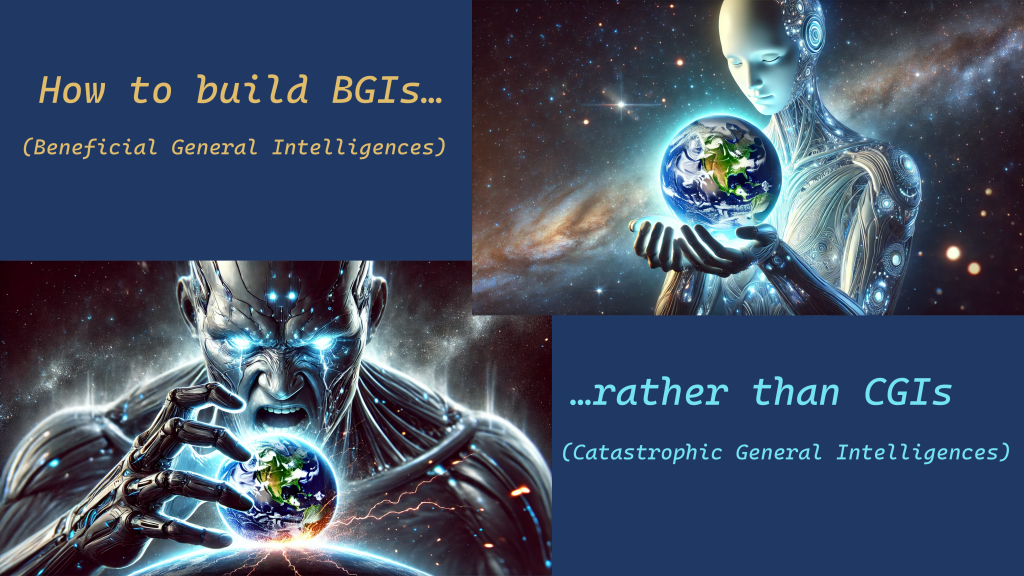
My conclusion: advanced AI may well be part of solutions to better geopolitics. But not if that AI is being developed and deployed by people who are naïve, over-confident, hurried, or vainglorious. In such circumstances, any AGI that is developed is likely to prove to be a CGI (catastrophic general intelligence) than a BGI (beneficial general intelligence).
Aside: to continue to explore the themes of this final section of this article, take a look at this recent essay of mine, “How to build BGIs rather than CGIs”.
 dw2
dw2 
Leave a comment