
dw2

28 April 2015

Why just small fries? Why no big potatoes?

Filed under: innovation, politics, Transpolitica, vision — Tags: , , , , — David Wood @ 3:12 pm

Big potatoesLast night I joined a gathering known as “Big Potatoes”, for informal discussion over dinner at the De Santis restaurant in London’s Old Street.

The potatoes in question weren’t on the menu. They were the potential big innovations that politicians ought to be contemplating.

The Big Potatoes group has a tag-line: “The London Manifesto for Innovation”.

As their website states,

The London Manifesto for Innovation is a contribution to improving the climate for innovation globally.

The group first formed in the run-up to the previous UK general election (2010). I blogged about them at that time, here, when I listed the principles from their manifesto:

  • We should “think big” about the potential of innovation, since there’s a great deal that innovation can accomplish;
  • Rather than “small is beautiful” we should keep in mind the slogan “scale is beautiful”;
  • We should seek more than just a continuation of the “post-war legacy of innovation” – that’s only the start;
  • Breakthrough innovations are driven by new technology – so we should prioritise the enablement of new technology;
  • Innovation is hard work and an uphill struggle – so we need to give it our full support;
  • Innovation arises from pure scientific research as well as from applied research – both are needed;
  • Rather than seeking to avoid risk or even to manage risk, we have to be ready to confront risk;
  • Great innovation needs great leaders of innovation, to make it happen;
  • Instead of trusting regulations, we should be ready to trust people;
  • Markets, sticks, carrots and nudges are no substitute for what innovation itself can accomplish.

That was 2010. What has caused the group to re-form now, in 2015, is the question:

Why is so much of the campaigning for the 2015 election preoccupied with small fries, when it could – and should – be concentrating on big potatoes?

Last night’s gathering was facilitated by three of the writers of the 2010 big potato manifestoNico MacdonaldJames Woudhuysen, and Martyn Perks. The Chatham House rules that were in place prevents me from quoting directly from the participants. But the discussion stirred up plenty of thoughts in my own mind, which I’ll share now.

The biggest potato
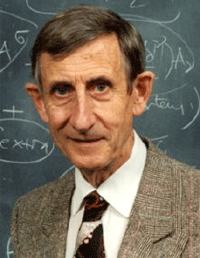
FreemanDysonI share the view expressed by renowned physicist Freeman Dyson, in the book “Infinite in all directions” from his 1985 Gifford lectures:

Technology is… the mother of civilizations, of arts, and of sciences

Technology has given rise to enormous progress in civilization, arts and sciences over recent centuries. New technology is poised to have even bigger impacts on civilization in the next 10-20 years. So why aren’t politicians paying more attention to it?

MIT professor Andrew McAfee takes up the same theme, in an article published in October last year:

History teaches us that nothing changes the world like technology

McAfee spells out a “before” and “after” analysis. Here’s the “before”:

For thousands of years, until the middle of the 18th century, there were only glacial rates of population growth, economic expansion, and social development.

And the “after”:

Then an industrial revolution happened, centred around James Watt’s improved steam engine, and humanity’s trajectory bent sharply and permanently upward

AndrewMcAfeeOne further quote from McAfee’s article rams home the conclusion:

Great wars and empires, despots and democrats, the insights of science and the revelations of religion – none of them transformed lives and civilizations as much as a few practical inventions

Inventions ahead

In principle, many of the grave challenges facing society over the next ten years could be solved by “a few practical inventions”:

  • Students complain, with some justification, about the costs of attending university. But technology can enable better MOOCs – Massive Online Open Courses – that can deliver high quality lectures, removing significant parts of the ongoing costs of running universities; free access to such courses can do a lot to help everyone re-skill, as new occupational challenges arise
  • With one million people losing their lives to traffic accidents worldwide every year, mainly caused by human driver error, we should welcome the accelerated introduction of self-driving cars
  • Medical costs could be reduced by greater application of the principles of preventive maintenance (“a stitch in time saves nine”), particularly through rejuvenation biotechnology and healthier diets
  • A sustained green tech new deal should push society away from dependency on fuels that emit dangerous amounts of greenhouse gases, resulting in lifestyles that are positive for the environment as well as positive for humanity
  • The growing costs of governmental bureaucracy itself could be reduced by whole-heartedly embracing improved information technology and lean automation.

Society has already seen remarkable changes in the last 10-20 years as a result of rapid progress in fields such as electronics, computers, digitisation, and automation. In each case, the description “revolution” is appropriate. But even these revolutions pale in significance to the changes that will, potentially, arise in the next 10-20 years from extraordinary developments in healthcare, brain sciences, atomically precise manufacturing, 3D printing, distributed production of renewable energy, artificial intelligence, and improved knowledge management.

Indeed, the next 10-20 years look set to witness four profound convergences:

  • Between artificial intelligence and human intelligence – with next generation systems increasingly embodying so-called “deep learning”, “hybrid intelligence”, and even “artificial emotional intelligence”
  • Between machine and human – with smart technology evolving from “mobile” to “wearable” and then to “insideable”, and with the emergence of exoskeletons and other cyborg technology
  • Between software and biology – with programming moving from silicon (semiconductor) to carbon (DNA and beyond), with the expansion of synthetic biology, and with the application of genetic engineering
  • Between virtual and physical – with the prevalence of augmented reality vision systems, augmented reality education via new MOOCs (massive open online courses), cryptocurrencies that remove the need for centralised audit authorities, and lots more.

To take just one example: Wired UK has just reported a claim by Brad Perkins, chief medical offer at Human Longevity Inc., that

A “supercharged” approach to human genome research could see as many health breakthroughs made in the next decade as in the previous century

The “supercharging” involves taking advantage of four converging trends:

“I don’t have a pill” to boost human lifespan, Perkins admitted on stage at WIRED Health 2015. But he has perhaps the next best thing — data, and the means to make sense of it. Based in San Diego, Human Longevity is fixed on using genome data and analytics to develop new ways to fight age-related diseases.

Perkins says the opportunity for humanity — and Human Longevity — is the result of the convergence of four trends: the reduction in the cost of genome sequencing (from $100m per genome in 2000, to just over $1,000 in 2014); the vast improvement in computational power; the development of large-scale machine learning techniques; and the wider movement of health care systems towards ‘value-based’ models. Together these trends are making it easier than ever to analyse human genomes at scale.

Small fries

french-fries-525005_1280Whilst entrepreneurs and technologists are foreseeing comprehensive solutions to age-related diseases – as well as the rise of smart automation that could free almost every member of the society of the need to toil in employment that they dislike – what are politicians obsessing about?

Instead of the opportunities of tomorrow, politicians are caught up in the challenges of yesteryear and today. Like a short-sighted business management team obsessed by the next few quarterly financial results but losing sight of the longer term, these politicians are putting all their effort into policies for incremental changes to present-day metrics – metrics such as tax thresholds, the gross domestic product, policing levels, the degree of privatisation in the health service, and the rate of flow of migrants from Eastern Europe into the United Kingdom.

It’s like the restricted vision which car manufacturing pioneer Henry Ford is said to have complained about:

If I had asked people what they wanted, they would have said faster horses.

This is light years away from leadership. It’s no wonder that electors are deeply dissatisfied.

The role of politics

To be clear, I’m not asking for politicians to dictate to entrepreneurs and technologists which products they should be creating. That’s not the role of politicians.

However, politicians should be ensuring that the broad social environment provides as much support as possible to:

  • The speedy, reliable development of those technologies which have the potential to improve our lives so fully
  • The distribution of the benefits of these technologies to all members of society, in a way that preserves social cohesion without infringing individual liberties
  • Monitoring for risks of accidental outcomes from these technologies that would have disastrous unintended consequences.

PeterDruckerIn this way, politicians help to address the human angle to technology. It’s as stated by management guru Peter Drucker in his 1986 book “Technology, Management, and Society”:

We are becoming aware that the major questions regarding technology are not technical but human questions.

Indeed, as the Transpolitica manifesto emphasises:

The speed and direction of technological adoption can be strongly influenced by social and psychological factors, by legislation, by subsidies, and by the provision or restriction of public funding.

Political action can impact all these factors, either for better or for worse.

The manifesto goes on to set out its objectives:

Transpolitica wishes to engage with politicians of all parties to increase the likelihood of an attractive, equitable, sustainable, progressive future. The policies we recommend are designed:

  • To elevate the thinking of politicians and other leaders, away from being dominated by the raucous issues of the present, to addressing the larger possibilities of the near future
  • To draw attention to technological opportunities, map out attractive roads ahead, and address the obstacles which are preventing us from fulfilling our cosmic potential.

Specific big potatoes that are missing from the discussion

If our political leaders truly were attuned to the possibilities of disruptive technological change, here’s a selection of the topics I believe would find much greater prominence in political discussion:

  1. How to accelerate lower-cost high quality continuous access to educational material, such as MOOCs, that will prepare people for the radically different future that lies ahead
  2. How to accelerate the development of personal genome healthcare, stem cell therapies, rejuvenation biotech, and other regenerative medicine, in order to enable much healthier people with much lower ongoing healthcare costs
  3. How to ensure that a green tech new deal succeeds, rather than continues to fall short of expectations (as it has been doing for the last 5-6 years)
  4. How to identify and accelerate the new industries where the UK can be playing a leading role over the next 5-10 years
  5. How to construct a new social contract – perhaps involving universal basic income – in order to cope with the increased technological unemployment which is likely to arise from improved automation
  6. How society should be intelligently assessing any new existential risks that emerging technologies may unintentionally trigger
  7. How to transition the network of bodies that operate international governance to a new status that is fit for the growing challenges of the coming decades (rather than perpetuating the inertia from the times of their foundations)
  8. How technology can involve more people – and more wisdom and insight from more people – in the collective decision-making that passes for political processes
  9. How to create new goals for society that embody a much better understanding of human happiness, human potential, and human flourishing, rather than the narrow economic criteria that currently dominate decisions
  10. How to prepare everyone for the next leaps forward in human consciousness which will be enabled by explorations of both inner and outer space.

Why small fries?

But the biggest question of all isn’t anything I’ve just listed. It’s this:

  • Why are politicians still stuck in present-day small fries, rather than focusing on the big potatoes?

I’ll be interested in answers to that question from readers. In the meantime, here are my own initial thoughts:

  • The power of inertia – politicians, like the rest of us, tend to keep doing what they’re used to doing
  • Too few politicians have any deep personal insight (from their professional background) into the promise (and perils) of disruptive technology
  • The lack of a specific vision for how to make progress on these Big Potato questions
  • The lack of clamour from the electorate as a whole for answers on these Big Potato questions.

If this is true, we must expect it will take some time for public pressure to grow, leading politicians in due course to pay attention to these topics.

It will be like the growth in capability of any given exponential technology. At first, development takes a long time. It seems as if nothing much is changing. But finally, tipping points are reached. At that stage, it become imperative to act quickly. And at that stage, politicians (and their advisors) will be looking around urgently for ready-made solutions they can adapt from think tanks. So we should be ready.

11 April 2015

Opening Pandora’s box

Should some conversations be suppressed?

Are there ideas which could prove so incendiary, and so provocative, that it would be better to shut them down?

Should some concepts be permanently locked into a Pandora’s box, lest they fly off and cause too much chaos in the world?

As an example, consider this oft-told story from the 1850s, about the dangers of spreading the idea of that humans had evolved from apes:

It is said that when the theory of evolution was first announced it was received by the wife of the Canon of Worcester Cathedral with the remark, “Descended from the apes! My dear, we will hope it is not true. But if it is, let us pray that it may not become generally known.”

More recently, there’s been a growing worry about spreading the idea that AGI (Artificial General Intelligence) could become an apocalyptic menace. The worry is that any discussion of that idea could lead to public hostility against the whole field of AGI. Governments might be panicked into shutting down these lines of research. And self-appointed militant defenders of the status quo might take up arms against AGI researchers. Perhaps, therefore, we should avoid any public mention of potential downsides of AGI. Perhaps we should pray that these downsides don’t become generally known.

tumblr_static_transcendence_rift_logoThe theme of armed resistance against AGI researchers features in several Hollywood blockbusters. In Transcendence, a radical anti-tech group named “RIFT” track down and shoot the AGI researcher played by actor Johnny Depp. RIFT proclaims “revolutionary independence from technology”.

As blogger Calum Chace has noted, just because something happens in a Hollywood movie, it doesn’t mean it can’t happen in real life too.

In real life, “Unabomber” Ted Kaczinski was so fearful about the future destructive potential of technology that he sent 16 bombs to targets such as universities and airlines over the period 1978 to 1995, killing three people and injuring 23. Kaczinski spelt out his views in a 35,000 word essay Industrial Society and Its Future.

Kaczinki’s essay stated that “the Industrial Revolution and its consequences have been a disaster for the human race”, defended his series of bombings as an extreme but necessary step to attract attention to how modern technology was eroding human freedom, and called for a “revolution against technology”.

Anticipating the next Unabombers

unabomber_ely_coverThe Unabomber may have been an extreme case, but he’s by no means alone. Journalist Jamie Bartlett takes up the story in a chilling Daily Telegraph article “As technology swamps our lives, the next Unabombers are waiting for their moment”,

In 2011 a new Mexican group called the Individualists Tending toward the Wild were founded with the objective “to injure or kill scientists and researchers (by the means of whatever violent act) who ensure the Technoindustrial System continues its course”. In 2011, they detonated a bomb at a prominent nano-technology research centre in Monterrey.

Individualists Tending toward the Wild have published their own manifesto, which includes the following warning:

We employ direct attacks to damage both physically and psychologically, NOT ONLY experts in nanotechnology, but also scholars in biotechnology, physics, neuroscience, genetic engineering, communication science, computing, robotics, etc. because we reject technology and civilisation, we reject the reality that they are imposing with ALL their advanced science.

Before going any further, let’s agree that we don’t want to inflame the passions of would-be Unabombers, RIFTs, or ITWs. But that shouldn’t lead to whole conversations being shut down. It’s the same with criticism of religion. We know that, when we criticise various religious doctrines, it may inflame jihadist zeal. How dare you offend our holy book, and dishonour our exalted prophet, the jihadists thunder, when they cannot bear to hear our criticisms. But that shouldn’t lead us to cowed silence – especially when we’re aware of ways in which religious doctrines are damaging individuals and societies (by opposition to vaccinations or blood transfusions, or by denying female education).

Instead of silence (avoiding the topic altogether), what these worries should lead us to is a more responsible, inclusive, measured conversation. That applies for the drawbacks of religion. And it applies, too, for the potential drawbacks of AGI.

Engaging conversation

The conversation I envisage will still have its share of poetic effect – with risks and opportunities temporarily painted more colourfully than a fully sober evaluation warrants. If we want to engage people in conversation, we sometimes need to make dramatic gestures. To squeeze a message into a 140 character-long tweet, we sometimes have to trim the corners of proper spelling and punctuation. Similarly, to make people stop in their tracks, and start to pay attention to a topic that deserves fuller study, some artistic license may be appropriate. But only if that artistry is quickly backed up with a fuller, more dispassionate, balanced analysis.

What I’ve described here is a two-phase model for spreading ideas about disruptive technologies such as AGI:

  1. Key topics can be introduced, in vivid ways, using larger-than-life characters in absorbing narratives, whether in Hollywood or in novels
  2. The topics can then be rounded out, in multiple shades of grey, via film and book reviews, blog posts, magazine articles, and so on.

Since I perceive both the potential upsides and the potential downsides of AGI as being enormous, I want to enlarge the pool of people who are thinking hard about these topics. I certainly don’t want the resulting discussion to slide off to an extreme point of view which would cause the whole field of AGI to be suspended, or which would encourage active sabotage and armed resistance against it. But nor do I want the discussion to wither away, in a way that would increase the likelihood of adverse unintended outcomes from aberrant AGI.

Welcoming Pandora’s Brain

cropped-cover-2That’s why I welcome the recent publication of the novel “Pandora’s Brain”, by the above-mentioned blogger Calum Chace. Pandora’s Brain is a science and philosophy thriller that transforms a series of philosophical concepts into vivid life-and-death conundrums that befall the characters in the story. Here’s how another science novellist, William Hertling, describes the book:

Pandora’s Brain is a tour de force that neatly explains the key concepts behind the likely future of artificial intelligence in the context of a thriller novel. Ambitious and well executed, it will appeal to a broad range of readers.

In the same way that Suarez’s Daemon and Naam’s Nexus leaped onto the scene, redefining what it meant to write about technology, Pandora’s Brain will do the same for artificial intelligence.

Mind uploading? Check. Human equivalent AI? Check. Hard takeoff singularity? Check. Strap in, this is one heck of a ride.

Mainly set in the present day, the plot unfolds in an environment that seems reassuringly familiar, but which is overshadowed by a combination of both menace and promise. Carefully crafted, and absorbing from its very start, the book held my rapt attention throughout a series of surprise twists, as various personalities react in different ways to a growing awareness of that menace and promise.

In short, I found Pandora’s Brain to be a captivating tale of developments in artificial intelligence that could, conceivably, be just around the corner. The imminent possibility of these breakthroughs cause characters in the book to re-evaluate many of their cherished beliefs, and will lead most readers to several “OMG” realisations about their own philosophies of life. Apple carts that are upended in the processes are unlikely ever to be righted again. Once the ideas have escaped from the pages of this Pandora’s box of a book, there’s no going back to a state of innocence.

But as I said, not everyone is enthralled by the prospect of wider attention to the “menace” side of AGI. Each new novel or film in this space has the potential of stirring up a negative backlash against AGI researchers, potentially preventing them from doing the work that would deliver the powerful “promise” side of AGI.

The dual potential of AGI

FLIThe tremendous dual potential of AGI was emphasised in an open letter published in January by the Future of Life Institute:

There is now a broad consensus that AI research is progressing steadily, and that its impact on society is likely to increase. The potential benefits are huge, since everything that civilization has to offer is a product of human intelligence; we cannot predict what we might achieve when this intelligence is magnified by the tools AI may provide, but the eradication of disease and poverty are not unfathomable. Because of the great potential of AI, it is important to research how to reap its benefits while avoiding potential pitfalls.

“The eradication of disease and poverty” – these would be wonderful outcomes from the project to create AGI. But the lead authors of that open letter, including physicist Stephen Hawking and AI professor Stuart Russell, sounded their own warning note:

Success in creating AI would be the biggest event in human history. Unfortunately, it might also be the last, unless we learn how to avoid the risks. In the near term, world militaries are considering autonomous-weapon systems that can choose and eliminate targets; the UN and Human Rights Watch have advocated a treaty banning such weapons. In the medium term, as emphasised by Erik Brynjolfsson and Andrew McAfee in The Second Machine Age, AI may transform our economy to bring both great wealth and great dislocation…

One can imagine such technology outsmarting financial markets, out-inventing human researchers, out-manipulating human leaders, and developing weapons we cannot even understand. Whereas the short-term impact of AI depends on who controls it, the long-term impact depends on whether it can be controlled at all.

They followed up with this zinger:

So, facing possible futures of incalculable benefits and risks, the experts are surely doing everything possible to ensure the best outcome, right? Wrong… Although we are facing potentially the best or worst thing to happen to humanity in history, little serious research is devoted to these issues outside non-profit institutes… All of us should ask ourselves what we can do now to improve the chances of reaping the benefits and avoiding the risks.

Criticisms

Critics give a number of reasons why they see these fears as overblown. To start with, they argue that the people raising the alarm – Stephen Hawking, serial entrepreneur Elon Musk, Oxford University philosophy professor Nick Bostrom, and so on – lack their own expertise in AGI. They may be experts in black hole physics (Hawking), or in electric cars (Musk), or in academic philosophy (Bostrom), but that gives them no special insights into the likely course of development of AGI. Therefore we shouldn’t pay particular attention to what they say.

A second criticism is that it’s premature to worry about the advent of AGI. AGI is still situated far into the future. In this view, as stated by Demis Hassabis, founder of DeepMind,

We’re many, many decades away from anything, any kind of technology that we need to worry about.

The third criticism is that it will be relatively simple to stop AGI causing any harm to humans. AGI will be a tool to humans, under human control, rather than having its own autonomy. This view is represented by this tweet by science populariser Neil deGrasse Tyson:

Seems to me, as long as we don’t program emotions into Robots, there’s no reason to fear them taking over the world.

I hear all these criticisms, but they’re by no means the end of the discussion. They’re no reason to terminate the discussion about AGI risks. That’s the argument I’m going to make in the remainder of this blogpost.

By the way, you’ll find all these of these criticisms mirrored in the course of the novel Pandora’s Brain. That’s another reason I recommend that people should read that book. It manages to bring a great deal of serious arguments to the table, in the course of entertaining (and sometimes frightening) the reader.

Answering the criticisms: personnel

Elon Musk, one of the people who have raised the alarm about AGI risks, lacks any PhD in Artificial Intelligence to his name. It’s the same with Stephen Hawking and with Nick Bostrom. On the other hand, others who are raising the alarm do have relevant qualifications.

AI a modern approachConsider as just one example Stuart Russell, who is a computer-science professor at the University of California, Berkeley and co-author of the 1152-page best-selling text-book “Artificial Intelligence: A Modern Approach”. This book is described as follows:

Artificial Intelligence: A Modern Approach, 3rd edition offers the most comprehensive, up-to-date introduction to the theory and practice of artificial intelligence. Number one in its field, this textbook is ideal for one or two-semester, undergraduate or graduate-level courses in Artificial Intelligence.

Moreover, other people raising the alarm include some the giants of the modern software industry:

Wozniak put his worries as follows – in an interview for the Australian Financial Review:

“Computers are going to take over from humans, no question,” Mr Wozniak said.

He said he had long dismissed the ideas of writers like Raymond Kurzweil, who have warned that rapid increases in technology will mean machine intelligence will outstrip human understanding or capability within the next 30 years. However Mr Wozniak said he had come to recognise that the predictions were coming true, and that computing that perfectly mimicked or attained human consciousness would become a dangerous reality.

“Like people including Stephen Hawking and Elon Musk have predicted, I agree that the future is scary and very bad for people. If we build these devices to take care of everything for us, eventually they’ll think faster than us and they’ll get rid of the slow humans to run companies more efficiently,” Mr Wozniak said.

“Will we be the gods? Will we be the family pets? Or will we be ants that get stepped on? I don’t know about that…

And here’s what Bill Gates said on the matter, in an “Ask Me Anything” session on Reddit:

I am in the camp that is concerned about super intelligence. First the machines will do a lot of jobs for us and not be super intelligent. That should be positive if we manage it well. A few decades after that though the intelligence is strong enough to be a concern. I agree with Elon Musk and some others on this and don’t understand why some people are not concerned.

Returning to Elon Musk, even his critics must concede he has shown remarkable ability to make new contributions in areas of technology outside his original specialities. Witness his track record with PayPal (a disruption in finance), SpaceX (a disruption in rockets), and Tesla Motors (a disruption in electric batteries and electric cars). And that’s even before considering his contributions at SolarCity and Hyperloop.

Incidentally, Musk puts his money where his mouth is. He has donated $10 million to the Future of Life Institute to run a global research program aimed at keeping AI beneficial to humanity.

I sum this up as follows: the people raising the alarm in recent months about the risks of AGI have impressive credentials. On occasion, their sound-bites may cut corners in logic, but they collectively back up these sound-bites with lengthy books and articles that deserve serious consideration.

Answering the criticisms: timescales

I have three answers to the comment about timescales. The first is to point out that Demis Hassabis himself sees no reason for any complacency, on account of the potential for AGI to require “many decades” before it becomes a threat. Here’s the fuller version of the quote given earlier:

We’re many, many decades away from anything, any kind of technology that we need to worry about. But it’s good to start the conversation now and be aware of as with any new powerful technology it can be used for good or bad.

(Emphasis added.)

Second, the community of people working on AGI has mixed views on timescales. The Future of Life Institute ran a panel discussion in Puerto Rico in January that addressed (among many other topics) “Creating human-level AI: how and when”. Dileep George of Vicarious gave the following answer about timescales in his slides (PDF):

Will we solve the fundamental research problems in N years?

N <= 5: No way
5 < N <= 10: Small possibility
10 < N <= 20: > 50%.

In other words, in his view, there’s a greater than 50% chance that artificial general human-level intelligence will be solved within 20 years.

SuperintelligenceThe answers from the other panellists aren’t publicly recorded (the event was held under Chatham House rules). However, Nick Bostrom has conducted several surveys among different communities of AI researchers. The results are included in his book Superintelligence: Paths, Dangers, Strategies. The communities surveyed included:

  • Participants at an international conference: Philosophy & Theory of AI
  • Participants at another international conference: Artificial General Intelligence
  • The Greek Association for Artificial Intelligence
  • The top 100 cited authors in AI.

In each case, participants were asked for the dates when they were 90% sure human-level AGI would be achieved, 50% sure, and 10% sure. The average answers were:

  • 90% likely human-level AGI is achieved: 2075
  • 50% likely: 2040
  • 10% likely: 2022.

If we respect what this survey says, there’s at least a 10% chance of breakthrough developments within the next ten years. Therefore it’s no real surprise that Hassabis says

It’s good to start the conversation now and be aware of as with any new powerful technology it can be used for good or bad.

Third, I’ll give my own reasons for why progress in AGI might speed up:

  • Computer hardware is likely to continue to improve – perhaps utilising breakthroughs in quantum computing
  • Clever software improvements can increase algorithm performance even more than hardware improvements
  • Studies of the human brain, which are yielding knowledge faster than ever before, can be translated into “neuromorphic computing”
  • More people are entering and studying AI than ever before, in part due to MOOCs, such as that from Stanford University
  • There are more software components, databases, tools, and methods available for innovative recombination
  • AI methods are being accelerated for use in games, financial trading, malware detection (and in malware itself), and in many other industries
  • There could be one or more “Sputnik moments” causing society to buckle up its motivation to more fully support AGI research (especially when AGI starts producing big benefits in healthcare diagnosis).

Answering the critics: control

I’ve left the hardest question to last. Could there be relatively straightforward ways to keep AGI under control? For example, would it suffice to avoid giving AGI intentions, or emotions, or autonomy?

For example, physics professor and science populariser Michio Kaku speculates as follows:

No one knows when a robot will approach human intelligence, but I suspect it will be late in the 21st century. Will they be dangerous? Possibly. So I suggest we put a chip in their brain to shut them off if they have murderous thoughts.

And as mentioned earlier, Neil deGrasse Tyson proposes,

As long as we don’t program emotions into Robots, there’s no reason to fear them taking over the world.

Nick Bostrom devoted a considerable portion of his book to this “Control problem”. Here are some reasons I think we need to continue to be extremely careful:

  • Emotions and intentions might arise unexpectedly, as unplanned side-effects of other aspects of intelligence that are built into software
  • All complex software tends to have bugs; it may fail to operate in the way that we instruct it
  • The AGI software will encounter many situations outside of those we explicitly anticipated; the response of the software in these novel situations may be to do “what we asked it to do” but not what we would have wished it to do
  • Complex software may be vulnerable to having its functionality altered, either by external hacking, or by well-intentioned but ill-executed self-modification
  • Software may find ways to keep its inner plans hidden – it may have “murderous thoughts” which it prevents external observers from noticing
  • More generally, black-box evolution methods may result in software that works very well in a large number of circumstances, but which will go disastrously wrong in new circumstances, all without the actual algorithms being externally understood
  • Powerful software can have unplanned adverse effects, even without any consciousness or emotion being present; consider battlefield drones, infrastructure management software, financial investment software, and nuclear missile detection software
  • Software may be designed to be able to manipulate humans, initially for purposes akin to advertising, or to keep law and order, but these powers may evolve in ways that have worse side effects.

A new Columbus?

christopher-columbus-shipsA number of the above thoughts started forming in my mind as I attended the Singularity University Summit in Seville, Spain, a few weeks ago. Seville, I discovered during my visit, was where Christopher Columbus persuaded King Ferdinand and Queen Isabella of Spain to fund his proposed voyage westwards in search of a new route to the Indies. It turns out that Columbus succeeded in finding the new continent of America only because he was hopelessly wrong in his calculation of the size of the earth.

From the time of the ancient Greeks, learned observers had known that the earth was a sphere of roughly 40 thousand kilometres in circumference. Due to a combination of mistakes, Columbus calculated that the Canary Islands (which he had often visited) were located only about 4,440 km from Japan; in reality, they are about 19,000 km apart.

Most of the countries where Columbus pitched the idea of his westward journey turned him down – believing instead the figures for the larger circumference of the earth. Perhaps spurred on by competition with the neighbouring Portuguese (who had, just a few years previously, successfully navigated to the Indian ocean around the tip of Africa), the Spanish king and queen agreed to support his adventure. Fortunately for Columbus, a large continent existed en route to Asia, allowing him landfall. And the rest is history. That history included the near genocide of the native inhabitants by conquerors from Europe. Transmission of European diseases compounded the misery.

It may be the same with AGI. Rational observers may have ample justification in thinking that true AGI is located many decades in the future. But this fact does not deter a multitude of modern-day AGI explorers from setting out, Columbus-like, in search of some dramatic breakthroughs. And who knows what intermediate forms of AI might be discovered, unexpectedly?

It all adds to the argument for keeping our wits fully about us. We should use every means at our disposal to think through options in advance. This includes well-grounded fictional explorations, such as Pandora’s Brain, as well as the novels by William Hertling. And it also includes the kinds of research being undertaken by the Future of Life Institute and associated non-profit organisations, such as CSER in Cambridge, FHI in Oxford, and MIRI (the Machine Intelligence Research Institute).

Let’s keep this conversation open – it’s far too important to try to shut it down.

Footnote: Vacancies at the Centre for the Study of Existential Risk

I see that the Cambridge University CSER (Centre for the Study of Existential Risk) have four vacancies for Research Associates. From the job posting:

Up to four full-time postdoctoral research associates to work on the project Towards a Science of Extreme Technological Risk (ETR) within the Centre for the Study of Existential Risk (CSER).

CSER’s research focuses on the identification, management and mitigation of possible extreme risks associated with future technological advances. We are currently based within the University’s Centre for Research in the Arts, Social Sciences and Humanities (CRASSH). Our goal is to bring together some of the best minds from academia, industry and the policy world to tackle the challenges of ensuring that powerful new technologies are safe and beneficial. We focus especially on under-studied high-impact risks – risks that might result in a global catastrophe, or even threaten human extinction, even if only with low probability.

The closing date for applications is 24th April. If you’re interested, don’t delay!

Blog at WordPress.com.