dw2

21 March 2013

The burning need for better supra-national governance

International organisations have a bad reputation these days. The United Nations is widely seen as ineffective. There’s a retreat towards “localism”: within Britain, the EU is unpopular; within Scotland, Britain is unpopular. And any talk of “giving up sovereignty” is deeply unpopular.

However, lack of effective international organisations and supra-national governance is arguably the root cause of many of the biggest crises facing humanity in the early 21st century.

That was the thesis which Ian Goldin, Oxford University Professor of Globalisation and Development, very ably shared yesterday evening in the Hong Kong Theatre in the London School of Economics. He was quietly spoken, but his points hit home strongly. I was persuaded.
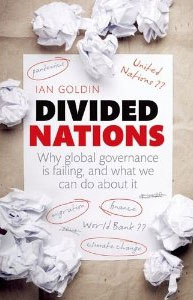
DividedNationsThe lecture was entitled Divided Nations: Why global governance is failing and what we can do about it. It coincided with the launch of a book with the same name. For more details of the book, see this blogpost on the website of the Oxford Martin School, where Ian Goldin holds the role of Director.

It’s my perception that many technology enthusiasts, futurists, and singularitarians have a blind spot when it comes to the topic of the dysfunction of current international organisations. They tend to assume that technological improvements will automatically resolve the crises and risks facing society. Governments and regulators should ideally leave things well alone – so the plea goes.

My own view is that smarter coordination and regulation is definitely needed – even though it will be hard to set that up. Professor Goldin’s lecture amply reinforced that view.

On the train home from the lecture, I downloaded the book onto my Kindle. I recommend anyone who is serious about the future of humanity to read it. Drawing upon the assembled insights and wisdom of the remarkable set of scholars at the Oxford Martin School, in addition to his own extensive experience in the international scene, Professor Goldin has crystallised state-of-the-art knowledge regarding the pressing urgency, and options, for better supra-national governance.

In the remainder of this blogpost, I share some of the state-of-consciousness notes that I typed while listening to the lecture. Hopefully this will give a flavour of the hugely important topics covered. I apologise in advance for any errors introduced in transcription. Please see the book itself for an authoritative voice. See also the live tweet stream for the meeting, with the hash-tag #LSEGoldin.

What keeps Oxford Martin scholars awake at night

The fear that no one is listening. The international governance system is in total gridlock. There are failures on several levels:

  • Failure of governments to lift themselves to a higher level, instead of being pre-occupied by local, parochial interests
  • Failure of electorates to demand more from their governments
  • Failure of governments for not giving clearer direction to the international institutions.

Progress with international connectivity

80 countries became democratic in the 1990s. Only one country in the world today remains disconnected – North Korea.

Over the last few decades, the total global population has increased, but the numbers in absolute poverty have decreased. This has never happened before in history.

So there are many good aspects to the increase in the economy and inter-connectivity.

However, economists failed to think sufficiently far ahead.

What economists should have thought about: the global commons

What was rational for the individuals and for national governments was not rational for the whole world.

Similar problems exist in several other fields: antibiotic resistance, global warming, the markets. He’ll get to these shortly.

The tragedy of the commons is that, when everyone does what is rational for them, everyone nevertheless ends up suffering. The common resource is not managed.

The pursuit of profits is a good thing – it has worked much better than central planning. But the result is irrationality in aggregate.

The market alone cannot provide a response to resource allocation. Individual governments cannot provide a solution either. A globally coordinated approach is needed.

Example of several countries drawing water from the Aral Sea – which is now arid.

That’s what happens when nations do the right thing for themselves.

The special case of Finance

Finance is by far the most sophisticated of the resource management systems:

  • The best graduates go into the treasury, the federal reserve, etc
  • They are best endowed – the elite organisation
  • These people know each other – they play golf together.

If even the financial bodies can’t understand their own system, this has black implications for other systems.

The growth of the financial markets had two underbellies:

  1. Growing inequality
  2. Growing potential for systemic risk

The growing inequality has actually led to lobbying that exaggerates inequality even more.

The result was a “Race to the bottom”, with governments being persuaded to get out of the regulation of things that actually did need to be regulated.

Speaking after the crisis, Hank Paulson, US Treasury Secretary and former CEO of Goldman Sachs, in effect said “we just did not understand what was happening” – even with all the high-calibre people and advice available to him. That’s a shocking indictment.

The need for regulation

Globalisation requires regulation, not just at the individual national level, but at an international level.

Global organisations are weaker now than in the 1990s.

Nations are becoming more parochial – the examples of UK (thinking of leaving EU) and Scotland (thinking of leaving UK) are mirrored elsewhere too.

Yes, integration brings issues that are hard to control, but the response to withdraw from integration is terribly misguided.

We cannot put back the walls. Trying to withdraw into local politics is dreadfully misguided.

Five examples

His book has five examples as illustrations of his general theme (and that’s without talking in this book about poverty, or nuclear threats):

  1. Finance
  2. Pandemics
  3. Migration
  4. Climate change
  5. Cyber-security

Many of these problems arise from the success of globalisation – the extraordinary rise in incomes worldwide in the last 25 years.

Pandemics require supra-national attention, because of increased connectivity:

  • The rapid spread of swine flu was correlated tightly with aircraft travel.
  • It will just take 2 days for a new infectious disease to travel all the way round the world.

The idea that you can isolate yourself from the world is a myth. There’s little point having a quarantine regime in place in Oxford if a disease is allowed to flourish in London. The same applies between countries, too.

Technology developments exacerbate the problem. DNA analysis is a good thing, but the capacity to synthesise diseases has terrible consequences:

  • There’s a growing power for even a very small number of individuals to cause global chaos, e.g. via pathogens
  • Think of something like Waco Texas – people who are fanatical Armageddonists – but with greater technical skills.

Cyber-security issues arise from the incredible growth in network connectivity. Jonathan Zittrain talks about “The end of the Internet”:

  • The Internet is not governed by governments
  • Problems to prosecute people, even when we know who they are and where they are (but in a different jurisdiction)
  • Individuals and small groups could destabilise whole Internet.

Migration is another “orphan issue”. No international organisation has the authority to deal with it:

  • Control over immigration is, in effect, an anarchic, bullying system
  • We have very bad data on migration (even in the UK).

The existing global institutions

The global institutions that we have were a response to post-WW2 threats.

For a while, these institutions did well. The World Bank = Bank for reconstruction. It did lead a lot of reconstruction.

But over time, we became complacent. The institutions became out-dated and lost their vitality.

The recent financial crisis shows that the tables have been turned round: incredible scene of EU taking its begging bowl to China.

The tragedy is that the lessons well-known inside the existing institutions have not been learned. There are lessons about the required sequencing of reforms, etc. But with the loss of vitality of these institutions, the knowledge is being lost.

The EU has very little bandwidth for managing global affairs. Same as US. Same as Japan. They’re all preoccupied by local issues.

The influence of the old G7 is in decline. The new powers are not yet ready to take over the responsibility: China, Russia, India, Indonesia, Brazil, South Africa…

  • The new powers don’t actually want this responsibility (different reasons for different countries)
  • China, the most important of the new powers, has other priorities – managing their own poverty issues at home.

The result is that no radical reform happens, of the international institutions:

  • No organisations are killed off
  • No new ones created
  • No new operating principles are agreed.

Therefore the institutions remain ineffective. Look at the lack of meaningful progress towards solving the problems of climate change.

He has been on two Bretton Woods reform commissions, along with “lots of wonderfully smart, well-meaning people”. Four prime ministers were involved, including Gordon Brown. Kofi Annan received the report with good intentions. But no actual reform of UN took place. Governments actually want these institutions to remain weak. They don’t want to give up their power.

It’s similar to the way that the UK is unwilling to give up power to Brussels.

Sleep-walking

The financial crisis shows what happens when global systems aren’t managed:

  • Downwards spiral
  • Very hard to pull it out afterwards.

We are sleep-walking into global crises. The financial crisis is just a foretaste of what is to come. However, this need not be the case.

A positive note

He’ll finish the lecture by trying to be cheerful.

Action on global issues requires collective action by both citizens and leaders who are not afraid to relinquish power.

The good news:

  • Citizens are more connected than ever before
  • Ideologies that have divided people in the past are reducing in power
  • We can take advantage of the amplification of damage to reputation that can happen on the Internet
  • People can be rapidly mobilised to overturn bad legislation.

Encouraging example of SOPA debate in US about aspects of control of the Internet:

  • 80 million people went online to show their views, in just two days
  • Senate changed their intent within six hours.

Some good examples where international coordination works

  • International plane travel coordination (air traffic control) is example that works very well – it’s a robust system
  • Another good example: the international postal system.

What distinguishes the successes from the failures:

  • In the Air Traffic Control case, no one has a different interest
  • But in other cases, there are lots of vested interest – neutering the effectiveness of e.g. the international response to the Syrian crisis
  • Another troubling failure example is what happened in Iraq – it was a travesty of what the international system wanted and needed.

Government leaders are afraid that electorate aren’t ready to take a truly international perspective. To be internationalist in political circles is increasingly unfashionable. So we need to change public opinion first.

Like-minded citizens need to cooperate, building a growing circle of legitimacy. Don’t wait for the global system to play catch-up.

In the meantime, true political leaders should find some incremental steps, and should avoid excuse of global inaction.

Sadly, political leaders are often tied up addressing short-term crises, but these short-term crises are due to no-one satisfactorily addressing the longer-term issues. With inaction on the international issues, the short-term crises will actually get worse.

Avoiding the perfect storm

The scenario we face for the next 15-20 years is “perfect storm with no captain”.

He calls for a “Manhattan project” for supra-national governance. His book is a contribution to initiating such a project.

He supports the subsidiarity principle: decisions should be taken at the most local level possible. Due to hyper-globalisation, there are fewer and fewer things that it makes sense to control at the national level.

Loss of national sovereignty is inevitable. We can have better sovereignty at the global level – and we can influence how that works.

The calibre of leaders

Example of leader who consistently took a global perspective: Nelson Mandela. “Unfortunately we don’t have many Mandelas around.”

Do leaders owe their power bases with electorates because they are parochial? The prevailing wisdom is that national leaders have to shy away from taking a global perspective. But the electorate actually have more wisdom. They know the financial crisis wasn’t just due to bankers in Canary Wharf having overly large bonuses. They know the problems are globally systemic in nature, and need global approaches to fix them.


ian goldin

18 March 2013

The future of the Mobile World Congress

Filed under: Accenture, Cambridge, Connectivity, innovation, Internet of Things, M2M, MWC — David Wood @ 3:37 am

How should the Mobile World Congress evolve? What does the future hold for this event?

MWC logoMWC (the Mobile World Congress) currently has good claims to be the world’s leading show for the mobile industry. From 25-28 February, 72 thousand attendees from over 200 countries made their way around eight huge halls where over 1,700 companies were showcasing their products or services. The Barcelona exhibition halls were heaving and jostling.

Tony Poulos, Market Strategist for TM Forum, caught much of the mood of the event in his review article, “Billions in big business as Barcelona beats blues”. Here’s an excerpt:

In one place for four days each year you can see, meet and hear almost every key player in the GSM mobile world. And there lies its secret. The glitz, the ritzy exhibits, the partially clad promo girls, the gimmicks, the giveaways are all inconsequential when you get down to the business of doing business. No longer do people turn up at events like MWC just to attend the conference sessions, walk the stands or attend the parties, they all come here to network in person and do business.

For suppliers, all their customers and prospects are in one place for one week. No need to send sales teams around the globe to meet with them, they come to you. And not just the managers and directors, there are more telco C-levels in Barcelona for MWC than are left behind in the office. For suppliers and operators alike, if you are not seen at MWC you are either out of business or out of a job.

Forget virtual social networking, this is good old-fashioned, physical networking at its best. Most meetings are arranged ahead of time and stands are changing slowly from gaudy temples pulling in passers-by to sophisticated business environments complete with comfortable meeting rooms, lounges, bars, espresso machines and delicacies including Swiss chocolates, Portuguese egg tarts, French pastries and wines from every corner of the globe…

But at least some of the 72,000 MWC attendees found the experience underwhelming. Kevin Coleman, CEO of Alliantus, offered a damning assessment at the end of the show:

I am wondering if I am the boy who shouts – “but the emperor is wearing no clothes” – or the masked magician about to reveal the secrets of the magic trick.

Here it is. “Most of you at Mobile World Congress have wasted your money.”

Yes, I have just returned from the MWC where I have seen this insanity with my own eyes…

That’s quite a discrepancy in opinion. Billions in business, or Insanity?

Or to rephrase the question in terms suggested by my Accenture colleague Rhian Pamphilon, Fiesta or Siesta?

To explore that question, Accenture sponsored a Cambridge Wireless event on Tuesday last week at the Møller Centre at Churchill College in Cambridge. The idea was to bring together a panel of mobile industry experts who would be prepared to share forthright but informed opinions on the highlights and lowlights of this year’s MWC.

Panellists

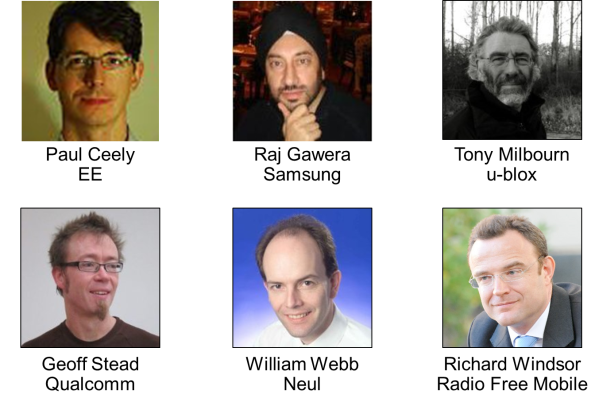
The event was entitled “Mobile World Congress: Fiesta or Siesta?!”. The panellists who kindly agreed to take part were:

  • Paul Ceely, Head of Network Strategy at EE
  • Raj Gawera, VP Marketing at Samsung Cambridge Mobile Solutions
  • Dr Tony Milbourn, VP Strategy at u-blox AG
  • Geoff Stead, Senior Director, Mobile Learning at Qualcomm
  • Professor William Webb, CTO at Neul
  • Dr. Richard Windsor, Founder of Radio Free Mobile.

The meeting was structured around three questions:

  1. The announcements at MWC that people judged to be the most significant – the news stories with the greatest implications
  2. The announcements at MWC that people judged to be the most underwhelming – the news stories with the least real content
  3. The announcements people might have expected at MWC but which failed to materialise – speaking volumes by their silence.

In short, what were the candidates for what we termed the Fiesta, the Siesta, and the Niesta of the event? Which trends should be picked out as the most exciting, the most snooze-worthy, and as sleeping giants liable to burst forth into new spurts of activity? And along the way, what future could we discern, not just for individual mobile trends, but for the MWC event itself?

I had the pleasure to chair the discussion. All panellists were speaking on their own behalf, rather than necessarily representing the corporate viewpoints of their companies. That helped to encourage a candid exchange of views. The meeting also found time to hear suggestions from the audience – which numbered around 100 members of the extended Cambridge Wireless community. Finally, there was a lively networking period, in which many of the audience good-humouredly button-holed me with additional views.

We were far from reaching any unanimous conclusion. Items that were picked as “Fiesta” by one panellist sometimes featured instead on the “Siesta” list of another. But I list below some key perceptions that commanded reasonable assent on the evening.

Machine to machine, connected devices, and wearable computers

MWC showed a lot of promise for machine-to-machine (M2M) communications and for connected devices (devices that contain communications functionality but which are not phones). But more remains to be done, for this promise to reach its potential.

The GSMA Connected City gathered together a large number of individual demos, but the demos were mainly separated from each other, without there being a clear overall architecture incorporating them all.

Connected car was perhaps the field showing the greatest progress, but even there, practical questions remain – for example, should the car rely on its own connectivity, or instead rely on connectivity of smartphones brought into the car?

For MWC to retain its relevance, it needs to bring M2M and connected devices further to the forefront.

Quite likely, wearable computers will be showing greater prominence by this time next year – whether via head-mounted displays (such as Google Glass) or via the smart watches allegedly under development at several leading companies.

NFC – Near Field Communications

No one spoke up with any special excitement about NFC. Words used about it were “boring” and “complicated”.

Handset evolution

The trend towards larger screen sizes was evident. This seems to be driven by the industry as much as by users, since larger screens encourage greater amounts of data usage.

On the other hand, flexible screens, which have long been anticipated, and which might prompt significant innovation in device form factors, showed little presence at the show. This is an area to watch closely.

Perhaps the most innovative device on show was the dual display Yota Phone – with a standard LCD on one side, and an eInk display on the other. As can be seen in this video from Ben Wood of CCS Insight, the eInk display remains active even if the device is switched off or runs out of battery.

Two other devices received special mention:

  • The Nokia Lumia 520, because of its low pricepoint
  • The Lenovo K900, because of what it showed about the capability of Intel’s mobile architecture.

Mobile operating systems

Panellists had dim views on some of the Android devices they saw. Some of these devices showed very little differentiation from each other. Indeed, some “formerly innovative” handset manufacturers seem to have lost their direction altogether.

Views were mixed on the likely impact of Mozilla’s Firefox OS. Is the user experience going to be sufficiently compelling for phones based on this OS to gain significant market traction? It seems too early to tell.

Panellists were more open to the idea that the marketplace could tolerate a considerable number of different mobile operating systems. Gone are  the days when CEOs of network operators would call for the industry to agree on just three platforms. The vast numbers of smartphones expected over the next few years (with one billion likely to be sold in 2013) mean there is room for quite a few second-tier platforms behind the market leaders iOS and Android.

Semiconductor suppliers

If the mobile operating system has two strong leaders, the choice of leading semiconductor supplier is even more limited. One company stands far out from the crowd: Qualcomm. In neither case is the rest of the industry happy with the small number of leading choices available.

For this reason, the recently introduced Tegra 4i processor from Nvidia was seen as potentially highly significant. This incorporates an LTE modem.

Centre of gravity of innovation

In past years, Europe could hold its head high as being at the vanguard of mobile innovation. Recent years have seen more innovation from America, e.g. from Silicon Valley. MWC this year also saw a lot of innovation from the Far East – especially Korea and China. Some audience members suggested they would be more interested in attending an MWC located in the Far East than in Barcelona.

Could the decline in Europe’s position be linked to regulatory framework issues? It had been striking to listen to the pleas during keynotes from CEOs of European network operators, requesting more understanding from governments and regulators. Perhaps some consolidation needs to take place, to address the fragmentation among different network operators. This view was supported by the observation that a lot of the attempted differentiation between different operators – for example, in the vertical industry solutions they offer – fail to achieve any meaningful distinctions.

State of maturity of the industry

In one way, the lack of tremendous excitement at MWC this year indicates the status of the mobile industry as being relatively mature. This is in line with the observation that there were “a lot of suits” at the event. Arguably, the industry is ripe for another round of major disruption – similar to that triggered by Apple’s introduction of the iPhone.

Unsurprisingly, given the setting of the Fiesta or Siesta meeting, many in the audience hold the view that “the next big mobile innovation” could well involve companies with strong footholds in Cambridge.

Moller Centre

Footnote: Everything will be connected

Some of the same themes from the Fiesta or Siesta discussion will doubtless re-appear in “The 5th Future of Wireless International Conference” being run by Cambridge Wireless at the same venue, the Møller Centre, on 1st and 2nd of July this year. Registration is already open. To quote from the event website:

Everything Will Be Connected (Did you really say 50 billion devices?)

Staggeringly, just 30 years since the launch of digital cellular, over 6 billion people now have a mobile phone. Yet we may be on the threshold of a far bigger global shift in humanity’s use and application of wireless and communications. It’s now possible to connect large numbers of physical objects to the Internet and Cloud and give each of them an online digital representation. What really happens when every ‘thing’ is connected to the Cloud and by implication to everything else; when computers know where everything is and can enhance our perception and understanding of our surroundings? How will we interact with this augmented physical world in the future, and what impact will this have on services, infrastructure and devices? More profoundly, how might this change our society, business and personal lives?

In 2013, The Future of Wireless International Conference explores strategic questions about this “Internet of Things”. How transformational could it be and how do we distinguish reality from hyperbole? What about the societal, business and technical challenges involved in moving to a future world where everyday objects are connected and autonomous? What are the benefits and pitfalls – will this be utopia or dystopia? What is the likely impact on your business and what new opportunities will this create? Is your business strategy correct, are you too early, or do you risk being too late? Will this change your business, your life? – almost certainly. Come to hear informed analysis, gain insight, and establish new business connections at this un-missable event.

The agenda for this conference is already well-developed – with a large number of highlights all the way through. I’ll restrict myself to mentioning just two of them. The opening session is described as an executive briefing “What is the Internet Of Things and Why Should I Care?”, and features a keynote “A Vision of the Connected World” by Prof Christopher M. Bishop, FREng, FRSE, Distinguished Scientist, Microsoft Research. The closing session is a debate on the motion “This house believes that mobile network operators will not be winners in the Internet of Things”, between

12 March 2013

The coming revolution in mental enhancement

Filed under: entrepreneurs, futurist, intelligence, neuroengineering, nootropics, risks, UKH+ — David Wood @ 2:50 pm

Here’s a near-future scenario: Within five years, 10% of people in the developed world will be regularly taking smart drugs that noticeably enhance their mental performance.

It turns out there may be a surprising reason for this scenario to fail to come to pass. I’ll get to that shortly. But first, let’s review why the above scenario would be a desirable one.

nbpicAs so often, Nick Bostrom presents the case well. Nick is Professor at the Faculty of Philosophy & Oxford Martin School, Director at the Future of Humanity Institute, and Director of the Programme on the Impacts of Future Technology, all at the University of Oxford. He wrote in 2008,

Those who seek the advancement of human knowledge should [consider] kinds of indirect contribution…

No contribution would be more generally applicable than one that improves the performance of the human brain.

Much more effort ought to be devoted to the development of techniques for cognitive enhancement, be they drugs to improve concentration, mental energy, and memory, or nutritional enrichments of infant formula to optimize brain development.

Society invests vast resources in education in an attempt to improve students’ cognitive abilities. Why does it spend so little on studying the biology of maximizing the performance of the human nervous system?

Imagine a researcher invented an inexpensive drug which was completely safe and which improved all‐round cognitive performance by just 1%. The gain would hardly be noticeable in a single individual. But if the 10 million scientists in the world all benefited from the drug the inventor would increase the rate of scientific progress by roughly the same amount as adding 100,000 new scientists. Each year the invention would amount to an indirect contribution equal to 100,000 times what the average scientist contributes. Even an Einstein or a Darwin at the peak of their powers could not make such a great impact.

Meanwhile others too could benefit from being able to think better, including engineers, school children, accountants, and politicians.

This example illustrates the enormous potential of improving human cognition by even a tiny amount…

The first objection to the above scenario is that it is technically infeasible. People imply that no such drug could possibly exist. Any apparent evidence offered to the contrary is inevitably suspect. Questions can be raised over the anecdotes shared in the Longecity thread “Ten months of research condensed – A total newbies guide to nootropics” or in the recent Unfinished Man review “Nootropics – The Facts About ‘Smart Drugs'”. After all, the reasoning goes, the brain is too complex. So these anecdotes are likely to involve delusion – whether it is self-delusion (people not being aware of placebo effects and similar) or delusion from snake oil purveyors who have few scruples in trying to sell products.

A related objection is that the side-effects of such drugs are unknown or difficult to assess. Yes, there are substances (take alcohol as an example) which can aid our creativity, but with all kinds of side-effects. The whole field is too dangerous – or so it is said.

These objections may have carried weight some years ago, but increasingly they have less force. Other complex aspects of human functionality can be improved by targeted drugs; why not also the brain? Yes, people vary in how they respond to specific drug combinations, but that’s something that can be taken into account. Indeed, more data is being collected all the time.

Evidence of progress in the study of these smart drugs is one thing I expect to feature in an event taking place in central London this Wednesday (13th March).

next big thingThe event, The Miracle Pill: What do brain boosting drugs mean for the future? is being hosted by Nesta as part of the Policy Exchange “Next big thing” series.

Here’s an extract from the event website:

If you could take a drug to boost your brain-power, would you?

Drugs to enhance human performance are nothing new. Long-haul lorry drivers and aircraft pilots are known to pop amphetamines to stay alert, and university students down caffeine tablets to ward off drowsiness during all-nighters. But these stimulants work by revving up the entire nervous system and the effect is only temporary.

Arguments over smart drugs are raging. If a drug can improve an individual’s performance, and they do not experience side-effects, some argue, it cannot be such a bad thing.

But where will it all stop? Ambitious parents may start giving mind-enhancing pills to their children. People go to all sorts of lengths to gain an educational advantage and eventually success might be dependent on access to these mind-improving drugs…

This event will ask:

  • What are the limits to performance enhancement drugs, both scientifically and ethically? And who decides?
  • Is there a role for such pills in developing countries, where an extra mental boost might make a distinct difference to those in developing countries?
  • Does there need to be a global agreement to monitor the development of these pills?
  • Should policymakers give drug companies carte blanche to develop these products or is a stricter regulatory regime required?

The event will be chaired by Louise Marston, Head of Innovation and Economic Growth, Nesta. The list of panelists is impressive:

  • Dr Bennett Foddy, Deputy Director and Senior Research Fellow, Institute for Science and Ethics, Oxford Martin School, University of Oxford
  • Dr Anders Sandberg, James Martin Fellow, Future of Humanity Institute, Oxford Martin School, University of Oxford
  • Dr Hilary Leevers, Head of Education & Learning, the Wellcome Trust
  • Dame Sally Davies, Chief Medical Officer for England.

Under-currents of mistrust

From my own experience in discussing smart drugs that could enhance mental performance, I’m aware that objections to their use often run more deeply than the technical questions covered above. There are often under-currents of mistrust:

  • Reliance of smart drugs is viewed as irresponsible, self-indulgent, or as cheating
  • There’s an association with the irresponsible advocacy of so-called “recreational” mind-altering drugs
  • Surely, it is said, there are more reliable and more honourable ways of enhancing our mental powers
  • Besides, what is the point of simply being able to think faster?

I strongly reject the implication of irresponsibility or self-indulgence. Increased mental capability can be applied to all sorts of important questions, resulting in scientific progress, technological breakthrough, more elegant product development, and social benefit. The argument I quoted earlier, from Nick Bostrom, applies here.

I also strongly reject the “either/or” implication, when people advocate pursuit of more traditional methods of mental enhancement instead of reliance of modern technology. Why cannot we do both? When considering our physical health, we pay attention to traditional concerns, such as diet and rest, as well as to the latest medical findings. It should be the same for our mental well-being.

No, the real question is: does it work? And once it becomes clearer that certain combinations of smart drugs can make a significant difference to our mental prowess, with little risk of unwelcome side effects, the other objections to their use will quickly fade away.

It will be similar to the rapid change in attitudes towards IVF (“test tube babies”). I remember a time when all sorts of moral and theological hand-wringing took place over the possibility of in-vitro fertilisation. This hubristic technology, it was said, might create soul-less monstrosities; only wickedly selfish people would ever consider utilising the treatment. That view was held by numerous devout observers – but quickly faded away, in the light of people’s real-world experience with the resulting babies.

Timescales

This brings us back to the question: how quickly can we expect progress with smart drugs? It’s the 64 million dollar question. Actually it might be a 640 million dollar question. Possibly even more. The entrepreneurs and companies who succeed in developing and marketing good products in the field of mental enhancement stand to tap into very sizeable revenue streams. Pfizer, the developer of Viagra, earned revenues of $509 million in 2008 alone, from that particular enhancement drug. The developers of a Viagra for the mind could reasonably imagine similar revenues.

The barriers here are regulatory as well as technical. But with a rising public interest in the possibility of significant mental enhancement, the mood could swing quickly, enabling much more vigorous investment by highly proficient companies.

The biophysical approach

But there’s one more complication.

Actually this is a positive complication rather than a negative one.

Critics who suggest that there are better approaches to enhancing mental powers than smart drugs, might turn out to be right in a way they didn’t expect. The candidate for a better approach is to use non-invasive electrical and magnetic stimulation of the brain, targeted to specific functional areas.

headset-renderA variety of “helmets” are already available, or have been announced as being under development.

The start-up website Flow State Engaged raises and answers a few questions on this topic, as follows:

Q: What is tDCS?

A: Transcranial direct-current stimulation (tDCS) is one of the coolest health/self improvement technologies available today. tDCS is a form of neurostimulation which uses a constant, low current delivered directly to the brain via small electrodes to affect brain function.

Q: Is this for real?

A: The US Army and DARPA both currently use tDCS devices to train snipers and drone pilots, and have recorded 2.5x increases in learning rates. This incredible phenomenon of increased learning has been documented by multiple clinical studies as well.

Q: You want one?

A: Today if you want a tDCS machine it’s nearly impossible to find one for less than $600, and you need a prescription to order one. We wanted a simpler cheaper option. So we made our own kit, for ourselves and for all you body hackers out there…

AndrewVSomeone who has made a close personal study of the whole field of nootropics and biophysical approaches (including tDCS) is London-based researcher Andrew Vladimirov.

Back in November, Andrew gave a talk to the London Futurists on “Hacking our wetware: smart drugs and beyond”. It was a well-attended talk that stirred up lots of questions, both in the meeting itself, and subsequently online.

The good news is that Andrew is returning to London Futurists on Saturday 23rd March, where his talk this time will focus on biophysical approaches to “hacking our wetware”.

You can find more details of this meeting here – including how to register to attend.

Introducing the smart-hat

In advance of the meeting, Andrew has shared an alternative vision of the ways in which many people in the not-so-distant future will pursue mental enhancement.

He calls this vision “Towards digital nootropics”:

You are tired, anxious and stressed, and perhaps suffer from a mild headache. Instead of reaching for a pack from Boots the local pharmacists, you put on a fashionable “smarthat” (a neat variation of an “electrocap” with a comfortable 10-20 scheme placement for both small electrodes and solenoids) or, perhaps, its lighter version – a “smart bandana”.

Your phone detects it and a secure wireless connection is instantly established. A Neurostimulator app opens. You select “remove anxiety”, “anti-headache” and “basic relaxation” options, press the button and continue with your business. In 10-15 minutes all these problems are gone.

However, there is still much to do, and an important meeting is looming. So, you go to the “enhance” menu of the Neurostimulator and browse through the long list of options which include “thinking flexibility”, “increase calculus skills”, “creative imagination”, “lateral brainstorm”, “strategic genius”, “great write-up”, “silver tongue” and “cram before exam” amongst many others. There is even a separate night menu with functionality such as “increase memory consolidation while asleep”. You select the most appropriate options, press the button and carry on the meeting preparations.

There are still 15 minutes to go, which is more than enough for the desired effects to kick in. If necessary, they can be monitored and adjusted via the separate neurofeedback menu, as the smarthat also provides limited EEG measurement capabilities. You may use a tablet or a laptop instead of the phone for that.

A new profession: neuroanalyst

Entrepreneurs reading this article may already have noticed the very interesting business-development opportunities this whole field offers. These same entrepreneurs may pay further attention to the next stage of Andrew Vladimirov’s “Towards digital nootropics” vision of the not-so-distant future:

Your neighbour Jane is a trained neuroanalyst, an increasingly popular trade that combines depth psychology and a variety of advanced non-invasive neurostimulation means. Her machinery is more powerful and sophisticated than your average smartphone Neurostim.

While you lie on her coach with the mindhelmet on, she can induce highly detailed memory recall, including memories of early childhood to go through as a therapist. With a flick of a switch, she can also awake dormant mental abilities and skills you’ve never imagined. For instance, you can become a savant for the time it takes to solve some particularly hard problem and flip back to your normal state as you leave Jane’s office.

Since she is licensed, some ethical modulation options are also at her disposal. For instance, if Jane suspects that you are lying and deceiving her, the mindhelmet can be used to reduce your ability to lie – and you won’t even notice it.

Sounds like science fiction? The bulk of necessary technologies is already there, and with enough effort the vision described can be realised in five years or so.

If you live in the vicinity of London, you’ll have the opportunity to question Andrew on aspects of this vision at the London Futurists meetup.

Smart drugs or smart hats?

Will we one day talk as casually about our smarthats as we currently do about our smartphones? Or will there be more focus, instead, on smart drugs?

Personally I expect we’ll be doing both. It’s not necessarily an either/or choice.

And there will probably be even more dramatic ways to enhance our mental powers, that we currently can scarcely conceive.

Blog at WordPress.com.