 There’s a great scene near the beginning of the film “Limitless“. The central character, Eddie (played by Bradley Cooper), has just been confronted by his neighbour, Valerie. It’s made clear to the viewers that Valerie is generally nasty and hostile to Eddie. Worse, Eddie owes money to Valerie, and is overdue payment. It seems that a fruitless verbal confrontation looms. Or perhaps Eddie will try to quickly evade her.
But this time it’s different. Eddie’s brain has been switched into a super-fast enhanced mode (which is the main theme of the film). Does he take the opportunity to weaken Valerie with fast verbal gymnastics and put-downs?
Instead, he uses his new-found rocket-paced analytic abilities to a much better purpose. Picking up the tiniest of clues, he realises that Valerie’s foul mood is caused by something unconnected with Eddie himself: Valerie is having a particular problem with her legal studies. Gathering memories out of the depths of his brain from long-past discussions with former student friends, Eddie is able to suggest ideas to Valerie that rouse her interest and defuse her hostility. Soon, she’s more receptive. The two sit down together, and Eddie guides her in the swift completion of a brilliant essay for the tricky homework assignment that has been preying on Valerie’s nerves.
Anyone who watches Limitless is bound to wonder: can technology – such as a smart drug – really have that kind of radical transformative effect on human ability?
Humanity+ is the name of the worldview that says, not only is that kind of technology feasible (within the lifetimes of many people now alive), but it is desirable. If you watch Limitless right through to the end, you’ll find plenty in the film that offers broad support to the Humanity+ mindset. That’s a pleasant change from the usual Hollywood conviction that technology-induced human enhancement typically ends up in dysfunction and loss of important human characteristics.
But the question remains: if we become smarter, does it mean we would be better people? Or would we tend to use accelerated mental faculties to advance our own self-centred personal agendas?
A similar question was raised by an audience member at the “Post Transcendent Man” event in Birkbeck in London last weekend. Is it appropriate to consider intellectual enhancement without also considering moral enhancement? Or is it like giving a five year old the keys to a sports car? Or like handing a bunch of Mujahideen terrorists the instructions to create advanced nuclear weaponry?
Take another example of accelerating technology: the Internet. This can be used to spy and to hassle, as well as to educate and uplift. Consider the chilling examples mentioned in the recent Telegraph article “The toxic rise of internet bullies“:
At first glance, Natasha MacBryde’s Facebook page is nothing unusual. A pretty, slightly self-conscious blonde teenager gazes out, posed in the act of taking her own picture. But unlike other pages, this has been set up in commemoration, following her death under a train earlier this month. Now though it has had to be moderated after it was hijacked by commenters who mocked both Natasha and the manner of her death heartlessly.
“Natasha wasn’t bullied, she was just a whore,” said one, while another added: “I caught the train to heaven LOL [laugh out loud].” Others clicked on the “like” symbol, safe in their anonymity, to indicate that they agreed. The messages were removed after a matter of hours, but Natasha’s grieving father Andrew revealed that Natasha’s brother had also discovered a macabre video – entitled “Tasha The Tank Engine” on YouTube (it has since been removed). “I simply cannot understand how or why these people get any enjoyment or satisfaction from making such disgraceful comments,” he said.
He is far from alone. Following the vicious sexual assault on NBC reporter Lara Logan in Cairo last week, online debate on America’s NPR website became so ugly that moderator Mark Memmott was forced to remove scores of comments and reiterate the organisation’s stance on offensive message-posting…
It’s not just anonymous comments that cause concern. As Richard Adhikari notes in his article “The Internet’s Destruction of Critical Thinking“,
Prior to the dawn of the Internet Age, anyone who wanted to keep up with current events could pretty much count on being exposed to a diversity of subjects and viewpoints. News consumers were passive recipients of content delivered by print reporters or TV anchors, and choices were few. Now, it’s alarmingly easy to avoid any troublesome information that might provoke one to really think… few people do more than skim the surface — and as they do with newspapers, most people tend to read only what interests them. Add to that the democratization of the power to publish, where anyone with access to the Web can put up a blog on any topic whatsoever, and you have a veritable Tower of Babel…
Of course, the more powerful the technology, the bigger the risks if it is used in pursuit of our lower tendencies. For a particularly extreme example, review the plot of the 1956 science fiction film “Forbidden planet”, as covered here. As Roko Mijic has explained:
Here are two ways in which the amplification of human intelligence could go disastrously wrong:
- As in the Forbidden Planet scenario, this amplification could unexpectedly magnify feelings of ill-will and negativity – feelings which humans sometimes manage to suppress, but which can still exert strong influence from time to time;
- The amplication could magnify principles that generally work well in the usual context of human thought, but which can have bad consequences when taken to extremes.
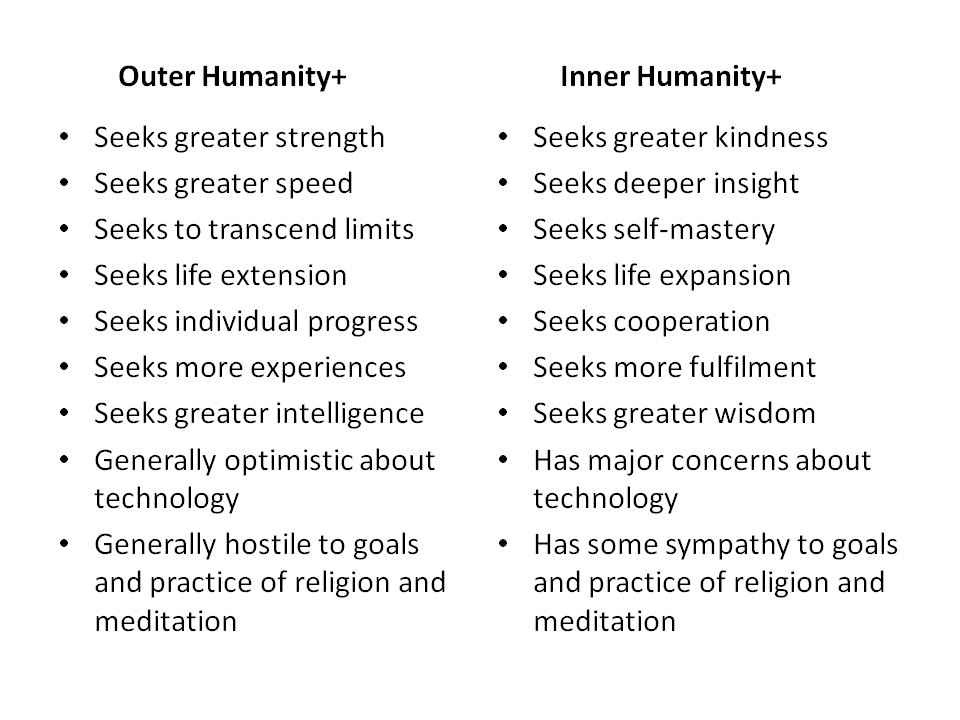
For all these reasons, it’s my strong conviction that any quest to what might be called “outer Humanity+” must be accompanied (and, indeed, preceded) by a quest for “inner Humanity+”. Both these quests consider the ways in which accelerating technology can enhance human capabilities. However the differences are summed up in the following comparison:
Outer Humanity+
- Seeks greater strength
- Seeks greater speed
- Seeks to transcend limits
- Seeks life extension
- Seeks individual progress
- Seeks more experiences
- Seeks greater intelligence
- Generally optimistic about technology
- Generally hostile to goals and practice of religion and meditation
Inner Humanity+
- Seeks greater kindness
- Seeks deeper insight
- Seeks self-mastery
- Seeks life expansion
- Seeks cooperation
- Seeks more fulfilment
- Seeks greater wisdom
- Has major concerns about technology
- Has some sympathy to goals and practice of religion and meditation
Back to Eddie in Limitless. It’s my hunch he was basically a nice guy to start with – except that he was ineffectual. Once his brainpower was enhanced, he could be a more effectual nice guy. His brain provided rapid insight on the problems and issues being faced by his neighbour – and proposed effective solutions. In this example, greater strength led to a more effective kindness. But if real-life technology delivers real-life intellect enhancement any time soon, all bets are off regarding whether it will result in greater kindness or greater unkindness. In other words, all bets are off as to whether we’ll create a heaven-like state, or hell on earth. For this reason, the quest to achieve Inner Humanity+ must overtake the quest to achieve Outer Humanity+.


 dw2
dw2 